Christian Zagel, Matthia Leyendecker (2022). Combining digital and physical user interfaces – concept of a self-service system for exhibitions. In: The Human Side of Service Engineering. AHFE Open Access, vol. 62, pp. 436–441. https://doi.org/10.54941/ahfe1002586
Digitization is finding its way into many different areas and applications, including exhibitions and museums. While until a few decades ago the information presented was purely restricted to physical elements, self-service systems are now increasingly applied in exhibitions. They allow the visitors to enhance their experience by obtaining additional digital information. Usually, these self-service systems are implemented using standard computers, equipped either with a keyboard or a touchscreen. Nevertheless, the added value of interacting with physical elements in our environment is undeniable. This article presents work in progress and describes the concept and prototype of a novel system that cleverly combines digital information with the interaction through physical elements using innovative technology. The aim is to design an interactive exhibition for museums that combines the traditional, physical user interface with the digital version and thus creates a mixture of both worlds. Using the example of a physical city map, the system offers visitors the opportunity to interact by touch and wooden cubes equipped with NFC tags. The article concludes with an outlook for an evaluation of the prototype and recommendations for further research.
Today - more than ever - digitization is penetrating almost all parts of social and economic interaction. New technologies, innovative business models, intensely competitive markets, well-informed customers, and growing cost pressure are major challenges that business organizations must face today. In recent years, technological developments have led to fundamental changes in the way we communicate, collaborate, obtain information, make decisions, and consume. In today’s competitive marketing environment, many products and services have become mass-produced and can no longer be used to dif- ferentiate companies or brands as part of a customer’s purchasing decision, as they usually only have small differences in quality. The markets are lar- gely saturated, so that the pure presentation of information and facts in the product presentation offers no advantage over other products (Esch, 2003). In addition, from a sociological and economic perspective, society has under- gone a change in attitude from a materialistic to a post-materialistic culture.
Combining Digital and Physical User Interfaces. Concept of a Self-Service System 437
This means that experiences are now given a higher priority than consumer goods (Hassenzahl, 2010; Van de Sand, 2017).
The change from a consumer to an experience society means that consu- mers today have much more comprehensive needs and demands for consumer goods that go far beyond the pure functionality or performance of a pro- duct or service. They desire holistic and long-lasting personal experiences that combine memories, sensations, and symbolism (Hosany and Witham, 2010). These developments require that business institutions upgrade their offerings and provide their customers with memorable and satisfying experiences that appeal to them on an emotional, physical, intellectual, and spiritual level (Pine and Gilmore, 1998). Such experiences have become a critical means of shaping a brand’s consumer perception, driving consumer advocacy, and ulti- mately creating a sustainable competitive advantage (Shaw and Ivens, 2002; Tynan and McKechnie, 2009).
However, not only companies are confronted with these developments, but also the entire tourism, leisure, and cultural sector, including museums. These not only compete amongst each other, but also with other leisure and cultu- ral facilities as well as with home entertainment. Museums today need to focus on customer satisfaction because only satisfied customers are repeating customers. Customer satisfaction is a result of all experiences throughout the entire customer journey of a museum visit, from the moment the customers want to park their car, navigating through the exhibition rooms, the impres- sions of the exhibits on display, to the moment when the customers leaves the museum. In their traditional role, museums are preservers and transmitters of culture, sources of information and research institutions at the same time. However, since consumers are increasingly asking for products and servi- ces that provide emotions, focusing on learning, being and doing instead of just physically being there (Mehmetoglu and Engen, 2011). Hence, museums seem to be under the same pressure as other economic institutions and their offer, which is currently primarily limited to collecting, researching, and exh- ibiting exhibits. This means that they now must include additional offers in order to expand into holistic experiences. “Consumption has begun to be seen as involving a steady flow of fantasies, feelings and fun encompassed by that we call the ‘experiential view”’ (Holbrook and Hirschman, 1982). Museums should therefore offer their visitors experiences in the sense of an experience economy (Pine and Gilmore, 1998). Previous research was able to prove that innovative technology in the area of ubiquitous computing and human-computer interaction is able to not only enhance existing experiences, but to create completely new systems that fascinate users (Zagel, 2016).
DEVELOPING A HYBRID INTERACTION SYSTEM FOR MUSEUMS Humans are characterized by the fact that they use their hands to carry out their daily work, with which even complex tasks are possible. Although the hand as a tool represents the most intuitive form of interaction, keyboards and mice have always been used to operate computers.
New developments in the field of computer technology nowadays more than ever involve new forms of human-computer interaction. Intuitive
438 Zagel and Leyendecker
operation using fingertips or gestures on a touchscreen display has gained popularity, especially since the introduction of Apple’s iPhone. Large-area touch-sensitive displays are also finding their way into modern workplaces and are gradually replacing conventional display devices. As the example of the Microsoft Surface Table from 2007 shows, the integration of the display surface into a table also offers a wide range of applications, especially at the point of sale. Since the release of Windows 7 in October 2009, as the first operating system with native multi-touch support, a broad platform for the development and use of touch-sensitive applications has been available for the first time. Due to the simultaneous evaluation of several touch points, this technology is not only suitable for recognizing more complex gestures with several fingers, but also for use in multi-user environments (Forlines and Lilien, 2008).
For a long time, the research field of human-computer interaction has not only included the physical elements of a system, but also theoretical and psychological aspects of operation (Dix, Finlay, Abword and Beale, 2004). The aim is to optimize the system by selecting the best possible selection of the interaction medium in such a way that a positive user experience is crea- ted. Studies have shown that systems with a positive user experience are given a higher value due to improved user satisfaction (Hassenzahl, Eckholdt, and Thielsch, 2009).
One approach in Human-Computer Interaction research is using physi- cal objects to access and manipulate digital information: so called “tangible user interfaces (TUIs)” (Ishii and Ullmer, 1997). As a concept of ubiquitous computing, they make use of the user‘s real-life skills, pushing the computer into the background by making elements of the system invisible (Diekmann, 2007). However, research focusing on the affective effects of ubiquitous computing are relatively new (Tan et al., 2013).
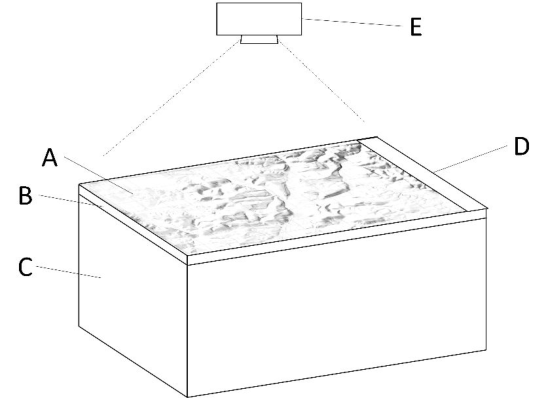
The system at hand has the goal to educate museum visitors regarding the history and chronicle of geographical places, such as cities, countries, or con- tinents. The basis is a three-dimensional topographical map that was milled into a wooden panel with a CNC milling machine (Fig. 1, A). This panel is mounted in a metal frame that houses an infrared touch frame (Fig. 1, B). Both elements are mounted on a table roughly one meter high (Fig. 1, C). To bridge the gap between physical environment and virtual content as well as to ease the process of navigation, we integrated NFC readers into the table (Fig. 1, D). These readers enable the users to trigger actions by using NFC enabled cards, wooden disks, or other physical elements like boxes or figures, comparable to the system developed by Zagel et al. (2016). All intera- ctions activated by placing the NFC-enabled item next to the reader result in a new historic scenario visualized through a high-resolution projector moun- ted above the table (Fig. 1, E). This setup allows browsing through history and historic scenes like ages, wars, or political developments.
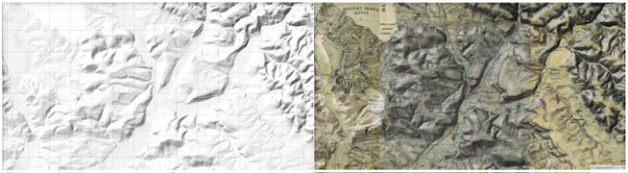
The right part of Figure 2 shows an example of a medieval scenario that is being projected on the three-dimensional geographic surface (left part of the image), when placing the according NFC token on the reader. This shows how many different scenarios can be illustrated. In this way, not only the settle- ment that predominates at the relevant time, but also forest cover, the change
Combining Digital and Physical User Interfaces. Concept of a Self-Service System 439
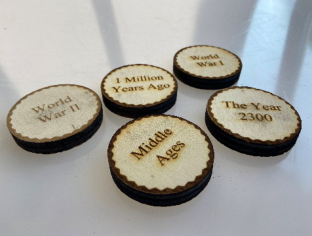
Figure 1: Physical setup.Figure 2: Original (left) and projected (right) scenario.Figure 3: Interaction tokens (left), embedded NFC tag (right).
in river courses or animations for the temporal change in the relief structures can be displayed on the respective piece of land. As we use digital data even visions of the future (e.g., “The year 2100”) as well as moving pictures (e.g., visualizing the attacks during World War II) are possible. As a data source we use the platform of the Bavarian “Agency for Digitization, High-Speed Internet and Surveying” which not only offers access to geographic data, but also to historic maps, aerial views, and many more.
440 Zagel and Leyendecker
For the prototype we use NFC tags (Figure 3, right) embedded into wooden disks (Figure 3, left).
CONCLUSION
In this paper we presented the concept of a novel system for interactive exhi- bitions in a museum context. The system uses tangible objects to manipulate digital information, hence, offering the visitors the possibility to experi- ence the presented knowledge in a novel way. As a result, it offers the possibility of natural human interaction while experiencing a value add. Currently, the concept is being realized as a physical system. It will be evalu- ated in a real-life context within an exhibition at an event held in Kronach, Germany, using the User Experience Questionnaire provided by Schrepp et al. (2014). Future applications of the underlying idea include the use of comparable systems in retail stores, in entertainment as well as in home environments.
REFERENCES
Diekmann, T. (2007). Ubiquitous Computing-Technologien im betrieblichen Umfeld: Technische Überlegungen, Einsatzmöglichkeiten und Bewertungsansätze. Göttingen: Cuvillier. Dix, A., Finlay, J., Abwod, G. D. and Beale, R. 2004. Human Computer Interaction.
Third Edition, Prentice Hall, Harlow, 3. Esch, F.-R., Langner, T. (2019). Ansätze zur Erfassung und Entwicklung der Markenidentität. In: Esch, F.-R. (Eds.): Handbuch Markenführung. Springer Fachmedien Wiesbaden. Forlines, C., Lilien, R. 2008. Adapting a single-user, single-display molecular visu-
alization application for use in a multi-user, multi-display environment. In AVI 2008: Proceedings of the working conference on advanced visual interfaces. ACM, New York, S. 367–371. Hassenzahl, M., Eckholdt, K. and Thielsch, M. T. (2009). User Experience and Experience Design – Konzepte und Herausforderungen. In: Usability Professionals 2009, S. 233–237. Holbrook, M. B., Hirschman, E. C. (1982). The experiential aspects of consum-
ption: Consumer fantasies, feelings, and fun. In: Journal of Consumer Research, 9, 132–140. Ishii, H., Ullmer, B. (1997). Tangible bits: Towards seamless interfaces between people, bits and atoms. Proceedings of the ACM SIGCHI Conference on Human Factors in Computing Systems, 234–241. Mehmetoglu, M., Engen, M. (2011). Pine and Gilmore’s concept of experience eco-
nomy and its dimensions: An empirical examination in tourism. In: Journal of Quality Assurance in Hos-pitality & Tourism, 12(4), 237–255. Pine, B. J., Gilmore, J. H. (1998). Welcome to the experience economy. Harvard Business Review, 76(4), 97–105. Schrepp, M., Hinderks, A. and Thomaschewski, J. (2014): Applying the User Experience Questionnaire (UEQ) in Different Evaluation Scenarios. In: Marcus, A. (ed.) Design, User Experience, and Usability. Theories, Meth- ods, and Tools for Designing the User Experience, pp. 383–392. Springer, Switzerland.
Combining Digital and Physical User Interfaces. Concept of a Self-Service System 441
Shaw, C., Ivens, J. (2002). Building great customer experiences. Palgrave Macmillan, New York. Tynan, C., McKechnie, S. (2009). Experience marketing: A review and reassessment.
In: Journal of Marketing Management, 25(5/6), 501–517. Zagel, C. (2016). Service Fascination: Gaining Competitive Advantage through Experiential Self-Service Systems. Springer Fachmedien, Wiesbaden. Zagel, C., Herpich, S., Eskofier, B. and Bodendorf, F. (2016). Improving UX and
Productivity through TUIs in Work Environments. In: Prinz, W., Borchers, J. & Jarke, M. (eds.): Mensch und Computer 2016 Tagungsband.
LISTED IN THE AHFE DIGITAL BOOKSTORE CATALOGUE
Explore the complete digital volume
The Human Side of Service Engineering
Read this individual research paper free through the original publisher, or explore the full digital proceedings book.
ISBN 978-1-958651-38-4
Explore this ISBN in the AHFE Bookstore ↗Listed in the July 2026 bookstore catalogue; search by ISBN to confirm current availability · Digital book purchase optional