Regina W Y Wang, I Ning Liu (2024). The Exploration of Puzzle Design in Advertising Images. In: Human Factors in Communication of Design. AHFE Open Access, vol. 136, pp. 75–83. https://doi.org/10.54941/ahfe1004970
Consumers often tend to ignore or avoid excessive textual information in advertisements. Curiosity is the primal human drive that enables consumers to actively seek out and engage with information. This study aimed to clarify the content creation and form design of intriguing puzzle images and analyze the design trends of 118 print advertising images from The One Show Awards from 2017 to 2023. The results showed the following. First, puzzle content creation is divided into the number of clues, product illustrations, and realism of the scenarios. Second, the missing form design is divided into non-closure, figure-ground, proximity, and similarity. Third, trend analysis reveals that most puzzle content creation uses two or fewer clues, direct product illustrations, and realistic scenarios. In terms of missing form design, most cases apply the non-closure design.
Not all advertisements can capture consumers’ attention; particularly, adver- tisements that are overloaded with textual information often detract people from the intended message. Researchers believe that advertising images can persuade consumers (Phillips and McQuarrie, 2004); attract attention, and arouse curiosity (Negm and Tantawi, 2015). Using the curiosity strategy in advertisements can strengthen consumers’ motivation to explore the product information (FitzGibbon et al., 2020); increase interest in the product, and prolong engagement (Menon and Soman, 2002, Park et al., 2015). Curios- ity is a driving force similar to hunger and thirst (Schmitt and Lahroodi, 2008, Shin and Kim, 2019), and the desire to acquire new knowledge or have new sensory experiences, stimulating exploratory behaviors (Litman and Spielberger, 2003, Berlyne, 1954).
Puzzle Content Creation and Advertisement Curiosity Successful advertising images attract consumers’ attention through both con- tent and form. Content is the information that advertising uses to promote a product, while form refers to the expressive elements in the aesthetics of advertising (Petrovicia, 2016). Therefore, this study attempts to clarify the relationship between the puzzle content that generates curiosity and how it
can be applied to the form design of advertising images. Epistemic curiosity can be stimulated by puzzles (Thumu et al., 2023, Kang et al., 2009). Adver- tisements prefer to make implicit connections between images and products (Messaris, 1997). In other words, they use less-related or unrelated image content to allude to products, thereby resembling puzzle (Myers and Jung, 2019, Madupu and Ranganathan, 2013).
The Number of Clues in the Puzzle Studies have shown that an increase in the implicit cues or information about the product in the advertisement content increases the viewer’s curiosity correspondingly (Park et al., 2015, Menon and Soman, 2002). Psycholo- gist Loewenstein believes that curiosity arises from information gaps, that is, the gap between what a person knows and what they want to know (Loewenstein, 1994). Park et al., examined the effect by using three levels of knowledge gaps in taekwondo sports advertisements. They found that when the information gap is moderate (i.e., when moderate cues are provided), people become more curious about advertisements. They explain that in addi- tion to presenting the basic images of taekwondo, adding explanations of the philosophy and spirit of taekwondo while not going into detail about the sport’s basic rules and grading can create greater consumer curiosity about the advertisement (Park et al., 2015).
Product Illustrations of the Puzzle To arouse curiosity, advertisements will express something opposite or dif- ferent from the literal meaning of the product’s attributes, presenting viewers with a small puzzle and encouraging them to expend cognitive resources to solve the puzzle (Conradie, 2013, Burgers et al., 2015, Brennan and Bahn, 2006). This leads viewers to search for these non-literal elements to satisfy their thirst for knowledge, which is necessary to resolve the contradiction (Hatzithomas et al., 2021, Ezzeldeen Mohamed et al., 2020). For example, the slogan of an advertisement “A small family business for big family fun!” conveys qualities that are opposite to the product attributes on the surface, but it can help viewers associate with the product’s benefits (Skraˇci´c and Kosovi´c, 2016).
Realism of the Scenarios of the Puzzle Surreal imagery can pique the viewer’s curiosity and involve puzzle-solving (Wang and Liu, 2022, Rana, 2022). Surreal imagery is created by defying logic and combining unrelated elements to create impossible compositions (Mostafa, 2005, Wade, 2015). For instance, in a certain car advertisement, the combination of a crying gas station attendant, a transforming fuel tanker, and a distorted clock illustrates the car’s absurdly low fuel consumption, making the gas station operator unprofitable (Silveira et al., 2012).
Missing Form Design and Advertisement Curiosity Some advertisements use partially missing ambiguous forms to arouse view- ers’ attention and perceptual curiosity (Chang et al., 2010, Jepma et al., 2012). The missing image involves the psychological process of Gestalt recog- nition, where Gestalt is the German word for form (Kobourov et al., 2015,
The Exploration of Puzzle Design in Advertising Images 77
Pilelien˙e and Grigali¯unait˙e, 2016); it mainly describes how humans inte- grate partially missing or overlapping visual forms into meaningful, coherent perceptions (Moratti et al., 2014). In accordance with the fundamental Gestalt principles (Paay and Kjeldskov, 2007, Wertheimer, 1923, Kim and Feldman, 2009), we have conducted a design investigation of non-closure, figure-ground, proximity, and similarity.
The Design of the Non-Closure When individuals see non-closure figures, it involves the process of perceiv- ing incomplete, incoherent, or disjointed objects as complete by filling in the missing information (Paay and Kjeldskov, 2007, Wertheimer, 1923). That is, sub-processes such as element integration, contour detection and formation, feature binding, and template matching enable perception to be completed (Belkacem et al., 2020). For example, although the IBM brand logo is inter- rupted by horizontal stripes, the perceptual system can automatically fill in the missing information, allowing one to perceive the complete letters (Mohamed and Adiloglu, 2023).
The Design of the Figure-Ground Figure-ground is the automatic differentiation of objects into a figure and background (Paay and Kjeldskov, 2007, Wertheimer, 1923, Kim and Feldman, 2009). Figure-ground percept involves shape assignment, which is formed by combining two missing shapes. When the viewer perceives one of the shapes, it becomes the foreground, and the other shape becomes the background (Trujillo et al., 2010). An example is the well-known Rubin’s vase visual puzzle, which can be seen as a vase or as two faces looking at each other (Hasson et al., 2001, Howie and Bagnall, 2013).
The Design of the Proximity Proximity is the perception of objects that are close to each other in space as part of a whole (Paay and Kjeldskov, 2007, Wertheimer, 1923, Garofalo, 2017). These closely positioned objects are considered to have the same value and purpose (Sani and Shokooh, 2016). The closer the elements, the stronger the relationship (Azmy and Nada, 2023). An example is the Dalmatian dog puzzle image, which, at first glance, appears only as a bunch of random black spots. However, the brain automatically groups the closely positioned black spots together to perceive a complete Dalmatian dog (van Tonder and Ejima, 2000, Heylighen and Petrovi´c, 2021, Ramachandran et al., 1998).
The Design of the Similarity Similarity is the perception of objects that appear to be alike as being part of a whole (Paay and Kjeldskov, 2007, Wertheimer, 1923, Garofalo, 2017). Whether arranged by shape or color, as long as the objects are arranged in a similar manner, it can create a stronger connection among these objects (Azmy and Nada, 2023). An example is the logo of the National Broad- casting Company (NBC), where the arrangement of similar peacock feathers close together reinforces the viewer’s perception of a single entity, the peacock (Mohamed and Adiloglu, 2023).
78 Wang and Liu
METHODS
A case study and content analysis were used to deconstruct advertising image samples and construct a puzzle design module for advertising images. The case study method can be used to investigate substantial contemporary phenomena, perform thorough analyses of real-life cases (Luo, 2015); and provide a first-hand understanding of people and events (Johnston et al., 1999). Content analysis is useful for examining trends and patterns in data (Stemler, 2000). It is a method for analyzing visual and linguistic data to classify phenomena or events into defined categories for better analysis and interpretation (Harwood and Garry, 2003).
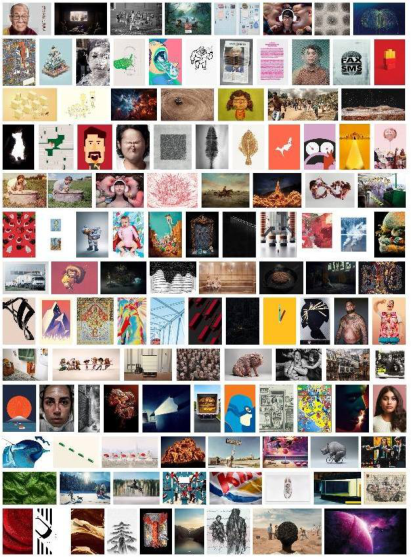
Samples The advertising image samples in this study were collected from The One Show Awards, organized by the One Club for Creativity, which is also the world’s most prestigious event for advertising and design awards (The one club for creativity, 2024). This study collected award-winning print advertise- ments from the past seven years (2017–2023), including Gold Pencil, Silver Pencil, Bronze Pencil, and Merit Awards, for 443 images (118 series). One image was randomly selected from each series, resulting in a total of 118 advertising image samples (Fig. 1).
Figure 1: Samples of print advertising images.
The Exploration of Puzzle Design in Advertising Images 79
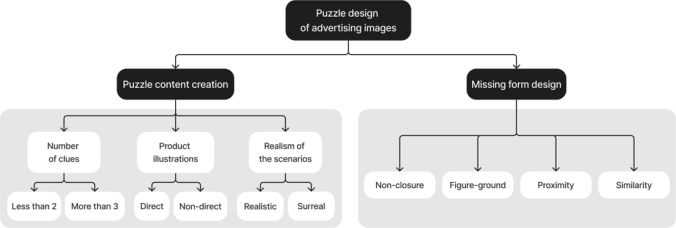
Analysis This study conducted analysis on the content and form of 118 print advertis- ing images. This had two aspects. The first included puzzle content creation regarding the number of clues, which was divided into fewer than two and three or more; product illustrations, which was divided into direct and non- direct; and the realism of the scenarios, which was divided into realistic and surreal. The second was the missing form design, divided into non-closure, figure-ground, proximity, and similarity.
RESULTS
This study proposes the content and form of puzzle-style advertising images (Fig. 2), in which puzzle content creation is divided into the number of clues, product illustrations, and realism of the scenarios. The missing form design is divided into non-closure, figure-ground, proximity, and similarity.
Figure 2: Puzzle design of advertising images.
Puzzle Content Creation
Table 1 shows the application results of advertising image puzzle content, revealing that 101 images (86%) utilize puzzle content, while 17 images (14%) do not. Among the advertising images with puzzle content, 35 images (30%) use one clue, 38 images (32%) use two clues, 20 images (17%) use three clues, 4 images (3.5%) use four clues, and 4 images (3.5%) use five or more clues. Fifty-five advertising images (47%) explain the product in a direct way, and 46 (39%) in a non-direct way. Fifty-seven advertising images (48%) use realistic scenarios, and 44 advertising images (38%) use surreal scenarios.
Table 1. Descriptive statistics of puzzle content creation.
Table available in the original PDF paper.
Content N (100%) Item Category Description N(100%)
Number of clues
1 Using 1 puzzle to allude to the product
35 images (30%)
Puzzle 101 images (86%)
2 Using 2 puzzles to allude to the product
38 images (32%) (Continued)
80 Wang and Liu
Table 1. Continued Content N (100%) Item Category Description N(100%)
Table available in the original PDF paper.
3 Using 3 puzzles to allude to the product
20 images (17%) 4 Using 4 puzzles to allude to the product
4 images (3.5%) More than 5
Using more than 5 puzzles to allude to the product
4 images (3.5%) Product illustrations
55 images (47%)
Direct Using the description of a product with the same attributes to allude to the product Non- direct 46 images (39%) Using the description of a product with the opposite attributes to allude to the product
Realism of the scenarios
Realistic Using rational and possible scenarios to allude to the product
57 images (48%) Surreal Using irrational and impossible scenarios to allude to the product
44 images (38%) Non-puzzle 17 images (14%)
Not using puzzles to allude to the product
17 images (14%)
Missing Form Design
Table 2 shows the application results of advertising image forms, revealing that 94 images (80%) utilize advertising images of the missing form, whereas 24 images (20%) utilize advertising images of the non-missing form. Among the advertising images with missing forms, 69 images (58%) use the non- closure form, 11 images (9%) use the figure-ground form, 8 images (7%) use the proximity form, and 6 images (5%) use the similarity form.
Table 2. Descriptive statistics of missing form design.
Table available in the original PDF paper.
Form N (100%) Item Description N (100%) Missing 94 images (80%) Non-closure Regarding the missing objects in the image as a complete entity 69 images (58%) Figure-ground Regarding the objects in the image as the main figure and background
8 images (7%)
11 images (9%) Proximity Regarding the objects close to each other in the image as a complete entity Similarity Regarding the similar objects in the image as a complete entity 6 images (5%) Non-missing 24 images (20%)
The objects are complete and whole in the image
24 images (20%)
CONCLUSION
This case study provided a content analysis of 118 print advertising images from The One Show Awards from 2017 to 2023, focusing on puzzle content creation and missing form design. Puzzle content was divided into the number of clues, product illustrations, and realism of the scenarios. The missing form design was divided into non-closure, figure-ground, proximity, and similarity. The trend analysis showed that over 85% of print advertising images contain
The Exploration of Puzzle Design in Advertising Images 81
puzzles, and the use of one to two puzzle ideas to allude to the product and use of direct illustrations to explain product attributes account for over 50% of the images studied. While contextual associations that match the reality of the product make up the majority, the creation of surreal scenarios also accounts for 40%. In addition, more than 80% of advertising image designs use the concept of missing forms, with the use of the non-closure design being the most common at approximately 60%.
ACKNOWLEDGMENT
This work was supported by Taiwan Building Technology Center from the Featured Areas Research Center Program within the framework of the Higher Education Sprout Project by the Ministry of Education in Taiwan (grant num- bers 112P013). We would like to express our deepest appreciation to One Club for Creativity for generously providing the copyright for the images incorporated in this thesis. The inclusion of these images not only enhances the content of this research but also contributes to a more comprehensive understanding of the subject matter for the readers.
REFERENCES
Azmy, A. & Nada, M. 2023. Eye Tracking in Outdoor Advertising: Exploring the Application of Gestalt Principles. International Design Journal, 13, 437–446. Belkacem, A. N., Jamil, N., Palmer, J. A., Ouhbi, S. & Chen, C. 2020. Brain computer
interfaces for improving the quality of life of older adults and elderly patients. Frontiers in Neuroscience, 14, 692. Berlyne, D. E. 1954. A theory of human curiosity. British Journal of Psychology.
General Section, 45, 180–191. Brennan, I. & Bahn, K. D. 2006. Literal versus extended symbolic messages and advertising effectiveness: The moderating role of need for cognition. Psychology & Marketing, 23, 273–295. Burgers, C., Konijn, E. A., Steen, G. J. & Iepsma, M. A. 2015. Making ads less
complex, yet more creative and persuasive: The effects of conventional metaphors and irony in print advertising. International Journal of Advertising, 34, 515–532. Chang, C.-H., Hsieh, K.-Y., Chiang, M.-C. & Wu, J.-L. 2010. Virtual spotlighted advertising for tennis videos. Journal of visual communication and image representation, 21, 595–612. Conradie, M. 2013. “ Oh, now I get it...”: comic dupe irony in print advertising.
Acta Academica, 45, 1–29. Ezzeldeen Mohamed, O., Abdellatif, T. & Ezzat, N. 2020. Contradictory strategy in advertising design and its relationship to coding and decoding theory. Journal of Architecture, Arts and Humanistic sciences, 5, 99–110. Fitzgibbon, L., Lau, J. K. L. & Murayama, K. 2020. The seductive lure of curiosity:
Information as a motivationally salient reward. Current Opinion in Behavioral Sciences, 35, 21–27. Garofalo, V. Visual perception and graphic analysis. The Pattern of Inlays in the Cathedral of Palermo. Proceedings, 2017. MDPI, 1085. Harwood, T. G. & Garry, T. 2003. An overview of content analysis. The marketing
review, 3, 479–498.
82 Wang and Liu
Hasson, U., Hendler, T., Bashat, D. B. & Malach, R. 2001. Vase or face? A neural correlate of shape-selective grouping processes in the human brain. Journal of cognitive neuroscience, 13, 744–753. Hatzithomas, L., Manolopoulou, A., Margariti, K., Boutsouki, C. & Koumpis, D.
2021. Metaphors and body copy in online advertising effectiveness. Journal of Promotion Management, 27, 642–672. Heylighen, F. & Petrovi ´C, K. 2021. Foundations of ArtScience: Formulating the problem. Foundations of Science, 26, 225–244. Howie, P. & Bagnall, R. 2013. A critique of the deep and surface approaches to
learning model. Teaching in Higher Education, 18, 389–400. Jepma, M., Verdonschot, R. G., Van Steenbergen, H., Rombouts, S. A. & Nieuwenhuis, S. 2012. Neural mechanisms underlying the induction and relief of perceptual curiosity. Memory and motivational/emotional processes, 100. Johnston, W. J., Leach, M. P. & Liu, A. H. 1999. Theory testing using case studies in
business-to-business research. Industrial marketing management, 28, 201–213. Kang, M. J., Hsu, M., Krajbich, I. M., Loewenstein, G., Mcclure, S. M., Wang, J. T.-Y. & Camerer, C. F. 2009. The wick in the candle of learning: Epistemic curiosity activates reward circuitry and enhances memory. Psychological science, 20, 963–973. Kim, S.-H. & Feldman, J. 2009. Globally inconsistent figure/ground relations
induced by a negative part. Journal of Vision, 9, 8–8. Kobourov, S. G., Mchedlidze, T. & Vonessen, L. Gestalt principles in graph drawing.
Graph Drawing and Network Visualization: 23rd International Symposium, GD 2015, Los Angeles, CA, USA, September 24-26, 2015, Revised Selected Papers 23, 2015. Springer, 558–560. Litman, J. A. & Spielberger, C. D. 2003. Measuring epistemic curiosity and its diversive and specific components. Journal of personality assessment, 80, 75–86. Loewenstein, G. 1994. The psychology of curiosity: A review and reinterpretation.
Psychological bulletin, 116, 75. Luo, H. 2015. Case study research in educational technology. The Sage encyclopedia of educational technology, 85–88. Madupu, V. & Ranganathan, S. 2013. The impact of visual structure complexity on
ad liking, elaboration and comprehension. Marketing Managemen, 23, 58–70. Menon, S. & Soman, D. 2002. Managing the power of curiosity for effective web advertising strategies. Journal of Advertising, 1–14. Messaris, P. 1997. Visual persuasion: The role of images in advertising, Sage. Mohamed, K. & Adiloglu, F. 2023. Analyzing the Role of Gestalt Elements and
Design Principles in Logo and Branding. International Journal of Communication and Media Science, pg40 Retrieved, 13, 2023. Moratti, S., Mndez-Brtolo, C., Del-Pozo, F. & Strange, B. A. 2014. Dynamic gamma frequency feedback coupling between higher and lower order visual cortices underlies perceptual completion in humans. Neuroimage, 86, 470–479. Mostafa, M. M. 2005. An experimental investigation of the Egyptian consumers’
attitudes towards surrealism in advertising. International Journal of Consumer Studies, 29, 216–231. Myers, J. & Jung, J. M. 2019. The interplay between consumer self-view, cognitive style, and creative visual metaphors in print advertising. Journal of Marketing Communications, 25, 229–246. Negm, E. & Tantawi, P. 2015. Investigating the impact of visual design on consumers’
perceptions towards advertising. International Journal of Scientific and Research Publications, 5, 1–9.
The Exploration of Puzzle Design in Advertising Images 83
Paay, J. & Kjeldskov, J. A Gestalt theoretic perspective on the user experience of location-based services. Proceedings of the 19th Australasian conference on Computer-Human Interaction: Entertaining User Interfaces, 2007. ACM, 283– 290. Park, S.-H., Mahony, D. F., Kim, Y. & Do Kim, Y. 2015. Curiosity generating
advertisements and their impact on sport consumer behavior. Sport Management Review, 18, 359–369. Petrovicia, I. 2016. The Role of Aesthetic Communication in Advertising. The European Proceedings of Social ir Behavioural Sciences, 748–755. Phillips, B. J. & Mcquarrie, E. F. 2004. Beyond visual metaphor: A new typology of
visual rhetoric in advertising. Marketing theory, 4, 113–136. Pilelien ˙E, L. & Grigali ¯Unait ˙E, V. 2016. Influence of print advertising layout complexity on visual attention. Eurasian business review, 6, 237–251. Ramachandran, V., Armel, C., Foster, C. & Stoddard, R. 1998. Object recognition
can drive motion perception. Nature, 395, 852–853. Rana, H. S. 2022. The Surreal Landscape as An Invitation to Imagine. NeuroQuantology, 20, 1379. Sani, S. M. & Shokooh, Y. K. Minimalism in designing user interface of commercial
websites based on Gestalt visual perception laws (Case study of three top brands in technology scope). 2016 second international conference on web research (icwr), 2016. IEEE, 115–124. Schmitt, F. F. & Lahroodi, R. 2008. The epistemic value of curiosity. Educational theory, 58, 125–148. Shin, D. D. & Kim, S.-I. 2019. Homo curious: Curious or interested? Educational
Psychology Review, 31, 853–874. Silveira, S., Graupmann, V., Frey, D., Blautzik, J., Meindl, T., Reiser, M., Chen, C., Wang, Y., Bao, Y. & PPerception, 41, 569–576. Skra ˇCI ´C, T. & Kosovi ´C, P. 2016. Linguistic analysis of English advertising slogans
in yachting. Transactions on Maritime Science, 5, 40–47. Stemler, S. 2000. An overview of content analysis. Practical assessment, research, and evaluation, 7, 17. The One Club For Creativity. 2024. About The One Show [Online]. Available: https:
//oneshow.org/about/ [Accessed]. Thumu, N., Meacham, F. & Normoyle, A. Towards Understanding the Role of Curiosity in Puzzle Design. Companion Proceedings of the Annual Symposium on Computer-Human Interaction in Play, 2023. 17–21. Trujillo, L. T., Allen, J. J., Schnyer, D. M. & Peterson, M. A. 2010. Neurophysiological
evidence for the influence of past experience on figure–ground perception. Journal of Vision, 10, 5–5. Van Tonder, G. J. & Ejima, Y. 2000. Bottom–up clues in target finding: Why a Dalmatian may be mistaken for an elephant. Perception, 29, 149–157. Wade, N. 2015. Art and illusionists, Springer. Wang, R. W. & Liu, I. 2022. Temporal and electroencephalography dynamics of
surreal marketing. Frontiers in Neuroscience, 16, 949008. Wertheimer, M. 1923. Laws of organization in perceptual forms. A source book of Gestalt Psychology.
LISTED IN THE AHFE DIGITAL BOOKSTORE CATALOGUE
Explore the complete digital volume
Human Factors in Communication of Design
Read this individual research paper free through the original publisher, or explore the full digital proceedings book.
ISBN 978-1-964867-12-0
Explore this ISBN in the AHFE Bookstore ↗Listed in the July 2026 bookstore catalogue; search by ISBN to confirm current availability · Digital book purchase optional