Tianzong Yu, Yan Ma, Peihan Wen (2024). An Interaction Engine and Question Refactor Method in Question Answering for Knowledge-Driven Process Planning. In: Human Dynamics, Product Evaluation and Quality. AHFE Open Access, vol. 131, pp. 51–61. https://doi.org/10.54941/ahfe1004863
Process planning is the intermediate stage between product design and product production. In the ever-evolving landscape of manufacturing, the optimization of process planning plays a key role in ensuring efficiency, cost-effectiveness and overall productivity. Traditional process planning methods often rely on predefined rules and expert knowledge, along with process engineers’ experiences, which are tacit and unstructured, existing in their minds. Weak optimal results and resource inefficiencies come in accordance with inefficient knowledge reuse. Existing research work has developed systematic knowledge modeling for process planning and constructed a process knowledge graph (PKG), based on which fundamental question answering (QA) has been performed. But there is the single round strategy in the process of QA over knowledge graph (QAKG). Process planners’ questions may be not parsed and they don’t have chance to implement or even don’t know what to implement. We propose an interactive QAKG framework containing the question refactor method for process planning. The interaction engine will be triggered when the input question can’t be parsed to query statement for target entities. Candidate intermediate entities are searched and listed for specifying. The initial question will be refactored after integrated with the entities selected by users. The methodology is implemented by taking the process data of CPU cooler from a manufacturing enterprise. Results show the method could promote the intelligence of knowledge-driven process planning as well as the level of knowledge acquiring and sharing.
The transformation of manufacturing to intelligence drives the revolution of product life cycles such as design, machining and maintenance, as well as for process planning (Zhang et al., 2020; Lu et al., 2020). A series of activities needs to be decided to determine the time, cost, tools and production qual- ity during the process planning, which is regarded as the intermediate stage between product design and manufacturing (Harabin and Behandish, 2022; Xiao et al., 2023; Zhang et al., 2022a). Intelligent manufacturing involves a series of complex processes, including many interrelated steps and depen- dencies, which become assets in the form of knowledge for manufacturing
enterprises. It is required that characteristics and relationships of the manu- facturing process knowledge need to be fully considered, accurately expressed and utilized during the knowledge-driven process planning.
Traditional process planning methods often rely on predefined rules and expert knowledge, as well as the experience of engineers, which are tacit and unstructured in the minds of engineers, making it difficult to share and reuse knowledge (Wen et al., 2023a). Depending on technologists’ experience, skills, and intuition, it’s labor-intensive and time-consuming to make process decisions during the knowledge-driven process planning. What’s more, senior engineers would adhere to their own preferences, ignoring the updating of process knowledge in the enterprise and the field. The above defects hinder the generation of optimal process planning results.
Knowledge graph is an important research direction of cognitive intelli- gence in AI, and it is an effective tool for knowledge management (Chen et al., 2020; Wen et al., 2023b). In the research of process planning, knowl- edge graph satisfies the storage and organization form of process knowledge, and provides great support for the sharing and reuse of process knowledge (Wen and Wang, 2021). Combining knowledge graph and process planning is one of the important bases of intelligent manufacturing (Xiao et al., 2023). Process knowledge graph (PKG) has been widely studied and applied, and has achieved good results (Guo et al., 2022; Zhang et al., 2022; Zhou et al., 2022). Current researches have proposed knowledge retrieval methods based on corresponding knowledge bases to support knowledge-driven process plan- ning (Zhang et al., 2020; Xu et al. 2017). From the PKG and its structure, process knowledge is researched and reused, by methods like case-based rea- soning (Dong et al., 2022), inference algorithms (Qian et al., 2021), similarity computing (He and Jiang, 2019). Question answering over knowledge graph (KGQA) system parses the questions raised by users, generates structured queries, and then retrieves and deduces the corresponding entity answers in knowledge graph (Xiong et al., 2021; Qiu et al., 2021), which is also consid- ered by the research on process planning (Wen et al., 2023a; Kumar et al., 2016; Liu et al., 2021). General retrieval methods have fixed limitations on the retrieval require- ments input. QAKG system has the ability to understand the query in the form of natural language, representing more intelligence for knowledge reuse. However, most QAKG s just provide assist in the single round and lack inter- action with users. When the input question could not be understood, the QA round would end. The system can’t ask for more information while the user has no way to supplement or even doesn’t know what information to supple- ment. So it is necessary to set the feedback engine for the lacking entity that is indispensable when searching with complex relationships. In the scenario of process planning, such interaction is needed for enterprise with a low level of knowledge reusing, which will be improved with highly structured process knowledge already organized in PKG.
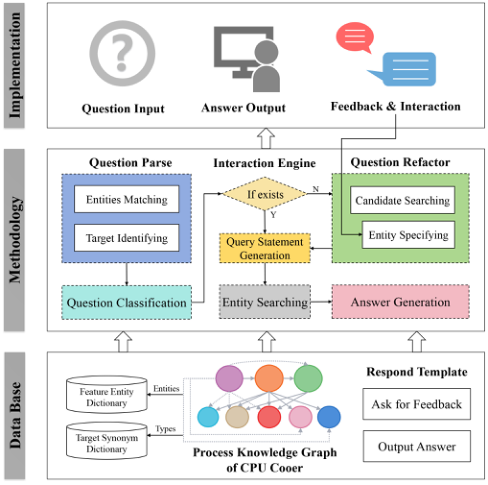
Based on the previous work by Wen et al. (2023a), this paper proposes an interactive QA framework (see Figure 1) for knowledge-driven process planning based on PKG. There is an interaction engine introduced in the
An Interaction Engine and Question Refactor Method in Question Answering 53
framework. The input question not parsed successfully in the regular route will trigger the interaction engine and be refactored. By the proposed ques- tion refactor method, candidate entities are retrieved for specifying to clarify the initial question and the search path will be complete. The manufactur- ing process data of CPU coolers is utilized to implement the QAKG system containing interaction engine along with the question refactor method. The proposed framework is proved to be helpful for the intelligence of QAKG during the knowledge-driven process planning.
Figure 1: The framework of interactive KGQA.
The rest of this article is structured as follows: The second part intro- duces the method proposed. In this part, PKG constructed in the previous work is introduced and the principle of propose of the KGQA is reviewed. Then the proposed method is implemented in the third part. The fourth part summarizes the whole article.
METHDOLOGY Previous work has constructed the PKG based on the domain ontology for process knowledge, which defines concepts and relationships of process knowledge and makes formal representation (Wen et al., 2023a). And a ques- tion answering approach over PKG is presented to support process planning. For more intelligent process of question answering by achieving interac- tion between human and system, a question refactor method is proposed,
which can refactor searching path by the selection feedback after providing candidate entities.
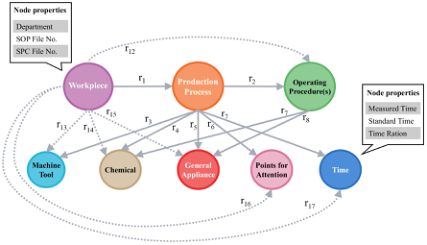
THE PKG AND QAKG APPROACH There are 8 types of entities represented by nodes, together with 15 types of relationships represented by edges, forming the structure of PKG (see Figure 2). Sequence of processes plays a vital role in process planning, dom- inated by which a workpiece is machined. Each process involves a series of operating procedures to achieve the processing task. In addition, there are corresponding machine tools (like punch press, stock cutter, CNC machine, etc), general appliances (like rubber basket, thermometer, fixture, etc), chem- icals (like acid degreasing agent, antioxidant, nitric acid, etc), points of attention and working hours for each process. Meanwhile, some operating procedures involve specific general appliances and chemicals.
Relationships among entities are listed in Table 1. Combined with Figure 2, we can see that the relationships r12, r13, r14, r15 are represented by dotted arrows, which means indirect relationships. Exactly the set of oper- ating procedures of a certain process is not unique. It is noted that some processes have more than one set of operating procedures, each correspond- ing to a certain workpiece. Similarly, different workpieces may have different corresponding entities belonging to other 5 types under the same process. So it is necessary to set these indirect relationships in order to clarify the condi- tion between the direct relationships, which is also required by the searching function.
Figure 2: The structure of PKG containing nodes and edges.Table 1. Relationships in the PKG.
Table available in the original PDF paper.
Relation Type Name r1 process# No. # Process r2 pcprocessed_follow(#) Processed following (No. #) operating procedures in the process r3 pcprocessed_by Processed by the machine tool in the process r4 pcprocessed_using Processed using the chemical in the process
(Continued)
An Interaction Engine and Question Refactor Method in Question Answering 55
Table 1. Continued Relation Type Name r5 pcprocessed_with Processed with the general appliance in the process r6 pcpay_attention_to Points of attention in the process r7 pctime Process hours r8 operated_using Operating procedure(s) using the chemical r9 operated_with Operating procedure(s) with the general appliance r12 wpprocessed_follow(#) The workpiece is processed following (No. #) operating procedures r13 wpprocessed_by The workpiece is processed by the machine tool r14 wpprocessed_using The workpiece is processed using the chemical r15 wpprocessed_with The workpiece is processed with the chemical r16 wppay_attention_to Points of attention in the process r17 wptime Process hours concerning the workpiece
Table available in the original PDF paper.
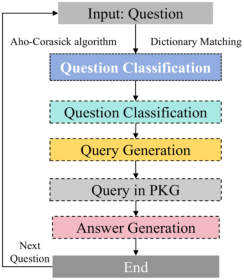
To assist process planners and support highly specialized process plan- ning in different scenarios, queries for process knowledge and corresponding answers need to be understood and retrieved respectively. The flow chart of question answering is shown in Figure 3. First, all nouns of entities are listed by their types and stored into the feature dictionary, which is then trans- formed into the AC tree by the Aho-Corasick algorithm (Aho and Corasick, 1975). Meanwhile, a synonym dictionary is designed containing the target words, which may exist in questions asked by users. Next, the feature enti- ties are detected and attached with types through the AC tree and the target word is identified as the entity type. Then feature entities and the target are integrated and the type of question is classified.
Figure 3: The flow chart of question answering over PKG.
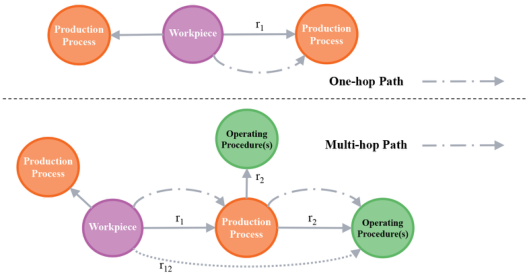
The query statement is generated with entities filled based on a meta path- based searching path (Yu et al., 2014). One-hop and multi-hop path are
designed to search the target entity. As shown in Figure 4, the Cypher query statement of the one-hop path is “MATCH (m:Workpiece)-[r]->(n:ProductionProcesses) where m.name = ‘entity’ return m.name, r.name, n.name ORDER BY r.name”
And the Cypher query statement of the multi-hop path is “MATCH (m:Workpiece)–>(n:ProductionProcesses) -[r:pcprocessed_follow]-> (p:OperatingProcedures) where m.name = ‘entity’ and n.name = ‘entity’ AND (m:Workpiece)–> (p:OperatingProcedures) return m.name, n.name, p.name” We can see that sequential relationships could be devoted to multi-hop path. The main relationship that works is “pcprocessed_follow”, but the constraint that the workpiece must have relation with returned operating procedures is indispensable. Otherwise, there are several sets of operating procedures returned.
Figure 4: Examples of one-hop path and multi-hop path design.
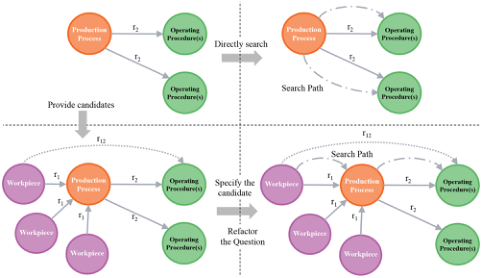
The current QAKG approach has some shortcomings like that it could perform limited types of question answer. For example, process planners won- der the operating procedures of the certain process of a workpiece. But they wouldn’t mention the workpiece. The search path needs to be designed just over the relationship r2. There might be several sets of operating procedures returned, which would be confusing for process planners. As the single-round QA ends, they need to re-enter more complete questions. So it is necessary to add the interaction engine to perform multi-round QA for indispensable entities, which is beneficial to planners and the efficiency of process planning. Here comes the interactive QA in the next subsection.
INTERACTIVE KGQA FOR PROCESS PLANNING Question refactor method and interaction engine are proposed and intro- duced into the mentioned QAKG. Facing the question types that need addi- tional feature entities, it is more efficient to generate feedback consisting of necessary candidate entities. Interactive QA aims to obtain more information and capture complete intentions of users. When obtaining specific feature entities selected by users from candidates, the search path and answer become more precise due to the more detailed constraints. Also, the QA process could
An Interaction Engine and Question Refactor Method in Question Answering 57
return to the stage that provides the candidates and wait for another detailed information.
As mentioned before, a certain process may have different sets of operat- ing procedures depending on the related workpiece, so as chemicals, general appliances, points for attention and working hours. So we concentrate on types of questions over the relationship r2, r4, r5, r6, r7. Similarly, take the question type over the relationship r2 as an example, namely, asking for oper- ating procedures of a certain process. The workpiece processed, relationship r1 and r12 are supposed to assist searching. The transition of search path is shown in Figure 5. With the question refactor method, the search path could be determined until the workpiece is specified from candidates.
Figure 5: Examples of transition of search path.
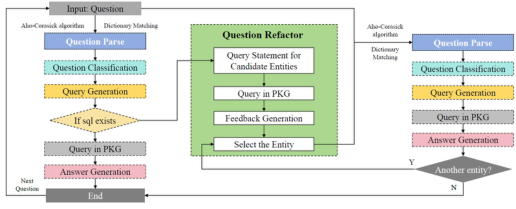
The flow chart of question answering containing interaction engine is shown in Figure 6. Due to the new type of questions which are parsed out uncertain search path, there is an interaction engine after query generation, on which the Cypher may not exist as lacking indispensable entities. So the ques- tion refactor method is performed and query statement for candidate entities is generated. For example, when the initial question is “operating procedures of the process”, the query statement for candidate entities is generated on the relationship r1 and shown as follows “MATCH (m:Workpiece)–>(n:ProductionProcesses) where n.name = ‘entity’ return m.name, n.name” Entities searched are workpieces involving the process specified in the ques- tion, which are to be listed as candidates for specifying. When specified, the entity is inserted into the initial question and the newly generated question will be processed in the same way. When finishing answer generation, it will still ask for other entities to start with next question refactor. There is another option to end this round of QA.
We give instructions on how the interactive KGQA containing interaction engine and question refactor method works in this subsection. With the gen- erated query statement, the entities searched will be returned based on the PKG to respond to the input question in the form of corresponding direct targets and related recommending targets, involving process planning-related knowledge, which can be devoted to the question-oriented process knowledge reuse.
Figure 6: The flowchart of the interactive KGQA.
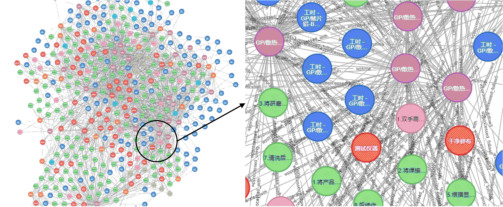
IMPLEMENTATION Process data concerning the manufacturing process of CPU cooler from a manufacturing enterprise is used to construct the PKG, which is applied to knowledge-driven process planning. After data processing, structured pro- cess knowledge is imported into Neo4j graph database (see Figure 7) by the py2neo package coded in Python 3.9. There are 476 nodes in 8 types of entities and 2872 edges in 15 types of relationships.
Figure 7: Partial schematic diagram of the PKG.
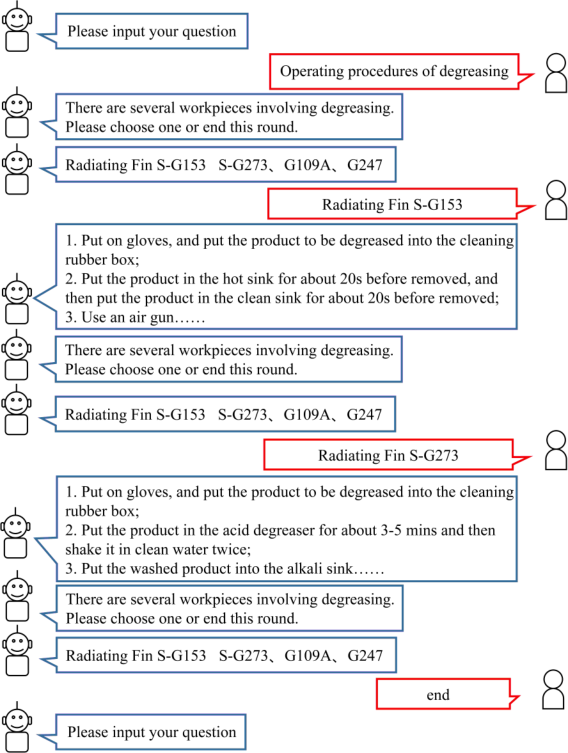
According to process planning scenario of CPU cooler and the structure of the PKG, there are 8 types of questions with the one-hop search path and 9 types of questions with multi-hop research path. And 5 types of questions to be answered by the interactive method are listed in Table 2. An example of implementation of interactive QA over PKG is shown in Figure 8.
Table 2. Types of questions concerning interaction.
Table available in the original PDF paper.
Question definition Explanation productionprocesses_operatingprocedures Operating procedures of the process productionprocesses_pointsforattention Points for attention of the process productionprocesses_chemicals Chemicals used in the process productionprocesses_generalappliances General appliances used in the process productionprocesses_time Working hours of the process
An Interaction Engine and Question Refactor Method in Question Answering 59
Figure 8: An example of implementation of interactive QA over PKG.
CONCLUSION PKG provides semantic framework for the optimized storage and representa- tion of process knowledge and its relationship to each other. KGQA is able to offer a rapid, simple and intelligent way for knowledge acquiring and sharing. The interactive KGQA framework proposed achieves the interaction between human and machine linked with PKG. With the interaction engine, question refactor method can be utilized for process planners to select intermediate entities from candidates searched in PKG to refactor the question. The imple- mentation of the framework proposed shows the effectiveness on promoting the intelligence of knowledge-driven process planning and convenience of planners.
ACKNOWLEDGMENT This work is supported by Chongqing Social Science Planning Foundation, China (grant No. 2019PY42).
REFERENCES
A. V. Aho and M. J. Corasick (1975) “Efficient string matching: an aid to bibliographic search,” Communications of the ACM, vol. 18, no. 6, pp. 333–340. Ankit Kumar, Ozan Irsoy, Peter Ondruska, et al. (2016) “Ask Me Anything: Dynamic
Memory Networks for Natural Language Processing,” proceedings of the 33rd International Conference on Machine Learning, vol. 48. Bin Zhou, Jinsong Bao, Zhiyu Chen, et al. (2022) “KGAssembly: Knowledge graphdriven assembly process generation and evaluation for complex components,” International Journal of Computer Integrated Manufacturing, vol. 35, no. 10–11, pp. 1151–1171. Changhong Xu, Shusheng Zhang, Bo Huang, et al. (2017) “NC process reuse ori-
ented effective subpart retrieval approach of 3D CAD models,” Computers in Industry, vol. 90, pp. 1–16. Chao Zhang, Guanghui Zhou, Jingjing Li, et al. (2022) “KAiPP: An interaction recommendation approach for knowledge aided intelligent process planning with reinforcement learning,” Knowledge-Based Systems, vol. 258, p. 110009. Chao Zhang, Guanghui Zhou, Junsheng Hu, et al. (2020) “Deep learning-enabled
intelligent process planning for digital twin manufacturing cell,” Knowledge- Based Systems, vol. 191, p. 105247. Chen Qiu, Guangyou Zhou, Zhihua Cai, et al. (2021) “A Global–Local Attentive Relation Detection Model for Knowledge-Based Question Answering,” IEEE Transactions on Artificial Intelligence, vol. 2, no. 2, pp. 200–212. Jianwei Dong, Xuwen Jing, Xiang Lu, et al. (2022) “Process knowledge graph model-
ing techniques and application methods for ship heterogeneous models,” Scientific Reports, vol. 12, no. 1. George P. Harabin and Morad Behandish. (2022) “Hybrid Manufacturing Process Planning for Arbitrary Part and Tool Shapes,” Computer-Aided Design, vol. 151, p. 103299. Hanxu Liu, Fangxu Dong, Meiqing Wang, et al. (2021) “Modelling and Implemen-
tation of a Knowledge Question-answering System for Product Quality Problem Based on Knowledge Graph,” Journal of Physics: Conference Series, vol. 2068, p. 012051 Haobo Xiong, Shuting Wang, Mingrong Tang, et al. (2021) “Knowledge Graph Question Answering with semantic oriented fusion model,” Knowledge-Based Systems, vol. 221, p. 106954. Jiahui Qian, Zhijing Zhang, Chao Shao, et al. (2021) “Assembly sequence planning
method based on knowledge and ontostep,” Procedia CIRP, vol. 97, pp. 502–507. Liang Guo, Fu Yan, Tian Li, et al. (2022) “An automatic method for constructing machining process knowledge base from knowledge graph,” Robotics and Computer-Integrated Manufacturing, vol. 73, p. 102222. Longlong He and Pingyu Jiang. (2019) “Manufacturing Knowledge Graph: A Con-
nectivism to Answer Production Problems Query With Knowledge Reuse,” IEEE Access, vol. 7, pp. 101231–101244. Peihan Wen and Ruiquan Wang. (2021) “Does knowledge structure matter? Key factors influencing formal and informal knowledge sharing in manufacturing,” Journal of Knowledge Management, vol. 26, no. 9, pp. 2275–2305. Peihan Wen, Yan Ma and Ruiquan Wang. (2023a) “Systematic knowledge modeling
and extraction methods for manufacturing process planning based on knowledge graph,” Advanced Engineering Informatics, vol. 58.
An Interaction Engine and Question Refactor Method in Question Answering 61
Peihan Wen, Yiming Zhao and Jin Liu. (2023b) “A systematic knowledge graphbased smart management method for operations: A case study of standardized management,” Heliyon, vol. 9, no. 10. Xiao Yu, Xiang Ren, Yizhou Sun. (2014) “Personalized Entity Recommenda-
tion: A Heterogeneous Information Network Approach,” proceedings of the 7th ACM International Conference on Web Search and Data Mining (WSDM), pp. 283–292. Xiaojun Chen, Shenbin Jia and Yang Xiang. (2020) “A review: Knowledge reasoning over knowledge graph,” Expert Systems with Applications, vol. 141. Yang Duan, Li Hou and Song Leng. (2021) “A novel cutting tool selection approach
based on a metal cutting process knowledge graph,” The International Journal of Advanced Manufacturing Technology, vol. 112, no. 11–12, pp. 3201–3214. Yuqian Lu, Xun Xu and Lihui Wang. (2020) “Smart manufacturing process and system automation – A critical review of the standards and envisioned scenarios,” Journal of Manufacturing Systems, vol. 56, pp. 312–325. Yajun Zhang, Shusheng Zhang, Rui Huang, et al. (2022). “Combining deep learn-
ing with knowledge graph for macro process planning,” Computers in Industry, vol. 140, p. 103668. Youzi Xiao, Shuai Zheng and Jiancheng Shi, et al. (2023) “Knowledge graphbased manufacturing process planning: A state-of-the-art review,” Journal of Manufacturing Systems, vol. 70, pp. 417–435.
LISTED IN THE AHFE DIGITAL BOOKSTORE CATALOGUE
Explore the complete digital volume
Human Dynamics, Product Evaluation and Quality
Read this individual research paper free through the original publisher, or explore the full digital proceedings book.
ISBN 978-1-964867-07-6
Explore this ISBN in the AHFE Bookstore ↗Listed in the July 2026 bookstore catalogue; search by ISBN to confirm current availability · Digital book purchase optional