Hyeseong Park, Myung Won Raymond Jung, Minji Kim, Jihye Kim (2024). Muse Alpha: AI-based Preliminary Diagnosis for Cognitive Thought Patterns. In: Healthcare and Medical Devices. AHFE Open Access, vol. 130, pp. 72–77. https://doi.org/10.54941/ahfe1004839
Recent issues of medication misuse and abuse have prompted research into utilizing big data and artificial intelligence to aid psychiatrists in determining medication dosages. Muse Alpha contributes through high-quality data collection, AI-based patient similarity analysis, and a patient-centric conversation approach. This includes the extraction of patterns of negative thoughts, achieving up to 87.5% accuracy in guiding conversations. The goal is to overcome the limitations of brief one to one interactions between doctors and patients, ensuring more accurate medication prescriptions. Discovering patterns of negative thoughts and conveying them visually to the doctor assists in providing an accurate diagnosis of the patient's condition and aids in the precise diagnosis of medication for the patient.
Traditional one to one interactions between doctors and patients in psy- chiatric settings present several inherent challenges. Time constraints often limit the depth of discussions, potentially leading to oversight of crucial details (Crits-Christoph et al., 2019). Moreover, the subjectivity and recall bias associated with self-reporting can affect the accuracy of diagnoses. Incomplete patient history, stemming from brief interactions, may hinder a comprehensive understanding of medical backgrounds and environmental factors.
The dynamic nature of mental health symptoms and the limited ability to continuously monitor progress pose additional challenges. Stigma and hesitation in verbal expression, as well as the dependency on spoken com- munication, may result in underreporting or a lack of critical information. Furthermore, the relatively small amount of data generated during traditional interactions limits the identification of subtle patterns or trends.
Addressing these issues is essential for ensuring more accurate psychi- atric diagnoses and precise medication prescriptions. The integration of
Muse Alpha: AI-based Preliminary Diagnosis for Cognitive Thought Patterns 73
technologies like Muse Alpha, with its emphasis on high-quality data col- lection and AI-based patient similarity analysis, aims to overcome these limitations, providing a more comprehensive and data-driven approach to mental health care.
Recent concerns about medication misuse and abuse have spurred investi- gations into the integration of big data and artificial intelligence (AI) to assist psychiatrists in determining optimal medication dosages (Park et al., 2021). The Muse Alpha initiative plays a pivotal role in this domain by focusing on high-quality data collection, leveraging AI for patient similarity analysis, and adopting a patient- centric conversation approach. A key element of its methodology involves extracting patterns of negative thoughts, achieving an impressive up to 80% accuracy in guiding conversations.
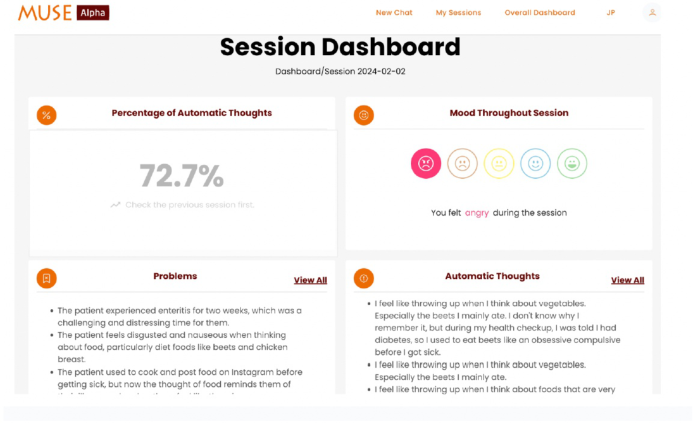
Figure 1: Analysis of patients’ cognitive thinking error patterns yields insights into negative thought patterns, analyzed by Muse Alpha.
This initiative aims to address the limitations associated with brief one- on-one interactions between doctors and patients, striving for more precise medication prescriptions. By identifying patterns of negative thoughts and visually conveying them to the healthcare provider, Muse Alpha facilitates a more accurate diagnosis of the patient’s condition. This not only contributes to a better understanding of the patient’s mental health but also aids in the tai- lored and precise prescription of medication based on the individual’s unique needs and responses. The integration of big data and AI in this context holds promise for enhancing the overall quality of psychiatric care and promot- ing more effective and personalized treatment approaches (Ray et al., 2022; Sharma and Shankar, 2015).
DEVELOPING AI TECHNICAL INTEGRTATION TO SUPPORT SYSTEMS DESIGN With 11 initial thought pattern categories, we gathered random utterances from therapy sessions and utilized few-shot learning to eliminate those iden- tified by GPT-4 as thought patterns. Through multiple fine-tuning steps in the training process, we expanded to 12 categories, encompassing 2153 utterances in the dataset.
Table 1. Thought pattern data.
Table available in the original PDF paper.
All-or-Nothing Thinking 1034 Discounting the Positive 990 Emotional Reasoning 905 Fortune Telling 1046 Labeling and Mislabeling 1036 Magnification (Catastrophizing) and Minimizing 1046 Mental Filter 1027 Mind Reading 925 Overgeneralizaing 1048 Personalization 870 Should Statements 1017 Total 22001
For training, we used a library provided by HuggingFace called SetFit (Weaver and Michael, 2015). SetFit is an approach of fine-tuning to get a high classification accuracy with a small number of examples.
Fine-tuning has the following steps: In the first step we fine-tune a sen- tence transformer model. ST models are text embedding models that vectorize input text. When vectorized using pre-trained ST, semantically similar texts end up closer in the vector space. When fine-tuning ST for classification, we provide it with pairs of texts. The model learns to generate embeddings (dense vector representations) that are close together for similar sentences (positive pairs that belong to the same category) and far apart for dissimilar sentences (negative pairs that belong to different categories). For the follow- ing step, we add a classification head to the model to classify the embeddings that fine-tuned ST generates into their respective categories. We use a logistic regression model as classification head.
Muse Alpha: AI-based Preliminary Diagnosis for Cognitive Thought Patterns 75
During training, 20% of the data from each category were held out for evaluation (80/20 train/test split). For the pretrained ST model we used all- mpnet-base-v2. We trained form multiple epochs with batch size 32 and cosine similarity loss, resulting in accuracy was (up to) 87.5%.
APPROACHING TO DOCTOR’S FEEDBACK Accurate summaries and diagnoses play a crucial role in offering physi- cians profound insights, utilizing data to enrich their comprehension of the patient’s condition [5]. This not only aids in making informed decisions but also fosters a more personalized and effective approach to healthcare. To enhance clarity, it is recommended to meticulously refine the separation between the perspectives of the patient and therapist within the summaries, ensuring that each party’s input is distinctly articulated.
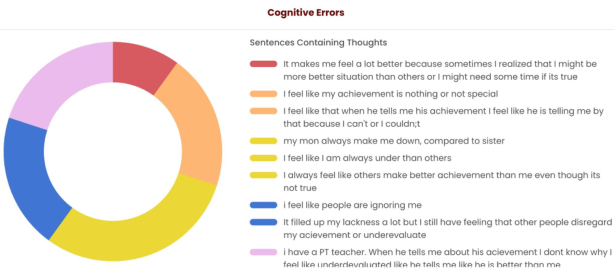
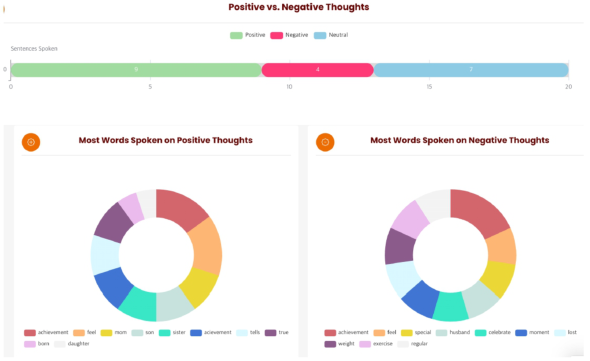
Figure 2: Categories for cognitive errors of the patient, analyzed by Muse Alpha.Figure 3: The Ratio of thoughts by positive or negative, analyzed by Muse Alpha.
The creation of a user-friendly dashboard interface is paramount, designed to facilitate seamless navigation for physicians. This streamlined interface should prioritize simplicity without compromising the depth of information
available, empowering physicians to extract valuable insights efficiently and without unnecessary complexities. The goal is to create an intuitive and acces- sible platform that aligns with the unique needs and workflow of healthcare professionals.
Integrating predictive analytics and interactive features into the dashboard represents a forward-looking approach. This not only allows for dynamic engagement with the data but also contributes to a more personalized user experience. Physicians can benefit from real-time data analysis and pre- dictions, enabling them to anticipate potential developments in a patient’s condition and tailor their approach accordingly.
Table 2. Feedback based on three conversation topic that chosen by Doctor.
Table available in the original PDF paper.
Cases Doctor’s Feedback Score (Out of 10) Doctor : 8.5 Counselor : 9 Postpartum depression There has been a shift towards encouraging meetings with professionals at an appropriate time. Encouragement of help-seeking behavior was also seen as a positive attitude.
Fear of flying
Probabilistic restructuring, breathing exercises, and meditation are all deemed appropriate.
Doctor : 8.5 Counselor : 9
Doctor : 8.5 Counselor : 6.5 Feelings of sadness
This scenario seemed similar to the last trials, but the previous instance appeared to be more beneficial. Solutions were proposed without sufficient exploration of the situation, and they seemed superficial.
As shown in Table 2, we attempted an experiment focusing on feedback received for three conversation topics selected by the psychiatrist. We received feedback and scores of 8.5 from Dr. Kim, who is a psychiatrist in the Harvard psychiatric doctoral program, and 9 from the counselor for counseling ses- sions conducted via MuseAlpha. Dr. Kim scored 8.5 for case 1 (Postpartum depression) and case 2 (Fear of flying), while the counselor scored 9 for case 1 (Postpartum depression) and case 3 (Feelings of sadness). This indicates that case 1 has secured consistently high scores across both evaluations.
To ensure optimal utilization of the advanced features embedded in the dashboard, the implementation of comprehensive training programs is essen- tial. These programs should focus on equipping users, particularly physicians, with the necessary skills to navigate the platform effectively. This includes training on interpreting complex data patterns, utilizing predictive analyt- ics, and making informed decisions based on the insights provided by the dashboard.
In summary, the expansion and refinement of accurate summaries, cou- pled with an emphasis on a user-friendly interface, predictive analytics, and comprehensive training, collectively contribute to a robust healthcare plat- form. This holistic approach aims to empower physicians with the tools and insights needed to deliver personalized and effective care to their patients.
Muse Alpha: AI-based Preliminary Diagnosis for Cognitive Thought Patterns 77
CONCLUSION
Leveraging AI techniques to analyze shifts in a patient’s cognitive thinking not only contributes to advancements in medical technology but also extends beyond the confines of brief interactions between healthcare providers and patients. This approach harnesses the wealth of intimate personal data from the patient, going beyond mere snapshots of information obtained in short encounters. The resultant dataset becomes a valuable resource for preci- sion medication therapy, offering a nuanced understanding of the patient’s cognitive changes over time. This comprehensive analysis, facilitated by AI, transcends the limitations of traditional data collection methods, providing a more holistic and accurate foundation for personalized medical interventions. The potential impact of such an approach lies in its ability to offer timely and tailored treatment plans, aligning with the unique needs and responses of individual patients. As AI continues to evolve, its role in understanding and addressing cognitive changes in patients holds promise for enhancing the overall quality of healthcare and ushering in a new era of precision medicine.
REFERENCES
Crits-Christoph, Paul et al. “Trust and respect in the patient-clinician relationship: preliminary development of a new scale.” BMC psychology vol. 7, 1 91. 30 Dec. 2019, doi: 10.1186/s40359-019-0347-3 Park, Hyeseong, Myung Won Raymond Jung, and Uran Oh. “APD: An Autoencoder-
based Prediction Model for Depression Diagnosis.” 2021 IEEE 22nd International Conference on Information Reuse and Integration for Data Science (IRI). IEEE, 2021. Ray, Adwitiya, et al. “Artificial intelligence and Psychiatry: An overview.” Asian Journal of Psychiatry 70 (2022): 103021. Sharma, Neha Shankar. “Patient centric approach for clinical trials: Current trend
and new opportunities.” Perspectives in clinical research vol. 6, 3 (2015): 134–8. doi: 10.4103/2229-3485.159936. Tunstall, Lewis, et al. “Efficient few-shot learning without prompts.” arXiv preprint arXiv:2209.11055 (2022). Weaver, Michael F. “Prescription Sedative Misuse and Abuse.” The Yale journal of
biology and medicine vol. 88, 3 247–56. 3 Sep. 2015.
LISTED IN THE AHFE DIGITAL BOOKSTORE CATALOGUE
Explore the complete digital volume
Healthcare and Medical Devices
Read this individual research paper free through the original publisher, or explore the full digital proceedings book.
ISBN 978-1-964867-06-9
Explore this ISBN in the AHFE Bookstore ↗Listed in the July 2026 bookstore catalogue; search by ISBN to confirm current availability · Digital book purchase optional