Zhuyun Yuan (2024). Crossing the East Asian cultural bridge: Comparison between Chinese and Japanese aesthetic education. In: Design for Inclusion. AHFE Open Access, vol. 128, pp. 49–57. https://doi.org/10.54941/ahfe1004790
This article aims to conduct a comparative study of aesthetic education in China and Japan, to explore the similarities and differences in history, theory, and practice of aesthetic education in the two countries, and to promote cross-border learning exchanges and cooperation. This article adopts the method of literature research and deductive induction, first introduces the history and current situation of aesthetic education in China and Japan, and then compares the theoretical system and practice of aesthetic education in the two countries. It is hoped that the aesthetic education of the two countries will be integrated and developed, jointly cultivate Asian talents.
Aesthetic education was first proposed by German poet Schiller in his Essays on Aesthetic Education. “Aesthetic education is a kind of educational activ- ity with beauty as its aim and means,” Tao Xingzhi stated.” Its aim is to cultivate people’s aesthetic ability and taste of beauty. Through cultivating people’s understanding, experience, feeling and appreciation of beauty, as well as the creation and expression of beauty, the educational purpose of all- round development of human beings can be achieved.” Aesthetic education is a kind of education mode which is based on the development needs and characteristics and cultivates aesthetic ability, creativity and artistic expres- sion through artistic education activities. It is not only a kind of art education, but also an all-round development education, which can enrich life, broaden vision and guide outlook on life.
Both China and Japan have a long history and rich experience in the field of aesthetic education, and the educational cooperation and exchange between the two countries are increasingly frequent. A comparative study of aesthetic education between China and Japan can reveal the differences and advantages of aesthetic education between the two countries and pro- vide reference for the improvement and development of aesthetic education in the two countries.
DEVELOPMENT HISTORY OF AESTHETIC EDUCATION IN CHINA The ancient Chinese aesthetic education thought attached importance to the combination of beauty and ethics, and emphasized the unity of moral edu- cation and aesthetic education. The earliest aesthetic concept is embodied in the “elegant words” of the Book of Songs, that is, harmonious and beauti- ful words, which are used to cultivate people’s aesthetic taste and cultural accomplishment. Confucianism has always emphasized that the text should be based on virtue and the text should carry the Tao. In the Chinese lan- guage, “beauty is synonymous with goodness,” which is why Chinese people often confuse beauty with morality and beauty with goodness. Even though humanism sprouted in the Ming Dynasty, aesthetic education did not have a fundamental development and change from the pre-Qin Dynasty to the late Qing Dynasty. This had a profound impact on the educational system and cultural traditions of ancient China.
Only in recent times has this situation begun to change. In 1906, Wang Guowei initiated aesthetic education in China. After the May 4th Movement, art education gradually became a new curriculum. The aesthetic education thought in the western classical philosophy was introduced into China by a group of scholars represented by Wang Guowei and Cai Yuanpei, and con- tinuously processed into a new knowledge suitable for China, which is also the beginning of modern Chinese aesthetic education.
After the founding of the People’s Republic of China, the popularization and popularization of aesthetic education became the direction of develop- ment. However, during the Cultural Revolution, China’s aesthetic education suffered a serious blow. After the 1980s, aesthetic education has been gradually restored and developed.
Since the 21st century, China’s aesthetic education has been greatly improved and developed in educational policies, curriculum, teaching meth- ods and other aspects, and various new teaching methods and technologies have been introduced into aesthetic education. At the same time, China’s aes- thetic education also pays more attention to inheritance and innovation, and pays attention to cultivating students ‘comprehensive ability, which lays a foundation for the further development of Chinese aesthetic education.
ANALYSIS OF THE CURRENT SITUATION OF AESTHETIC EDUCATION IN CHINA On October 15, 2020, the Opinions on Strengthening and Improving Aes- thetic Education in Schools in the New Era issued by the General Office of the CPC Central Committee and the General Office of the State Council further emphasized the importance of aesthetic education work, and made compre- hensive arrangements for strengthening and improving aesthetic education and realizing the integration of five educations. Facing the call, all parts of the country have taken measures to strengthen and improve aesthetic education.
At present, there are still some problems in aesthetic education in China, such as paying too much attention to skill training, separating art education from humanistic education, etc. In addition, most students only receive aes- thetic education in school, lacking external cultural resources and activities.
Crossing the East Asian Cultural Bridge 51
By analyzing the present situation and problems of contemporary aesthetic education in China, the study puts forward that aesthetic education needs to develop from technical training to aesthetic education and cultural education, and expand students ‘aesthetic vision and cultural accomplishment through diversified teaching methods and external resources. In addition, some pri- vate institutions and enterprises are also providing support to aesthetic education in China.
Generally speaking, China is constantly promulgating relevant policies to promote the popularization of aesthetic education, and at the same time, it is constantly exploring the contents and methods of aesthetic education. Through the research and practice, China has gradually formed its own aesthetic theory system and practice methods.
DEVELOPMENT HISTORY OF AESTHETIC EDUCATION IN JAPAN Ancient Japan also has a long aesthetic tradition. From the Heian period, art, music, literature and other art forms gradually developed and became part of Japanese traditional culture, and had an important impact on later aesthetic education. After Buddhism was introduced into Japan, the collision of different cultural thoughts formed a unique Zen aesthetics: the pursuit of “unreasonable and wonderful” aesthetic scene, “clear mind to see nature” intuitive understanding. The abstruse sense of impermanence in “Wu Ai” is also a unique aesthetic sentiment in Japan since ancient times. Tradi- tional handicrafts such as flower ceremony and tea ceremony are important contents in ancient Japanese education. Natural aesthetics in flower cere- mony and silence aesthetics in tea ceremony have great influence on aesthetic education in Japan.
Aesthetic education in modern Japan began in Meiji Restoration, and has undergone three stages since its introduction in 1872: imitation and develop- ment, revival and reconstruction, and overall perfection. During the period of imitation and development, i.e. from Meiji Restoration to the eve of World War II, aesthetic education in Japan experienced a change from imitating the West to advocating personality development. During the period of revival and reconstruction, i.e. from World War II to 1970s, the educational pur- pose of aesthetic education in Japan experienced several swings between individualism and nationalism. After entering the 1980s and 1990s, Japan’s knowledge-intensive industries gradually replaced labor-intensive industries, thus putting forward higher requirements for population quality. Therefore, developing students ‘personality and overall ability has become an important goal of educational reform facing the 21st century.
ANALYSIS OF THE CURRENT SITUATION OF AESTHETIC EDUCATION IN JAPAN Japan’s aesthetic policy and aesthetic education system are relatively perfect. Japan has proposed six bills on education reform, known as the Rain- bow Plan, which is a social development plan for children launched by the Japanese government to promote the healthy growth and development of children by providing a good environment for education, health and safety.
52 Yuan
Japan’s Department of Culture and Ministry of Education, Culture, Sports, Science and Technology also cooperate to assist primary and secondary schools in art education, and carry out cultural and artistic training projects such as touring public performance projects, artist dispatch projects, and art communication ability improvement projects. Among them, the artist dis- patch project refers to sending artists to non-profit destinations in primary and secondary schools to assist schools in carrying out art education.
While paying attention to the inheritance of traditional culture, Japan also implements a “two-track system” in aesthetic education, integrating traditional aesthetics with modern ideas, combining technical means with traditional crafts, making aesthetic education tools very rich.
Generally speaking, Japan attaches great importance to aesthetic educa- tion and promotes its development through various ways and means. This not only contributes to the cultivation of children’s creativity, expression and imagination, but also helps to improve children’s aesthetic ability and cultural literacy.
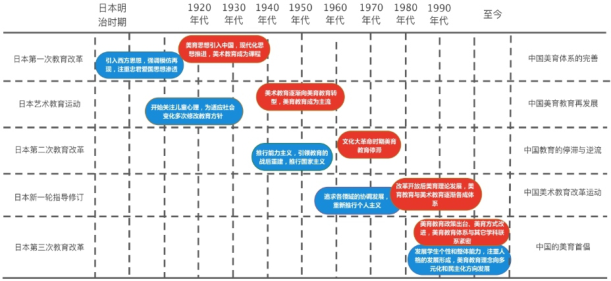
Figure 1: Comparison of aesthetic education systems between China and Japan.
COMPARISON OF THE THEORETICAL SYSTEMS OF AESTHETIC EDUCATION BETWEEN CHINA AND JAPAN The aesthetic education of the two countries has the same general direction, but the process and progress are different.
The theoretical system of aesthetic education in China can be divided into four stages. The first stage, from the 1920s to the early 1950s, was domi- nated by art education, mainly aimed at improving students ‘painting skills. The second stage, from the 1950s to the early 1970s, was the transition period between art education and aesthetic education, and aesthetic edu- cation gradually became the mainstream. The third stage, from 1970s to early 1990s, aesthetic education theory gradually matured, aesthetic educa- tion and art education have their own systems. In the fourth stage, since the 1990s, the theoretical system of aesthetic education has become more and more complete, and aesthetic education has a closer relationship with other disciplines.
Crossing the East Asian Cultural Bridge 53
The development of aesthetic education theory system in Japan can also be divided into four stages. The first stage, Meiji period to prewar period, began to introduce western aesthetic education theory, mainly to cultivate painting skills and aesthetic ability as the goal. In the second stage, from the postwar period to the 1960s, the theory of aesthetic education gradu- ally matured, and the goal of aesthetic education changed from single skill training to the cultivation of personality and social responsibility conscious- ness. In the third stage, from 1970s to 1990s, aesthetic education theory gradually developed in the direction of comprehensiveness, practicality and individuation. From 1990s to now, the theory of aesthetic education has grad- ually developed in the direction of pluralism and democratization, focusing on exploring individual creativity and aesthetic experience.
Both China and Japan introduced western aesthetic education theory in early modern times, which had an important influence on the development of aesthetic education in both countries. Aesthetic education theories in both countries pay more and more attention to comprehensiveness, empha- size the relationship between aesthetic education and other disciplines, and combine aesthetic education with social practice to cultivate students ‘mul- tiple qualities. Aesthetic education theories of both countries emphasize the importance of aesthetic education and believe that students ‘aesthetic and cultural qualities can be improved through artistic and cultural experience and appreciation.
The difference lies in the fact that the development of Chinese aesthetic education theory system has undergone a transformation from single art edu- cation to comprehensive aesthetic education. The development of aesthetic education theory system in Japan has experienced a transformation from skill training to personality all-round development and then to pluralism and democratization. China’s aesthetic education method pays more attention to basic education and standardized teaching, emphasizing the cultivation of students ‘skills and basic knowledge, while Japan’s aesthetic education method pays more attention to flexibility and diversity, encouraging students to learn and create independently. China’s aesthetic education theory system pays more attention to systematization and systematization, organically com- bines aesthetic education with other disciplines, forming a relatively complete theoretical system, while Japan’s aesthetic education theory pays more atten- tion to practice and encourages students to create and express themselves independently. Chinese aesthetic education aims to inherit and carry forward traditional culture, but also emphasize the cultivation of students ‘innovative ability and comprehensive quality, while Japanese aesthetic education aims to emphasize personalized and diversified development, encouraging students to explore their own strengths and potentials.
COMPARISON OF PRACTICES IN AESTHETIC EDUCATION BETWEEN CHINA AND JAPAN Aesthetic education practices in China and Japan have shown unique char- acteristics and common ground in many aspects. By comparing the practical experience of the two countries, we can understand the influence of different
54 Yuan
cultural backgrounds on aesthetic education ideas and methods, and provide beneficial enlightenment for their respective education systems. This com- parison helps us to understand the present situation of aesthetic education in both countries more comprehensively and provides constructive reference for future development and exchange.
Practical Implementation of Aesthetic Education in China Xishang Art Museum in the deep mountain of Ganxitan Town, Changde City, Li County, Hunan Province, offers a series of public welfare aesthetic education classes for children in the mountains. Young teachers take children to appreciate and record the beauty of architecture on the stream, so that children in remote areas can deeply understand the folk customs and culture around them and cultivate the cognition and understanding of beauty.
Shanghai University of Science and Technology runs aesthetic education through all fields of the school, allowing students to appreciate art and expe- rience tradition, so as to improve aesthetic taste and cultural accomplishment, cultivate talents with both aesthetic knowledge and aesthetic accomplish- ment, and construct a new pattern of aesthetic education in science and technology universities.
“Dream Fulfillment Moment” into Beijing is an original youth study aes- thetic education cultural program. It allows children to walk behind Beijing’s history and culture in the form of study. Through various ways such as study practice, personal experience and on-site explanation, children can deeply understand and feel Chinese traditional culture, deeply explore its essence, broaden historical and cultural vision and improve artistic and cultural accomplishment.
China’s aesthetic education practice focuses on cultivating students ‘aes- thetic taste and cultural literacy, and comprehensively improves students’ comprehensive quality and cultural literacy through various forms of artistic activities, curriculum design and campus culture construction.
Practical Implementation of Aesthetic Education in Japan The Tokyo National Museum of Modern Art, which is representative of the education of Japanese art museums, includes many educational activities, among which the “Student Exhibition”, a project designed and exhibited by students themselves, attracts a large number of people to visit and appre- ciate every year. In addition, the Yamaguchi Prefectural Art Museum has set up a teacher’s day to regularly conduct aesthetic education seminars for art teachers in kindergartens and primary and secondary schools in the prefecture.
In 2019, Tokyo, Japan launched a year-long “Artists on Campus” cam- paign, sending famous artists from home and abroad to Tokyo High School to personally guide students ‘cultural club activities. Teachers of Du Li High School said that this activity effectively improved students ‘literary skills, improved students’ enthusiasm and strengthened teachers ‘guidance ability in the school.
Crossing the East Asian Cultural Bridge 55
“Ah! Design”is a Japanese short and long aesthetic enlightenment film that covers all ages. From the reality of life, the film asks questions and explores common things. Different series have different perspectives and dimensions for observing and thinking about life, but the consistency is to stimulate people’s perception of life and love for creation.
Japan’s aesthetic education practice pays attention to inheriting and car- rying forward Japanese traditional culture, and actively introduces interna- tional advanced artistic concepts and technologies to cultivate artistic talents with international vision and innovative ability.
COMPARISON OF AESTHETIC EDUCATION IN CHINA AND JAPAN In aesthetic education concept, China and Japan are influenced by Confu- cianism and attach importance to the social value and educational effect of aesthetic education. However, due to the differences in social values between the two countries, China pays more attention to the moral norms and social responsibility of aesthetic education, while Japan pays more attention to cultivating students ‘creativity and autonomy. China’s aesthetic education concept also pays more attention to the inheritance and development of traditional culture, pays attention to systematization and systematization, organically combines aesthetic education with other disciplines, and forms a relatively perfect and rigorous theoretical system. Western ideas play an important role in Japanese educational philosophy, encouraging students ‘individuality, advocating students’ independent thinking and innovation ability, and stimulating students ‘potential to a greater extent’. At the same time, it pays attention to the practicality of aesthetic education and its theory, encourages the expression of emotion and creativity, and creates a more free, diverse and vivid artistic atmosphere.
As for the purpose of aesthetic education, China and Japan pay equal atten- tion to the comprehensiveness of students ‘education and the improvement of comprehensive quality’. The difference lies in that aesthetic education in China not only inherits culture and craft, but also cultivates quality, advocates cultivating cultural accomplishment and aesthetic ability through aesthetic education, and molds perfect personality so as to build a more harmonious and stable society. Japan’s aesthetic education fully respects students, but also pays attention to applying aesthetic education to daily life, for example, encouraging students to express their feelings and thoughts through artistic creation, and applying this ability to daily communication and interpersonal relationship, so that people can understand life better.
In the way of aesthetic education, Chinese and Japanese educational meth- ods, that is, the art forms used, also have different emphases. Aesthetic education in China pays attention to the inheritance and development of tra- ditional culture and folk arts, helping students master traditional skills and techniques through teachers ‘explanations and demonstrations’. Face-to-face teaching and copying of traditional arts account for the majority of art edu- cation. However, aesthetic education in Japan tends to stimulate students ‘interest and appreciation ability by means of art museum education and activity education’. Aesthetic education in schools is also diversified in art
56 Yuan
forms, attaches importance to the introduction and development of western modern art, combines Chinese and Western, blends ancient and modern, pays attention to students’ practice and creative ability, and encourages students to actively participate in artistic creation and expression.
RECOMMENDATIONS FOR AESTHETIC EDUCATION IN CHINA AND JAPAN China and Japan can learn from each other in aesthetic education and make progress together, making positive contributions to the all-round development of students and cultural exchanges between the two countries.
Both China and Japan have their own unique aesthetic education system and tradition. It is suggested that both sides should deeply understand each other’s educational ideas, teaching methods and curriculum settings, so as to find common ground and complementarity. Cultural exchange and dialogue are important. Promoting cultural exchange and dialogue between teachers and students can be achieved through student exchange programs, teacher visits, academic seminars, etc. This will enhance mutual understanding of each other’s aesthetic education, and at the same time help to cultivate cross- cultural awareness and understanding. In the field of aesthetic education, both sides can share teaching materials, teaching resources and experience. This will help improve the quality of teaching, enrich the content of educa- tion and benefit students. Holding joint art exhibitions and cultural activities will help students of the two countries to understand each other’s culture and art, and promote cultural exchanges and integration. In addition, both sides can jointly explore and promote innovative ideas and methods of aesthetic education. For example, cross-border educational cooperation is carried out by means of technical means, and the integration of aesthetic education with other disciplines is jointly studied. The two sides can also jointly train aesthetic education professionals, establish exchange programs, scholarship programs, etc., so as to contribute to the cultivation of more educational talents who love art and have professional qualities.
CONCLUSION
At present, the methods and achievements of aesthetic education in China and Japan reflect the similarities and differences in ideology and culture and the differences in national development level to a certain extent. The two coun- tries are geographically separated by a river, their culture and art are closely intertwined, and aesthetic education should also help each other and teach and learn from each other. Both belong to the period of diversified extension of education and deep integration of science, technology and art. The two countries should attach importance to cultural exchanges and dialogues, help each other and learn from each other, jointly develop and innovate aesthetic education concepts. Crossing the bridge of East Asian culture and promot- ing the integration of aesthetic education between the two countries, the two countries can improve students ‘artistic literacy and aesthetic ability, enhance cross-cultural communication and understanding ability, and help to jointly
Crossing the East Asian Cultural Bridge 57
cultivate Asian talents’. Aesthetic education in East Asia will also develop into more diversified, open and innovative.
ACKNOWLEDGMENT
We would like to thank the organizers of the AHFE Conference for providing a valuable platform for knowledge exchange and collaboration.
This study was supported by Philosophy and Social Science Program Office of Hunan Province, Grant No. 21YBQ036. Thank you for your financial support in conducting this study.
REFERENCES
Hu, Y. F. (2015). A Century of Chinese Aesthetic Education. In Journal of Wenzhou University, 2015(5), 1–2. Kong, X. M. (2022). On Art Education for Aesthetic Education. In Aesthetic
Research, 2022(04), 1–10. Liao, Y. J. (2003). A Comparative Study on Aesthetic Education at Home and Abroad. In Journal of Xiangtan Normal University, 2003(09), 114–117. Li, D. M. (2021). Art Education in Japanese Elementary and Middle Schools:
Focusing on Creative Thinking and Aesthetic Experience. In Shanghai Education, 2021(35), 32–34. Ling, C., & Wang, Y. X. F. (2020). Influence of Japanese Scholars on Wang Guowei’s Aesthetic Views. In Journal of Anhui Agricultural University, 2020(11), 108–114. Ma, L. J. (2013). Reference and Enlightenment of Art Museum Popularization in Pri-
mary and Secondary School Art Education in Japan. In Art Education, 2013(12), 26–27. Peng, J. X. (2019). Leap-forward Development of Aesthetic and Art Education in China in the New Period. In Aesthetic Research, 2019(05), 11–16. Wang, Y. X. (2002). Modernization of Elementary School Art Education in Japan
and Its Implications. In Journal of Japanese Studies, 2002(04), 56–58. Wu, C., & Zhang, Z. Y. (2017). The Role of Aesthetic Education in the General Education Curriculum. In Art Education, 2017(07), 35–36. Yao, X. G., & Liu, X. (2022). A Hundred Years of Development of Aesthetic
Education in Japan. In Educational Science Research, 2022(06), 32–37. Zeng, F. R. (2000). Towards Aesthetic Education in the 21st Century. In New Era Construction of Literary and Art Studies (p. 10).
LISTED IN THE AHFE DIGITAL BOOKSTORE CATALOGUE
Explore the complete digital volume
Design for Inclusion
Read this individual research paper free through the original publisher, or explore the full digital proceedings book.
ISBN 978-1-964867-04-5
Explore this ISBN in the AHFE Bookstore ↗Listed in the July 2026 bookstore catalogue; search by ISBN to confirm current availability · Digital book purchase optional