Oliver Trepping, Kevin Schuler, Philipp Rupp, Bernhard Schick (2023). A Full-Factorial Analysis of Combined Vehicle Motion Profiles on Cross-Coupled Coriolis Effect, Subjective Vertical and Motion Sickness Incidence. In: Application of Emerging Technologies. AHFE Open Access, vol. 115, pp. 433–443. https://doi.org/10.54941/ahfe1004341
Motion sickness research has always been shaped by current events. With the advent of highly automated vehicles (HAVs), the topic is currently being revisited as 60% of users of HAV functions are expected to suffer from motion sickness. Failure to address this condition will jeopardize user acceptance of HAV functions. We investigated the vestibular mechanisms of motion misinterpretation and hypothesized that cross-coupled stimuli induce more sensory conflict and lead to higher motion sickness incidence compared to the non-coupled control condition. We conducted an experiment on a dynamic driving simulator with realistic motion profiles and analyzed the influence of cross-coupled motion on motion sickness incidence. Results show no significant difference in motion sickness incidence between cross-coupled and non-coupled motion profiles. Further research is needed to investigate the thresholds of the Coriolis effect and should include the measurement of compensatory or inertial head motion of participants.
The study of motion sickness has always been shaped by the zeitgeist of the current era with research inspired by contemporary civil and military events (Reason and Brand, 1975, p. 9). Irwin (1881) was the first to systemati- cally observe ship motion in response to waves as the cause of seasickness, prompting the renaming of “Sea Sickness” into “Motion Sickness” (Dobie, 2019, p. 21). The English word “nausea” is derived from the ancient Greek word “naus” (ship) and is associated with the occurrence of motion sickness at sea (Golding, 2016). In the 20th century, large troop transports by sea, air and land during the world wars and the “space race” between the two Cold War rivals were each the cause for contemporary research. With the current advent of highly automated vehicles (HAVs), the topic has been revisited. Diels et al. (2016) coined the term “self-driving carsickness” in this context,
with an estimated incidence of this condition in 60% of the population (Diels et al., 2016). However, Irwin’s overarching term “Motion Sickness” remains valid because, regardless of the context, the primary stimulus is the influence of low-frequency translatory acceleration on the vestibular system. Individ- uals with vestibular dysfunction are the only group immune to all forms of motion sickness (Diels et al., 2016).
For the different modes of transport, the specific motion sickness stimuli vary. While vertical motion is the primary stimulus on ships due to heave motion on waves, the primary stimulus on road vehicles is horizontal accel- eration due to cornering, lane changes as well as fore-and-aft-acceleration. Several studies indicate non-linear effects of coupled translatory and rota- tional motion on the incidence of motion sickness (Wertheim, Bos and Bles, 1998; Joseph and Griffin, 2007; Cohen et al., 2011). To date, there are no published studies which investigate motion variables in a full-factorial design, likely due to the inability to vary motion variables independently. Riding ele- phants and camels causes motion sickness, whereas riding horses does not. The different gaits of the animals produce different stimuli to the riders (Treis- man, 1977; Dobie, 2019, p. 4). Turning today’s ‘camel’ into tomorrow’s ‘horse’ must be the goal of chassis development for HAVs.
The objective of this research is to investigate motion sickness from the perspective of vestibular misinterpretation and to identify critical influences of vehicle dynamics to mitigate self-driving carsickness. Failure to address this issue could jeopardize user acceptance of HAV functions. In the fol- lowing section, the mechanisms between eyes and vestibulars are explained with reference to the misinterpretation of coupled motion based on the medical literature. Subsequently, we present the findings of a full-factorial study conducted on a dynamic driving simulator to investigate the effect of cross-coupled rotation and translatory acceleration on incidence of motion sickness.
THEORETICAL BACKGROUND The vestibular system with its two functionally separated subsystems – semi- circulars (SC) for sensing rotational acceleration and macular organs for sensing translatory acceleration – is involved in all forms of motion sick- ness. The vestibular system works appropriately within the natural repertoire of human movement: In healthy individuals, the vestibular system provides reliable information about head position and movement and remains funda- mentally in the unconscious (Schmidt and Schaible, 2006). However, with passive locomotion, the system reaches its limits, named Coriolis effect of the SC and subjective vertical conflict of the macular organs. The sensory conflict theory is the most widely accepted theory regarding motion sickness today. Reason (1978) argues that conflict occurs in the central nervous system (CNS) when afferents are incongruent within a sensor organ (intra-modal) or between two sensor organs (inter-modal).
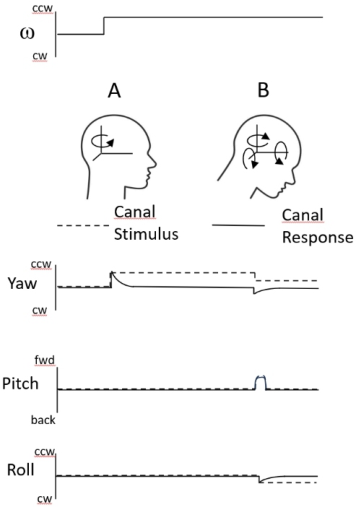
Semicircular Misinterpretation: Coriolis Effect The qualitative canal outputs of the Coriolis effect for sustained yaw rotation and one set of the bilaterally symmetrical SCs are shown in Figure 1. Rotation
A Full-Factorial Analysis of Combined Vehicle Motion Profiles 435
is sensed in three spatial planes by the three SCs. The SCs contain a fluid called endolymph. Due to its inertia, the fluid reacts with a delay to angu- lar accelerations of the head in the respective plane. When the head rotates counterclockwise around the longitudinal (vertical) body axis, the “yaw canal” is stimulated (see Figure 1 condition A) until the canal and the inertial endolymph have the same angular velocity. If now, e.g., a pitch forward head movement is performed (see Figure 1 condition B), the “yaw canal” is moved out of the horizontal plane and experiences a deceleration. The result is a per- ceived clockwise rotation because the endolymph, due to its inertia, rotates faster than the canal. In addition, the “roll canal” is moved into the hori- zontal rotation plane and experiences a clockwise rotation. Consequently, the Coriolis effect produces a sensation of three rotations through the cross-coupled stimulus about two rotation axes, with each SC canal produc- ing incorrect motion information (Hixson et al., 1966, p. 50; Eyeson-Annan, 1996; Kaufman et al., 2001). The onset of motion sickness in tilting trains is largely attributed to the Coriolis effect of cross-coupled roll and yaw motion (Bertolini 2017).
Figure 1: Stimulus and response of the Coriolis effect (adapted from Lackner, 2014).
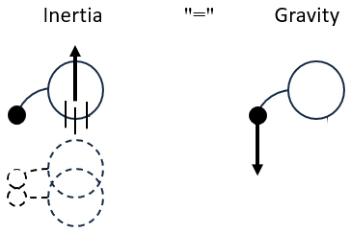
Otolith Misinterpretation: Subjective Vertical Conflict The principle of translatory acceleration perception is illustrated in simpli- fied form as a spring-mass system (see Figure 2). When the head experiences a translatory acceleration, the otoliths, as inertial masses, react with a delay to the body’s acceleration and the hair cells are bent. The same sensory affer- ents are also produced by the action of gravity on the otoliths when there is no inertial acceleration. This means that, according to Einstein’s equivalence
principle, the macula organs and the CNS cannot distinguish between inertial acceleration and gravity. Subsequently, this can produce a false adaptation of the subjective vertical due to the resultant vector of inertial acceleration and gravity, the so-called gravito-inertial force vector (GIA) (Clarke and Engelhorn, 1998).
Figure 2: Misinterpretation of the GIA according to the equivalence principle (adapted from Bos, 2017).
The interpretation of the GIA can be determined by eye tracking: Studies show that the CNS acts as a low-pass filter under these conditions: For trans- latory acceleration with a frequency below 1 Hz, eye torsion occurs (Clarke and Engelhorn, 1998; Hamann, Schönfeld and Clarke, 2001). The nau- seogenic effect of sensory conflict through a misinterpretation of the SV has not been fully investigated. However, studies show eye torsion in the group which is always spared from motion sickness: In people with a dysfunctional vestibular system, proprioception can replace the missing vestibular afferents (Clarke and Engelhorn, 1998), which means that despite eye torsion, vestibu- lar dysfunctional individuals are resistant to motion sickness. This implies that the rotation of the visual environment by eye torsion remains in the unconscious or is not nauseating due to reafferences of the eye muscles when compared to the cues of the visual system.
METHODS
Participants A total of n = 8 individuals participated in the within-subject study (1 female, 7 male). Each participant was an employee of IFM Institute of Driver Assis- tance and Connnected Mobility, Benningen or MdynamiX AG, Benningen. Participants were selected by their score in the Motion Sickness Susceptibil- ity Questionnaire (MSSQ) (Golding, 2006). All participants’ MSSQ scores were below the the 80th percentile of the total population.
Stimuli The three independent variables of yaw, roll and pitch were combined with lateral acceleration in a full-factorial study design (see Table 1). In the
A Full-Factorial Analysis of Combined Vehicle Motion Profiles 437
within-subjects study, all motion cueings were completed by each partici- pant. The sequence of exposure to the motion profiles was randomized using Minitab Design of Experiments (Minitab LLC, 2023). According to Reason (1978), each motion profile in the study (see Table 1) provoked a type 1 visuo-intertial, intermodal sensory conflict with the internal visual reference (IVR) of the Head Down Display. For motion profiles MS5-MS8 with more than one axis of rotation, an additional semicircular-otolith, intramodal type 1 sensory conflict occurs due to the Coriolis effect (Reason, 1978). The inci- dence of motion sickness generally peaks at 0.2 Hz translatory motion, both vertically and horizontally (O’Hanlon and McCauley, 1973; Ziavra, 2003). However, if the travel paths are limited, as on the driving simulator, Motion Sickness Incidence (MSI) can be increased if the frequency and thus also the maximum lateral acceleration is increased. Kuiper et al. (2019) found that in such cases, higher frequencies up to 0.35 Hz are preferable due to the higher possible lateral acceleration. The isolated lateral sine motion at the given frequency and travel paths of the aVDS, leads to an expected MSI of under 20% for the control condition MS1 (Kuiper et al., 2019). A strictly sinusoidal motion achieves the frequency objective but could lead to subjects anticipat- ing the movement and bracing themselves by activating the core and neck muscles, which we hypothesize could lead to a lower MSI incidence. There- fore, a random motion pattern was created to prevent this type of action and to simulate a more realistic driving environment.
Apparatus The advanced Vehicle Driving Simulator (aVDS) is developed by AB Dynam- ics (AB Dynamics, 2023) and installed at the Institute for Driver Assistance and Connected Mobility (IFM) associated with the University of Applied Sci- ences Kempten. It features eight electric drives that move the simulator in six degrees of freedom, with the greatest possible travel path of ±1000mm on the lateral axis, and the greatest possible rotatory movement of ±30 degrees on the vertical z-axis. Frequency limits range from 15 Hz to 50 Hz depending on the degree of freedom.
Compared to a hexapod setup often used in driving simulator design, the aVDS setup allows for more isolated lateral motion and larger yaw angles when combined with lateral displacement. Despite this design, it was found during pre-testing that a sinusoidal motion input using the full lateral travel while rotating around all axes, as a vehicle would, was accepted by the aVDS controller, but the controller then failed to deliver a smooth sinusoidal motion. The motion cueing was consequently adjusted by reducing rotational velocities until a smooth motion was achieved.
On the simulator, a VW Golf Mk7 was used as a half-cockpit to increase physical fidelity of the simulator and to give the subjects the feeling of sitting in a real vehicle. As this experiment focused on motion sickness induction based on movement rather than simulator sickness, the visualization of the simulator was deactivated, and the cockpit was covered up with opaque fabric to prevent external visual reference.
A validated vehicle model of a VW Golf Mk7 on a Pacejka tire (Pacejka, 2012) was placed on a wide and flat surface in a CarMaker simulation at a speed of 60 km/h and sinusoidal steering inputs of 20 degrees were imposed on the car via the maneuver control. Full steering cycles were interspersed with half cycles in both directions at random intervals. A full steering cycle at 0.2 Hz lasted 5 seconds, but if, for example, a half period steering maneu- ver to the right was repeated immediately, the maneuver time was extended by 1 second to allow the motion base of the driving simulator to return to the centre. With this modification, the lateral accelerations and therefore the MSI incidence of motion sickness was expected to be higher than without the additional second. All maneuvers accumulated to around 30 minutes of driving.
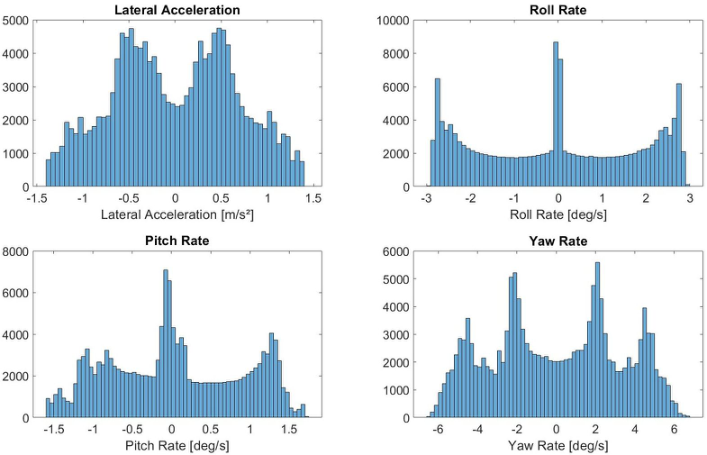
A measurement that sampled approximately 10 minutes of the driving simulator’s motion showed peak lateral accelerations of 1.4 m/s2 in either direction. A histogram showed however that most acceleration values were around the ±0.5 m/s2 mark. The yaw rate, roll rate and pitch rate had their maximum values at ±6.6 deg/s, ±3.0 deg/s and ±1.6 deg/s respectively (see Figure 3).
Figure 3: Motion analysis for motion profile MS8.
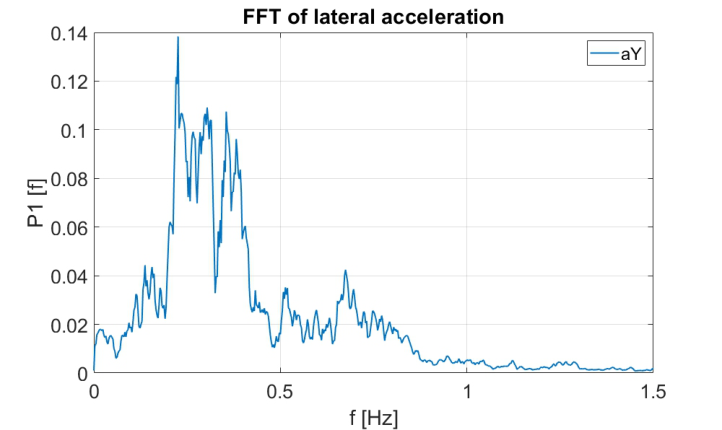
A Fast Fourier Transformation of the lateral acceleration signal revealed high frequency magnitudes in the range of 0.2 to 0.4 Hz, with a peak at around 0.23 Hz (see Figure 4). It was concluded that a good balance between target frequency, lateral acceleration and randomized motion was achieved with this motion pattern and therefore fitting for the experiment at hand.
A Full-Factorial Analysis of Combined Vehicle Motion Profiles 439
Figure 4: Fast fourier transformation of lateral acceleration.
Experimental Procedure Before each simulator run, participants were instructed about the Fast Motion Sickness Scale (FMS) a unidimensional scale that measures nau- sea and general discomfort (Keshavarz and Hecht, 2011). Participants were reminded of their option to terminate the study at any time. They were instructed to stare at the Head Down Display, not to lean on the head- rest, and to provide a verbal FMS rating every minute when prompted by the study staff over the intercom. If the FMS score exceeded 15 out of 20, participants were reminded of their option to terminate the simulator run. Participants had no workload from secondary tasks other than self-reporting their subjective state over the FMS. The duration of each simulator run was 30 minutes, which is consistent with other studies of motion sickness in driving simulators (Donohew and Griffin, 2004). After the simulator run, participants were asked to rate their symptoms using the Simulator Sickness Questionnaire (SSQ) (Kennedy et al., 1993). The SSQ consists of three sub- scales, namely the nausea (SSQ-N), disorientation (SSQ-D), and Oculomotor (SSQ-O) subscales. Only the SSQ-N scale was analyzed, since the partici- pants were specifically instructed not to focus on nervousness, boredom, and fatigue in the instructions of the FMS. The simulator runs were separated by at least two days.
RESULTS
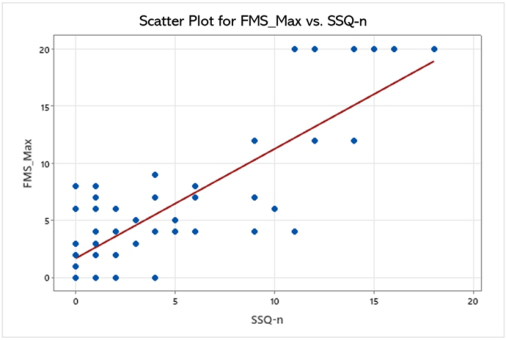
As proposed by Keshavarz and Hecht (2011), we examined participants’ peak verbal ratings of FMS and correlated these with the SSQ-N after stim- ulus offset. Raw data were analysed using Minitab statistical software, while Student’s t-test for FMS_max and post-hoc power analysis were performed manually in Microsoft Excel and G*power (Faul et al., 2007) respectively. We were able to reproduce the reported high correlation between FMS_max
and SSQ-n (Pearson’s r = 0.82). This suggests that the method reflected the subjective state of the participant during and immediately after the trial. The residual plot of the time series data showed no adaptation or carry-over effects across the randomised trials, suggesting that the separation of test runs by at least two days was sufficient to minimise adaptation or carry-over effects in participants. The scatter plot in Figure 5 shows the distribution of the FMS-max score and the SSQ-n subscore for the test group.
Figure 5: Scatter plot for FMS_Max vs. SSQ-n.
Factorial regression at a significance level of α=0.05 showed no significant results for both the FMS_max and the SSQ-N scales between stimuli and the control condition MS1. P-values for the stimuli range from p = 0.90 for MS7 to p = 0.16 for MS8. The two-sample Student’s t-test showed no significant differences for the cross-coupled stimuli compared to the control condition of MS1, with a lowest t = 0.58 for MS7 and a highest t = 1.79 for MS8, all results were below the respective critical t-value. Contrary to our hypothesis, there were no significant effects for two- or three-factor-interactions of the rotational components.
To assess the probability of beta error, a post-hoc power analysis was per- formed. FMS_max showed a power of 0.17 for MS7 and 0.36 for MS8, which is below the typical threshold of 0.8 for hypothesis testing. Effect sizes (Cohens d) for the stimuli ranged from d = 0.36 for MS7 to d = 0.68 for MS8. This, combined with the large standard deviation, requires a large sam- ple size for statistical significance which was not attainable in the simulator study.
Stimulus termination at the request of the participant was scored as 20 (frank sickness) on the FMS. Of the 6 terminations (see Table 1), none of the participants had to terminate MS1, MS5 or MS7. Two participants ter- minated MS8. Motion profiles MS2, MS3 and MS6 were each terminated by one participant. The duration of the stimulus before termination was between 14 and 25 minutes.
A Full-Factorial Analysis of Combined Vehicle Motion Profiles 441
Table 1. Motion components and test results for motion profiles.
Table available in the original PDF paper.
MS2 MS3 MS4 MS5 MS6 MS7 MS8
Motion profile MS1 (c.c.)* Lateral sine yes yes yes yes yes yes yes yes Yaw no yes no no yes yes no yes Roll no no yes no yes no yes yes Pitch no no no yes no yes yes yes Factor interaction 0 1 1 2 2 2 2 3 Mean FMS_max (SD) 3.63 (3.04)
The aim of the study was to test the hypothesis that, due to the cross- coupled Coriolis effect, stimuli with cross-coupled rotational components would lead to a greater incidence of motion sickness than the translatory control condition.
Low statistical power indicates that the current study cannot afford to investigate the influence of the Coriolis effect on motion sickness and that the sample size must be elevated for further research. Small effect size for all stimuli independent from the number of factor interactions indicate that the amplitude and/ or angular velocity of the rotational components may be below the needed threshold. Our aim was to give a realistic model of vehicle motion in the simulator study, therefore the peak rotational veloci- ties were low especially for roll (±3.0 deg/s) and pitch ( ±1.6 deg/s). Studies in tilting trains used cross-coupled angular velocities of 4 deg/s and above (Cohen et al., 2011, Bertolini et al., 2017). For comparison, a slalom maneu- ver with a VW Golf Mk7 in a real driving environment was analyzed. The slalom maneuver with 6 steering periods showed maximum lateral accel- erations of ±4 m/s2, roll rates of up to 6 deg/s, pitch rates up to ±1.5 deg/s, and yaw rates up to ±15 deg/s. These values would also be attainable and realistic for simulator studies. Although it is hypothesized that cross- coupling lower angular velocities also can produce the Coriolis effect and motion sickness (Cohen et al., 2011), this could not be replicated in our experiment.
The participants’ head movement was not restricted or measured in any way, which should be improved upon in further research. If the head is not directly coupled to the vehicle motion, compensatory or inertial head movement may alter the transmitted stimulus. Deliberate head movement during motion, e.g. when tilting the head down towards a screen, may have a greater influence on the cross-coupled coriolis effect due to the higher amplitude of movement. This will be espe- cially relevant for self-driving carsickness, where the once-a-driver may be inclined to direct their gaze to screens for entertainment or information purposes.
ACKNOWLEDGMENT
We thank Stefanie Trunzer and Mike Köhler for advice in the study prepa- rations and assistance during data collection. We thank all the participants who willingly accepted the potentially unpleasant effects of taking part in the motion sickness study.
REFERENCES
AB Dynamics. (March 24, 2023) www.abdynamics.com. https://www.abdynamics.c om/en/products/simulation/avds. Bertolini, G. et al. (2017): “Determinants of Motion Sickness in Tilting Trains:
Coriolis/Cross-Coupling Stimuli and Tilt Delay” in: Frontiers in Neurology, 8: 195. Clarke, A. H., Engelhorn, A. (1998) “Unilateral testing of utricular function” in: Experimental Brain Research, pp. 457–464 Cohen, B. et al. (2011): “Motion sickness on tilting trains” in: FASEB journal,
pp. 3765–3774. Diels, C., Bos, J. E. (2016): “Self-Driving Carsickness,” in: Applied Ergonomics, pp. 374–382. Dobie, T. G. (2019): Motion Sickness: A Motion Adaptation Syndrome. Cham:
Springer International Publishing Donohew, B. E., Griffin, M. J. (2004): “Motion Sickness: Effect of the Frequency of Lateral Oscillation” in: Aviation, Space, and Environmental Medicine, pp. 649–656. Eyeson- Annan, M. (1996) “Visual and Vestibular Components of Motion Sickness”
in: Aviat Space Environ Med., pp. 955–962. Faul, F. et al (2007):”G*Power 3: A flexible statistical power analysis program for the social, behavioral, and biomedical sciences” in: Behavior Research Methods, pp. 175–191. Golding, J. F. (2006): “Predicting individual differences in motion sickness suscepti-
bility by questionnaire,” in: Personality and Individual Differences, pp. 237–248. Golding, J. F. (2016): “Motion Sickness” in: Handbook of clinical neurology, pp. 371–390. Hamann, C., Schönfeld, U. and Clarke, A. H. (2001): “Der otolith-okuläre Reflex
bei linearen Beschleunigungen mit niedrigen Frequenzen” HNO, pp. 818–824. Hixson, W. et al. (1966) Kinematics Nomenclature for Physiological Accelerations, Naval Aerospace Medical Institute. Joseph, J. A., Griffin, M. J. (2007) “Motion sickness from combined lateral and
roll oscillation: effect of varying phase relationships” in: Aviation, Space, and Environmental Medicine pp. 944–950. Jelte Bos. (September 3, 2022). Motion Perception and Sickness, Eye Movements and Human Performance. https://www.jeltebos.info/perception_sickness.htm. Kaufman, G. D. et al. (2001): “Spatial orientation and balance control changes
induced by altered gravitoinertial force vectors,” in: Experimental brain research, pp. 397–410. Kennedy, R. S. et al. (1993): “Simulator Sickness Questionnaire: An Enhanced Method for Quantifying Simulator Sickness” in: The International Journal of Aviation Psychology, pp. 203–220. Keshavarz, B., Hecht, H. (2011) “Validating an efficient method to quantify motion
sickness,” in: Human factors, pp. 415–426.
A Full-Factorial Analysis of Combined Vehicle Motion Profiles 443
Kuiper, O. X. et al. (2019) “Moving base driving simulators’ potential for carsickness research,” in: Applied Ergonomics, 102889. Lackner, J. R. (2014) “Motion sickness: more than nausea and vomiting” in:
Experimental brain research, pp. 2493–2510. O’ Hanlon, J. F., McCauley, M. E. (1973): “Motion Sickness Incidence as a Function of the Frequency and Acceleration of Vertical Sinusoidal Motion”, Office of Naval Research. Pacejka, H. (2012): Tire and Vehicle Dynamics, 3 ed. Oxford: Butterworth-
Heinemann. Reason, J. (1978): “Motion sickness: Some theoretical and practical considerations” in: Applied Ergonomics, pp. 163–167. Reason, J. T., Brand, J. J. (1975) Motion Sickness. London, New York: Academic
Press. Schmidt, F., Schaible, H.-G. (2006) Neuro- und Sinnesphysiologie. Heidelberg: Springer Medizin Verlag. Treisman, M. (1977) “Motion sickness: an evolutionary hypothesis” in: Science,
pp. 493–495. Wertheim, A., Bos, J. and Bles, W. (1998): “Contributions of roll and pitch to sea sickness,” in: Brain research bulletin, pp. 517–524. Ziavra, N. V. et al. (2003) “Effect of breathing supplemental oxygen on motion
sickness in healthy adults” in: Mayo Clinic proceedings, pp. 574–578.
LISTED IN THE AHFE DIGITAL BOOKSTORE CATALOGUE
Explore the complete digital volume
Application of Emerging Technologies
Read this individual research paper free through the original publisher, or explore the full digital proceedings book.
ISBN 978-1-958651-91-9
Explore this ISBN in the AHFE Bookstore ↗Listed in the July 2026 bookstore catalogue; search by ISBN to confirm current availability · Digital book purchase optional