Toshio Tsuchiya, Kentarou Nakamoto (2023). Availability of Wave Transducer in Car Onboard System Interface. In: Application of Emerging Technologies. AHFE Open Access, vol. 115, pp. 397–402. https://doi.org/10.54941/ahfe1004337
The accident caused by the wrong treading of the pedal of the car becomes the social problem. The spread of advanced safety vehicles (ASV) is hurried as a passive safety in late years to reduce and prevent the damage of the accident. However, requiring a certain period of time for the spread of ASV and the valid situations are limited, and the problem such as not necessarily working appropriately is pointed out. On the other hand, it is thought that the information presentation system to let a driver recognize danger as the active safety is effective. In addition, the automatic operation system is in use to level 4 in Japan. A purpose of this study is to investigate the influence that shown information gives the cognitive function of the driver in the information presentation system of the onboard system. Therefore, the cognitive of the wave transducer interface implemented on the seat is confirmed by an experiment. For the experiment, we investigated the difference of the performance between the visual and the vibration interface using the simple driving simulator which embedded in both sides of the seat back. As a result, the difference was not seen between the visual and the vibration. In addition, by the subjective evaluation, the experiment participant felt that both stimulations were recognizable, and the difference was not seen. The experiment was suggested by a laboratory test as one of multi-modal interface by the transducer stimulation to be possible.
In this research, we focus on the interface of Advanced Safety Vehicle, which has been popularized in recent years to prevent traffic accidents. Ministry of Land, Infrastructure, Transport and Tourism Japan has incorporated ASV promotion plan since 1991. It has formulated the concept of driving assis- tance that considers the practical application of ASV technology and drivers. In addition, technological development of ASV is being carried out with the spread of autonomous driving vehicle. Some of ASV vehicles are those equipped with collision safety brakes that detect obstacles and automatically stop or sensors that automatically keep the following distance from the lead- ing vehicle. Although the on-board AI is highly reliable, it cannot completely prevent accidents. For example, it is difficult to distinguish between intended and unintended acceleration.
There are about 3,800 accidents by the pedal misapplication and nearly 10,000 in the last three years (ITARDA, 2022). Accidents caused by pedal misapplication do not account for a large percentage of all accidents, but in
Japan where the population is aging, they cannot be ignored. In such cases, if the problem of AI imperfection can be compensated for by the user inter- face, it is thought that the risk of accidents by unintended acceleration can be reduced. So, it is important to give appropriate feedback to the driver through the interface (Schmidt, 1989). We consider the use of vibration stim- ulation by a wave transducer device in addition to the visual and the sound stimulation used in conventional on-board systems. In this research, the char- acteristics of stimulation by the wave transducer are clarified by experiments. The experiments used stop-signal task including inhibitory function (Eagle, 2008). The experiment indicated the difference between visual and vibration stimulations.
METHOD OF EXPERIMENT BY STOP-SIGNAL TASK Accidents involving misapplication of the accelerator and the brake pedal in automobile driving often occur when the driver suddenly accelerates and crashes into a building when starting from a parking lot or when the vehicle moves backward. It should be possible to release the accelerator immediately and depress the brake pedal again, but the driver who cannot perform this simple operation panics and further depresses the accelerator. However, it is difficult to analyse the causes of pedal misapplication and the circumstances in which the pedal misapplication occurs because they are ambiguous.
Therefore, stop-signal task is used in the experiment. The task is used to analyze the situation and behavioral characteristics of stepping errors. The purpose of the task is to inhibit the behavior regulation function that initiates and terminates behavior, and to cause a pseudo stepping mistake (Tsuchida, 2007). In this situation, subjects are given visual and vibration stimuli to measure the driver’s discriminating ability. In addition, subjective assessments are used to assess stimuli after the experiment. We investigated the degree of recognition of the stimulus by having the experiment participants fill out a questionnaire about the perception during pedal operation.
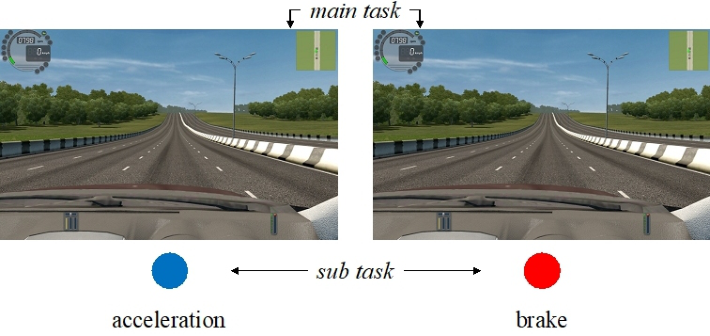
Equipment of Experiment The purpose of this experiment is to investigate the discrimination of visual and vibration stimulation and the drivers’ performance to pedal operations (Nakano, 2021). The experiment uses facilities as the driving environment. PC displays images of stimulus and the other PC for a driving simulator (Tsuchiya, 2022). The participants were given a task of driving a car as the main task. The participants are also shown a task of distinguishing left and right presented with images at random intervals. For that purpose, a steering wheel, driver’s seat, and pedals are installed to construct a pseudo-driving space. The operation uses two USB foot pedal switches for accelerator and brake. A highway simulator is projected on the screen. The participants were given the main task of driving according to the lane. As a subtask, the red and blue circles are presented as visual stimuli for 3000 milliseconds (ms) illustrated in Figure 1. The participants were instructed to press the right pedal for blue and the left pedal for red. As a vibration stimulus, transduc- ers (Vibro-transducer Vp416 16, Acouve Laboratory) were placed on the
Availability of Wave Transducer in Car Onboard System Interface 399
left and right sides of the back at positions spaced apart by 23 cm (Okuwa, 2019). A sine wave sound source is transmitted to the transducer from PC through an amplifier for 3000ms. The participants were instructed to press the right pedal when the right transducer vibrated and the left pedal when the left transducer vibrated. As an inhibition, the participants were instructed to press the opposite pedal (left pedal for blue or right transducer, right pedal for red or left transducer) when both color and vibration stimuli were pre- sented with flash on and of every 300ms. Twenty stimuli (ten visual stimuli, five red and five blue, ten vibration stimuli, five right and five left, with one of each five being an inhibition stimulus) are presented per trial. This trial is performed four times per person, so total 80 operations were performed by the participants. The interval between stimuli was random and was set to 8 to 18 second intervals. The participants were given sufficient practice after instructions to become familiar with the equipment before proceeding to the actual trials. After completing the trials, the participants responded to a questionnaire regarding their subjective evaluation of the stimuli used (Table 1). The survey aimed to assess the ease of recognition and the diffi- culty experienced during driving under the influence of these two types of stimuli.
Figure 1: Pattern diagram of main and sub task in experiment.Table 1. Questionnaires of subjective evaluation to stimulus.
Table available in the original PDF paper.
Visual 1 2 3 4 5
1. Did you recognize the visual information sufficiently? 2. Did you notice the difference in colour between red and blue? 3. Did you notice the flashing of visual information?
Vibration 1 2 3 4 5
4. Could you recognize the vibration information sufficiently? 5. Could you distinguish between the vibrations on the left and right? 6. Could you perceive the repetition of the vibrations?
400 Tsuchiya and Nakamoto
Research Method
Table 2 shows the stimulus types and the number of occurrences used in the stop-signal task. Based on these conditions, the participants’ reaction times and errors were measured. The reaction time was prescribed as from the pre- sentation of visual or vibration stimuli to the pressing of the pedal. From this data, the average value of reaction time was calculated. Subjective evalua- tions from the participants were also collected and used for the analysis. The participants consisted of 8 university students in their 20s. The possession of a driver’s license was not a requirement.
Table 2. Stimulus type and number of occurrence for stop-signal task.
Table available in the original PDF paper.
Label of stimulus
Type of stimulus Inhibition Pedal Number of occurrence in one trial A1 Right vibration No Acceleration 4 A2 Blue Circle No Acceleration 4 A3 Right vibration Flash Brake 1 A4 Blue Circle Flash Brake 1 B1 Left vibration No Brake 4 B2 Red Circle No Brake 4 B3 Left vibration Flash Acceleration 1 B4 Red Circle Flash Acceleration 1
RESULTS OF STOP-SIGNAL PEDAL DISCRIMINATION TASK
Table 3 shows the average reaction time along with the standard deviation (SD) for the eight patterns of stimulus labels, measured in milliseconds. The number of the occurrence was 640 times (8 participants, 4 trials, 20 stimuli). Among them, the number of correct pedal operation was 631. The number of mis pedaling was 9.
Table 3. Stimulus type and number of occurrence for stop-signal task.
Total 780 307 631 9 (1.4) We examined the statistical significance of the differences in average reac- tion time for each attribute. The average reaction times for the visual stimuli and the vibration stimuli were 765ms and 795ms, respectively, and the dif- ference was not statistically significant at the probability level p < 0.05
Availability of Wave Transducer in Car Onboard System Interface 401
(p = 0.232) by Welch’s t-test. Therefore, we cannot conclude that there is a significant difference in reaction time between the visual stimulus and the vibration stimulus. The differences in reaction time for the involvement of inhibition or not and the pedal positions (accelerator or brake) were 758ms, 870ms and 815ms, 745ms, respectively. Both of differences were statistically significant (p = 0.004, p = 0.004). The results of the average reaction time did not indicate an advantage of vibration stimuli. However, it was statisti- cally suggested that it is at least an effective means comparable to the visual stimuli. On the other hand, the error rate was 1.4 % over all pedal opera- tions. Since it was very low, we were not unable to make many consideration. There was no significant difference in the error rates in the all attributes (type of the stimulus, the inhibition or the pedal) by Fisher’s exact probability test.
Table 4 shows the summary of the subjective evaluations. The ratings for the stimuli were high across the questionnaires. There was not observed between visual and vibration stimuli in these evaluations. Due to the small number of participants, further investigation is required.
Table 4. Results of subjective evaluation, count of responses, in difference of stimulus.
This study focused on the method of information presentation for onboard system to let a driver recognize driving situation. The cognitive of the wave transducer interface was confirmed by the experiment using stop-signal task. The difference of the performance between the visual and the transducer interface was investigated. The stop-signal task was composed with the driv- ing task and the task of pressing the pedal in response to the stimulus. The measures of evaluation for the task were the response time, the number of pedal errors and the subjective evaluations.
From this experiment, there was no statistically significant difference in response time between the visual and the vibration stimuli. As there was a significant difference in response speed due to the variation in the inhibi- tion and the pedal position, it cannot be concluded that the vibration stimuli are inferior to the visual stimuli. There was no significant difference observed between the two stimuli in terms of the error rate. Based on the results of sub- jective ratings, though the number of participants was limited, the vibration stimuli exhibited performance comparable to the visual stimuli especially in the recognition and the inhibition by the questionnaires. However, there were
402 Tsuchiya and Nakamoto
some responses indicating that it is a little harder to discriminate between left and right by the vibration stimulus.
As a result, the appreciable difference was not seen between the visual and the vibration. In addition, by the subjective evaluation, the experiment participant felt that both stimulations were recognizable. The experiment was indicated by the laboratory test as one of multi-modal interface by the transducer to be possible. Further investigation is necessary to consider its effectiveness in real driving situations, the wave transducer interface can be considered a positive option.
REFERENCES
Eagle, D. M., Baunez, C., Hutcheson, D. M., Lehmann, O., Shah A. P. and Robbins, T. W. (2008) Stop-Signal Reaction-Time Task Performance: Role of Prefrontal Cortex and Subthalamic Nucleus, Cerebral Cortex, Volume 18, Issue 1. Institute for Traffic Accident Research and Data Analysis (ITARDA). (2022). Pedal
Misapplication Accidents ∼Uncovering the reality of multiple collisions through statistical accident analysis ∼. ITARDA Information No. 139 Website: https://ww w.itarda.or.jp/contents/9352/info139_e.pdf Nakano, Y., Okazaki, S. (2021). Psychophysiological Investigations of the Combination Effect Go and Stop Stimuli in the Stop-Signal Task in Typically Devel- oping Adults With and Without ADHD Propensity, International Journal of Psychophysiology, Volume 168, Supplement. Okuwa, M. Nakashima, A. Fujieda, N. (2019) Development of a Tactile Driver
Interface using Seat Vibrations, Japanese Journal of Human Interface Society, Volume 10. No. 3. Schmidt, R. A. (1989). Unintended Acceleration: A Review of Human Factors Contributions, Human Factors, Volume 31, No. 3. Tsuchida, N. (2007). Classification of Inhibitory Function, Ritsumeikan Unniversity,
Vol. 500. Tsuchiya, T., Kuwada, K., Oguri, M., Kawaguchi, N., Higashinaga, Y. (2022). Availability of Pedaling Depth Monitor for Preventing Unintended Acceleration. In: Mitsuo Nagamachi and Shigekazu Ishihara (eds) Kansei Engineering. AHFE2022 International Conference. AHFE Open Access, vol. 40. AHFE International, USA.
LISTED IN THE AHFE DIGITAL BOOKSTORE CATALOGUE
Explore the complete digital volume
Application of Emerging Technologies
Read this individual research paper free through the original publisher, or explore the full digital proceedings book.
ISBN 978-1-958651-91-9
Explore this ISBN in the AHFE Bookstore ↗Listed in the July 2026 bookstore catalogue; search by ISBN to confirm current availability · Digital book purchase optional