Luis Filipe Rodrigues, Abilio Oliveira, Helena Rodrigues (2023). e-Banking Usage by Generations X, Y, and Z. In: Application of Emerging Technologies. AHFE Open Access, vol. 115, pp. 234–246. https://doi.org/10.54941/ahfe1004320
In a time of digital disruption, users are deciding how they want banks to respond and even exceed their expectations. Banks rushed to face-lift their front-end look and enable non-essential digital services without acknowledging users’ needs. This recent attitude has harmed a good digital banking experience, and consequently the adoption of e-banking. To have a clear vision of how banks can stand out in a digital transformation 634 e-banking users were interviewed from the generations’ X, Y, and Z. A qualitative analysis was conducted using Leximancer software, to determine similarities and differences in three generations’ attitudes toward digital banking. The findings highlighted nineteen concepts grouped into eight key themes, namely: transfers, availability, use, speed, information, price, complex(ity), and market. Digital bank users are concerned about price, speed of transfers, and product information, valuing the easy availability of services and operations in the financial market, with some constraints about the complexity of options used to manage their accounts and savings. While Gen X (older age) looks at digital banking mainly for the availability of services, Gen Y (middle age) takes more advantage of digital banking to explore the bank/financial market and perform operations anywhere, and Gen Z (younger age) simply for transfers. This study contributes to understanding the adoption of digital banking, allowing to propose a new conceptual map to explain e-banking usage and identifying what is more important for each Gen X, Y, and Z generation may adopt digital banking.
The coronavirus pandemic and its mutations spread swiftly, wreaking havoc on people’s lives. Governments and organizations are working to discover solutions to manage safety, health, and well-being while attempting to sup- port business and economic recovery. Individuals’ physical contact rates were reduced by governments imposing social separation, regardless of their con- dition or status. Due to the Covid 19 pandemic, multiple businesses adjusted their strategies to meet customer needs, nonetheless, financial institutions that have digital resources and have been providing services through digital channels kept their business going. However, banks also face many complex challenges in the world market to quickly respond to customers’ desires with slight modifications, without studying the needs of different generations of
What attitudes do clients from Generations X, Y, and Z have about e-banking?
Our major objective is to present a conceptual model that outlines the key components that explain the attitudes of bank clients from Generations X, Y, and Z toward bank digital platforms.
From a professional point of view, we observe that banks are modifying the user experience (UX) without first verifying how different generations X, Y, and Z use digital channels and what motivates them.
For the present study, we developed an online questionnaire following a qualitative methodological approach. The data collected from the ques- tionnaire was imported, and classification utilizing Leximancer semantic software, which conducts determinable content reasoning utilizing a machine intelligence method to label what are the main concepts grouped in themes. The concepts and themes have a connection with each other, creating a concept map sketch that climaxes the main matters attracted by respon- dents/generation type, and establishes the co-difference of ultimate frequent conversation about the answers (Angus-Lipan et al., 2013). Thus, the pur- pose of this paper is to map the written research concerning the attitudes of Generation X, Y, and Z customers towards e-banking.
In sum, the current research employs Leximancer as the methodological tool to do so and connects three fields of knowledge: customers of Genera- tion X, Y, and Z, information technologies and digital transformation, and bank digital channels (e-banking / mobile banking). We had a qualitative approach to develop a conceptual map highlighting the main users’ perceived dimensions they evaluate for the adoption and usage of digital banking.
We build the paper in this manner: from now on literature review, we offer a report of generation profile, banking services and digital solutions in times of crisis; the next groups present the verdicts concerning this practical work before a short discourse on digital banking usage, preferences and what is important for each X, Y, and Z generation to increase the adoption of digital banking.
LITERATURE REVIEW
Digital Banking The generation of today has completely digitalized their lives and depends exclusively on digital tools to carry out their daily tasks. Everything is now done digitally on computers or mobile devices, including literature, food, finance, and banking (Beliatis et al., 2021). Digital banking is a very afford- able means for users to access basic financial services, but how banks interact with these customers and how they use the services they provide will deter- mine the viability and uptake of this technology (Ofosu-Ampong, 2021).
Customers can now pay their bills, transfer money, make deposits, purchase online from the comfort of their homes, and manage their money whenever and wherever they choose with the highest safety thanks to digital banking (Gigante et al., 2022). Online or digital banking has advantages for both customers and financial organizations, but it also has drawbacks.
The usage of digital channels by banks to provide services to their con- sumers has grown over time. The unexpected disruption brought on by the pandemic acted as an impetus for the digitalization of several banking areas, but the average online banking penetration rate has remained relatively low, in the Euro area is 61%. The pandemic’s dire circumstances have caused some businesses to reevaluate their strategies, reorient toward innovation, and make the transformation of the banking industry’s digital infrastructure a top priority.
Despite the simplicity and effectiveness of digital banking, something is still lacking and does not appeal to all age groups. Customers may have various preferences for the convenience of digital and omnichannel banking depend- ing on their generation, but some also value the personal touch that comes from dealing with a representative at their financial institution. Because of this, it’s critical to gather and analyze data on how different client genera- tions (X, Y, and Z) use and prefer digital banking. This will enable banks to better serve and interact with consumers across the customer lifecycle.
Generation (Gen) X, Y, and Z
Table 1 below summarizes the generation X, Y and Z segmentation and cus- tomer mobile banking expectations (Shams et al., 2020). Gen Z treasured the instant payment of a long list of expenses anywhere and anytime, and Gen X, see comparatively more convenient fees. Given the technological growth, Gen Y stressed moments of truth and services they used to give while achieving the monetary undertaking through the usual investment order.
Table 1. Comparison of the generations.
Table available in the original PDF paper.
Generation X Generation Y Generation Z
Other names Baby Busters, the Latchkey Generation, Post-Boomers.
Millennials, Echo, Boomers, Gen Me, Gen We
i-Generation, Post-millennials, Homeland Generation Birth year 1965 - 1979 1980 - 1994 1995 - 2010 Current age 43 - 57 28 - 42 12 - 27 Portugal Population: 10 million in 2020 2,2 million 2,0 million 2,1 million Arora & Dhole (2019); INE (2021).
References Wiedmer (2015); Riedy (2018); INE (2021).
Bona (2019); Fedorko et al., (2021); INE (2021).
Mobile banking – experience attributes by generation (Shams et al., 2020).
Life compatible Trustworthy Clarity
Instant payment Time effective, Useful Time effective Time effective, Useful Comfort in use Easy, Cost-effective Easy Easy Spontaneous availability e-Banking Usage by Generations X, Y, and Z 237
In 2017, the INSEAD Emerging Markets Institute, Universum, and the HEAD Foundation performed a study in 19 countries including 18,000 peo- ple and disclosed some significant variations in their objectives and values (Bresman & Rao, 2017).
According to Zacharias et al. (2019), it would be crucial for banks to grasp the distinct generational challenges. When Gen X and Gen Y want things that are very different from what Gen Z, banks have global digital strategic efforts rather than fragmented strategies that target distinct gener- ations. For example, Gen Z, likes to work for an organization, but Gen Y and Gen X prefer to own their own firm, according to the poll. Banks should provide “entrepreneurship” services to allow workers to work on their com- pany ideas to retain people who are interested in entrepreneurship (Prexl, 2019). As a result, this bank’s mindset has a higher impact on creating a pos- itive e-banking customer experience that encourages them to fully embrace e-banking (Singh, 2021).
Financial Services Industry The financial sector has grown quickly and doesn’t appear to be slowing down. A confluence of variables, including shifting economics and client expectations, rising privacy concerns, regulatory restrictions, and the Fin- tech revolution, is accelerating the change of the whole financial services industry (Lee & Shin, 2018). Because of increased cost control and digi- talization, banks, wealth management companies, mortgage and real estate advisory businesses, and other financial services organizations are becoming commodities (Gomber et al., 2018). It is crucial to significantly enhance prod- ucts and services while also providing clients with value to maintain growth (Drasch & Urbach, 2018). Consequently, banks must thus immediately adopt suitable digital platforms.
Implementing video communications and real-time content sharing for staff, clients, and other stakeholders is a hot subject across all industries (Batra, 2017). E-banking is therefore essential to keep up with the digital dis- ruption. Since the outbreak, the banking sector has shifted away from using traditional branches for its services and toward being more technologically flexible (Haralayya, 2021).
In a time of digital upheaval, users are deciding how they want banks to respond and go above and beyond their expectations. The banking sector has modified its services since the outbreak, moving away from conven- tional branches and toward being more technologically responsive. Because of this, the mentality of this bank is more likely to have an influence on giv- ing e-banking customers a great experience and motivating them to use it extensively (Singh, 2021).
Digital Solutions in Times of Crisis Businesses are compelled to use digital solutions due to regulation thar require social distancing (Iverson & Barbier, 2021). Since technology is an important driver of service innovation during times of crisis, we should take
into account customer digital channels in our policies (Heinonen & Strand- vik, 2020). Since 2008, most banks reform initiatives have been centered on following federal rules rather than improving services or streamlining funda- mental procedures (Shah, 2021). A disease pandemic (like COVID-19) has led to public health and economic crises globally, but a financial crisis happens when the value of financial assets in a country decreases sharply (Talbot & Ordonez-Ponce, 2020). More than half a billion people have been forced into deeper into severe poverty as a result of healthcare expenditures as a result of the COVID-19 outbreak, which has disrupted global health systems. Accord- ing to the World Health Organization and the World Bank, the COVID-19 pandemic is likely to put a stop to two decades of worldwide progress toward universal health coverage (Yap et al., 2020). The groups also indicate that more than half a billion people have already been pushed or will be pushed into extreme poverty as a result of having to pay for health services out of their own pockets before the epidemic and that the pandemic is expected to exacerbate the situation.
Due to lost jobs and delayed paychecks, retirement funds have decreased. Banks should be aware of their customers’ need to refocus and reorganize by offering personal financial applications and expanding their selection of savings, annuity, and retirement products. Therefore, banks may use their analytical and customization skills to communicate via their digital channels with targeted message (Rishi & Kuthuru, 2021).
METHOD AND SAMPLE To complement our qualitative research activities, we use Leximancer – a prominent quantitative content analytics software tool that uses machine learning, produced by Leximancer Pty Ltd, an Australian software company founded at The University of Queensland’s Faculty of Social and Behavioral Sciences.
This study used an online questionnaire survey available on a Portuguese bank website with a responsive design (user experience is the same on the website and the mobile) to uncover digital bank users’ attitudes. The 634 responses were collected from November to December 2021 from digital bank users who have accessed the bank’s digital channels. Then we orga- nize the response data by users X (Gen Z-1965-1980), (Gen Y-1981-1996), and (Gen Z-1997-2012) and conduct a textual content analysis through Lex- imancer software, to verify the differences and characteristics of consumers’ views about digital banking.
The questionnaire was developed including open-ended questions to allow participants to respond in their own words, spontaneously and freely express- ing their thoughts, ideas, and feelings about banks’ digital channels. Quali- tative research methodologies were used, as they are more appropriate to capture customers’ attitudes and opinions. The questionnaire comprised four questions, to gather the necessary data for this research: I Age? One of the most fundamental questions is to identify different age groups (Generations X, Y, and Z).
e-Banking Usage by Generations X, Y, and Z 239
II What are the most important factors and experiences that the Bank’s Digital Channels should include/make available? (Please describe or give examples…). Adapted from Kaur & Ali, 2021). III What are the positive factors and experiences in the use of Banks’ Digital Channels? (Please describe or give examples…). Adapted from Shin (2021). IV What are the negative factors and experiences in the use of Banks’ Digital Channels? (Please describe or give examples…). Adapted from Nguyen et al., (2021).
All the responses were compiled into a Microsoft Excel spreadsheet, hav- ing one row for each participant. When all the data was gathered, a total of 28,530 words were obtained. To analyze the data obtained from con- sumers’ responses were performed several content and theme analyses with Leximancer, a proficient statistical tool, ideal for qualitative data processing, that has been also used in software development contexts (Rodrigues et al., 2017). Leximancer software facilitates data mining, and it also helps to verify how these word clusters may be similar, opponent or complement.
RESULTS
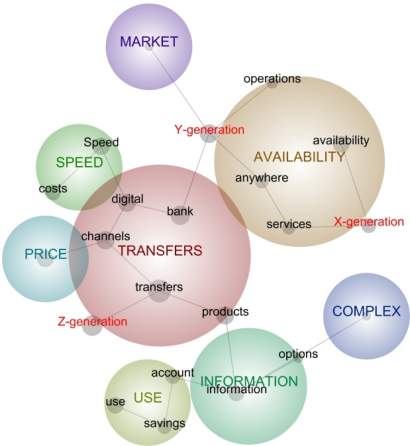
The participants’ responses were analyzed in Leximancer, resulting in a con- cept map with eight themes. The participants’ attitude about bank digital channels reveals a concept map with 8 main themes “Transfers, 316 hits”, “Availability, 232 hits”, “Speed, 172 hits”, “Use, 152 hits”, “Information, 148 hits”, “Price,108 hits”, “Complex, 28 hits” and “Market,12 hits”, (see Figure 1).
Figure 1: Leximancer conceptual map - attitudes toward digital banking by user generation XYZ (source: Leximancer output).
A Leximancer “Theme” is a collection of Concepts that, when grouped or clustered together on the Concept Map, exhibit some degree of similarity or connection. The Theme rings are essentially borders; their size has nothing to do with how prevalent or significant a theme is in the text. Prevalence is based on the quantity of Concepts included in the Theme, and the Thematic Report indicates this. The Theme circle border color reflects the color-coded hot-cold histogram bars used in the Thematic Report to further denote the prevalence of the Theme.
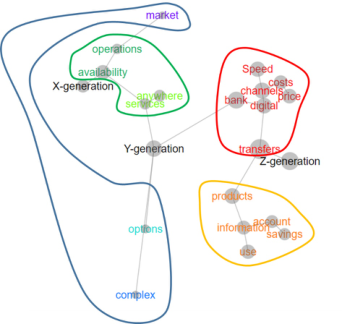
The statistical relevance of the concepts is based on their co-occurrence relative to other words in the text and is presented in a Concept Cloud (see Figure 2). The Concept Cloud in Figure 2 evidence the most relevant con- cepts (hot colours, red, orange) as speed, costs, channels, transfers, price, bank and digital (red colours) and products, information, account, savings, and use (orange colours). The cool colours (blue, and green), denote the least relevant, options, complex and market (blue colours) and availability, opera- tions, services and anywhere (green colours). The concept cloud views allow us to visually the customers’ generation relationships based on color group proximity showing that the X-generation is closer to green, the Z-generation to red and yellow and finally y-generation to green, blue and red.
Through surveying age ranges and using appropriate survey open questions permit us to understand the digital banking usage and preferences, of the dif- ferent generations. So, we identify what is important for each X, Y, and Z generation really increase the adoption of digital banking and verify how a complex of some multiple options are likely not the main focus to be consid- ered for each generation. Furthermore, based on our results, we will propose a new conceptual map to explain digital banking usage.
Highlighting the users’ attitudes is important to emphasize customers’ positive and negative experiences with bank digital services supported on spontaneously and open responses.
e-Banking Usage by Generations X, Y, and Z 241
Examining the positive and negative factors and experiences in the use of Banks’ Digital Channels (question III and IV) the findings showed that the customers had most positive experiences towards transfers and availabil- ity and negative experiences towards information and availability. although availability is equally relevant in the negative and positive experiences of cus- tomers - it does not take away its strength, on the contrary, it reinforces the importance of this topic for customers like transfers (Table 2).
Table 2. Customers positive and negative experiences (source: own elaboration).
Table available in the original PDF paper.
Concepts Hits Customer Positive experience Hits Customers Negative experiences Transfers 217 “Lower costs in national bank transfers between different banks.”
109 “Service unavailability sometimes.”
99 “Save information from past transfers for easier use in the future.” Availability 123 “Operations (transfers, payments, MB Way, ...) availability anywhere.”
Use 99 “The mobility that digital channels allow anytime, anywhere.”
53 “Unavailability, slowness and complex processes of carrying out operations.” Information 30 “Easy access to information and operations.”
118 “Lack of more detailed information about savings account products.” Price 36 “Low cost and ease of selecting products.”
20 “Clarity in detail of complex products.”
72 “To grant bank loans through digital channels it is not possible to negotiate the best price.” Complex 8 “Maintain a more favorable price than personal relationship and friendly usage channels that do not require additional learning.”
7 “Not all products or services are available in the digital channels of some banks.”
Market 5 “Having so much information on how to spin my money should make more practical recommendations.”
This study is also novel from a methodological standpoint because it adopts a quantitative approach to perform content analysis and catego- rization of qualitative data and because it proposes a conceptual map to identify and graphically illustrate the key themes and concepts that explain the attitudes of bank customers toward the use of bank digital channels. The participants’ opinions toward the use of bank digital channels are explained by eight key themes and nineteen topics from our research (see Figure 1).
With 316 hits, “Transfers” is the most relevant theme, covering five dif- ferent concepts (transfers, bank, channels, products, and digital). This theme captures the simple and welcoming user interface of online banking for han- dling financial activities including money transfers between accounts. This discovery is consistent with bank objectives to include payments and transfers gateways with their digital channels for routine banking activities (Har- alayya, 2021). Due to time savings, mobile banking has grown in popularity as a means of remittance that delivers significant efficiency advantages over
more conventional ways (Lashitew et al., 2019). For instance, several partic- ipants discussed this in their written responses to the following “Even lower costs in national bank transfers between different banks”, “Save information from past transfers for easier use in the future” and “Payments and transfers out off-hours Unavailability”.
With 232 hits, “Availability” is the second most relevant theme and repre- sents the four concepts of availability, anywhere, services, and operations. Investments in technology can improve the efficiency and availability of financial products and services from any digital channel without having to wait in lines, anywhere, around-the-clock (Mo¸steanu et al., 2020). Due to the additional security services and operations, as well as the accessibility and usability of mobile banking, the operations and scope of digital banking are rapidly rising (Shareef et al., 2018).
The other themes, which include eleven concepts (speed, cost, use, account, savings, information, options, price, complex, and market) are “Speed “Use,” “Information,” “Price,” “Complexity,” and “Market.” Customers may access bank accounts, financial products, and services through both conventional and digital channels. They can also do business with the assis- tance of an employee or online with a few taps on a smartphone. With greater usability, information, and market accessibility, banks’ digital chan- nels exploit their reduced cost to deliver speedier daily operations, encourage their usage and acceptance by clients, and give them what they want in a digital connection (Bossert, 2016).
In conclusion, these main themes show that convenience counts in banks’ digital channels and that these channels should have flexible structures, decrease costs, expand quickly, and focus on financial markets where banks should provide non-complex services and information (Shankar & Rishi, 2020). Around the Tags: Gen XYZ in terms of those digital banking-related per- ceptions a strong culture is emphasized in which generations are defined from the coexistence of people in groups (Pathirage & Weerasinghe, 2020). Thanks to digital banking advances and usage facilities, these three generations are all using similar services and, in their way, somehow, navigating the same digital channels’ environments. Nevertheless, each generation has different banking preferences when it comes to products, services, and digital func- tionalities, whether it’s through a specific medium, frequency, or at a certain access speed.
“Generation X” the result show that boomers emphasize the impor- tance of availability, in other words, the relevance of being able to do any bank operations, anywhere, efficiently using any digital device. According to Korobeynikova et al., (2021) Gen X is seen as technologically natives, demanding, and computer literate. They are also aware of the availability of bank digital services.
“Generation Y”Tags show that the idea of a bank, anywhere, services, and market are important to Millennials. Their response to bank digital channels is different from Gen X because they demand access anywhere, to any bank services, but with no financial market restriction (Dabija & Lung, 2018).
e-Banking Usage by Generations X, Y, and Z 243
“Generation Z” According to results from the tags, post-millennials emphasize bank transfers above any other services. Compared to baby boomers and Millennials, Generation Z is less concerned with living in a world of constant updates and quick-to-process information. Instead, they are familiar using bank transfers as a preferred service to conduct financial transactions conveniently through digital channels (Vasylieva et al., 2017).
The pandemic accelerated some consumers’ use of digital banking, includ- ing those who were less digitally savvy (Nguyen et al., 2021), but even the customers with less technological skills found out that the tools weren’t as intimidating as they initially thought. The benefits of digital banking are not new, but we admit they are now more widely recognized. In recent years, sev- eral authors developed important research on this topic and demonstrated the key user satisfaction, technology adoption, and business impact success of digital banking services (Shareef et al., 2018). Several findings highlighted some benefits of digital bank services like ease of use, simple transfers, speedy transaction, low service cost, and wide availability (Rodrigues et al., 2016).
The present study differentiates from the previous research (Shams et al., 2020) because it focused on different generations’ attitudes during the pan- demic, and evidence of other key factors considered very relevant for the users or digital bank customers, such as the wide availability of online (with easy access) of products, services, relevant information and options, the com- plexity (made easy, or the possibility of doing even complex operations in an informed and easy way) and the accessibility to access to financial markets (see Figure 2).
Our results show a paradigm shift from the convenience of access to infor- mation to business transactionality and widespread digital channels, which implies users’ attitudes according to generation behavior. In any case, no mat- ter their attitudes and reactions, customers are driven towards greater use of banks’ digital channels in the face of the restrictions imposed by governments in terms of social distancing and confinement. The question is, as we have discussed, how they adapt to this reality.
Our results may be effectively useful for banks to have different and appro- priate digital orientations in their web or mobile channels, according to their different customers’ characteristics, expectations, or demands.
CONCLUSION
Considering that, Gen X, Y, and Z see digital banking differently: Genera- tion X or baby boomers highlight ‘availability’ above all, Generation Y or Millennials evidence the importance of ‘anywhere’ and ‘market’, and Gener- ation Z or post-millennials highlight the possibility of making transfers. The results evidence the practical need to the most appropriate way for the digital bank to communicate and offer services and financial products, according to different generations preferences, needs, and cultures.
This will permit an important boost in e-banking and mobile banking adoption. Finally, this research aids in understanding the preferences asso- ciated with the use of digital banking, and in identifying what is important for each X, Y, and Z generation to increase their adoption of digital bank- ing, alerting to the use of some complex multiple options that are likely not
the primary focus for this generations to successfully use. The cluster ana- lyze (see Figure 2) allows to propose a new conceptual map to explain digital banking usage that shows new insights, and directions for future research. These should be considered by practitioners, managers, and academics to rethink which is the most appropriate way for the digital bank channels to communicate and present products and services, according to customers’ preferences, needs, and cultures. These should be considered by practition- ers, managers, and academics to rethink which is the most appropriate way for the digital bank channels to communicate and present products and ser- vices, according to customers’ preferences, needs, and culture. Although the global pandemic has highlighted the importance of digital banking platforms, mobile and online banking are not new. The pandemic has merely accel- erated the digital transformation phenomenon that was already underway, as traditional banking methods – by branch, phone, or ATM – have not been particularly appealing over the past two years. During a global pan- demic, banks limited or closed branch hours, customer service call lines were backed up, and ATMs required anyone to go out in public and use some- thing that is touched by many people. Our findings indicate a paradigm shift in users’ attitudes toward digital channels, from the convenience of access to trans actionality and widespread use, which is somehow a consequence of government-imposed restrictions, reflected on social distancing and confine- ment. In conclusion, it is critical for the banking industry to value and pay more attention to users’ attitudes about digital channels, to develop digital banking features that may be aligned with users’ needs and expectations.
FUNDING This work is partially funded by national funds through FCT - Fundação para a Ciência e Tecnologia, I.P., under the project FCT UIDB/04466/2020.
REFERENCES
Angus, D., Rintel, S., & Wiles, J. (2013). Making sense of big text: a visual-first approach for analysing text data using Leximancer and Discursis. International Journal of Social Research Methodology, 16(3), 261–267. Arora, N., & Dhole, V. (2019). Generation Y: Perspective, engagement, expecta-
tions, preferences and satisfactions from workplace; a study conducted in Indian context. Benchmarking: An International Journal. Barak, M. (2018). Are digital natives open to change? Examining flexible thinking and resistance to change. Computers & Education, 121, 115–123. Batra, M. M. (2017). Customer experience-an emerging frontier in customer ser-
vice excellence. In Competition Forum (Vol. 15, No. 1, pp. 198–207). American Society for Competitiveness. Beliatis, M. J., Jensen, K., Ellegaard, L., Aagaard, A., & Presser, M. (2021). Next generation industrial IoT digitalization for traceability in metal manufacturing industry: A case study of industry 4.0. Electronics, 10(5), 628. Bona, J. T. C. (2019). El comportamiento de ahorro de la iGeneracion. Religación.
Revista de Ciencias Sociales y Humanidades, 4(15), 122–129. Bossert, O. (2016). A two-speed architecture for the digital enterprise. In Emerging trends in the evolution of service-oriented and enterprise architectures (pp. 139–150), Springer, Cham.
e-Banking Usage by Generations X, Y, and Z 245
Bresman, H., & Rao, V. D. (2017). A survey of 19 countries shows how generations X, Y, and Z are—and aren’t—different. Harvard Business Review, 25, 1–8. Drasch, B. J., Schweizer, A., & Urbach, N. (2018). Integrating the ‘Troublemakers’:
A taxonomy for cooperation between banks and fintechs. Journal of Economics and Business, 100, 26–42. Fedorko, R., Skerhakova, V., Markova, S., Bacík, R., & Fejercak, L. (2021). Differences in the Perceived Financial Risk Factors between Digital Natives in the E-Commerce. Fernández-Rovira, C., Valdés, J. Á., Molleví, G., & Nicolas-Sans, R. (2021). The
digital transformation of business. Towards the datafication of the relationship with customers. Technological Forecasting and Social Change, 162, 120339. Gigante, N. I., Martin, P. A., & Marutani, H. (2022). Transitioning Towards a Fully Digital Banking Environment: Analyzing Financial Consumption Preferences of Metro Manila Banking Customers. Journal of Business and Management Studies, 4(2), 213–229. Gomber, P., Kauffman, R. J., Parker, C., & Weber, B. W. (2018). On the fintech
revolution: Interpreting the forces of innovation, disruption, and transformation in financial services. Journal of management information systems, 35(1), 220–265. Gong, C., & Ribiere, V. (2021). Developing a unified definition of digital transformation. Technovation, 102, 102217. Grace, D., Weaven, S., & Ross, M. (2010). Consumer retirement planning: an
exploratory study of gender differences. Qualitative Market Research: An Inter- national Journal, 13(2), 174–188. Haralayya, B. (2021). How Digital Banking has Brought Innovative Products and Services to India. Journal of Advanced Research in Quality Control and Management, 6(1), 16–18. Heinonen, K., & Strandvik, T. (2020). Reframing service innovation: COVID-19 as
a catalyst for imposed service innovation. Journal of Service Management. INE (2021). Annual Estimates of the Resident Population. Available at: https://www.pordata.pt/DB/Portugal/Ambiente+de+Consulta/Tabela Iverson, T., & Barbier, E. (2021). National and Sub-National Social Distancing Responses to COVID-19. Economies, 9(2), 69. Khan, B., & Iqbal, P. (2019). The Impact of Emotional Intelligence on Service Quality
in Major Banks, With Special Reference to Mardan. The Discourse, 5(2), 41–55. Kaur, S. J., & Ali, L. (2021). Understanding bank employees’ perception towards technology enabled banking: a developing country perspective. Journal of Finan- cial Services Marketing, 26(3), 129–143. Korobeynikova, O. M., Korobeynikov, D. A., Agievich, T. G., Minaeva, O. A., &
Shaldokhina, S. J. (2021). Availability of Digital Financial Services: Problems and Solutions. In Socio-economic Systems: Paradigms for the Future (pp. 431–440). Springer, Cham. Lashitew, A. A., van Tulder, R., & Liasse, Y. (2019). Mobile phones for financial inclusion: What explains the diffusion of mobile money innovations?. Research Policy, 48(5), 1201–1215. Lee, I., & Shin, Y. J. (2018). Fintech: Ecosystem, business models, investment
decisions, and challenges. Business horizons, 61(1), 35–46. Leximancer Pty Ltd. (2016), Leximancer User Guide, Release 4.5, available at: https://doc.leximancer.com/doc/LeximancerManual.pdf (accessed). Mo¸steanu, D., Roxana, N., Faccia, D., Cavaliere, L. P. L., & Bhatia, S. (2020).
Digital technologies’ implementation within financial and banking system during socio distancing restrictions–back to the future. International Journal of Advanced Research in Engineering and Technology, 11(6).
Nguyen, N. T. H., Kim-Duc, N., & Freiburghaus, T. L. (2021). Effect of digital banking-related customer experience on banks’ financial performance during Covid-19: a perspective from Vietnam. Journal of Asia Business Studies. Ofosu-Ampong, K. (2021). Determinants, barriers and strategies of digital transfor-
mation adoption in a developing country Covid-19 era. Journal of Digital Science, 3(2), 67–83. Pathirage, U. K., & Weerasinghe, T. D. (2020). Difference of Work Related Behaviors between Generation X and Generation Y: A Study of Professionals of a Development Bank in Sri Lanka. Kelaniya Journal of Management, 9(1). Prexl, K. M. (2019). The intrapreneurship reactor: how to enable a start-up culture
in corporations.e & i Elektrotechnik und Informationstechnik, 136(3), 234–240. Riedy, C. (2018). Cross-generational counseling strategies: Understanding unique needs of each generation. Journal of Counselor Practice, 9(1), 6–23. Rishi, B., & Kuthuru, N. R. (2021). A review for managerial guidelines for social
media integration of IMC in digital era. In Digital Entertainment (pp. 187–212). Palgrave Macmillan, Singapore. Rodrigues, L. F., Oliveira, A., & Costa, C. J. (2016). Does ease-of-use contributes to the perception of enjoyment? A case of gamification in e-banking. Computers in Human Behavior, 61, 114–126. Ross, J. W., Beath, C. M., & Sebastian, I. M. (2017). How to develop a great digital
strategy. MIT Sloan Management Review, 58(2), 7. Shah, S. (2021). Compliance Monitoring and Testing Seismometer to Detect Compliquake. In Money Laundering and Terrorism Financing in Global Financial Systems (pp. 238–260). IGI Global. Shams, G., Rehman, M. A., Samad, S., & Oikarinen, E. L. (2020). Exploring cus-
tomer’s mobile banking experiences and expectations among generations X, Y and Z. Journal of Financial Services Marketing, 25(1), 1–13. Shareef, M. A., Baabdullah, A., Dutta, S., Kumar, V., & Dwivedi, Y. K. (2018). Consumer adoption of mobile banking services: An empirical examination of factors according to adoption stages. Journal of Retailing and Consumer Services, 43, 54–67. Shin, J. W. (2021). Mediating effect of satisfaction in the relationship between cus-
tomer experience and intention to reuse digital banks in Korea. Social Behavior and Personality: an international journal, 49(2), 1–18. Singh, S. (2021). Determinants of e-banking adoption from customers’ perspective: an empirical study. International Journal of Business and Globalisation, 29(4), 470–485. Talbot, D., & Ordonez-Ponce, E. (2020). Canadian banks’ responses to COVID-
19: A strategic positioning analysis. Journal of Sustainable Finance & Investment, 1–8. Vasylieva, T. A., Leonov, S. V., Kryvych, Y. N., & Buriak, A. V. (2017). Bank 3.0 concept: global trends and implications. Financial and credit activity: problems of theory and practice, 1(22), 4–10. Wiedmer, T. (2015). Generations do differ: Best practices in leading traditionalists,
boomers, and generations X, Y, and Z. Delta Kappa Gamma Bulletin, 82(1), 51. Yap, J., Chaudhry, V., Jha, C. K., Mani, S., & Mitra, S. (2020). Are responses to the pandemic inclusive? A rapid virtual audit of COVID-19 press briefings in LMICs. World development, 136, 105122. Zachariadis, M., Hileman, G., & Scott, S. V. (2019). Governance and control in
distributed ledgers: Understanding the challenges facing blockchain technology in financial services. Information and Organization, 29(2), 105–117.
LISTED IN THE AHFE DIGITAL BOOKSTORE CATALOGUE
Explore the complete digital volume
Application of Emerging Technologies
Read this individual research paper free through the original publisher, or explore the full digital proceedings book.
ISBN 978-1-958651-91-9
Explore this ISBN in the AHFE Bookstore ↗Listed in the July 2026 bookstore catalogue; search by ISBN to confirm current availability · Digital book purchase optional