Alina Vladu, Emilia Visileanu, Alina Popescu, Roxana Rodica Constantinescu (2023). Antimicrobial treatments of undergarments designed for the combat-protective clothing of soldiers. In: Artificial Intelligence, Social Computing and Wearable Technologies. AHFE Open Access, vol. 113, pp. 373–382. https://doi.org/10.54941/ahfe1004210
1 National R&D Institute for Textile and Leather, 16 Lucretiu Patrascanu Str., 3 rd District, 030508, Bucharest, Romania ↗
2 National R&D Institute for Textile and Leather – Division Leather and Footwear Research Institute, 93 Ion Minulescu Str., 031215, Bucharest, Romania ↗
Military forces around the world must be equipped with combat-protective clothing made from the best technical textiles available that must provide sufficient protection, increased comfort, and even antimicrobial protection, especially for underwear pieces. Antibacterial treatments for textile materials include the use of various substances such as chitosan, silver, collagen and so on. Chitosan is a polysaccharide that promotes changes in the permeability properties of the membrane wall causing internal osmotic imbalances and consequently inhibits the growth of microorganisms. Silver can also damage the bacterial RNA and DNA, eventually leading to the bacteria`s death. Moreover, collagen, a fibrous natural protein, has an intrinsic ability to fight infection and contributes to keeping the infection site sterile.This paper focuses on the functionalization of four variants of textile materials with different compositions to increase their antibacterial properties. The variants were treated through two different technologies: exhaustion (30 min at 40°C, 500 rpm) and padding (3 consecutive passes). V1-V4 were functionalized with colloidal silver and V1-V3 with a mixture of collagen hydrolysate and colloidal silver through exhaustion. Variants V1-V3 were also treated through the padding technique using 0.5% chitosan, 1% collagen hydrolysate and a mixture of chitosan and colloidal silver. Untreated textile variants were evaluated regarding their physical-mechanical characteristics. Moreover, the functionalized variants were characterised according to their pH, loading degree with active substances (%), wettability by drop test and contact angle methods, thermal resistance (m2K/W) and vapour resistance (m2Pa/W) according to ISO 11092. Treated textile samples were also investigated relating to their antimicrobial resistance using two methods according to ISO 20743/2013 and SR EN ISO 20645/2005. The evaluation of antibacterial resistance using the standards SR EN ISO 20645/2005 and SR EN ISO 20645/2005 demonstrated the effectiveness of treatments with active substances for approx. 95% of the tested variants.
Textile materials are excellent media for the growth of microorganisms, espe- cially those used in hospitals, infant clothing, underwear and sportswear, due to their large surface area of contact with bacteria. Military forces around the
world must be equipped with combat-protective clothing made from the best technical textiles available that must provide sufficient protection, increased comfort, and even antimicrobial protection, especially for underwear pieces (Scott, 2009). Surface modification of textiles offers a way to impart novel and diverse properties (such as antibacterial activity, self-decontamination, hydrophilicity, hydrophobicity, and biocompatibility) to textiles while main- taining comfort and mechanical strength. However, surface modification of textiles often involved multi-step chemical treatments that could con- sume a large amount of water and energy and consequently increase costs and environmental impact. For this reason, the textile industry is looking for an environmentally friendly surface modification process that can be performed without toxic textile chemicals. Recently, the use of low envi- ronmental impact technologies based on sustainable biopolymers presents a possible new route for the large-scale development of functional textiles through an ecological approach. For example, alginate, chitosan, cyclodex- trin, propolis and collagen-like agents have been used for functional finishing of textiles (Li et al., 2017). Chitosan is a polysaccharide which is considered both bactericidal and bacteriostatic. The mechanism of action, although not fully understood is considered to be related to modifications of the perme- ability properties of the membrane wall causing internal osmotic imbalances and consequently inhibiting the growth of microorganisms. Also, chitosan can bind with the microbial DNA leading to the inhibition of RNA and protein synthesis through the penetration of chitosan into the nuclei of the microorganism (Monica et al., 2017). Silver is a metallic salt which possesses strong bactericidal effects against many pathogen bacteria. When metallic sil- ver reacts with skin surface moisture or wound fluids, silver ions are released, damaging bacterial RNA and DNA, thereby inhibiting replication (Sheila and Jakub, 2012). Also, collagen, a fibrous natural protein, has an intrinsic ability to fight infection and contributes to keeping the infection site sterile (Amit Kumar, 2022).
EXPERIMENTS Materials and Preparation
Five different solutions were prepared for the application on textile sub- strates. Chitosan solution of 0.5% concentration was prepared by dissolving the amount of chitosan in 1% acetic acid solution. Colloidal silver solution of 1% concentration was obtained by adding the required amount of colloidal silver powder in distilled water. Collagen hydrolysed solution of 1% concen- tration was prepared by dissolving the collagen gel of bovine origin supplied by Leather and Footwear Research Institute (Bucharest, Romania) in dis- tilled water. The other two solutions were a mixture of 0.5% chitosan with 1% colloidal silver solution and a mixture of 1% collagen with 1% colloidal silver solution. Chitosan, medium molecular weight, 75-85% deacetylation and colloidal silver, 65-75% Ag basis were purchased from Sigma Aldrich.
The obtained solutions were applied on three types of textile materials, V1- CO/elastane, V2-CO/PES, V3-PES. Colloidal silver solution was also applied on an additional substrate V4-CO/Acetate.
Undergarments Designed for the Combat-Protective Clothing of Soldiers 375
Two techniques were used for the treatment with antibacterial substances of the textile substrates: padding and exhaustion. For padding a Roaches machine was used to apply chitosan, collagen hydrolysate and chitosan/- colloidal silver solution on the textile substrates by three passes. For the exhaustion method the machine which has been used to treat the textile sub- strates with colloidal silver and collagen/colloidal silver is an Ugolini device (8 L drum) with 1:10 hydro module (4 L float). Materials were centrifuged at 500 rpm for 30 min at 40
C. Solutions used for the treatment were colloidal silver and collagen hydrolysate/ colloidal silver solutions. After treatment, textile materials were subsequently dried at room temperature and finished by heat treatment at 120
C.
Methods
The hydrophilic properties of the textile samples were tested according to two methods: the drop test and by analyzing the contact angle according to ASTM D7490-08 by VCA-Optima device. Samples were also tested according to the loading degree of textile structures with active substances. The pH of the functionalized textile substrates was determined according to ISO 3071. Variation diagrams of thermal resistance, Rct (m2K/W) and water vapour resistance in steady state, Ret (m2Pa/W), determined in accordance with SR EN ISO 11092/2015, for textile structures treated with active substances were also obtained. The evaluation of the antibacterial activity of textile structures treated with active substances was made by applying two methods: according to SR EN ISO 20645/2005 and ISO 20743:2013 on Staphylo- coccus aureus ATCC 6538 (gram-positive) Escherichia coli ATCC10536 (gram-negative) and Candida albicans ATCC 10231.
For the first method the agar volume for the bottom layer without bacteria is prepared (International Organization for Standardization, 2004). Then 10 ±0.1 ml is added into each sterilized Petri dish and the agar is left to solid- ify. The amount of agar for the upper layer is prepared and cooled down to 45
C in a water bath. 150 ml of agar is then inoculated with 1 ml of working bacterial solution (1-5 × 10 8 cfu/ml). The container is shaken vigorously to distribute the bacteria evenly. 5±0.1 ml is added into each Petri dish and the agar is left to solidify. The samples are placed on the surface of the nutrient medium and then incubated at 37
C between 18h and 24h. The evaluation is based on the absence or presence of bacterial growth in the contact area between the agar and the sample and on the appearance of a possible inhibi- tion area around the samples. The width of the inhibition area, i.e. the area without bacteria near the edge of the sample, is calculated according to the following formula:
Equations and mathematical formulas are available in the original paper PDF.
2 (1)
H = inhibition area, in millimetres; D = the total diameter of the specimen and the inhibition area, in millimetres; d = diameter of the specimen, in millimetres.
For the second method, bacteria are taken from the preserved stock to achieve the initial concentration. The initial cell concentration was deter- mined previously, by decimal dilutions (105), and from the last dilution, for each strain, 100 µL were taken and displayed on Nutrient Agar nutrient medium. The counts on the plate were performed at 24h of incubation, these being kept as a reference for the cell developments in the control sample from the set of samples. The test pieces with a mass of 0.09 g were introduced into the vials and then precisely, 0.2 ml of the inoculum was pipetted in several points on each test tube so as to ensure that the inoculum does not touch the surface of the vial. The vials containing 20 ml of SCDLP culture medium were incubated at 37
C ± 2
C for 18 to 24 h.
After incubation, 20 ml of SCDLP culture medium were added to each vial, shaked with a shaker. 1 ml of the inoculum coming from the bacterial suspension from the shaken test tubes was taken and inserted into a test tube containing 9.0 ml ± 0.1 ml of NB culture medium. A series of dilutions were prepared so that they are made 10 times in total. 1 ml of each dilution were pipetted into two Petri dishes. 15 ml of heated TSA culture medium was added to the Petri dishes and mixed well. When the media solidifies, the Petri dishes were turned upside down (with the lid down) and incubated at 37
C ± 2
C, for 24 to 48 h. The results were expressed as average percentage and logarithmic reduc- tion. Counts on the plate were performed at 24 h of incubation, in order to detect colony-forming cellular units.
When the test is considered to be effective, the antibacterial activity value is obtained according to the following formula: A = lg Ct −lgTt (2)
where A is the antibacterial activity value; lg Ct is the decimal logarithm of the arithmetic mean of the number of bacteria obtained from three control samples, after an incubation of 1 to 4 h;
lg Tt is the decimal logarithm of the arithmetic mean of the number of bac- teria obtained from three antibacterially treated samples after an incubation of 1 to 4 h.
Table 1 shows how the antibacterial properties of the tested textile material can be evaluated.
Table 1. Effectiveness of antibacterial properties.
Table available in the original PDF paper.
Effectiveness of antibacterial properties Antibacterial activity : A Significant 2 ≤A < 3 High A ≥3
X100% (3) Ct
where R is the antibacterial activity ratio; Ctis the mean of the number of bacteria obtained from three control samples after 18 to 24 h incubation;
Undergarments Designed for the Combat-Protective Clothing of Soldiers 377
Ttis the mean of bacterial counts obtained from three test samples treated with antibacterial after 18 to 24 hours incubation (International Organiza- tion for Standardization, 2004).
RESULTS AND DISCUSSION
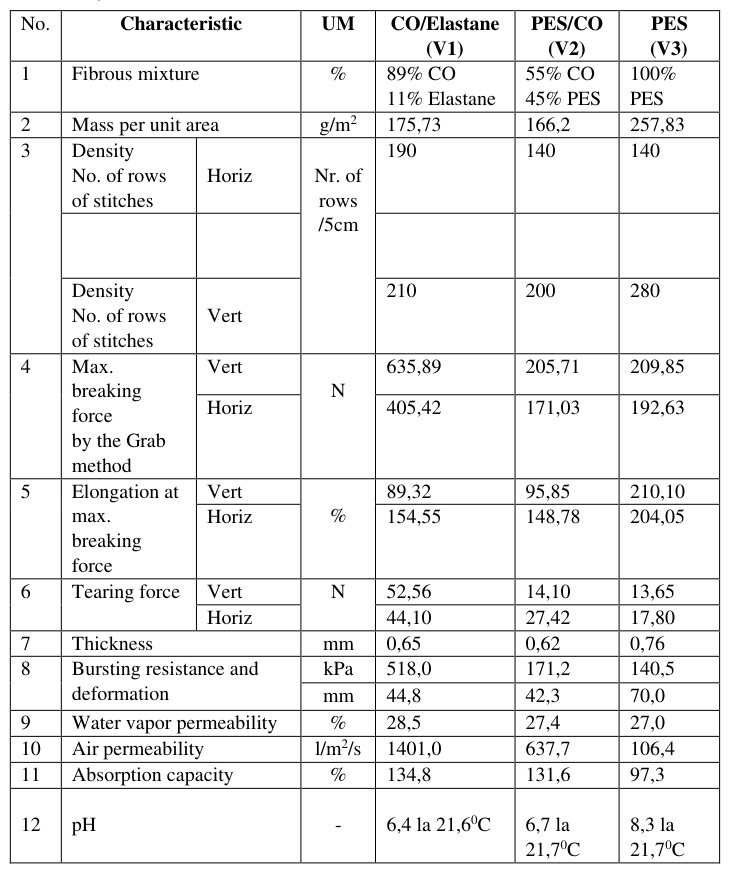
To create the module of the undergarment structure, the protective equip- ment for primary homeostasis, textiles made by knitting technology were selected. Table 2 shows the physical-mechanical characteristics of untreated textile structures.
Table 2. Physical-mechanical characteristics of untreated textile structures.
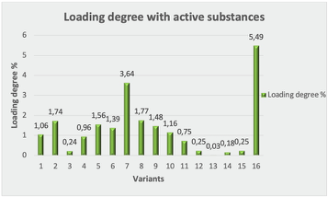
Loading Degree With Active Substances The loading degree was determine in order to evaluate the uptake of active substances by the raw textile structures. Figure 1 shows the loading degree for 16 samples, 4 variants of textile supports treated by two methods (exhaustion and padding), as previously mentioned.
The highest value of the loading degree was recorded for the woven tex- tile structure (V4) treated with Ag - 5.49%, followed by the textile structure made of Co/Elastane (V1), with a loading degree of 3.64% (Collagen + Ag). Load levels >1% were obtained for: the textile structures treated with Colla- gen + Ag (1.47% and respectively 1.77%) - the exhaustion method and the textile structures treated with Chitosan + Ag (1.06%, 1.56%, 1.39%) - the padding method. Knitted textile structures treated with Ag by exhaustion registered loading degrees <1.0% (0.18%, 0.25 %, 0.03%) except for the woven structure, which registers the highest loading degree (5.49%). Among the textile structures treated by padding, the best values of the loading degree were obtained for the variants treated with Chitosan + Ag (1.06%, 1.56% and 1.39%).
Evaluation of Hydrophilicity of Textile Structures Treated With Active Substances Hydrophilicity was determined using two test methods: the drop test and by analysing the contact angle according to ASTM D7490-08.
Table 3 shows the results obtained by both test methods, which highlight the following aspects: The textile structure from CO/PES records the highest values of the absorp- tion time of the drop as follows: the treatment with Ag – 240 s, the treatment with Chitosan – 180 s and the treatment with Chitosan + Ag – 180 s. All the others textile structures present very good (immediate absorption) and good (4-46 s) hydrophilicity. Table 3 also show the results obtained by analysing the contact angle according to ASTM D7490-08, using distilled water as liq- uid and a droplet volume of 4 µL. The knitted structures: CO/Elastane, 100% PES and CO/PES fabrics are hydrophilic for all treatment options with active
Undergarments Designed for the Combat-Protective Clothing of Soldiers 379
substances. The CO/PES knitted structure has the lowest contact angle values for the Collagen treatment option (122.80 and 125.70) and the highest for the Chitosan treatment option (135.590 and 136.70).
Table 3. Hydrophilicity evaluation of treated textile materials.
Table available in the original PDF paper.
Textile variant Treatment Drop test Contact angle CO/Elastane knitted fabric Chitosan + Ag 16 s Hydrophilic Collagen immediate Hydrophilic Chitosan 23 s Hydrophilic Ag 4 s Hydrophilic Collagen + Ag immediate Hydrophilic
100% PES knitted fabric Collagen immediate Hydrophilic Ag immediate Hydrophilic Chitosan + Ag immediate Hydrophilic Collagen+Ag immediate Hydrophilic Chitosan immediate Hydrophilic CO/PES knitted fabric Ag 240 s Left angle Right angle 130,9
130,9
Collagen+Ag 23 s 125,7
125,7
Collagen 46 s 135,5
135,5
Chitosan+Ag 180 s 130,57
130,57
Chitosan 180 s 136,7
136,7
CO/Acetate Woven fabric Ag immediate Hydrophilic
pH Evaluation of Textile Structures Treated With Active Substances
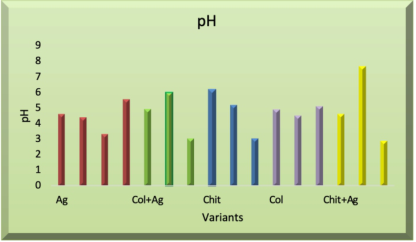
Figure 3 show the pH values for textile structures treated with active sub- stances, indicating that the values are placed between 2.88 -5.57 (acidic) and 6-7.67 (neutral). It is mentioned that human skin has a pH between 4.5 and 6.5 (acidic).
Figure 2: pH values of antibacterial treated textiles.
Evaluation of Thermal Resistance and Water Vapor Resistance
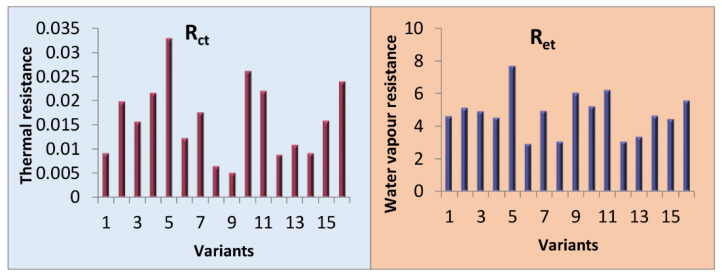
Figure 3 shows the variation diagrams of thermal resistance, Rct (m2K/W) and water vapor resistance in steady state, Ret (m2Pa/W), determined in accordance with SR EN ISO 11092/2015, for textile structures treated with active substances.
Figure 3: Thermal and water vapor resistance of antibacterial treated textiles.
From the analysis of the data presented in figure 3, it results that the low- est thermal resistance is registered by the CO/PES textile structure variant treated with Collagen Hydrolysate and Ag (0.0051 m2K/W) and the highest (0.0262 m2K/W) for CO/PES textile structure, treated with Chitosan. The water vapor resistance, shows the lowest value for the textile structure of 100% PES, treated with Chitosan and Ag (2.88 m2Pa/W) and the highest value for the textile structure of CO/PES treated with Chitosan and Ag (7.67 m2Pa /W).
Antibacterial Properties The antimicrobial activity of functionalized textile materials has been tested by two methods, as previously mentioned, according to SR EN ISO 20645/2005 – Determination of antibacterial activity – Agar diffusion plate test (Table 4) and ISO 20743:2013 – Determination of antibacterial activity of textiles products, on Staphylococcus aureus ATCC 6538 (gram-positive) Escherichia coli ATCC10536 (gram-negative) and Candida albicans ATCC 10231 (Table 5). According to the obtained results, all the treated textile supports have higher antimicrobial activity compared to the untreated samples, but still unsatisfactory for CO/Elastane textile structure treated with collagen, where the loading degree is 0.24% the CO/Pes textile structure treated with chi- tosan, with 1.16% loading degree. No multiplication and higher inhibition areas were observed for the textile structures treated with Ag, which is well-known for its great antibacterial properties.
Undergarments Designed for the Combat-Protective Clothing of Soldiers 381
Table 4. Antibacterial efficiency of the treated textile materials according to SR EN ISO 20645/2005.
Table available in the original PDF paper.
Characteristics E. coli S. aureus C. albicans
Inhibition area (mm)
Inhibition area >1 mm, without any multiplication
2 H= 2,5 (mm) Multiplication No multiplication No multiplication No multiplication Description Inhibition area >1 mm, without any multiplication
Inhibition area >1 mm, without any multiplication Evaluation Satisfactory Satisfactory Satisfactory
Characteristics E. coli S. aureus C. albicans
Inhibition area (mm)
2 H= 1 (mm) Multiplication No multiplication No multiplication No multiplication Description Inhibition area >1 mm, without any multiplication
Inhibition area >1 mm, without any multiplication
Inhibition area >1 mm, without any multiplication Evaluation Satisfactory Satisfactory Satisfactory
Table 5. Antibacterial efficiency of the treated textile materials according to ISO 20743:2013.
Table available in the original PDF paper.
Probe S. aureus E. coli C. albicans R(%) A R(%) A R(%) A
The evaluation of antibacterial resistance using the standards SR EN ISO 20645/2005 and SR EN ISO 20645/2005 demonstrated the effectiveness of treatments with active substances for approx. 95% of the tested variants. The application of both methods revealed that the CO/Elastane textile struc- ture treated with collagen by padding and the the CO/Pes textile structure treated with Chitosan does not ensure satisfactory antibacterial efficiency. Therefore, the treated textile structures designed for the combat-protective clothing of soldiers offer great antimicrobial efficiency and good thermal and evaporative properties.
ACKNOWLEDGMENT
The authors would like to acknowledge. This work was carried out through the Core Programme within the National Research Development and Inno- vation Plan 2022-2027, carried out with the support of MCID, project no. 6N/2023, PN 23 26, project title “Intelligent equipment to ensure the survival of combatants in operational conditions” Acronym: IRHEM.
REFERENCES
Amit Kumar, V. 2022. Collagen-Based Biomaterial as Drug Delivery Module. In: Nirmal, M. & Sanjiban, C. (eds.) Collagen Biomaterials. Rijeka: IntechOpen. International Organization for Standardization. (2004). Textile fabrics - Determina-
tion of antibacterial activity - Agar diffusion plate test (ISO 20645:2004). Li, j., He, J. & Huang, Y. (2017). Role of alginate in antibacterial finishing of textiles.
International Journal of Biological Macromolecules, 94, 466–473. Monica, p., Franco, f., Claudia, v., Alessio, v. & Giuseppe, G. (2017). Novel Antimicrobial Agents and Processes for Textile Applications. In: Ranjith, N. K. (ed.) Antibacterial Agents. Rijeka: IntechOpen. Scott, R. A. (2009). 14 - Cold weather clothing for military applications. In: Williams,
J. T. (ed.) Textiles for Cold Weather Apparel. Woodhead Publishing. Sheila, S. & Jakub, W. 2012. Antibacterial Agents in Textile Industry. In: Varaprasad, B. (ed.) Antimicrobial Agents. Rijeka: IntechOpen.
LISTED IN THE AHFE DIGITAL BOOKSTORE CATALOGUE
Explore the complete digital volume
Artificial Intelligence, Social Computing and Wearable Technologies
Read this individual research paper free through the original publisher, or explore the full digital proceedings book.
ISBN 978-1-958651-89-6
Explore this ISBN in the AHFE Bookstore ↗Listed in the July 2026 bookstore catalogue; search by ISBN to confirm current availability · Digital book purchase optional