Wen Huei Chou, Ya-ling Ko, Chung-wen Hung (2023). Transdisciplinary design research of Homebound Seniors. In: Human Systems Engineering and Design (IHSED 2023): Future Trends and Applications. AHFE Open Access, vol. 112, pp. 474–481. https://doi.org/10.54941/ahfe1004160
1 Department of Digital Media Design, National Yunlin University of Science and Technology, 123 University Road, Section 3, Douliou, Yunlin 64002, Taiwan, R.O.C ↗
2 Department of Design Research, National Yunlin University of Science and Technology, 123 University Road, Section 3, Douliou, Yunlin 64002, Taiwan, R.O.C ↗
3 Department of Electrical Engineering, National Yunlin University of Science & Technology, 123 University Road, Section 3, Douliou, Yunlin 64002, Taiwan, R.O.C ↗
According to the World Population Prospects report released by the United Nations, the proportion of individuals aged 65 and above is expected to increase from 9% in 2019 to 16% between 2019 and 2050. This trend indicates a rapid increase in the elderly population, which poses significant social development challenges. Maintaining the health of the elderly is essential for their continued ability to contribute to their families and communities. The complex effects of aging, such as physiological degradation, memory loss, and diminished physical coordination, can significantly impact daily life, making it crucial to find ways to delay aging and enhance the quality of life of the elderly. Achieving this goal requires transdisciplinary collaboration among professionals.This design research project involved a transdisciplinary team comprising geriatric occupational therapy, electrical engineering, and digital design professionals who proposed a design solution for solitary older adults. The proposed solution is a multi-player drumming interactive device designed for home use, integrating virtual and physical elements with low technological burden on users. This interactive device combines various elements, including music therapy, interactive games, upper limb exercises, cognitive training, and social connection, among others.Transdisciplinary collaboration among professionals is crucial in addressing complex issues that require diverse perspectives and expertise. The collaboration between professionals in geriatric occupational therapy, electrical engineering, and digital design can lead to more comprehensive and effective solutions. However, challenges associated with such collaborations include integrating diverse knowledge systems, aligning different work logics, and incorporating different problem-solving approaches. The potential benefits of transdisciplinary collaboration include more innovative problem-solving and consideration of the needs and preferences of aging populations.In this study, digital designers studied game-based learning theories for older adults, interface design requirements, and their habits of using online courses. They collaborated with geriatric occupational therapists to investigate the interactive user needs and drumming course planning for older adults, while electrical engineers integrated the virtual and real operating interface to reduce the elderly's learning burden. The system enabled older adults to play online games with other players at home through a simple drumming game using Unity and Bluetooth connection technology. This not only helped to prevent muscle atrophy but also facilitated remote communication with other players.Experimental testing of the proposed design showed its suitability for future applications in the field of elderly entertainment. The study examined the effects of drumming on the upper limb muscles, cognition, and emotions of older adults, as well as the ease of use of the overall system structure for the elderly. Despite communication barriers due to the use of technical language and jargon specific to each profession and the need for team members to develop a mutual understanding of each other's work logic and problem-solving approaches, transdisciplinary collaboration offers a promising approach to addressing complex issues in geriatric occupational therapy, electrical engineering, and digital design.
The aging population grapples with numerous daily challenges, particularly social isolation, emotional loneliness, and the decline of physiological and psychological functions. Research emphasizes the impact of social isola- tion on older adults’ health and well-being (Cudjoe et al., 2020; Perkins et al., 2016) and links social isolation and emotional loneliness to increased depression, cognitive decline, and poor mental health outcomes (Masi et al., 2011; Ong et al., 2016). Declining physiological functions, such as mobil- ity, strength, and balance, are also common challenges faced by the elderly (Milanovi´c et al., 2013). This decline can result in increased risk of falls, injuries, and reduced independence, exacerbating feelings of isolation and loneliness (Yardley et al., 2006). Additionally, the aging process often leads to cognitive decline, impacting memory, attention, and problem-solving abilities (Zokaei et al., 2017).
Transdisciplinary Design Research of Homebound Seniors 475
Interventions targeting social, emotional, and physical aspects of aging are essential for maintaining older adults’ overall well-being (Nim- rod et al., 2020). Research suggests that physical activity, social engagement, and cognitive stimulation can effectively mitigate aging’s negative effects on physiological and psychological functions (Hwang, Park, & Kim, 2018). Thus, developing comprehensive approaches addressing elderly individuals’ multifaceted challenges in their home environment is crucial.
Older adults face various technology adoption challenges, including cog- nitive barriers, operational complexity, and fear of new technologies (Czaja et al., 2019; Marston et al., 2016; Neves et al., 2018). Employing user- centered design and incorporating design research principles can improve technology accessibility for this population (Elboim-Gabyzon et al., 2021; Vines et al., 2013). Involving older adults in the design process allows devel- opers to better understand their needs, preferences, and limitations, leading to more intuitive and age-friendly digital solutions (Brankaert et al., 2015; Wild et al., 2020).
Transdisciplinary collaboration can encounter numerous challenges, such as communication barriers, differing terminologies, and cultural differences among professionals from diverse fields (Feng, & Kirkley, 2020; Newman, 2023). Integrating expertise from engineering, healthcare, and digital design is particularly challenging due to diverse methodologies and perspectives involved (Celi et al., 2015; Cozza et al., 2021). However, interdisciplinary research is necessary for generating innovative solutions addressing com- plex societal problems like aging and healthcare provision (Wang et al., 2020). Various music therapy approaches underscore drumming’s significance as an early human musical activity transcending cultural and historical barriers (Amad et al., 2017; Roy, Devroop, & Bohn, 2019; Miyazaki et al., 2020). Recent studies explore drumming’s role in promoting social engagement and emotional well-being for older adults (Bensimon et al., 2008; Fancourt et al., 2016). Drumming interventions have shown improvements in cognitive func- tion and upper limb mobility for older adults with cognitive impairments, and enhanced motor skills and coordination in aging populations (Miyazaki et al., 2020). Drumming strengthens individuals’ stability and control through basic rhythms, and positively correlates with improved sensorimotor integration and complex motor execution (Hsu et al., 2021).
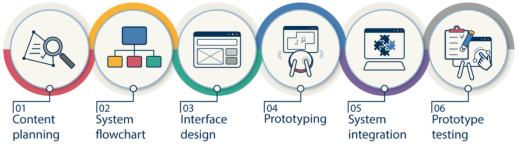
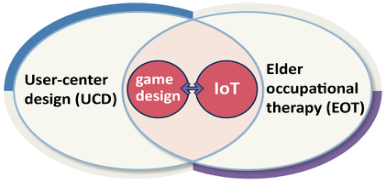
Our research sought to promote healthy aging and well-being by foster- ing transdisciplinary cooperation and refining collaborative frameworks for interdisciplinary integration. To this end, we developed a user-centered inter- active drumming game as an intervention approach, investigating its impact on older adults’ physiological, psychological, and social aspects. This mul- tifaceted approach involved several stages, such as designing a drumming course, planning and creating a multiplayer online drumming game, and incorporating sensing device systems (Fig. 1). By employing this compre- hensive strategy, we aimed to enhance elderly well-being and facilitate the achievement of successful aging benefits.
Figure 1: Research and implement process.
RESEARCH AND TRANSDISPLINARY DESIGN PROCESS Experts Focus Group Interviews
In the research stage for designing a drumming course for older adults, we conducted focus group interviews with five experts experienced in teaching such courses. The focus group interview lasted approximately two hours, and after the interview, the experts’ opinions were summarized verbatim. From their insights, we identified key design elements for the drumming game: (1) Offer opportunities for personal skill display and reward mechanisms, providing feedback and levels after system evaluation; (2) Give immediate, clear feedback including visuals, text, and scores; (3) Set various difficulty levels catering to different players; (4) Increase fault tolerance by adjusting the detection area of the striking zone; (5) Offer diverse options, including unlocking songs, and single or multiplayer games; (6) Incorporate teamwork through multiplayer modes; (7) Meet target players’ needs by selecting emo- tionally resonant songs; (8) Utilize mnemonic devices or visual features to enhance learning, with intuitive designs; (9) Plan a progression from basic to advanced; (10) Retain physical teaching functions, limiting sessions to 40–50 minutes. The online course mode accommodates seniors affected by the pan- demic or with limited mobility, enabling teachers to monitor their learning status via video calls.
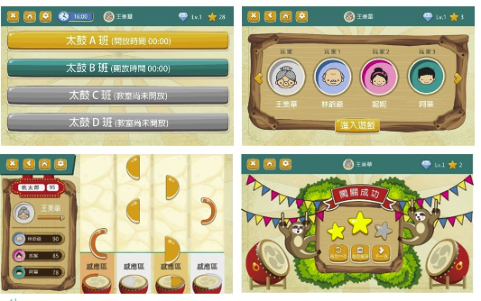
UX and UI Design We employ a Samsung Tab A7 tablet with a 10.7-inch touch screen running on the Android system and is developed using the Unity game engine. Follow- ing the flow chart, interface visual design is conducted with a focus on the elderly, a target group that presents unique challenges due to physiological, cognitive, and computer usage experience limitations. These challenges are closely related to age-related changes in perception, physiology, psychology, and cognition (Chang et al., 2018). To accommodate the needs of the tar- get group, specifications are made for font, color combinations, and button settings (Fig. 2 & 3).
1. Font size and vocabulary Adapting to age-related physiological declines, such as weakened vision, is crucial. Font size impacts users’ understand- ing of functions. Both overly bold and thin fonts can hinder readability for the elderly. Scholars Zongliang (2020) recommend using Heiti and sans-serif fonts with regular thickness. Font size varies depending on the interface medium, with 20pt being commonly used. For standard tablet
Transdisciplinary Design Research of Homebound Seniors 477
sizes, Kaufman, Suave, & Ireland (2020) suggests a 23pt font size. This study sets the font size at 40pt or larger to reduce reading errors. In- game wording aims to be familiar to the elderly, emphasizing accuracy to minimize operational misunderstandings and boost willingness to use. 2. Color planning Age-related vision decline affects dark adaptation, visual processing speed, and perceptual flexibility (Iancu & Iancu, 2020). Color recognition and sensitivity change with age, with colors serving as a dis- tinguishing and identifying feature in interfaces (Pereira et al., 2021). In color planning, attention should be paid to weaker contrasting objects, which may be harder for older individuals to discern. Additionally, degeneration of the eye’s lens selectively absorbs blue light, reducing blue light discrimination ability (Zongliang et al., 2020). Thus, blue colors should be minimized. Contrasting colors help enhance visual functions, especially for those with lower visual sensitivity (Morey et al., 2019). This study focuses on highly recognizable and contrasting colors, with a low-brightness beige background and high-saturation buttons and pat- terns. Warm colors, such as red and gold, are primarily used, followed by green, to establish recognizability and utilize contrasting colors for improved visibility. 3. Physiological decline also affects fine motor skills, potentially limiting gestures like dragging and pinch-to-zoom (Chang et al., 2018). This study minimizes the need for such gestures, focusing on simple ones like single- tapping, accompanied by auditory feedback. Indicator symbols are used for button design, fixed in the upper left corner of the interface. Button size and spacing impact elderly users’ ability to learn and interact with the interface. Lin & Ho (2020) suggests a minimum button size of 9mm x 9mm for tablet interfaces, while Yu et al. (2022) examines the impact of physical conditions on touchscreen use for elderly and middle-aged groups, finding that buttons positioned at the top of the screen and sized at 16mm are ideal. This study follows these guidelines and adds a button size adjustment feature as recommended by Petrovˇciˇc et al. (2018) for improved usability for elderly users.
Figure 2: Enter and setting pages of Drum game.Figure 3: Interface design of Drum game.
System Development This research introduces a drumming apparatus that fuses both physical and virtual aspects, leveraging interactive technologies, remote instruction, and the ideas of a virtual orchestra. The objective is to facilitate the rapid acclimatization of elderly individuals to an interactive drumming educational setting, diminish the learning pressures, and boost their upper body muscle power and overall physical health. The ultimate aim is to reconcile the divide between traditional and virtual drumming encounters.
The hardware aspect of the solution amalgamates conventional drum- ming practices with sensory equipment and IoT technologies. In contrast, the software component utilizes the Unity game engine for the creation of cross-platform interactive materials. The Samsung Tab A7 tablet serves as the digital interface, and the apparatus is engineered for both tactile strik- ing and distant interaction, guaranteeing an instinctive user experience while fostering upper body strength and physical health.
The research incorporates a CC2541 Bluetooth module for the applica- tion of IoT technology and sensor apparatuses. The drumming instrument encompasses a tangible drum structure and drumsticks, utilizing piezoelectric sensors for the detection of vibrations on the drum surface. These sensors pro- duce equivalent positive and negative charges upon the application of force, assisting in pinpointing the exact locations of drum strikes.
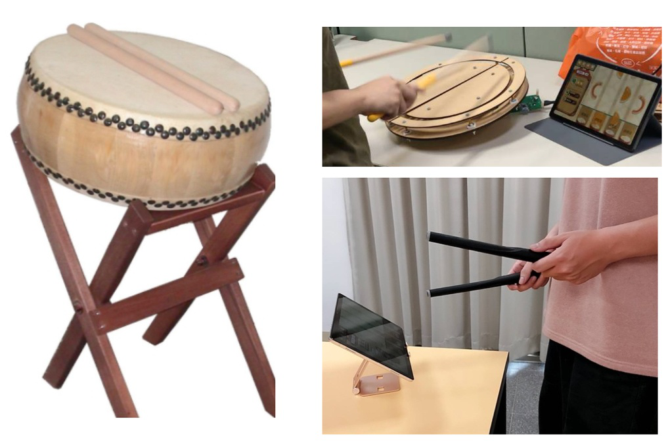
including traditional taiko drums, electronic drums, and alternative drum surfaces produced by laser cutting. The final design choice is a laser-cut alter- native drum surface, which is appropriate for domestic use and offers precise feedback. The middle layer undergoes alteration from foam to a hollow con- figuration with screws, with the aim of minimizing the contact area with the base. A piezoelectric sensor is affixed to the rear of the drum surface to pin- point the strike locations. Given the device’s dimensions, air drumsticks are employed for the drumming game. The AeroBand PocketDrum is selected as the primary air drumstick, which captures data and ascertains the strike locations during game play. Integrated Bluetooth modules relay data to Unity, thereby activating the sensing area of the UI interface. For the chronological progression of hardware device research, please refer to Figure 4.
Transdisciplinary Design Research of Homebound Seniors 479
Figure 4: The design evolution of percussion instruments, the tractional drum (left), sensor devices and IoT technology applying on volume-improved version of the drum (upper right), and the air drumstick drum game device.
CONCLUSION
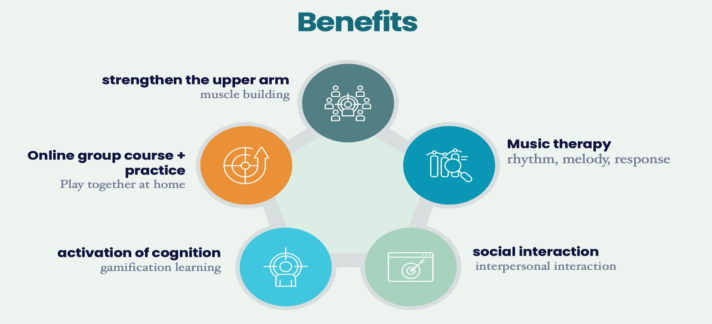
This study successfully developed a home-based group drumming course for the elderly, as a comprehensive and effective solution which supports the health and social connection of the elderly population. This drumming game integrating virtual and reality actives five effective results outcomes for elderly, contains social, irrational, and psychological functions (Fig. 5).
Figure 5: Five effective results outcomes.
The transdisciplinary collaboration, rather than linear, focuses on user- centered design as a prerequisite. To achieve the primary goal of providing
occupational therapy interventions for the elderly, professionals from vari- ous fields must continuously communicate and discuss, ensuring a shared understanding of the issues and coordinating responses to different adaptive challenges, developing a comprehensive solution, then ultimately perfecting the design proposition. In the foreseeable future, real-world problems require more interdisciplinary collaboration, breaking the boundaries of traditional learning paradigms and complementing each other to seek the greatest social welfare (Fig. 6).
This research is granted by Taiwan National Science and Technology Council, project number 110-2410-H-224-025.
REFERENCES
Aboelela, S. W., Larson, E., Bakken, S., Carrasquillo, O., Formicola, A., Glied, S. A., Haas, J., & Gebbie, K. M. (2021). Defining interdisciplinary research: Conclusions from a critical review of the literature. Health Services Research, 56(1), 9–20. Amad, A., Seidman, J., Draper, S. B., Bruchhage, M. M., Lowry, R. G., Wheeler,
J.,... & Smith, M. S. (2017). Motor Learning Induces Plasticity in the Resting Brain-Drumming Up a Connection. Cerebral Cortex, 27(3), 2010–2021. https: //doi.org/10.1093/cercor/bhx054 Bensimon, M., Amir, D., & Wolf, Y. (2008). Drumming through trauma: Music therapy with post-traumatic soldiers. The Arts in Psychotherapy, 35(1), 34–48. https://doi.org/10.1016/j.aip.2007.09.002 Birch, H., & Cheshire, L. (2022). Health and social care integration: A system-
atic review of the literature on the implementation and impact of integrated care. Health & Social Care in the Community, 30(1), 1–14. Bittman, B., Berk, L., Felten, D., Westengard, J., Simonton, O., Pappas, J., & Ninehouser, M. (2001). Composite effects of group drumming music therapy on mod- ulation of neuroendocrine-immune parameters in normal subjects. Alternative Therapies in Health and Medicine, 7(1), 38–47. Brankaert, R., Ouden, E., & Brombacher, A. (2019). Innovate dementia: the devel-
opment of a living lab protocol to evaluate interventions in context. Health Environments Research & Design Journal, 12(1), 110–124. Celi, L. A., Marshall, J. D., Lai, Y., & Stone, D. J. (2019). Disrupting electronic health records systems: the next generation. npj Digital Medicine, 2(1), 1–5.
Transdisciplinary Design Research of Homebound Seniors 481
Chen, Y., Li, X., Liang, J., & Zhang, L. (2023). Drumming enhances sensorimotor integration in older adults: A pilot study. Aging & Mental Health, 1–8. https: //doi.org/10.1080/13607863.2023.1584720 Cudjoe, T. K. M., Roth, D. L., Szanton, S. L., Wolff, J. L., Boyd, C. M., & Thorpe, R. J.
(2020). The epidemiology of social isolation: National Health and Aging Trends Study. The Journals of Gerontology: Series B, 75(1), 107–113. Czaja, S. J., Boot, W. R., Charness, N., Rogers, W. A., & Sharit, J. (2021). Designing for older adults: Principles and creative human factors approaches. CRC Press. Green, S., Hadley, S., & Dunn, E. (2019). The effects of group drumming on depres-
sion and anxiety: A randomized control trial. Journal of Affective Disorders, 260, 142–148. https://doi.org/10.1016/j.jad.2019.08.080 Johnson, L., Gallagher, R., & Hadley, S. (2022). Exploring the benefits of group drumming for older adults: A randomized control trial. Journal of Aging and Physical Activity, 1–12. https://doi.org/10.1123/japa.2021-0006 Kim, J., & Gajos, K. Z. (2020). Data-driven design guidance for developing accessi-
ble touchscreen applications. International Journal of Human-Computer Studies, 144, 102496. Marston, H. R., Samuels, J., & Freeman, S. (2022). A scoping review of digital gaming research involving older adults aged 85 and older. Games for Health Journal, 11(1), 1–11. Masi, C. M., Chen, H. Y., Hawkley, L. C., & Cacioppo, J. T. (2021). A meta-analysis
of interventions to reduce loneliness. Personality and Social Psychology Review, 15(3), 219–266. Milanovi´c, Z., Panteli´c, S., Trajkovi´c, N., Sporiš, G., Kosti´c, R., & James, N. (2021).
Age-related decrease in physical activity and functional fitness among elderly men and women. Clinical Interventions in Aging, 8, 549–556. Miyazaki, Y., Patterson, M., & Morimoto, Y. (2020). Drumming communication program for older adults with dementia: A pilot study. Journal of Music Therapy, 57(3), 245–272. https://doi.org/10.1093/jmt/thaa003 Neves, B. B., Franz, R. L., Munteanu, C., & Baecker, R. (2019). Adoption and feasi-
bility of a communication app to enhance social connectedness amongst frail insti- tutionalized oldest old: an embedded case study. Information, Communication & Society, 22(6), 849–864. Ong, A. D., Uchino, B. N., & Wethington, E. (2020). Loneliness and health in older adults: A mini-review and synthesis. Gerontology, 56(6), 573–579. Smith, C., Klemm, E., & McDermott, O. (2021). Group drumming as a social inter-
vention for lonely older adults: A pilot study. Journal of Applied Gerontology, 40(5), 497–506. https://doi.org/10.1177/0733464820910039 Smith, S. J., & Victor, C. (2019). Typologies of loneliness, living alone and social isolation, and their associations with physical and mental health. Ageing and Society, 39(8), 1709–1730. Stokols, D., Hall, K. L., Taylor, B. K., & Moser, R. P. (2020). The science of team sci-
ence: overview of the field and introduction to the supplement. American Journal of Preventive Medicine, 38(2), S77–S89. Vines, J., Clarke, R., Wright, P., McCarthy, J., & Olivier, P. (2022). Configuring participation: on how we involve people in design. In Proceedings of the SIGCHI Conference on Human Factors in Computing Systems (pp. 429–438). Xie, B., Charness, N., Fingerman, K., Kaye, J., Kim, M. T., & Khurshid, A.
(2021). When aging meets technology: Gerontechnology and the life course. The Gerontologist, 61(3), 315–325. Yardley, L., Donovan-Hall, M., Francis, K., & Todd, C. (2021). Older people’s views of advice about falls prevention: a qualitative study. Health Education Research, 21(4).
LISTED IN THE AHFE DIGITAL BOOKSTORE CATALOGUE
Explore the complete digital volume
Human Systems Engineering and Design (IHSED 2023): Future Trends and Applications
Read this individual research paper free through the original publisher, or explore the full digital proceedings book.
ISBN 978-1-958651-88-9
Explore this ISBN in the AHFE Bookstore ↗Listed in the July 2026 bookstore catalogue; search by ISBN to confirm current availability · Digital book purchase optional