Kanita Nitjarunkul (2023). An Augmented Reality Book for Schematic English Reading Comprehension Development Skills in Grade 6 Students. In: Human Systems Engineering and Design (IHSED 2023): Future Trends and Applications. AHFE Open Access, vol. 112, pp. 224–234. https://doi.org/10.54941/ahfe1004133
Significant advancements are still required for augmented reality (AR). Augmented reality (AR) is a partly immersive experience in which users interact directly with a 3-D overlay onto the external reality in real time. This research aimed to examine the results of using an augmented reality (AR) book in improving students' schematic English reading comprehension skills, students' learning achievement, and students' knowledge retention, and to identify students' level of learning satisfaction. A total of 29 grade 6 students participated in the quasi-experimental study. The results revealed that students have significantly increased their English reading scores after exposing to the AR book at 0.01 significance level. There was non-significant difference between the first and second posttest scores as promoting knowledge retention. Students were satisfied in using the AR book at the highest level.
McKinsey Global Institute revealed that Augmented Reality (AR) is a partly immersive experience in which users interact directly with a 3-D overlay onto the external reality in real time. In addition, it was emphasized that AR increases the interests, motivations, and experiences of students in the field of education and plays a role in transferring knowledge and skills gained in the virtual environment to real environments. Implementing AR technology in learning transforms a small classroom with a teacher, students, and conven- tional media into an interactive and participatory world of fun, offering new learning experiences through printed AR books that could be personalized for individual students (Arth, Gruber, Grasset, Langlotz, Mulloni, Schmalstieg, & Wagner, 2015; Marr, B., 2021; Hall & Takahashi, 2017; Arzuma, 1997).
AR technology plays the role of technology in the future of language- learning discussed that technology continues to disrupt education while enhancing our lives. So, it’s natural to ask how all this will affect the future of language-learning (Chui, Roberts, & Yee, 2022; Milgram & Kishino, 1994).
The technological marvels rehash of a teaching method called Teaching Proficiency through Reading and Storytelling (TPRS). With TPRS, the teacher
guides students using comprehensible input through various stories. These tales only serve to reinforce bite-sized language learning lessons. Engagement is high along with memory retention. If teachers treat language as a subject to study and not a tool to use, students will continue to struggle to reach fluency in a foreign language classroom. However, there is an increase in remote, digital learning.
If the students are plenty of opportunities to use a language that language- learning could continue to increase in popularity. The students will need to read, listen, speak, and write that language. A language is a tool for com- munication, not something to be studied in a laboratory. If students want to reach fluency, students need to start reading. With AR books, students are free to review lessons at their own pace, and this autonomous learning pro- motes positive attitudes towards reading and decreases textbooks’ boredom (Mee-Kaew et al., 2014).
English is the current lingua franca. Many students study it as a second language. English has been recognized as the world language, a tool for communication. The advancements of the information and communication technology (ICT) have increased the use of English to bridge the gaps of people from the different regions. The countries that have their own native language should promote English language education as well as prioritize English as a second language in school.
As learning activities, schema theory is a theory about how knowledge is represented and about how the representation facilitates the use of the knowl- edge in particular ways. According to the schema theory, all knowledge is packed into units, called schemata. Piaget defined a schema as the mental rep- resentation of an associated set of perceptions, ideas, and/or actions. Piaget considered schemata to be the basic building blocks of thinking (Woolfolk, 1987). In addition to knowledge itself, these packets of knowledge embedded information about how this knowledge is to be used. Therefore, schemata are used by readers to make sense of text; the printed work evokes the reader’s experiences, as well as past and potential relationships. (Rummelhart, 1980; Fahriany, 2014).
With reference in this paper based on the justification of how essential reading for comprehension should be fostered, this study aimed to investigate an AR book for schematic English reading comprehension development skills of grade 6 students. This academic endeavor was conducted based on an optimistic expectation that AR books would help enhance students’ word knowledge, memory, and reading comprehension skills that gained from AR environments and applications, including more effective learning, practicing, and exercising; to more positive learning, satisfaction, knowledge retention, and happiness in learning.
METHODOLOGY AND EXPERIMENTAL SETTING Research participants were grade 6 students in Tessaban 5 School, Pattani, Thailand. A total of 29 students, with the permission of their parents, voluntarily consented to the study. Research design is quasi-experimental, one-group and pre-test-post-test design was conducted to examine the results
226 Nitjarunkul
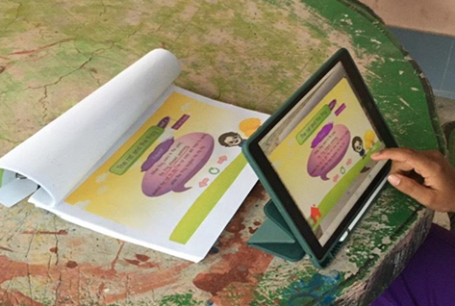
of the AR book in enhancing English reading comprehension development skills of students. The experiment took place for seven hours in semester 1/2022 in the following steps: The pre-test was taken by the students before use the AR book learning experiment as pre-test for 7 hours, following the experiment as Figure 1. After finished the learning experiment, the students took a post-test 1 and filled the satisfaction questionnaire. Two weeks after the post-test 1, the students, then, took the retention test as post-test 2.
Figure 1: An interaction between a student and the AR books on an iPad device.
Data analysis proceeded in two steps: 1) researcher conducted a descriptive analysis of students’ scores including English reading comprehension devel- opment skills scores, and satisfaction scores. 2) researcher compared pre-test and post-test 1 scores as well as compared post-test 1 and post-test 2 scores by using t-test dependent test.
Research instruments were conducted with literature review as informa- tion to producing an AR book, learning achievement test, satisfaction ques- tionnaire, and lesson plans which were evaluated by the experts and revised by the researcher accordingly. The research instruments were constructed, as independent variables-AR book was implemented as intervention of the study and dependent variables-English reading comprehension development skill test, learning achievement, knowledge retention, and satisfaction.
1. An AR book: the tales of moral doctrines based on schematic English reading comprehension development skills is created for grade 6 stu- dents with efficiency values of 82.90/80.67 based on the efficiency 80/80 criteria. The AR book was developed following the 5 stages of learning material development process, ADDIE Model. (1) The analysis stage aimed to analyze research samples, objectives, and content. (2) The design stage aimed to create animation markers which were content- related and outstanding with clear and unique composition. At this stage the AR book and content-related animated videos were also designed. (3) The development stage was carried out to develop the designed AR book and animated videos through the using of Unity program and the efficiency evaluation by expert. The results revealed the very high
An Augmented Reality Book 227
quality and the efficiency scores at M = 4.79. (4) The implementation stage aimed at the trial of the AR book by the students who were not the samples of this research. (5) The evaluation stage as an experiment aimed at the quality assessment by 30 grade 6 students for the efficiency evaluation. 2. Learning achievement test with IOC between > 0.66 - 1.00, reliability at 0.85, item difficulty between 0.40 - 0.73, and item discrimination > 0.33 - 0.73 and was tried out with 30 grade 6 students who were not the samples of this research. 3. Satisfaction questionnaire with a confidence of 0.95, towards AR book to enhancing English reading comprehension development skills in grade 6 students using and after the revision and improvement of the assessed AR book. 4. Lesson plans of AR book to enhancing English reading comprehen- sion development skills in grade 6 students were the high quality at the quality assessment by the experts was the efficiency scores at M = 4.44.
RESEARCH RESULTS AND DISCUSSION After examining the effects of the utilization of the AR book for schematic English reading comprehension development skill in grade 6 students, the following findings are revealed:
1. Are there statistically significant differences in English reading compre- hension development skills scores between before and after using the AR book? The results of the pre-test and post-test were compared to determine if the AR book helps improve the students’ reading comprehension develop- ment skill and promote students’ learning achievement. Table 1 shows the results of the analysis.
Table 1. Comparison results of the pre-test and post-test score on reading comprehension development skills.
Table available in the original PDF paper.
Score n M SD t (28) p Cohen’s d Pre-test 29 7.00 2.04 25.14 <.001 4.94 Post-test 29 15.72 1.49
There were statistically significant differences between pre-test and post-test 1 scores, t(28) = 25.14, p < 0.001, d = 4.94. The students’ English reading comprehension development skill increased after exposure to the AR book.
This study set out to investigate the English reading comprehension devel- opment skill of grade 6 students who use a designed AR book in reading activ- ities, learning achievement, knowledge retention, and levels of satisfaction towards this instructional media, AR book.
The grade 6 students schematic English reading comprehension develop- ment skill after using English AR book receive higher post-test scores when compared to their pre-test scores, and it was found that the pre-test and post-test mean scores of 7.00 and 15.72, respectively. This indicates a higher
228 Nitjarunkul
post-test score, with at p < 0.001 significance level, once the students learned from the AR book which positively confirms the hypothesis.
When the students were exposed to the English AR book, their post-test reflected a significantly higher learning achievement than the pre-test results at the 0.01 level, and the results are consistent with the predetermined hypothesis. The AR book had efficiency values of 82.90/80.67 due to the following designed and embedded learning systems. The researcher states that AR book was constructed based on schema’s English reading com- prehension development skill (Rumelhart & Ortony, 1977), a theory that sees values in existing knowledge. It perceives that student might be able to comprehend reading content more effectively when they can learn naturally. Hence, pre-reading activities were most vital because they helped students prepare for the upcoming reading and apply their existing word knowledge to maximize reading comprehension. A variety of exercises were prepared for the students to test their comprehension, such as correct or incorrect, sentence completion, story quizzes, and exercises. The notion was congru- ent with Carrell & Eisterhold (1983), stating that there are three steps to schematic reading comprehension. Step 1 is pre-reading. Step 2 is reading. Step 3 is post-reading, which deals with summarizing. Students are assessed by answering questions, completing exercises, and constructing a summary purposely to see whether their reading-derived understanding is accurate. Similarly, Smith (1989) proposed that schemas serve two purposes: 1) to classify experiences through brain activities which store and retrieve mem- ories into and from brain folders to generate an understanding of what has occurred and anticipate what would occur subsequently, and 2) to enhance memory efficiency by storing data, word knowledge, and experiences for later retrievals to generate an understand or establish as new word knowledge that helps students gain an in-depth understanding about matters (e.g., through reviews of existing words in the vocabulary repertoire in conjunction with newly introduced ones and simultaneously reading words aloud) with the help of language and content schemas in memorization and comprehension. Sounnoi (2008) investigated the development of a schematic English reading practice for grade 5 students and discovered that their English reading com- prehension development skills were significantly higher than before learning at the 0.01 level.
Since the English AR book was constructed through integration between AR and printing technologies, it magically came to life. Students could immediately explore information related to the subject through a virtual experience, which helped them establish word knowledge through tangi- ble demonstrations, conversations, and immediate feedback. The AR book offered learning adjustments by bridging gaps between traditional learn- ing models and an immersive virtual world. When the AR book was being created, two factors played critical roles in shaping it: (1) its develop- ment process, which involved 1) planning, 2) design, 3) development, and 4) assessment and improvement (Songkhram, 2010) and (2) its AR software environment that had to be adequately versatile to handle a 2D game, aug- ment the reality, blend a typical graphical object into the real world with unique identities and scalability (Azuma, 1997; Behringer, Mizell, & Klinker,
An Augmented Reality Book 229
1999; Sutherland, 1965). Incorporating these factors into the AR book’s construction was projected to offer the students a deeper and more meaning- ful experience by associating the learning content with specific locations or objects via 3D visualization, e.g., in educational games, self-study, and learn- ing challenges (Chaiya, 2017). Perhaps word knowledge allows students to reinforce partial activations of letters that are consistent with word is stu- dents’ vocabulary (Rummelhart, 1977). In this context, interactive model of reading proceeds is increased the learning environments by using AR envi- ronments and applications. The effect of augmented reality-based reading environments on retelling skills: Formative experiment was investigated that augmented reality-based reading environments improved the oral retelling skills and augmented reality-based story text samples were presented to pri- mary school in grade 3students (Çetin & Ulusoy, 2022; Rabbi & Ullah, 2013). 2. What are the levels of satisfaction of grade 6 students after learning with the AR book? The satisfaction questionnaire filled by students immediately after using the AR book provides the information regarding the students’ satisfaction level toward the AR book. Table 2 exhibits the numerical value of arithmetic mean and standard deviation.
Table 2. Students’ satisfaction toward the AR book.
Table available in the original PDF paper.
Aspects Mean SD Level of satisfaction The lesson objectives were clarified. 4.73 0.58 Extremely high The presentation content was clear and easy to understand. 4.50 0.73 Extremely high The lesson was eye-catching and interesting. 4.80 0.48 Extremely high The lesson helped the students improve their reading skill. 4.63 0.61 Extremely high The students were able to learn by themselves. 4.73 0.50 Extremely high The lesson was problem-free, easy, and convenient to use. 4.60 0.62 Extremely high The exercises were diverse and promoted content comprehension. 4.77 0.52 Extremely high The learning duration was appropriate. 4.47 0.78 Extremely high The students enjoyed the learning. 4.80 0.48 Extremely high The students gained knowledge after learning with this AR book. 4.57 0.63 Extremely high Total 4.66 0.45 Extremely high
As presented in Table 2, the students were extremely satisfied with using the AR book (M = 4.66 and SD = 0.45). In all aspects, “the lesson was eye-catching and interesting” was rated the highest (M = 4.80 and SD = 0.48), followed by “the exercises were diverse and promoted content comprehension” (M = 4.77 and SD = 0.52), whereas “the learning duration was appropriate” was rated the lowest (M = 4.47, SD = 0.78).
The students were expected to be extremely satisfied with the AR book enhancement the schematic reading comprehension development skill and the findings confirmed a positive agreement with the hypothesis when it was found that the students were extremely satisfied with it at a 4.66 mean score. (M = 4.66 and SD = 0.45). The mean level of student satisfaction in the AR book was extremely satisfied overall 4.66, meaning that this book was satis- factorily able to provoke their thoughts and stimulate their eagerness to learn as the students were able to instantly interact and receive feedback from the
230 Nitjarunkul
computer. While students are Generation Alpha are in change society play- ing with a computer or smart phone in the room alone different personalities from previous generations. Whether its ingenuity understanding of modern technology, AR applications that are based on the learning approach anytime and anywhere and support individual learning (Michigan Virtual, 2023).
Moreover, learning in sequence with the freedom to repeat promotes posi- tive attitudes towards English language learning. The AR book was used as a teaching supplement and contained texts, images, animations, and sounds. Its learning units and activities, such as reviews, tales reading, repeating, listening, memory game, and exercises, were designed to encourage stu- dents to autonomously practice reading for comprehension until they master it. Interactive model is one in data-driven, bottom-up processing combine with top-down, conceptually driven processing to cooperatively determine the most likely interpretation of the input. Processing in interactive model of reading proceeds in the following way: the reader begins with a set of expectation about what information is likely to be available through visual input (Rumelhart & McClelland, 1981. Furthermore, Nula–ong et al. (2014) examined grade 1 students, elementary, and teachers’ satisfaction in AR mul- tiple intelligences-based learning using tablets. They discovered that creating instructional media for multiple intelligences-based learning in tablets incen- tivized learning through triggered learning eagerness from fun and happiness. The study showed that the students and the teachers congruently agreed on the notion, especially when media that required physical activities were implemented. Similarly, Kanchanachaya and Nitjarunkul (2018) stated as a good AR media should be constructed through a research process with con- tent examining and analysis; a lesson design aiming to catch attention e.g., the use of image and video in the lessons; a verification measure; a trial session; and an efficiency evaluation. Similarly to some educators which concluded that the following traits define a good school book: (1) Good printing tech- niques and layout design: Before printing, the texts must be clear, the cover must be beautiful and attractive, book size and font size must be appropriate for learners, paper quality must be good, book layout must look clean, image and text placement must be harmoniously arranged as opposed to overlap- ping, and the title must sound appealing; (2) Attractive content: The content must be made interesting and not to be too easy or difficult to the age of the learner. Ensure that the content is correct, and the story is plotted in a manner that learners are attracted to follow along. The content length must not be too long or short and it must be beneficial to the learners; and (3) Supplementary images: Ensure that they are colorful and consistent with the content. The images must be accurate and correct while the size must be suitable with the book size because they offer colorful and attractive video presentations, cover design, and book formats. In AR interfaces, three-dimensional virtual images appear superimposed over real objects. AR applications typically use head- mounted or handheld displays to make computer graphics appear in the user’s environment (Billinghurst, Grasset, & Looser, 2005). The AR books were distinctively designed and contained skill drills that students could repeat- edly work on. Furthermore, since they were perceived as modern media, they were more valued as learning motivation than typical books. Since the
An Augmented Reality Book 231
students were able to learn at their convenience through these books, they learned with happiness, quality, and effectiveness. Consistently, Phecharawet & Namman (2016) suggested that AR book with easily digestible content and attractiveness helped enhance the understanding of content and lessons and led to high levels of satisfaction.
3. Does the AR book promote knowledge retention in grade 6 stu- dents? The results of the post-test 1 and the 2-week retention test as post-test 2 were analyzed on the purpose of identifying whether the AR book could enable knowledge retention. Table 3 displays the findings obtained from the post-test 1 and the 2-week retention test as post-test 2.
Table 3. Comparison results of the post-test 1 and post-test 2 score on reading comprehension development skills.
Table available in the original PDF paper.
Score n M SD t (28) p Cohen’s d Post-test 1 29 15.72 1.49 1.98 0.057 0.23 Post-test 2 29 15.38 1.44
There was non-significant difference between post-test 1 and post-test 2 scores, t(28) = 1.98, p = 0.057, d = 0.23. The knowledge retention did not deteriorate over time when using an English AR book.
The grade 6 students who utilize the AR book enhancement the schematic English reading comprehension development skill receive indistinctive scores on the post-test 1 and post-test 2 taken with a 2-week interval and the result suggested that the post-test 1 scores were higher than the post-test 2, however, without any statistical significance which positively confirms the hypothesis.
The knowledge retention gained from the book was congruent with the study’s hypothesis. This notation indicates that the knowledge retention was extremely high, i.e., with the post-test 1 as immediate post-test score and that of the 2-week retention post-test of scores, t(28) = 1.98, p = .057. The students were able to recall vocabulary and demonstrate their reading com- prehension obtained after using the AR book, which was implemented as a stimulus for learning vocabulary and story-reading for comprehension. The AR book was designed by integrating the AR technology into the schema theory based on Skinner’s operant conditioning theory, which perceives learn- ing stimuli and responses as its backbones. In this theoretical framework, responses are controlled by positive reinforcements. Hence, the book’s lessons were programmed to lead the students in their autonomous learning jour- neys with guides to provide correct answers. The core of language-learning change presences that most language learning theories have been relatively consistent in the last few decades. The main language learning theories have remained unchanged for decades (Skinner, 1954). Students also have a bet- ter understanding of how memory and learning works. Correspondent to Chui, Roberts, & Yee (2022) state that the students know that learning a lan- guage requires access to comprehensible input. Their brain also needs time to build new neural pathways to store that information and the students need to revisit lessons to help push them deeper and deeper into your long-term
232 Nitjarunkul
memory. So that benefit of a language learning app of AR that we know, such as: (1) It teaches students useful words and phrases. (2) Presented in a natu- ral, everyday context. (3) Spaced out over time, so students absorb their new language organically. And (4) It’s kind of like learning the words to their new favorite tales. And Limpinan (2017), which is on AR technology’s promotion of persistence in memorizing English words, reported that Preschool 3 stu- dents’ vocabulary memories could be retained with the AR technology. The results were reflected by a higher mean immediate post-test when compared to that of the pre-test and indifferent mean scores between the immediate post-test 1 and the 14-day post-test 2. It was concluded that the AR tech- nology helped retain preschool 3 students’ vocabulary memories when the AR word application, containing vocabulary flashcards, meaning-matched images, interactive 3D model animations, and vocabulary audio pronuncia- tion, was implemented. While the AR technological marvels that the teacher guides the student using comprehensible input through various stories. These tales serve to reinforce bite-sized language learning lessons. Engagement is high along with memory retention and to revisit lessons to help push them deeper into long-term memory.
CONCLUSION
The AR book enhances the schematic English reading comprehension devel- opment skill in grade 6 students by the contemporary technology and AR, new technology integrated with student-centered learning (individual learn- ing, group learning, specific learning) effect the learner to be enabled to schematic English reading comprehension development skill in higher level. Developing the AR book enhances the schematic English reading compre- hension development skill integrated with student-centered learning that was designed appropriately which affects the knowledge retention because of AR book integrating with interactive model, so the learner can remember words knowledge and storytelling by using schematic English reading comprehen- sion development skill on the higher order learning as 21st century learning skill in communication skills, information literacy, and technology skills and digital literacy.
ACKNOWLEDGMENT
The authors would like to thank Faculty of Education, Prince of Songkla University and the Office Sustainable Development Education in Multicultural Society Research Center (SERC), Prince of Songkla University, Thailand.
REFERENCES
Angwatanakul, S. (1994). Methods of Teaching English. Bangkok: Chulalongkorn University Press Arth, C.; Gruber, L.; Grasset, R.; Langlotz, T.; Mulloni, A.; Schmalstieg, D.;
& Wagner, D.; (2015). History of Mobile Augmented Reality: Devel- opments in Mobile AR over the Last Almost 50 Years. Austria:
An Augmented Reality Book 233
Computer Graphics and Vision Graz, University of Technology. Website: https://www.icg.tugraz.at/∼daniel/HistoryOfMobileAR Azuma, R. T. (1997). A Survey of Augmented Reality. Presence: Teleoperators and Virtual Environments. 6(4): 355–385. Behringer, R.; Klinker, G.; & Mizell, D. (1999). Augmented Reality–Placing Artifi-
cial Objects in Real Scenes. Proceedings of the First International Workshop on Augmented Reality 1998. A. K. Peters. ISBN 1-56881-098-9. Bhattacharya, K. & Han, S. (2010). Emerging Perspectives on Learning, Teaching, and Technology: Piaget’s Constructivism. (Editor-In-Chief Michael Orey), Zurich, Switzerland: The Global Text Project is funded by the Jacobs Foundation. Billinghurst, M.; Grasset, R.; & Looser, J. (2005). Designing Augmented Reality
Interfaces. Computer Graphic, University of Canterbury. Carmigniani, J.; Furht, B.; Anisetti, M.; Ceravolo, P.; & Damiani, E.; & Ivkovic, M. (2011) Augmented Reality Technologies, Systems, and Applications. Springer, Science Business Media: Multimedia Tools and Applications. 51:341–377. Carrell, P. L. & Eisterhold, J. C. (1983). Schema Theory and ESL Reading Pedagogy.
TESOL Quarterly. 17(4): 553–573. Çetin, H. & Ulusoy, M. (2022). The Effect of Augmented Reality- Based Reading Environments on Retelling Skills: Formative Experi- ment. Springer: Education and Information Technologies. Website: https://doi.org/10.1007/s10639-022-11415-8 Chaiya, S. (2017). Using Augmented Reality Technology in Public Libraries. Journal of Library Science, SWT. 10(2): 134–148. Chui, M.; Roberts, R.; & Yee, L. (2022). McKinsey Technology Trends Outlook
2022: Immersive-reality technologies. Website: https://www.mckinsey.com/capab ilities/mc\ kinsey-digital/our-insights/the-top-trends-in-tech. Fahriany, F. (2014). The Role of Awareness in Second Language Development.
Journal on English as a Foreign Language. 4(1): 37–40. Hall, S. & Takahash, R. (2017). Augmented and Virtual Reality: The Promise and Peril of Immersive Technologies. Website: https://www.mckinsey.com/industries/ technology-media-and-telecommunications/our-insights/augmented-and-virtual -reality-the-promise-and-peril-of-immersive-technologies Kanjanachaya, N. & Nitjarunkul, K. (2018). Effectiveness of AR Books on “Callig-
raphy with Parallel Pens” towards the Pre-Service Teachers’ Capability of Instruc- tional Media. International Journal of Information and Education Technology. 8(12), 868–873. Limpinan, P. (2017). Augmented Reality Technology Promotes Persistence in Memorizing English Words. Journal of Information Technology and Innovation Management, Faculty of Information Technology, Rajabhat Maha Sarakham University. 4(2): 7–16. Makorov, A. (2022). 12 Augmented Reality Trends of 2023: New Milestones in
Immersive Technology. Website: https://mobidev.biz/blog/augmented-reality-tre nds-future-ar-technologies. Malithong, K. (2000). Educational Technology and Innovation. Bangkok: Arun Printing Press. Marr, B. (2021). Future Predictions of How Virtual Reality and Augmented Real-
ity will Reshape Our Lives. Website: https://www.forbes.com/sites/bernardma rr/2021/06/04/future\ -predictions-of-how-virtual-reality-and-augmented-reality- will-reshape-our-lives/?sh=7b29eee368b4 Mee Kaew, N.; Engchuan, S.; & Ketpichainarong, W. (2014). Creation of Augmented Reality Media Technology (AR) for Application in Education. Innovation Brochure, Mahidol University. 9(36): 8–16.
234 Nitjarunkul
Michigan Virtual. (2023). The Importance of Digital Learning: Gen Z and Gen Alpha in the Classroom. Available online: https://michiganvirtual.org/blog/the-importa nce-of-digital-learning-gen-z-and-gen-alpha-in-the-classroom Milgram, P. & Kishino, F. (1994). A Taxonomy of Mixed Reality Visual Displays.
IEICE Transaction on Information Systems. Vol E77-D, No. 12 December (1–15). Nula-ong, W.; Nula-ong, T.; Preechadirek, N.; Ubuathong, A.; Mulnisarn, W.; Daengsuwan, J.; Phalaprei, W.; & Sahaya, E. (2014). Satisfaction of Students and Teachers in Grade 1 Students to Multiple Intelligences-Based Learning through Augmented Reality in Tablet Devices. Journal of the Psychiatric Association of Thailand. 59(3): 245–256. Office of the Basic Education Commission. (2008). Basic Education Core Curricu-
lum B. E.2551 (A. D. 2008). Bangkok: Printing House, Agricultural Cooperative Federation of Thailand, Ltd. Phecharawet, P. & Namman, C. (2016). Development of A Three-Dimensional Book to Supplement the Lessons of the Solar System with Augmented Real- ity Technology. Journal of Science and Technology, RMUTT, Thanyaburi. 6(2): 48–57. Rabbi, I.; & Ullah, S. (2013). A Survey of Augmented Reality Challenges and
Tracking. Journal for Printing Science and Graphic Communications. 24(1-2): 29–46. Rumelhart, D. (1980). Schemata: The Building Blocks of Cognition. In: Spiro, R., Bruce, B. & Brewer, W., Eds., Theoretical Issues in Reading Comprehension, Erlbaum Associates, Mahway. (33-58). Rumelhart, D. E. (1977). Toward an Interactive Model of Reading. In Theoretical
Models and Processes of Reading (722–750). Newark, DE: International Reading Association. Website: https://doi.org/10.1111/j.1540-4781.1989.tb05321.x Rumelhart, D. E. & McClelland, J. L. (1981). Interactive Processing through Spreading Activation. New Jersey: Lawrence Erlbaum Associates. Rumelhart, D. E. & Ortony, A. (1977). The Representation of Knowledge in Mem-
ory. In R. C. Anderson, R. J. Spiro, & W. E. Montague (Eds.), Schooling and the Acquisition of Knowledge. Hillsdale, New Jersey: Erlbaum. Skinner, B. (1954). The Science of Learning and the Art of Teaching. Harvard Educational Review. 24: 86–97. Smith, F. (1989). Overselling Literacy. Phi Delta Kappan. 70(5): 352–359. Songkhram, N. (2010). Design and Development of Multimedia for Learning.
Bangkok: Chulalongkorn University Press. Sounnoi, P. (2008). Development of English Reading Skills for Comprehension Based on Schema Theory for Grade 5 Students. Master of Education Thesis, Bansomdejchaopraya Rajabhat University. Sutherland, I. (1965). The Ultimate Display. International Federation of Information
Processing. 2: 506–508. Tangthong, O. (2019). Learning Materials for Planets in the Solar System with Augmented Reality (AR) Technology: A Case Study of the Grade 4 Students, Cram School. IMaths & Robots Child’s Lopburi. Academic Journal Technology Management, Rajabhat Maha Sarakham University. 6(2): 77–83. Woolfolk, A. E. (1987). Educational Psychology. 3rd Edition. New Jersey: Engle-
wood Cliffs.
LISTED IN THE AHFE DIGITAL BOOKSTORE CATALOGUE
Explore the complete digital volume
Human Systems Engineering and Design (IHSED 2023): Future Trends and Applications
Read this individual research paper free through the original publisher, or explore the full digital proceedings book.
ISBN 978-1-958651-88-9
Explore this ISBN in the AHFE Bookstore ↗Listed in the July 2026 bookstore catalogue; search by ISBN to confirm current availability · Digital book purchase optional