Vesa Salminen, Jyrki Peltomaa, Juha Varis (2023). Data-Based Creativity in Systemic Evolutionary Innovation. In: Human Factors, Business Management and Society. AHFE Open Access, vol. 97, pp. 50–66. https://doi.org/10.54941/ahfe1003882
Fast evolving business environment requires excellent innovation performance for the success and growth of organizations. Above all, creativity is a critical component in the competition. Analytical thinking and innovation, active learning and learning strategies and creativity are the main skills in continuous coevolution of businesses. All these skills are essential during the early phases of innovation. These skills give us a guidance in the pathway to growth – entrench the competitive advantages. A deep study reveals answers to early activities - pre-inventive actions open the way of innovation initiatives to growth. It is important really immerse us to explanations for origins of innovation.Ambitious growth objectives cannot be achieved without effective, dynamic and systematic innovation. The early activities – pre-inventive actions - are designed to be a valuable innovation assistance in the step-by-step evolutionary pathway to growth. This is a new value stream innovation paradigm. Challenges and insights emerge during the pathway.Data management is policies and procedures to effectively manage the information lifecycle needs. It means data collection, classification, validation, storing, protection, and processing during lifecycle from creation to deletion - the practice of collecting, keeping, and using data securely, efficiently, and cost-effectively. This is a foundation for digitalization – mining for insights in company’s data.The amount of usable data in business environment and as big data is exponentially increasing. Technology opportunities are available to be used in data- analytics and in managing by data for the purpose of business co-evolution. The understanding of human factors inside self- organized teams during collective interpretation and imagination of future opportunities is becoming most important feature.The goal of this article is to identify and analyze futures thinking in innovation capability. The article attempts to develop evolutionary framework for data and event analytics in content management of fuzzy front end of innovation. An essential team performance is collective interpretation and imagination. That can be used in prospective innovation.This research is partly constructive, conceptual and analytical because it introduces data analytics progression framework in fuzzy front end of innovation.Data for this concept creation has been collected over several years on continuous flow of qualitative analysis of scientific articles and used methodologies in operative industrial environment. This can be seen as a type of applied science. Experiences and many results gathered during this analysis work can be used in sustainable development. These can be benefited in development work on data- based creativity, interpretation, innovation and foresight. A generic perception of this analysis work is that successful fuzzy front end of innovation needs structured data- analysis methodology and dynamic team performance to execute collective interpretation and imagination to serve as basis for common value creation in systemic and evolutionary innovation.
A fast-evolving business environment requires excellent innovation perfor- mance for the success and growth of organizations. Above all, creativity is a critical component in the competition. Analytical thinking and innovation, active learning, and creativity are the main competencies in the continuous coevolution of businesses. All these capabilities are essential during the early phases of innovation.
These skills give us guidance on the pathway to growth, as they entrench competitive advantages. A deep study reveals answers to early activities – pre- inventive actions open the way to innovation initiatives to growth. It is really important to immerse ourselves in explanations for the origins of innovations.
Ambitious growth objectives cannot be achieved without effective, dyna- mic, and systematic innovation. The early activities – pre-inventive acti- ons - are designed to be valuable innovation assistance in the step-by-step
Data-Based Creativity in Systemic and Evolutionary Innovation 51
evolutionary pathway to growth. This is a new value stream innovation paradigm. Challenges and insights emerge during the pathway.
Data management is policies and procedures that effectively manage infor- mation lifecycle needs. It means data collection, classification, validation, storage, protection, and processing during the lifecycle from creation to deletion - the practice of collecting, keeping, and using data securely, effi- ciently, and cost-effectively. This is a foundation for digitalization – mining for insights in the company’s data.
The amount of usable, valuable data flow in business environments and in the form of big data is exponentially increasing. Technological opportu- nities are available to be used in data-analytics and in managing by data for the purpose of business co-evolution. The understanding of human factors inside self-organized teams during collective interpretation and imagination of future opportunities is becoming the most important feature.
The goal of this article is to identify and analyze future thinking in innova- tion capability. The article attempts to develop an evolutionary framework for data and event analytics in the content management of the fuzzy front end of innovation. This can be seen as a type of applied science.
Experiences and many results gathered during this analysis work can be used in sustainable development. These can be benefited in development work on data-based creativity, interpretation, innovation, and foresight. A generic perception of this analysis work is that the successful fuzzy front end of innovation needs structured data-analysis methodology and dynamic team performance to execute collective interpretation and imagination to serve as the basis for common value creation in systemic and evolutionary innovation.
THEORETICAL FRAMEWORK ‘Organizational interpretation is formally defined as the process of trans- lating events and developing shared understanding and conceptual schemes among members.’ (Daft and Weick, 1984). ‘Through social interactions, a shared understanding of the opportunity idea begins to emerge and thus the overall learning process enters the integrating phase, i.e., it becomes organi- zational in nature.’ (Dimov, 2007). ‘Insights and ideas occur to individuals, not organizations – but learning manifests in organizations when ideas are shared, actions are taken, and common meaning development occurs at the group and organizational level.’ (Hurley, 2002).
‘Organizational learning depends on information management – the capa- city to harness the organization’s information resources and information capabilities to energize organizational growth.’ (Choo, 1995). ‘Learning is the process of acquiring new, or modifying existing, knowledge, behaviors, skills, values, or preferences.’ (Gross, 2010).
‘Digitalization enables the generation of data-driven complementarities across markets, products, and services, a better unit of analysis might be an ecosystem that can cut across markets or sectors. In digital ecosystems, data is a valuable currency that gives rise to potentially contentious issues, such as to the identity of customers and their activities. Successful ecosystem drivers define who gets what information and establish guidelines for how it will be shared – both digitally and ethically (Sebastian et al., 2021).
RESEARCH QUESTIONS The goal of this article is to identify and analyze future thinking in terms of innovation capability. The article presents an evolutionary framework for data and event analytics in the content management of the fuzzy front end of innovation. An essential team performance is collective analysis, interpre- tation and synthesis that can be used in prospective successful innovation initiative creation. The main research questions are
How is data mining and management used in systemic and evolutionary innovation?
How are business analytics and interpretation integrated into data-based content creation and opportunity identification?
How is data-based creativity executed in support of evolutionary innova- tion?
This research is partly constructive, conceptual, and analytical because it introduces data- analytics progression framework in the fuzzy front end of innovation. Data for this concept creation has been collected over several years on the continuous flow of qualitative analysis of scientific articles and used methodologies in an operative industrial environment. This can be seen as a type of applied science. The following introduces the step-by-step conce- ptual framework of data management and the data-based content creation process for evolutionary innovation.
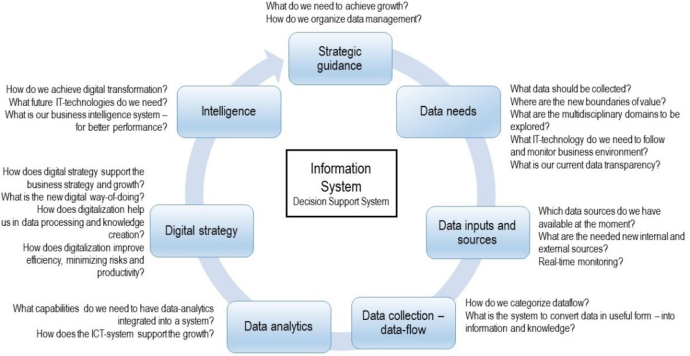
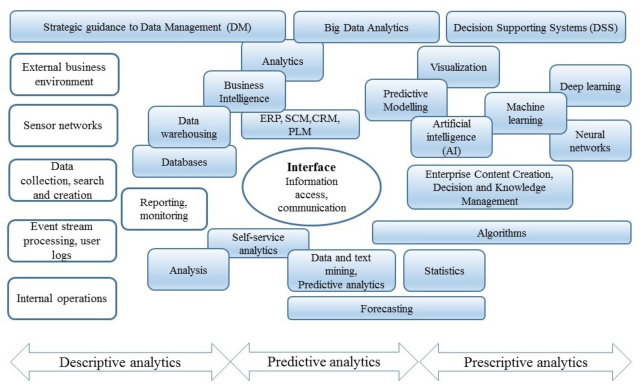
DATA MANAGEMENT IN EVOLUTIONARY INNOVATION Data management is policies and procedures for effectively managing infor- mation life cycle needs. It means data collection, classification, validation, storage, protection and processing during lifecycle from creation to deletion – the practice of collecting, keeping, and using data securely, efficiently, and cost-effectively. This is a foundation for digitalization – mining for insights in companies’ data. The next picture lights the path toward digitalization – from strategic data flow to digital transformation, i.e., changing the way the work is done. Data analytics has to be seen as one of the key drivers fueling innovation and growth.
Data management supported by the Decision Support System (DSS) is the pathway to new knowledge creation, in which collected data flows into analytics and digitally controlled opportunity processing. It can be used in aligning digital strategy with overall growth strategy. Intelligence is based more and more on fact-based decision making where you turn data mining and enrichment into useful information (Figure 1). The figure explains the interconnectedness between the components of a system. It guides the viewer to think about the capabilities needed in order to con- struct a digital way-of-doing, creating new value and increasing customer loyalty.
Digital strategy answers the question: How do we benefit from a gro- wing amount of data? The goal of the digital strategy is to maximize business benefits with data-based processes and IT-technology initiatives and investments.
Data-Based Creativity in Systemic and Evolutionary Innovation 53
Figure 1: Data process flow and management in the pathway to new knowledge creation.
Real-time monitoring opens new opportunities when emitting data from various sources like sensor networks, Internet of Things, remote control, robotics and automation cells for real-time data exploitation.
VALUE INFORMATION IN SYSTEMIC INNOVATION Data is an essential asset to organizations today. It is an important asset to keep things under control and to respond to external changes, needs and problems. Emerging data is creating innovation initiatives and AI makes it possible to automatize the main steps of the process. An effective ICT system means classification of data.
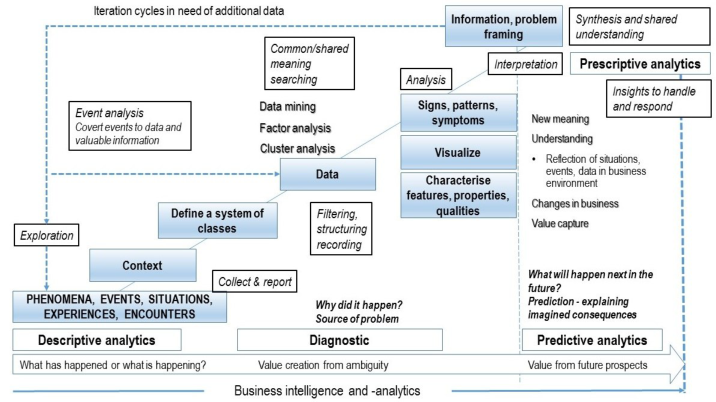
Pre-Inventive Actions in Value Creation Value Information Flow (VIF) stems from descriptive-, diagnostic- and pre- dictive analytics. Data mining enables data enrichment, ambiguity and uncertainty clearance, and knowledge creation. VIF generates information from data, creating opportunities, being alert about critical issues in the busi- ness environment. Data mining and value information flow can be seen as synonyms. The main goal is to leverage data in order to create insights of new opportunities, i.e., a data-driven smart decision system. The next figure enlightens information enrichment from unexpected or novel events and situ- ations – turning points – into useful information and a shared understanding of an opportunity, change, customer insights, business problem, or initiative.
There is a need for a systematic procedure to create new value and enrich data for business purposes. Data mining has an essential role in systemic innovation. It is important to turn events into data, information, and new value. When a successful interpretation occurs, new additional needs for data collection may be needed. This is an organizational process to convert unstructured data into insights, foresight information, valuable knowledge and know-how (Figure 2). The model enables knowledge creation, problems identification, customer analytics and predictive analytics.
Figure 2: A systematic procedure to create new value and enrich data for business purposes in systemic innovation.
On the left side of Figure 2, individuals play a key role in reflecting and noticing issues of ambiguity, uncertainty and even the unknown. While uncertainty refers to a lack of information, ambiguity refers to the existe- nce of multiple and conflicting interpretations regarding an organizational situation (Kijkuit and van den Ende, 2007). Going to the right side means more organizational active involvement in creating new value – learning and development of expertise. The figure highlights the early activities of FEI – pre-inventive actions. The process is iterative and ongoing both on individual and organisational levels – data-based creativity into evolutionary innovation.
This is one of the pathways from unknown to known. In order to add value from events, descriptive analytics is a first step of the chain – event logs and customer encounter documents are excellent sources of initiative development. We need to provide a holistic view with context of what has happened. It describes and summarizes the important data of an event in a way that it is interpretable for further steps. This is understanding of all issues involved: circumstances, who participated, where and why did it happen – all of it featuring context. Things like features, numerical data, qualitative data and properties may help uncover links, interrelationships, causes and effects. Then some questions arise: How do we process useful information for the creation of new knowledge? How does data evolve from ambiguity to a clear element of opportunity?
Customer events, situations, experiences, complaints, satisfaction, expe- ctations, and encounters enable a holistic database for customer insights - customer-data analytics. Analytics and diagnosis enable a customer value stream. Precise descriptive analytics make the next steps easier – contextual data gives context to an entity. The objective of analytics is to better under- stand how events evolve and change the future - foresight. Event analysis in
Data-Based Creativity in Systemic and Evolutionary Innovation 55
this context includes a description of an event with a diagnosis of why it hap- pened and what it means to us today and in the future in further sufficiently deep diagnosis. Focused information processing in the area of interest even provides creative options and insights – a reflection of perception.
When we have enough data and information on an event, it is possible to characterize objects according to characteristic properties, primary quali- ties, typical features or other defined criteria. Classify things into a system of classes, ordered according to a predetermined set of principles. Organize a set of entities with classes according to some common relations – a group or class in the classification system. Visualize data for analysis and interpreta- tion, and finally generate insights – new and original views, ideas, values and perspectives.
On one hand, exploration is the key procedure in the beginning of inno- vation and on the other hand, exploitation identifies known things to be implemented. This is a sign of an agile organization. How do CRM systems work in these kinds of issues? Events, situations, experiences or encounters enable various growth elements, e.g., surprising situations, disturbances, co- incidents, unpredictable, abnormal, unexpected occurrences, success, failure or encounters, symptoms, signs of change, growing pain, customer expe- ctations (customer-friendly), customers’ points of view, user experiences, regulatory environments and legislation, value opportunity, sources, or even a mix of different things.
We need a data classification system - a context map including the follow- ing headlines, e.g., main headlines – internal and external grouping of themes, main areas of interest, and sublines (related, boundary, multidisciplinary areas).
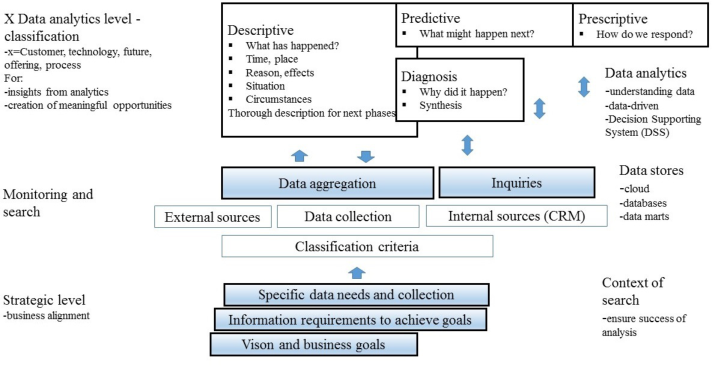
To be able to predict the future – predictive analytics – create a thorough description of what has happened. After thorough description, it is possible to make a diagnosis of the situation which is a basis for predictive analy- tics. Think of prescriptive analytics as a way to make decisions about what happens next. Prescriptive analytics is possible due to insights revealed from predictive analytics, diagnosis and synthesis.
Different classes might be product- or service-related issues, processes, innovation, customers, competitors, technologies or legislation-related items. An additional area may be foresight information. Innovation needs systema- tics and information infrastructure.
Data aggregation is a component of business intelligence solutions. Data aggregation software searches databases, finds relevant search query data and presents data findings in a summarized format that is meaningful and useful for the end user or application (Techopedia.com). What are the next steps ahead of us? Could it be possible to create an ICT solution for this specific need to identify innovation initiatives?
From Data and Text Mining Into Systematic Analytics Data mining (DM) is the process of exploring, sorting and analyzing data from different perspectives and to generating it into useful information, i.e., data integration and preprocessing to information discovery. The objective of data mining is to find correlations, interrelationships and patterns in order
Figure 3: Data aggregation is the gathering, utilization and presentation of data as a foundation of data analytics.
to discover new and novel information. Data mining has also been defi- ned as extraction of implicit, previously unknown and potentially useful knowledge from a huge amount of data, i.e., KDD (Knowledge Discovery from Data). The KDD process selects specific data from different items, classes or categories using identifying attributes (e.g., time, place, region, etc.). This is connected with value information flow and systematic data processing.
Data mining depends on effective data collection and data warehousing as well as computer processing. It is defined as a part of cognitive technology which is expected to have a drastic effect on the way that people interact with technology in the future. Goals for the DM are prediction, identification items or events, classification by enriching data into new classes by means of parameters. Data mining is usually used with collection, extraction, warehou- sing, analytics, statistics, artificial intelligence, machine learning and business intelligence.
Text mining is the process of transforming unstructured text into a stru- ctured format to identify meaningful patterns and new insights. By applying advanced analytical techniques and learning algorithms, companies can explore and discover hidden relationships within their unstructured data. (IBM, 2022) Preparatory phases for data mining are reporting, diagnosis and analy- sis, i.e., descriptive analysis – what has happened and why did it happen? Descriptive analytics provides the basis for predictive analytics and foreca- sting including collection and arrangement in a systematic order. Predictive questions are formed to predict an event, result or future. It is analytics to understand the future. It can be a forecasting type of question in the form of “What could happen?”, “What will happen next?”, “What is making this happen?” and “What if…?” The result of this kind of analytics can be the predictive modeling systems. ‘What will happen next if…’ -type of questions.
Data-Based Creativity in Systemic and Evolutionary Innovation 57
Predictive questions can also be used to simulate different scenario building or thinking consequences if we change something. Questions can start with words like: “What is the probability?”, “What could be the best?” or “What is the estimated impact on?” Predictive analytics is divided into different cate- gories: predictive modelling, root cause analysis, forecasting and data mining. Once predictive variables are found, data is sorted into classes, analytics are conducted and visualized, and new interesting things start to be revealed from big data.
Future-based analytics is both descriptive and predictive analytics. This gives us a solid basis for prescriptive analytics – what our responses are and what we need to do next. As we can see from these different definitions, an analytics system must be tailor-made using suitable building blocks of actual and future, i.e., there is not a one-fits-all system. Diagnostic type of analytics includes questions starting with the word “why” or “Why did it happen?” in order to identify root causes and consequences. Prescriptive questions are in forms like: “What should we do?” or “What should we change?” aiming to support decision making. Prescriptive analytics is also an issue “How can we make it happen”? It is an interesting question which we will return to later on.
Information Technology Solutions of Knowledge Processing How can we make all monitored, collected and analyzed important events, alerts and data visible for all members exploiting and exploring new use- ful information? They should have the capability to interpret and transform data into useful information, insights and ideas. How can we make infra- structure and information architecture supporting the successful beginning of innovation? How do ICT systems enable processing of the fuzzy front of innovation in the future? Ontology and semantics play an important role when developing an ICT-system – shared understanding of vocabulary, semantics, used concepts and classification. Ontology and semantics augment our understanding and usability of ICT systems.
An increasing discussion today is big data analytics. The future of busi- ness intelligence technologies includes reporting, online analytical processing, data mining, process mining, business performance management, and descri- ptive/predictive/prescriptive analytics. How can data be codified in a way to enrich and transform it into information and knowledge? Data mining entails dealing with a large amount of data. It is defined as the analysis of observa- tional data sets to find unsuspected relationships and summaries the data in novel ways that are both understandable and useful to the data owner (Hand et al. 2001). How would we utilize ICT systems in to help us see the unknown and forecast the future better?
In documenting events, observe, pay attention, notice signs, symptoms, and anomalies, and ask:
What happened?
How did it evolve into an event?
Why did it happen?
What were the reasons and circumstances (i.e., the context)?
What does this mean to us?
What does it signal to us?
In order to avoid inaccuracy of perception, the in-depth descriptive analysis is needed to be able to get adequate evidence of the circumstances and facts – contextual data. Accurate perception increases the predictive and prescriptive analytics quality.
Additionally, further studies may need information on circumstances, bro- ader context, the people involved, catalysts for phenomena, background, context, drivers, game players, essentials, outcomes and forces behind the phenomena. The core of a Business Intelligence (BI) system is technical infrastructure to collect, store and parse data in business-related actions. BI includes data mining, performance information, descriptive analytics and organizing data in reports, presentations and visualizations.
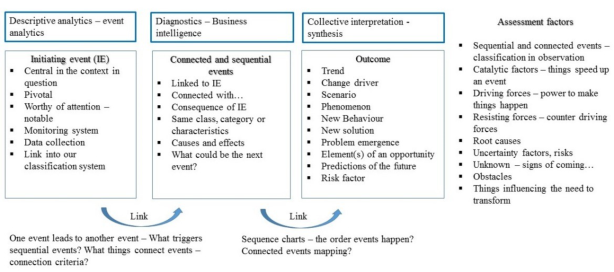
BUSINESS ANALYTICS INTEGRATION INTO OPPORTUNITY IDENTIFICATION The starting point for business analytics is descriptive analytics on events and situations. A situation can be an initiating event for a chain of events. There are event chains leading to a major phenomenon, change or crisis. An initi- ating event can be followed by a series of sequential or even pivotal events. Diagnostics and analysis of such event chains can lead us to scenario for- mation, drivers of change or new emerging behavior or phenomena. We can name it event analytics based on event logs. The objective of such studies is to detect sequences of events, problems or opportunity emergence. Busi- ness analytics refers to the skills, technologies, applications and practices for continuous iterative exploration and investigation of past business perfor- mance to gain insight and drive business planning. Analytics is a potential methodology into insights.
What factors link events together into chains? Common things can be inter alia: event type, attribute, frequency or other company-specific classification. Event chain diagrams or sequence charts can be a visualization showing the relationships between events and how the events affect each other. In event chains, analysis of catalytic factors may shed light on event. There may even be reducing, limiting, blocking and inhibiting factors. These factors help us make a force field analysis of the case. With these analyses, the concept is also close to change identification. How does one act? First, collect data, make descriptions of events and analyze features, indicators, signs, early war- ning signals, alerts, symptoms, mistakes, failures (Figure 4). Second, assess common features, properties or symptoms to connect different events into a chain. Third, conduct collective interpretation: form a shared understan- ding of a situation, problem definitions, seek out new patterns, element into future opportunities and possible predictive analytics. Fourth, add descri- ptive analytics with diagnostics and create Business Analytics (BA) including past, present and future-oriented data. We have data and information to question: What has happened? Why did it happen? What does this mean
Data-Based Creativity in Systemic and Evolutionary Innovation 59
Figure 4: Event analytics, i.e., visualization of connected events.
to us? Interpretation and synthesis are the processes to find answers to the question “What should we do next?”
Business analytics is an essential part in the beginning of innovation search- ing for value innovations, new insights and creating information from data. The usage of business intelligence and analytics leads us to successful inno- vation. We have to clear the fuzzy elements in our business environment. Big data analytics makes the “game” more complicated and complex. Big data needs data cleaning, preparation, optimization, indexing, and organization to report what has happened and conduct analytics. Preprocessing has to be done before feeding into the algorithm. It is connected in machine learning and AI. Data analytics enables pattern recognition!
Business Information System Enable Ideas to Evolve Into New Opportunities Information Systems (IS) must be seen as a combination of technology, peo- ple and processes. The core of the information system is to support dynamic capabilities’ development and continuous evolution. It also facilitates pro- blem solving performance by knowing each other’s areas of expertise. It consists of two parts: Internal part of the BIS should include:
Business related data, information, knowledge – converting data and infor- mation into new knowledge, practices and solutions – disseminate the knowledge to everyone,
Individual expertise descriptions (skills and competencies, experience areas, specialized know-how areas and internal training) – description who knows what– awareness of internal human power potential,
Knowledge, content management and documentation of learning organi- zation,
Best practices (routines, evolution, learning-by-exploration).
External part of the IS:
Business related databases (input, process, output, storage and control activities) and critical information sources to enable supporting of foreca- sting, planning, control, coordination, decision making and operations,
Available external competencies, specialized consulting and supporting expertise
Domain-specific information, technology, R&D, articles and development projects How could information sharing system help the progress of idea evolu- tion? Innovation is finding new connections and associations. Therefore, it is beneficial to have an integrated ICT system to make effective and even vir- tual communication possible in order to find and combine the best ideas for final solutions. The whole information flow from observations to initiative should be integrated because information flow, analytics and collaboration improve ideas and ignite insights. This is done by keeping adequate records of them – store them in a database for actual use for everyone. All members of an organization can exploit needed data, information and knowledge fast from one distributed document system – a digital information sharing system. Ideas are essential parts of innovation which need to be processed and tran- sformed into solutions and innovation initiatives. The creative process itself produces insights. Descriptive-, predictive- and prescriptive analytics ignites multiple ideas and insights. This is a reason to make adequate descriptions and documentation. By this means, we can avoid overlapping work to invent the same things again. In order to utilize all this information, we need an integrated and consistent classification system.
Predictive analytics makes us think about future-oriented issues. We should ask here: “What is driving this?” and “Why does it matter to us?” Trends may have significant impacts in the business. Exploring trends is about observa- tion, listening, reading, asking and scanning specific areas of interest. Weak signals are also to be detected early before they may become strong ones and seen by everyone.
Classification and indexing should be consistent and in-line throughout the whole path from observations to solutions. It makes it easier to group, com- bine, improve, change and add components of proposed ideas. It may offer the possibility to generate new more interesting ideas. Idea evolution happens whenever one comes back to them. The system describes the total pathway to innovation initiative for evaluation, risk analysis and decision making. Make learning possible by using a systematic approach. Idea classification includes descriptions, value for the company and customers, costs for implementation and needed resources. We need an indexing system – to represent information and ideas so that those conducting searches can retrieve the information whe- never needed. Visualization helps foster understanding of the holistic picture of an idea.
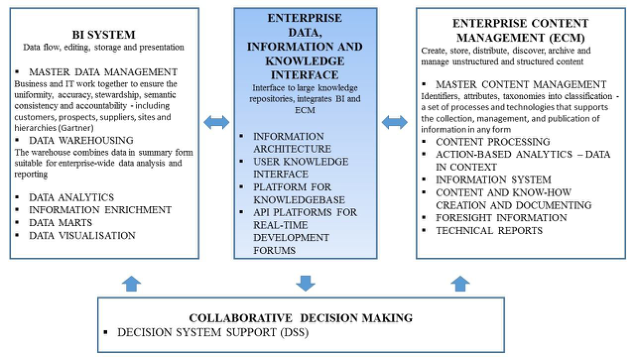
FUTURE PROSPECTS – SUPPORT THE EARLY ACTIVITIES Consider BI–structure starting from descriptive analytics and function-based event logs in order to both collect and share data in context and analyze meanings of events in an agile way collectively. Enterprise content manage- ment software and tools enable systematic and organization-wide processing (Figure 5).
Successful content analysis in teams starts from access to collected, essen- tial and firm-specific data, information and knowledge – the digital backbone
Data-Based Creativity in Systemic and Evolutionary Innovation 61
Figure 5: Business intelligence system parts.Figure 6: Content creation and management.
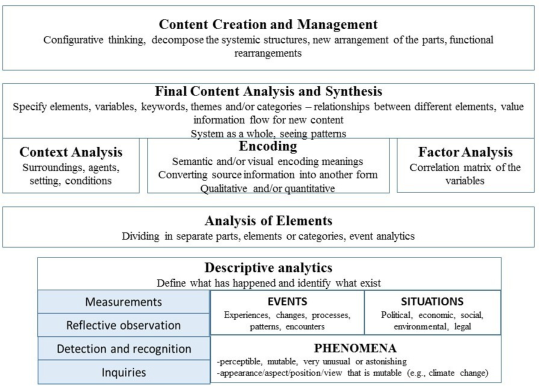
for the Enterprise Content Management (ECM) system. Looking at value information flow (Figure 6) into the content creation perspective, we can propose that comprehensive, systematic and proactive information proces- sing, encoding (converting into another form), context analysis and sharing all that content in organization enable more complete viewing of context, factors and elements - final content analysis from value information flow and descriptive analytics.
Lexical semantics is a useful method of creating understandable and holi- stic views as a part of content analysis procedure – analysis of definitions of words and their interdependence. Key words’ semantics open deep meanings of key words, allowing us to understand and create new novel concepts and
Figure 7: Information architecture and content creation platform.
solutions. Content analysis is used to open up meanings, interrelationships and interdependence between different elements. It is interpreting and coding textual material - changing qualitative data into quantitative data.
Content analysis reveals alternatives into the creative synthesis and new knowledge creation. This is a fast-flowing process to new valuable informa- tion, knowledge and know-how – a vital process to stimulate imagination and creativity – value creation collectively in order to make better decisions.
Digital transformation is the profound transformation of business and organisational activities, processes, competencies and models to fully leve- rage emerging changes and opportunities. (iScoop, 2022) Consider interfaces to help share essential content to create new knowledge and innovation ini- tiatives. We see an ongoing integration of digitalization - including big data and process mining, data analytics, embedded analytics and enterprise con- tent management - and business intelligence systems, smart devices, robotics and artificial intelligence together. This integration is an engine of industry and society’s evolution.
There is a trend from traditional data warehousing (DW) and business intelligence (BI) into advanced analytics combining AI and machine learning for big data processing. The term advanced analytics is used to combine descriptive, predictive and prescriptive analytics – predicting future events and optimization to get the most optimal and ideal events to happen. Fast knowledge creation in learning communities needs adaptive and suppor- ting ICT systems combining BI into new Enterprise Content Management procedures (ECM). ECM includes capturing, storing, managing and sha- ring essential content. Integration of these tools help organizations focus on core activities of performance - to be able to find new business advantages and opportunities. One part of the system is a computer-based application of Decision Supporting Systems (DSSes), which help to identify and solve problems, create innovation initiatives, new knowledge, and make decisions for future needs.
Data-Based Creativity in Systemic and Evolutionary Innovation 63
Shared terminology, semantics and ontology plays a key role in enabling such collaborative network systems for co-creation and co-innovation. Digi- tal transformation happens on internal operational, external ecosystem and business environment levels. Combine all relevant data and actions in the same place, which means that people don’t have to navigate many different applications in order to get a holistic view. This is a path to an effective tea- mwork where all participants have access to the same data, information and knowledge. Databases are the origins of business intelligence platforms. In the following are listed some of the benefits of using idea databases:
A system of value information flow.
Keeping track of proposed ideas residing in one place – idea database.
Fragmented pieces of data, information and ideas can be integrated, and connections triggered.
Helps connecting and sharing useful ideas – associations and third alter- native creation.
Everyone can give their contribution as a part of a larger whole – people engagement.
Grouping observation support combining, reflecting and producing ideas.
Enables work groups or teams to enrich ideas efficiently.
Classification includes main areas of interests: technological observations, trend spotting.
We do not invent the same things again and again.
It gives a structure into idea management.
It might include idea criteria, rules, methods, and other process-relevant instructions.
‘Automatic data flow is beginning to be possible with new IT-products like RSS readers. RSS feeds can, for example, allow user to keep track of many different websites in a single news aggregator’ (Wikipedia, 2023). ‘Feed rea- ders aggregate internet content into one convenient place, making it possible for you to quickly scan headlines and full stories at a glance from a variety of different providers’ (Lifewire, 2023). This is useful for collecting events and data for analytics.
Analytics evolution is going towards advanced analytics. It is autonomous or semi-autonomous examination of data or content using sophisticated tech- niques and tools, typically beyond those of traditional business intelligence (BI), to discover deeper insights, make predictions, or generate recommen- dations. ‘Advanced analytics techniques include data/text mining, machine learning, pattern matching, forecasting, visualization, semantic analysis, sen- timent analysis, network and cluster analysis, multivariate statistics, graph analysis, simulation, complex event processing, neural networks.’ (Gartner1, 2022) Provide the right information, at the right time to the right people in a way that it can be understood, and in the process, enable insights, associati- ons or corrective actions. This kind of precision-guided analytics helps people work smarter and more efficiently via data-in-context workflow and support organizations with bottom-up exploration of new opportunities. We need applications and technologies for gathering, analyzing, storing, sharing and providing access to data for making business decisions. This type of BI- appli- cations should be supported with content creation and management, data
and content visualization, and user-friendly interfaces and platforms for col- laborative decision support from virtually anywhere. ICT system architecture supports knowledge creation, innovation, learning, business performance, decision making and growth in an integrated manner.
Infusing AI into analytics workflows can transform an organization and bridge the supplier-consumer divide by giving everyone access to the tools they need to make data-driven decisions. The good news is that AI has already arrived on the market and is changing business. Today, the use of AI in analy- tics can be boiled down to three categories of technology: automated data discovery, search and conversational analytics, and intelligent modelling and recommendations. ‘AI-powered search is transforming the way businesspe- ople are interacting with enterprise information assets’ (Thoughspot, 2022). The integration of new IT tools, methods, procedures, software and plat- forms is possible when we have an information structure based on strategic business model choices. The basic thing for future ICT solutions are taxono- mies (classification systems), semantics and ontology, in addition to including strategic decisions.
What are the basic benefits of APIs? They are like paths for information flow in a controlled manner from one system, piece of equipment, or web service to another – information sharing with partners and customers – a path to digitalization for a business ecosystem. Could it be possible to create an ICT solution that turns data into insight? Is there an ICT solution availa- ble for creating growth initiatives? Considering new technologies: advanced analytics, API (SaaS), AI, Enterprise Content Management (ECM) and even data management solutions for analytics, we have tools and opportunities to be able to configure system to identify growth initiatives from data. APIs are the components that enable diverse platforms, apps, and systems to con- nect and share data with each other. Augmented analytics, an approach that automates insights using machine learning and natural-language generation, marks the next wave of disruption in the data and analytics market (Gar- tner2, 2022). The fourth industrial revolution – driven by data – forces us to transform offering, distribution, processes and capabilities. The final obje- ctive is to construct a company-specific idea management system as a part of the knowledge management process in order to store, share, create and transform knowledge effectively.
Fast digital economy evolution drives business model emergence for the sake of data science, integration the multitude of data sources within a business into an enterprise-wide analytics systems and decision supporting systems based on information architecture and analytics. As a response cre- ation of digital transformation strategy and initiatives are needed. These are areas to be considered in strategic agenda setting.
CONCLUSION
Continuous co-evolution of business requires such competences as analytical thinking and innovation, active learning and creativity. They are especially essential during the early phases of innovation. Competences can be used as guiding power and competitive advantage in the pathway to growth. The research introduces the origins of innovation and shows that pre-inventive
Data-Based Creativity in Systemic and Evolutionary Innovation 65
actions open the door for innovation initiatives for growth. Nowadays, complex business environments and ever-increasing competition requires effective, dynamic, and systematic innovation.
It is essential to have data-based pre-inventive actions giving stimulus for evolutionary, step-by-step, pathway to growth. This is a new value stream innovation paradigm. Challenges and insights emerge during the pathway. A new value stream innovation paradigm is proposed which opens possibili- ties of creative pre-inventive actions by understanding events, situations and problems in a holistic way. Challenges and insights emerge in many different phases during this systematic procedure in creating new value.
The goal of this article is to identify and analyze futures thinking in inno- vation capability. The article presents an evolutionary framework for data and event analytics in content management of the fuzzy front end of inno- vation. An essential team performance is collective analysis, interpretation and synthesis that can be used in prospective successful data-based foresight, creativity and innovation initiatives.
This article introduces data mining and management opportunities in systemic and evolutionary innovation. It also shows how business analytics and interpretation is integrated on data-based content creation and oppor- tunity identification and how data-based creativity is executed in a manner that supports evolutionary innovation.
In the future, virtual and augmented reality and digital twin techno- logy will bring new opportunities for data-based creativity in executing evolutionary innovation.
REFERENCES
Choo, C. W. 1995. Information Management for the Intelligent Organization. Digital Libraries Conference (March 27-30, 1995; Proceedings p. 81-99). Singapore: National Computer Board of Singapore. OR Dedi´c, N. and Stanier C. (2016). An Evaluation of the Challenges of Multilingualism
in Data Warehouse Development”in 18th Intern. Conf. on Enterprise Information Systems – ICEIS. Dimov, D. (2007) From opportunity insight to opportunity intention: The importance of person-situation learning match. Entrepreneurship Theory and Practice, 31(4): 561–583. Daft, R. L. and Weick, K. E. (1984). Toward a Model of Organizations as Interpre-
re-data-analytics. Hand, D, J., Mannila, H., Smyth. P. (2001) Principles of Data Mining, MIT Press.
USA. Hurley, R. F. 2002. Putting people back into organizational learning. Journal of Business and Indutrial Marketing; 17(4): 270–281. IBM (2022) https://www.ibm.com/cloud/learn/text-mining (read 14.1.2022). iScoop (2022) https://www.i-scoop.eu/digital-transformation/ (read 14.1.2022). Kijkuit, B., van den Ende, J. (2007) The organisational life of an idea: integra-
ting social network, creativity and decision making perspectives, Journal of Management Studies, Vol.44, No.6, pp. 863–882.
Lifewire (2022) https://www.lifewire.com/what-is-feedly-3482778 (read 14.1.2022). Sebastian I., Weill, P., Woermer S. (2021) Driving Growth in Digital Ecosystems. MIT Sloan Management Review, Fall 2020, Vol 62, No 1, MIT Press, Cambridge, USA. Techopedia (2022) https://www.techopedia.com/definition/14647/data-aggregation. Thoughspot, 2022 https://go.thoughtspot.com/rs/816-MBH-536/images/ThoughtSp
ot-SpotIQ-AI-Driven-Analytics-White-Paper.pdf . Wikipedia (2022) https://en.wikipedia.org/wiki/RSS#cite_note-Netsc99-3 (read 14.1.2022).
LISTED IN THE AHFE DIGITAL BOOKSTORE CATALOGUE
Explore the complete digital volume
Human Factors, Business Management and Society
Read this individual research paper free through the original publisher, or explore the full digital proceedings book.
ISBN 978-1-958651-73-5
Explore this ISBN in the AHFE Bookstore ↗Listed in the July 2026 bookstore catalogue; search by ISBN to confirm current availability · Digital book purchase optional