Jakob Würfel, Boris Djartov, Anne Papenfuß, Matthias Wies (2023). Intelligent Pilot Advisory System: The journey from ideation to an early system design of an AI-based decision support system for airline flight decks. In: Human Factors in Transportation. AHFE Open Access, vol. 95, pp. 589–597. https://doi.org/10.54941/ahfe1003844
The availability of more and more data from commercial aircraft , opens up new development potential for AI-based assistance systems on the flight deck . In this context, a number of research areas need to be addressed, including the interaction between AI and the cockpit crew. Designing systems which can facilitate this new interaction between the crew and the AI merits exploration.This concept paper discusses the need for an AI-based decision support system in the cockpit of commercial aircraft. An initial proposal is made on how such a system can be developed to address human-machine interaction aspects of implementing AI-based systems in the cockpit.To discuss the need for such a system, interviews with pilots, as well as videos of emergency situations from simulator-sessions were analyzed. Based on the findings, potential use cases and research topics were identified and a system design for a selected use case was developed.The interviews have shown that crews would like to be assisted by a system during high workload events, such as emergencies and abnormal situations. According to the interviews, one of the most important demand is assistance in the decision-making process. Situations where the crew need to abruptly select an alternate airport due to a technical failure or unforeseen changes at their destination, are of particular interest. In such situations, pilots must collect and interpret information and discuss options for action. The system requested should help pilots improve their available information, situation analysis and option generation. Based on the interviews, a use case and a basic system design will be outlined, and finally two approaches for implementing the system will be proposed, focusing on separate research topics . One approach develops the system from the end-user's perspective while the other examines it from the AI development perspective.For the first approach, the challenge of designing an interface between the crew and the artificial intelligence is discussed. One requirement is that the system present the information and generated options in a comprehensible way so that the crew can understand them quickly. One possible approach would be the research area of explainable AI, which attempts to explain to the user how the system computed the proposed solution. However, there is also the approach that domain-specific, more interpretable Human-AI-Interfaces is the better solution for end-user friendly systems. In this paper, we propose a human centered approach to develop an AI-based decision support system so that the AI-based information is presented in an understandable and interpretable way.Second ly, we present some additional details regarding the AI core. The focus here would be on how this system might be envisioned and which contemporary methods from the field of AI may be employed. Given the nature of the system the Learning Classifier System (LCS) will be discussed as one of the most suitable models for the AI core, as it is characterized by a more human understandable approach. Additional benefits of LCS’s will also be presented and compared with the most currently relevant models from the field of AI and machine learning.
In emergencies and time-critical situations, making decisions in the cock- pit of commercial aircraft is one of the biggest challenges for pilots. Decision-making schemes such as FORDEC (Facts, Options, Risks, Decision, Execution, Control) (Hoermann 1994) or TDODAR (Time, Diagnosis, Options, Decide, Assign Task, Review) (Walters 2002) help pilots make deci- sions in a structured way. In such cases, the pilots have to make operational decisions: Is the aircraft able to finish the planned flight? Should the aircraft land as fast as possible? What is the best alternative airport for a safe landing?
Interviews with seven airline pilots conducted at the DLR (Deutsches Zentrum für Luft- und Raumfahrt e.V., engl. German Aerospace Center) indi- cate a need for development in the area of decision support systems in airline cockpits. Already in 1996, Mosier and Skitka calls for developing decision support systems because of the increasing amount of data available to pilots.
In aviation, AI is increasingly being found and implemented. Intelligent assi- stance systems that support pilots in the cockpit will play a major role in the future (European Union Aviation Safety Agency 2020). This paper analyses interviews on the topic of new assistance systems, presents the most impor- tant results and outlines possible use cases. In addition, a preliminary system design of an Intelligent Pilot Advisory System (IPAS) is presented on the basis of the selected use cases. The goal is to expand the current body of work per- taining to AI decision support systems and address current research questions on aspects of human-system integration.
BACKGROUND
Cockpit systems have been constantly improving, and certain pilot tasks have become increasingly automated over the years with the help of new assistance systems. This have been done to both improve the safety and reduce the num- ber of crew members needed (Coombs 2005). Expert systems, which have been developed for aviation applications since the 1960s, represent the begin- ning of the development of intelligent assistance systems (Walsdorf 2002). Examples for knowledge-based decision support systems are CASSY (Cock- pit Assistant System) and CAMA (Crew Assistant Military Aircraft) which were developed in the 90s. The goal of the systems was to improve the pilots’ situational awareness and to take over tasks in order to reduce the pilots’ workload (Walsdorf 2002; Onken 1999). Both systems can be also seen as early cognitive assistant systems (Flemisch and Onken 1998).
Cognitive assistance systems are systems that automate mentally deman- ding tasks usually performed by humans, such as acquiring and analysing information, then generating and implementing decisions based on this infor- mation (Parasuraman et al. 2000). Shared control between humans and automation can be defined more detailed in three different levels: the stra- tegic level, the tactical level and the operational level (Flemisch et al. 2019). While the first AI technologies, such as expert systems, still process data using rules defined “manually”by the developer, machine learning algorithms learn on the basis of data and create their own rules for solving a problem or opti- mize them. Thanks to self-learning algorithms such as Machine Learning or the more advanced Deep Learning, which process huge amounts of data, the field of AI is seeing a new boom (Paaß and Hecker 2020).
In 2020, the European Union Aviation Safety Agency (EASA) published a roadmap for the development of AI in the domain of aviation with a “human-centric approach” (European Union Aviation Safety Agency 2020). Special attention should be paid to the interaction between AI and the pilots, because its application opens up new challenges and opportunities with regard to human system integration aspects for cockpit systems. For example, Endsley (2015) and the EASA Roadmap (2020) provide a valuable overview of some aspects of human factors involved in developing effective human AI systems. These aspects include the need for calibrated trust, system transpare- ncy, and adequate explainability, as well as mitigating potential risks such as lack of situational awareness, the “irony of automation”, and out-of-the-loop problems.
Intelligent Pilot Advisory System: The Journey From Ideation 591
Thus, the DLR has projected the development of the IPAS in 2021. The IPAS should be developed as an experimental platform to explore suitable AI algorithms, but also to take a closer look at the aspects of human factors of AI-based systems. The IPAS is intended to assist pilots in decision making by identifying and assessing situations and generating options for action at the strategic flight management level (Programmdirektion Luftfahrt 2021).
ANALYSIS OF AN INTERVIEW STUDY AND IDEATION As an approach for the research and development of the IPAS, an explo- rative design process is chosen, as presented in (Flemisch et al. 2022). The characteristic feature of this iterative development process called “Human System Exploration” is that users are involved in the development process at an early stage and thus new ideas and development hints are discovered with each development iteration, which seems very appropriate for exploring novel systems with a focus on human-AI interaction. The basic application and design ideas for the IPAS are identified in an ideation process that also involves the end users, airline pilots. At the beginning of the ideation process, it is only defined that the IPAS should be an AI-based decision support system on a strategic level.
Interview Analysis The development of the IPAS started by evaluating an interview study conducted with seven active first officers holding flight licenses for vari- ous commercial aircraft types, ranging from short- to long-haul aircraft such as the Airbus A320 and the Boeing 747. All pilots reported betw- een 3,000 and 10,000 flight hours. At the beginning of the semi-structured interviews, the need for support that is not covered by the existing cockpit systems was discussed. The pilots were not informed in advance of the inte- rview about the considerations of the IPAS described above, nor about the planned implementation of the IPAS as an AI-based system, so they went into the interviews unbiased and with an open mind. The second part of the inte- rview focused on AI-assisted decision support, wherein the IPAS concept was presented and discussed with the pilots using fictitious scenarios to gather insights on concerns, requirements, and functionalities. The goal of these ses- sions was to identify possible functionalities for the IPAS as well as ideas for the future of AI-based assistance systems and their possible realization. The statements of the interviewed pilots are summarized and grouped in the following main categories:
1. Problem areas and possible applications. 2. General concerns, comments and ideas about AI-based decision support. 3. Possible functionalities of an AI-based decision support system.
The first main topic deals with the question of what support is currently lacking in the cockpit from the pilot’s point of view. This was discussed in an open-minded way and was not restricted to decision support systems. The collected statements show that today’s cockpit lacks projection support to assist flight planning on a strategic level by providing a forecast of the status
of the aircraft and environment in the future. The quote “We don’t know anything beyond the next 10 minutes” is referring to the weather (5 menti- ons) as well as to the traffic situation (3 mentions) along the route or at the destination. The desire for early mapping and forecasting of the situation on the complete flight route was requested several times in all interviews. This is also shown by the fact that pilots inform themselves about the situation on the route and at the destination airport via flight tracking or weather apps on their personal mobile phones. Related to these strategic planning issues, all pilots interviewed mentioned the need for an assistance system that assists in finding and assessing operational options and supports stra- tegic planning in emergencies, such as helping pilots find a suitable alternate airport. A suggestion showed that the system can also help with normal ope- rations. By analysing weather and traffic data, pilots could be informed early about potential events at the destination so that planning for route changes could begin sooner. This would also allow the flight path to be adjusted - routing and speed corrections - in terms of sustainability. It is noteworthy that, without influencing the participants in advance, one of the most impor- tant demands is related to the original idea of the IPAS - support in decision making at a strategic level. The second major issue is the need for a technical error support system. 6 out of 7 pilots requested support in interpreting tech- nical errors and assessing their impact on operations. The current provision of technical information by the cockpit systems is either too complex or the search for the required information in the available manuals takes too much time. In addition, according to participants, the combination of two errors and their operational impact are not taken into account in today’s systems.
Under the second main topic, the pilot’s concerns regarding AI-based systems are discussed. It is discussed which characteristics the participants expect from an AI-based assistance system and which problems they see regarding such systems. All participants mentioned in the interviews that the understandability of the system results is very important. For example, it is important for pilots to know how up-to-date the data is and what criteria the system uses to evaluate the options. In the case of self-collected information, the pilots know where the data comes from and how old it is. If the data is collected by an automated system, the pilots do not know anything about the origin of the data – this system transparency must be guaranteed. In addition, three pilots mentioned that besides the understandability of the data, good interpretability must also be ensured, as situations with high workloads do not allow much time to interpret the information on the display. It is also clear (4 out of 7 mentions) that a sufficient and well-designed familiarization period is necessary for a high level of acceptance of a new system. This is also specifically addressed by the pilots: Quotes “regular training in the simula- tor” or “understanding must be trained what the IPAS does and how”. This desire for system transparency, to show what the system does, is also directly related to the topic “understandability of results” and is extremely impor- tant to the pilots for new unfamiliar systems. Last, some ideas for design and implementation, as well as worries about the IPAS were raised. The concerns mentioned are aimed at the pilot being overwhelmed by too much informa- tion, as well as the overloading of information channels and cockpit displays.
Intelligent Pilot Advisory System: The Journey From Ideation 593
It was also mentioned that pilots might get used to the assistance over time and thus might have difficulties in making decisions on their own.
Lastly the information and relevant factors for the decision support system, pertaining to alternate airport selection, were discussed. Time, available fuel and the particular landing risk were named as main factors here. In addition, current and predicted weather, the traffic conditions, as well as up-to-date NOTAMS, were named as important decision factors. In particular, the expected weather conditions in combination with the runway infrastructure (technical equipment, approach procedures, runway length) contribute signi- ficantly to the evaluation of an alternate airport. Additional logistical and operational factors, such as passenger handling, and maintenance availability were mentioned as further factors.
Results of Ideation Process Based on the gathered information and the accompanying ideation process, the following IPAS functions were determined, focusing decision support functionalities. The idea behind this is to describe what the system should roughly do so that it can be defined more specific in the following design phase.
1. Support in strategic in-flight planning during normal operations – The new system should assist the crew by analysing weather and traffic data in real time along the route and especially at the destination. The system should assist crews in projecting future status and predicting potential events by, for example, identifying possible route changes, predicting which approach direction is active at the destination, or whether holding patterns are required at the destination. 2. Find alternate airports and routing options in case of emergency and abnormal situations – The new assistance system should support the pilots in the decision-making process by collecting data, analy- sing the data and generating and assessing options for action. It will display the relevant information to the pilots, identify potential risks and the effects of technical errors on operational limitations, and finally provide decision options adapted to the situation. For example, it will find suitable alternative airports based on situational factors when the system detects that a continuation of the flight is no longer possible.
Given the intended use of the IPAS, valid concerns were raised, regar- ding the explainability and interpretability of an AI-based decision support system. To address these concerns, the research areas of Explainable AI (XAI) (Gunning et al. 2021; Rojat et al. 2021) and interpretable AI (Rudin 2019; Molnar 2022) should be take into account.
PROPOSED IPAS CONCEPT At the beginning of the conceptual design phase, the basic system idea and requirements are defined using the ideation process outcome to obtain a basic understanding of the system. This forms the transition between the ideation and the development of the new system (Flemisch et al. 2022). The IPAS 1. is
intended to be a decision support system whose recommendations are based on AI algorithms. 2. should assist pilots in workload-intensive situations. 3. should continuously monitor the status of the mission and the aircraft, highlight anomalies, and assist in decision-making if needed. 4. The resulting support should be easily interpretable by the pilots.
Use Cases First, eight detailed use cases are formulated to specify the ideas of the functions and usage of the IPAS. All Use Cases are categorized in two main applications.
1. Information Support - In normal operation, the IPAS prepares and displays data regarding traffic conditions, weather, etc. along the route and at the destination airport. The crew will be informed if increased traffic is detected, a change in weather is likely, or any other situation that will affect the flight is identified. Possible effects on the mission are then calculated by the IPAS and advices are provided to the crew.
2. Decision Support – The IPAS detects a technical error that leads to ope- rational limitations and risks. Based on the aircraft status and collected data from the environment (weather, airport, …) the IPAS calculates the critica- lity of the situation, if a diversion is necessary and if so, which airports are suitable for a landing with the given parameters and constraints.
Basic System Functions To go deeper into the system design, some more detailed basic functions are developed, which the IPAS has to provide to fulfil the previously defined use cases. All functions are grouped into four pillars. First, the situation must be perceived and evaluated automatically by the system using AI. Depending on the situation, functions from pillar 2 - functions for assistance in normal operations - or pillar 3 - functions for assistance in abnormal or emergency situations - are used. The last pillar provides interaction functions between the crew and the IPAS. With the help of these functions, all use cases can be realized.
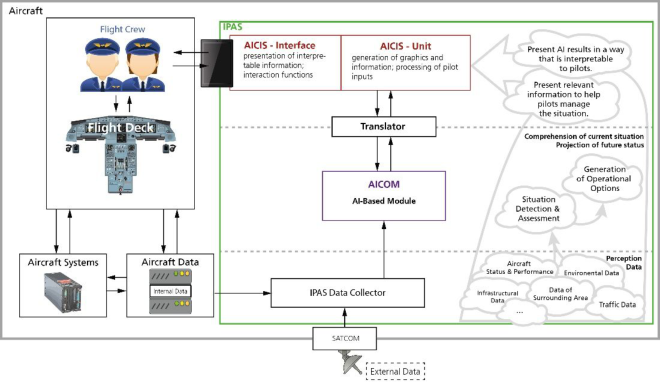
System Modell After the required base functions are defined, a first system model of the IPAS is developed, which can be seen in Figure 1. On the right side you can see which process steps are performed in the different system modules. The classification of the described functionality is oriented by the model of sha- red situation awareness and the situation model of autonomy according to Endsley (2015). First, the “IPAS Data Collector” has to collect data from the aircraft, but also from outside the aircraft via satellite communication. Some examples are weather data, topographical data or traffic data. The “AI-Core-Module” (AICOM) continuously assesses the situation based on the collected date. If the situation assessment detects a situation like an emer- gency, the AICOM generates operational options to assist the pilot in decision making. Finally, the “AI Crew Interaction System” (AICIS) presents the AI results and relevant information to the pilots in an understandable way so
Intelligent Pilot Advisory System: The Journey From Ideation 595
Figure 1: System model of the IPAS.
that the pilots can quickly interpret the information and recommendations even under time pressure.
OUTLOOK This concept paper gives an overview of an AI-based Intelligent pilot decision support system, the IPAS. The concept for this system stems from the analysis of a pilot interview. The system consists of two key elements: The AICIS and the AICOM.
The AICIS is intended to present AI results to pilots in a way that allows pilots to quickly understand and interpret them, even under time pressure. This is one of the findings from the interviews and is also addressed in the baseline requirements. Since the end user is not in the focus of XAI and therefore the usability of XAI is neglected (Rudin 2019), the focus of the research of the AICIS will be placed on better interpretability for the end user. A domain-specific and end-user centered interface should be developed, which contains features that support interpretability. Finding these characte- ristics is the main research question of the AICIS development. The goal of the AICIS is to present the information provided by an AI model in a way that is understandable and interpretable, similar to what is described by Lipton (2018) and not to create new more interpretable models. In order to find the mentioned characteristics that should support interpretability, the explorative development approach is chosen. Through multiple iterative prototypes and immediate feedback from the pilots, the goal here is to find as many clues as possible for characteristics that support interpretability. These characteristics will then be evaluated in a final prototype.
The AICOM is tasked with the determination of the proper course of action. The AICOM should make use of models to provide the decision that will then be given to the AICIS. Given the requirements for explainable and interpretable AI along with the number of factors that should be considered
simultaneously, the AICOM is currently envisioned to be based on multi- criteria decision making (MCDM) concepts (Aruldoss et al. 2013) with the main algorithm being a learning classifier system (LCS) (Urbanowicz and Moore 2009). MCDM allows decision makers to take into account multiple variables at once, while making a decision. On the other hand, the LCS has been shown to be a prudent approach when trying to tackle MCDM pro- blems (Bernadó-Mansilla et al. 2006) and also is a more interpretable model as it is a rule-based model, where the rule follows a more simple if, then structure (Urbanowicz and Moore 2009). The LCS also allow both offline and online learning, which means new rules can be added dynamically with little hassle and it may acquire new rules on the fly (pun intended) (Urbano- wicz and Moore 2009). Given limited data availability the plan is to train the AI model in a simulated environment which incorporates multitude of real world data, where many varying scenarios can be represented. The simulated environment enables the algorithm to be exposed to very extreme and niche situations, that although unlikely, can happen in the real world. Thus, the hope of our system is to truly be a helping hand even in the toughest and strangest of situations.
REFERENCES
Aruldoss, M.; Lakshmi, T.; Venkatesan, V. (2013): A survey on multi criteria decision making methods and its applications. In: American Journal of Information Systems 1, S. 31–43. DOI: 10.12691/ajis-1-1-5. Bernadó-Mansilla, E.; Llorà, X.; Traus, I. (2006): Multi-objective Learning Classifier
Systems. In: Yaochu Jin (Hg.): Multi-objective machine learning, Bd.16. Berlin, Heidelberg, New York: Springer (Studies in Computational Intelligence, Vol. 16), S. 261–288. Coombs, L. F. E. (2005): Control in the sky. The evolution and history of the aircraft cockpit. Barnsley: Pen & Sword Aviation. Endsley, Mica R. (2015): Autonomous Horizons: System Autonomy in the Air
Force – A Path to the Future. Volume I: Human-Autonomy Teaming. European Union Aviation Safety Agency (Hg.) (2020): EASA-AI-Roadmap. A human-centric approach to AI in aviation. Version 1.0. Cologne, Germany. Flemisch, F. O.; Onken, R. (1998): The cognitive assistant system and its contri-
bution to effective man/machine interaction. In: The Application of Information Technology (Computer Science) in Mission Systems. Flemisch, F. O.; Preutenborbeck, M.; Baltzer, M.; Wasser, J.; Kehl, C.; Grünwald, R. et al. (2022): Human Systems Exploration for Ideation and Innovation in Potentially Disruptive Defense and Security Systems. In: Adlakha-Hutcheon, Gitanjali; Masys, Anthony (Hg.): Disruption, Ideation and Innovation for Defence and Security: Springer, Cham (Advanced Sciences and Technologies for Security Applications), S. 79–117. Flemisch, F.; Abbink, D. A.; Itoh, M.; Pacaux-Lemoine, M.-P.; Weßel, G. (2019):
Joining the blunt and the pointy end of the spear: towards a common framework of joint action, human–machine cooperation, cooperative guidance and control, shared, traded and supervisory control. In: Cogn Tech Work 21 (4), S. 555–568. DOI: 10.1007/s10111-019-00576-1. Gunning, D.; Vorm, E.; Wang, J. Y.; Turek, M. (2021): DARPA ‘s explainable AI (XAI) program: A retrospective. In: Applied AI Letters 2 (4). DOI: 10.1002/ail2.61.
Intelligent Pilot Advisory System: The Journey From Ideation 597
Hoermann, Hans (1994): FOR-DEC - A Prescriptive Model for Aeronautical Decision Making. Lipton, Zachary C. (2018): The mythos of model interpretability. In: Commun. ACM
61 (10), S. 36–43. DOI: 10.1145/3233231. Molnar, Christoph (2022): Interpretable Machine Learning. A Guide for Making Black Box Models Explainable. 2. Aufl. Online verfügbar unter https://christop hm.github.io/interpretable-ml-book. Mosier, K.; Skitka, L. (1996): Human Decision Makers and Automated Decision
Aids: Made for Each Other? In: Autom. Hum. Perform. Theory Appl, Bd.40, S. 201–220. Onken, Reiner (1999): The Cognitive Cockpit Assistant Systems CASSY/CAMA. In: SAE Technical Paper Series. World Aviation Congress & Exposition, OCT. 19, 1999: SAE International400 Commonwealth Drive, Warrendale, PA, United States (SAE Technical Paper Series). Paaß, G.; Hecker, D. (2020): Künstliche Intelligenz. Wiesbaden: Springer Fachmedien
Wiesbaden. Parasuraman, R.; Sheridan, T. B.; Wickens, C. D. (2000): A model for types and levels of human interaction with automation. In: IEEE transactions on systems, man, and cybernetics. Part A, Systems and humans: a publication of the IEEE Systems, Man, and Cybernetics Society 30 (3), S. 286–297. DOI: 10.1109/3468.844354. Programmdirektion Luftfahrt (Hg.) (2021): Schwerpunktplan Luftfahrt 2021. Geplante Leistungen und Ressourcen der internen Vorhaben und Projekte. Inter- ner Bericht. Deutsches Zentrum für Luft- und Raumfahrt. Rojat, T.; Puget, R.; Filliat, D.; Del Ser, J.; Gelin, R.; Díaz-Rodríguez, N. (2021):
Explainable Artificial Intelligence (XAI) on TimeSeries Data: A Survey. Online available http://arxiv.org/pdf/2104.00950v1. Rudin, Cynthia (2019): Stop explaining black box machine learning models for high stakes decisions and use interpretable models instead. In: Nat Mach Intell 1 (5), S. 206–215. DOI: 10.1038/s42256-019-0048-x. Urbanowicz, Ryan J.; Moore, Jason H. (2009): Learning Classifier Systems: A Com-
plete Introduction, Review, and Roadmap. In: Journal of Artificial Evolution and Applications 2009, S. 1–25. DOI: 10.1155/2009/736398. Walsdorf, Anton (2002): Zentrale, objektorientierte Situationsrepräsentation angewandt auf die Handlungsziele eines Cockpitassistenzsystems. Dissertation. UNI- VERSITÄT DER BUNDESWEHR MÜNCHEN, Munich, Germany. Fakultät für Luft- und Raumfahrttechnik. Walters, A. J. (2002): Crew Resource Management Is No Accident. Wallingford:
Aries.
LISTED IN THE AHFE DIGITAL BOOKSTORE CATALOGUE
Explore the complete digital volume
Human Factors in Transportation
Read this individual research paper free through the original publisher, or explore the full digital proceedings book.
ISBN 978-1-958651-71-1
Explore this ISBN in the AHFE Bookstore ↗Listed in the July 2026 bookstore catalogue; search by ISBN to confirm current availability · Digital book purchase optional