Shuo-Fang Liu, Chien-Ting Wu (2023). Using Fuzzy Theory to Analyze Delivery Platforms Using Foodpanda as an Example. In: Human Factors in Software and Systems Engineering. AHFE Open Access, vol. 94, pp. 127–132. https://doi.org/10.54941/ahfe1003778
With the development of e-commerce in recent years and the changing habits of consumers, delivery platforms have emerged, and businesses in food, clothing, housing and transportation are gradually collaborating with platforms to provide services that meet the needs of today's consumers. Many delivery platforms have emerged in response to this trend, and many food and beverage businesses have partnered with delivery platforms to expand their market size. Therefore, a fuzzy theory approach is used to help Foodpanda analyze user satisfaction to help companies make decisions in the future.
BACKGROUND AND MOTIVATION In this era of booming Internet, people don’t want to go out to buy food as long as they have delivery platforms. In addition to the outbreak of COVID-19, the business of delivery platforms continues to rise, and people’s lives have become very dependent on delivery platforms.
E-commerce and online food purchasing have experienced continuous gro- wth over the past decade, and the emergence of COVID-19 has prompted a major shift in food buying behavior. With the rapid growth of online food purchases, the scale of food delivery platforms and food delivery services con- tinues to expand, the number of participating consumers, the number and scope of purchases have increased significantly, and more and more people are participating in online purchases (Liang et al., 2022).
This food delivery platform has been full of times in our lives. We really want to know whether people are satisfied with the use of the food delivery platform, and whether there is room for improvement, so we use Foodpanda as an example to conduct a survey.
RESEARCH PURPOSES This study explores the satisfaction with the use of the Foodpanda plat- form. We analyze the Foodpanda interface and purchase process, analyze the online food delivery platform market, indirectly understand consumers’ satisfaction with use, and study consumers’ use of the food delivery platform
interface. ideas, which can help researchers understand consumer prefere- nces and identify market trends. Based on the above research purposes, find out consumers’ satisfaction with various services of the delivery platform, and help companies better grasp customers’ consumption preferences when making decisions.
RESEARCH OBJECT AND SCOPE The general public who use Foodpanda is used as the research object, and the research period is from May to June 2022. Research on the satisfaction analysis of the interface and purchase process of consumers using the delivery platform Foodpanda.
FOODPANDA The Foodpanda platform is available in more than 50 countries/regions around the world. It provides not only gourmet food but also groceries for consumers to purchase, and in the gourmet part, food from various countries is included. It is a very popular delivery platform for modern consumption Consumers can order meals in the platform or app to be delivered to their preferred locations. Online food ordering service apps help consumers eli- minate unnecessary processes by delivering food from specific restaurants to desired locations. Such delivery services can save unnecessary time (Yeo et al., 2021). Foodpanda has struggled for a while with vendors and restaurants in Tai- wan using traditional payment methods, which may be cash or credit cards. However, repeated communication and explanations have made many manu- facturers realize that online customers can also increase sales and generate new customers. Foodpanda has successfully signed contracts with more than 7000 suppliers or restaurants. According to the announcement in January 2019, the number of daily orders has increased by 1000 times since its ince- ption, making Foodpanda the No. 1 food delivery platform industry and gaining a 55% market share (Liu et al., 2021).
DELIVERY PLATFORM The total revenue of the global food delivery platform market is further sur- ging in the COVID-19 triggered food delivery platform industry. Since the COVID-19 pandemic, its sales and orders have grown a lot, and as custo- mers have increasingly turned to delivery platforms, service items have also increased (Niu et al., 2021), and now delivery The delivery platform not only provides food delivery services, but also provides different commo- dity delivery services, including buying electronic supplies, art supplies, daily necessities, etc., all of which are included.
People’s lives have become more and more dependent on food delivery platforms. As the market of food delivery platforms grows, more and more delivery people join the industry, and delivery people can be seen everywhere in daily life.
Using Fuzzy Theory to Analyze Delivery Platforms Using Foodpanda as an Example 129
With the boom of the Internet, smartphones have become more common and ubiquitous, and more and more companies are taking advantage of this to reach as many consumers as possible through mobile applications (Yeo et al., 2021), many stores have obtained more business income through the delivery platform, creating a new service model.
The COVID-19 pandemic is putting food delivery workers at health risk when delivering meals to people who are unable to go out due to the pande- mic. Delivery drivers are also often at risk of contracting the virus and need to take the necessary precautions to minimize the risk to their health. The- refore, most of the needs of couriers during the pandemic are different from before the pandemic and are a direct result of the risks and challenges posed by the pandemic (Umer, 2021).
FUZZY THEORY Fuzzy theory provides a rigorous mathematical framework in which fuzzy conceptual phenomena can be studied precisely and rigorously, and it can also be considered as a modeling language to understand (Lin & Hsieh, 2004).
This study will use fuzzy theory to evaluate. Fuzzy theory is usually used in human factors engineering improvement verification (Ruan & Li, 2021), industrial design, artificial intelligence, robot improvement, etc. We can understand the parts that users care about with the data collected earlier, so we can use these data to sort out the factor set of Foodpanda and analyze the degree of emphasis to make a judgment, so as to understand the satisfaction of the testees with Foodpanda.
RESEARCH PROCESS On the premise of the research background and motivation, we formed a team to discuss. The team included users who often use Foodpanda and other delivery platforms. We consulted domestic and foreign references on delivery services and customer satisfaction, and then To carry out relevant research, and then we design, collect and analyze questionnaires, and carry out statistical analysis.
1. Discuss the importance of food delivery platforms in Taiwan, taking Foodpanda as an example. 2. Introduction of Foodpanda and food delivery platform. 3. Find out various needs from the research content and design the questi- onnaire topics. 4. Summarize the verification results of the questionnaire, 5. Using fuzzy mathematics to explore Foodpanda satisfaction. 6. Sort out the conclusions and then put forward opinions and suggestions on the delivery platform.
RESEARCH AND ANALYSIS
1. According to the research, we have sorted out 5 Foodpanda factor sets
Factor sets U = {Interface is easy to understand, Pleasant to use, Interface operation is smooth, Intuitive interface, Smooth purchase process}.
130 Liu and Wu
2. Create an weight set According to the research, make the “weight” of the emphasis degree of each factor, and make an appropriate emphasis judgment A = 0.15/ Interface is easy to understand + 0.05/Pleasant to use + 0.35/Interface operation is smooth + 0.3/ Intuitive interface +0.15/ Smooth purchase process A = (0.15, 0.05, 0.35, 0.3, 0.15). 3. Create an evaluation set The purpose of the evaluation is to understand the satisfaction degree of the public to the delivery platform, and the evaluation result should be each level of satisfaction, so the evaluation set should be V={very satisfied, satisfied, not too satisfied, dissatisfied}.
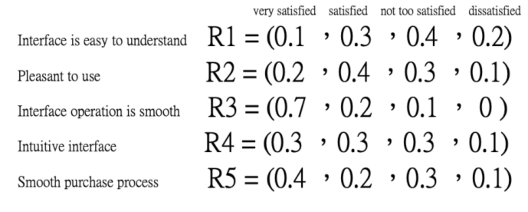
4. Factor Judgment Matrix Users are asked to evaluate each factor individually. A total of 30 people participated in the voting and evaluated this delivery platform.
Figure 1: Factor evaluation.
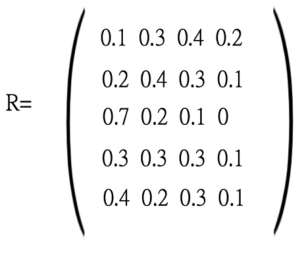
The evaluation matrix R of the factors of Foodpanda
Figure 2: Evaluation matrix R.
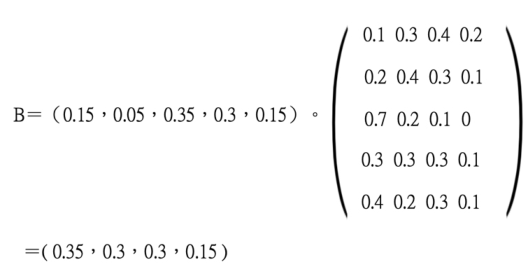
5. Fuzzy comprehensive evaluation Calculated according to fuzzy comprehensive evaluation formula, B=A
R 6. Judgment analysis Since the sum of all factors of the evaluation result is not 1, it will be treated as 1 ∵0.35 + 0.3 + 0.3 + 0.15 = 1.1
Using Fuzzy Theory to Analyze Delivery Platforms Using Foodpanda as an Example 131
Figure 3: Fuzzy comprehensive evaluation.
The judgment result can be changed to (0.35/1.1, 0.3/1.1, 03/1.1, 0.15/1.1) = (0.32, 0.27, 0.27, 0.14) The result of this judgment is that 32% of people are “very satisfied” with this delivery platform 27% of people are “satisfied” with this delivery platform 27% of people are “not too dissatisfied” with this delivery platform 14% of people are “dissatisfied” with this delivery platform.
CONCLUSION
Although the research results show that 32% of people are very satisfied with foodpanda, and 27% are satisfied. Generally speaking, the majority of people are satisfied with this platform, but the statistics show that the easy- to-understand part of the interface needs to be strengthened. Satisfied The degree is lower than other parts, so it can be strengthened and improved towards this part when making decisions.
While upgrading the APP function, quality brands must also improve their own service quality, and will have more advantages to compete with other brands in the future.
REFERENCES
Liang, Y. J., Zhong, T. Y., & Crush, J. (2022). Boon or Bane? Urban Food Security and Online Food Purchasing during the COVID-19 Epidemic in Nanjing, China. Land, 11(6). https://doi.org/ARTN 945 10.3390/land11060945. Lin, C. H., & Hsieh, P. J. (2004). A fuzzy decision support system for strategic portfolio management. DecisionSupportSystems, 38(3), 383-398. https://doi.org/10.1016/S0167-9236(03)00118-0. Liu, Y. Y., Chen, S. H., & Zhang, J. X. (2021). Applying Importance-Satisfaction
Model to Evaluate Customer Satisfaction: An Empirical Study of Foodpanda. Sustainability, 13(19). https://doi.org/ARTN 10985 10.3390/su131910985. Niu, B. Z., Li, Q. Y., Mu, Z. H., Chen, L., & Ji, P. (2021). Platform logistics or self-logistics? Restaurants’ cooperation with online food-delivery platform considering profitability and sustainability. International Journal of Production Economics, 234. https://doi.org/ARTN 108064 10.1016/j.ijpe.2021.108064.
132 Liu and Wu
Ruan, K., & Li, Y. (2021). Fuzzy mathematics model of the industrial design of human adaptive sports equipment. Journal of Intelligent & Fuzzy Systems, 40(4), 6103–6112. https://doi.org/10.3233/Jifs-189449. Umer, H. (2021). Illusory freedom of physical platform workers: Insights from Uber
Eats in Japan. Economic and Labour Relations Review, 32(3), 437-452. https: //doi.org/Artn 1035304621992466 10.1177/1035304621992466. Yeo, S. F., Tan, C. L., Teo, S. L., & Tan, K. H. (2021). The role of food apps servitization on repurchase intention: A study of FoodPanda. Interna- tional Journal of Production Economics, 234. https://doi.org/ARTN 108063 10.1016/j.ijpe.2021.108063.
LISTED IN THE AHFE DIGITAL BOOKSTORE CATALOGUE
Explore the complete digital volume
Human Factors in Software and Systems Engineering
Read this individual research paper free through the original publisher, or explore the full digital proceedings book.
ISBN 978-1-958651-70-4
Explore this ISBN in the AHFE Bookstore ↗Listed in the July 2026 bookstore catalogue; search by ISBN to confirm current availability · Digital book purchase optional