Zhaken Kuanyshbayev (2023). Definitions of The Tariff between Dostyk St. (Kazakhstan) – Mannheim Industry and Hafen St. (Germany). In: Human Factors in Management and Leadership. AHFE Open Access, vol. 92, pp. 81–94. https://doi.org/10.54941/ahfe1003737
The article deals with the issue of determining the tariff for freight transportation along the route Dostyk station (Kazakhstan) - Mannheim Industry Hafen station (Germany) on the basis of the Common Transit Tariff (ETT) methodology under the scheme with a tariff break and under the through shoulder scheme. A method for determining the tariff based on the supranational currency EvroNur is proposed. The effectiveness of the use of supranational currency in the organization of international freight traffic is clearly shown.
Determination of the Carriage Charge for Wagon Departments The cargo of wide consumption is presented for transportation, wagon shipment. The rolling stock is selected in accordance with the transport chara- cteristics of the cargo (protection from solar radiation, moisture, unpleasant odor). Therefore, loading was carried out in a covered wagon with a carrying capacity of 65 tons. Freight train route Dostyk (Kazakhstan).
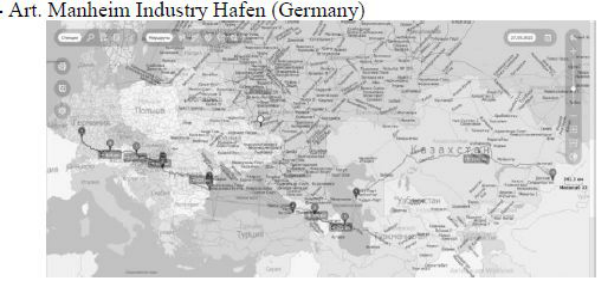
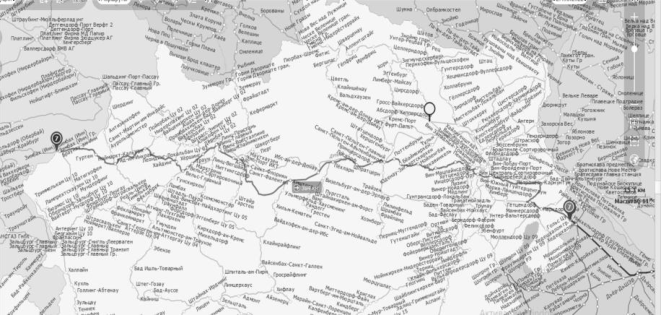
Figure 1: Freight train route Dostyk station (Kazakhstan) - Art. Mannheim Industry Hafen station (Germany), through-arm.
Initial data for the freight train route, intermodal route. The freight train route runs along the railways of the Republic of Kazakhstan, the Caspian Sea, the railways of the Republic of Azerbaijan, the Republic of Georgia, the Black Sea, the railways of Romania, Hungary, Austria, the railways of Germany. We will present the initial data of the route indicating the departure stations, destination stations and the tariff distance between border stations (Table 1).
Table 1. Initial data of a freight train.
Table available in the original PDF paper.
# Station departures
Station destination
Tariff distance, km
Port of Baku-Torgovaya 345,0
1 Dostyk Port Kuryk (Kazakhstan) 3170,0 2 Caspian Sea, Port Kuryk
1093,0
3 Baku-Torgovaya Boyuk-Kesik (Azerbaijan 301,0 4 Gardebani (exp.) Batumi (exp.) (Georgia) 390,0 5 Black Sea, Port of Batumi (Georgia)
Port of Constanta (Romania) 829,0
6 Port of Constanta ferry
Kurtic gran Timana (Romania) 407,0
7 Lökeshaza (Hungary)
Hedeshhalom gr. (Hungary) Simbach Inn Gr. (Austria) 384,0
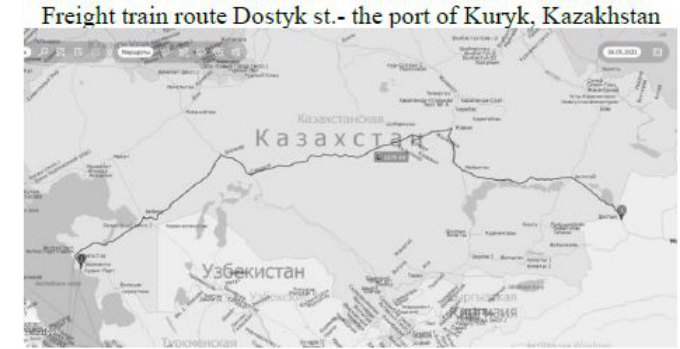
Determination of the Carriage Fee Along the Route Dostyk St - The Port of Kuryk, Republic of Kazakhstan For the specified route, we determine the freight charge. Initial data: wagon shipment, shipment weight 65t. From the presented table, we select specific tariff rates, so at a distance of 3170.0km. The unit tariff rate for class 2 cargo is 73.80ChF; for the return of empty rolling stock - 157.95ChF per axle. Then, the freight charge according to the Unified Transit Tariff (UTT) method will be (Table 2).
T = 73,80 ∗65 + 157,95*4 = 5428,8 ChF Sea Route - Caspian Sea, Port Kuryk (Kazakhstan) - Port Baku- Torgovaya, Azerbaijan
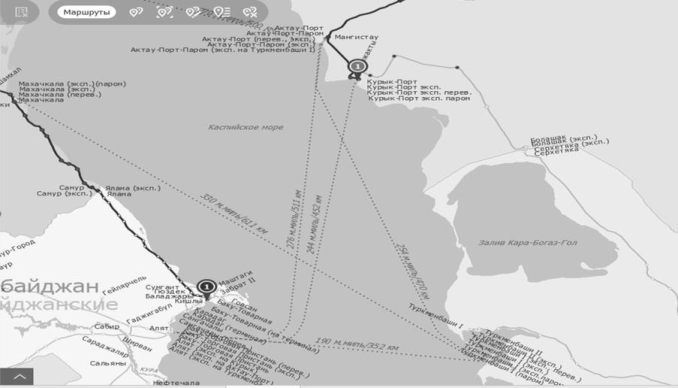
The tariff distance of the sea route is 345.0 km. The rolling stock is loaded onto the ferry. As a rule, 5 innings of 10 wagons are placed. In each specific case, there are deviations from the specified layout, but in principle the pri- nciple of symmetrical loading of the ferry is observed. The determination of
Definitions of the Tariff 83
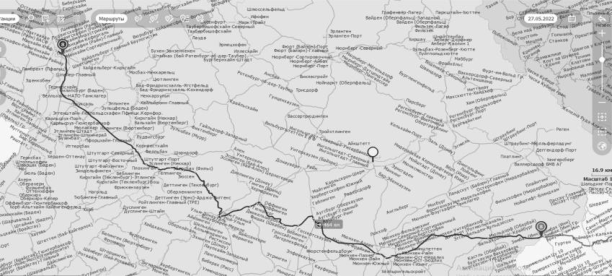
Figure 2: Freight train route Dostyk st.- the port of Kuryk, tariff distance 3170.0 km. (Kazakhstan).Table 2. Determination of the freight charge on the route Dostyk st. - Kuryk port.
the carriage fee is carried out on the basis of the specific tariff rate, 1tkm - $1.0. Based on this, the freight charge for the transportation of a unit of rolling stock will be.
Equations and mathematical formulas are available in the original paper PDF.
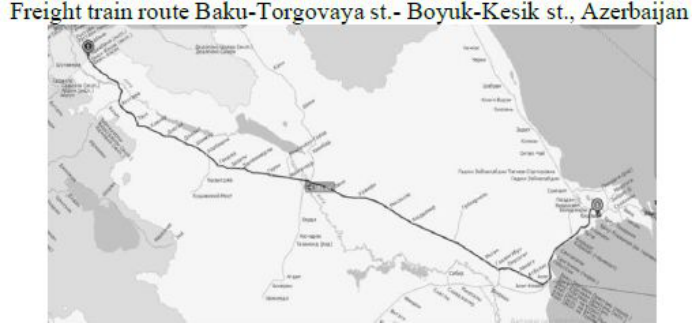
Determination of the Carriage Fee Along the Route St. Baku - Torgovaya - St. Boyuk-Kesik, Azerbaijan Sending wagon - 65 tons, tariff distance - 501.0km. The unit tariff rate for class 2 cargo is 11.50ChF; for the return of empty rolling stock - 24.69ChF per axle. Then, the freight charge according to the Unified Transit Tariff (UTT) method will be (Table 3).
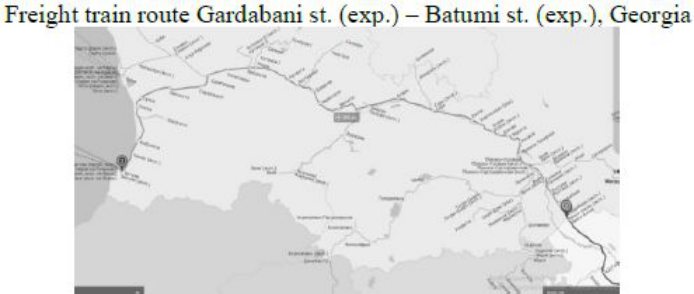
Determination of the Carriage Fee Along the Route Gardabani Station (Exp.) - Batumi Station (Exp.), Georgia The tariff distance along the route is 396.0 km. The unit tariff rate for class 2 cargo is 9.30ChF; for the return of empty rolling stock - 19.76ChF per axle. Then, the freight charge according to the methodology of the Unified Transit Tariff (ETT) will be (Table 4).
84 Kuanyshbayev
Figure 3: Sea route Kuryk port (Kazakhstan) – port of Baku-Torgovaya (Azerbaijan).Table 3. Determination of the carriage fee along the route Baku-Torgovaya station- Boyuk-Kesik station.
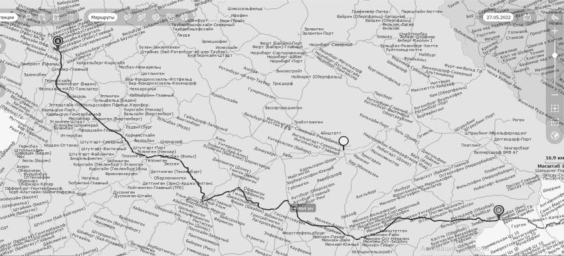
Figure 4: Freight train route Baku-Torgovaya st.- Boyuk-Kesik st.
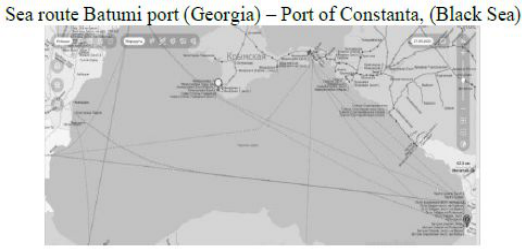
Sea Route - Black Sea, Port of Batumi (Georgia) - Port of Constanta, Romania The tariff distance of the sea route is 1093.0 km. The determination of the freight charge is carried out on the basis of the specific tariff rate, 1tkm - $1.0. Based on this, the freight charge for the transportation of a unit of
Definitions of the Tariff 85
Table 4. Determining the fare along the route Gardabani st. (exp.) – Batumi st. (exp.).
Figure 5: Freight train route Gardabani st. (exp.) – Batumi st. (exp.), tariff distance 396.0 km. Georgia.Figure 6: Sea route route Batumi port (Georgia) - Constanta port (Romania), tariff distance 1093.0 km (699.0 miles).
rolling stock will be.
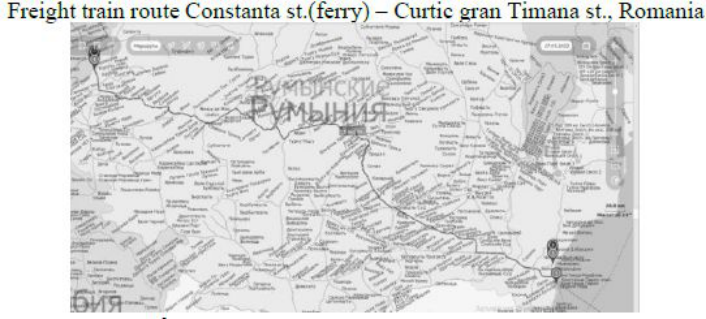
Determination of the Carriage Fee on the Route St. Constanta (Ferry) St. Kurtic Gran Timan, Romania The tariff distance along the route is km. The unit tariff rate for class 2 cargo is 19.20ChF; for the return of empty rolling stock - 40.98ChF per axle. Then, the freight charge according to the method of the Unified Transit Tariff (ETT)
86 Kuanyshbayev
will be (Table 5).
Table 5. Determining the fare along the route Constanta stattion (ferry) - Kurtic gran Timana station.
Figure 7: Freight train route Constanta port - Kurtic gran Timan st., tariff distance 829.0 km (Romania).
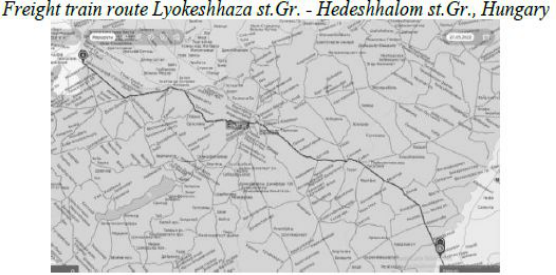
Determination of the Carriage Fee Along the Route Lyokeshhaza Station Gr. - Hedeshhalom Station Gr., Hungary The tariff distance along the route is 407.0 km. The unit tariff rate for class 2 cargo is 9.50ChF; for the return of empty rolling stock - 20.24ChF per axle. Then, the freight charge according to the method of the Unified Transit Tariff (ETT) will be (Table 6).
T = 9, 50 ∗65 + 20, 24 ∗4 = 698, 46 ChF Determination of the Fare on the Route Nikkelsdorf Station Gr/Hedeshhalom Station Simbach (Inn) Station Gr., Austria
The tariff distance along the route is 384.0 km. The unit tariff rate for class 2 cargo is 8.90ChF; for the return of empty rolling stock - 18.77ChF per axle. Then, the freight charge according to the method of the Unified Transit Tariff (ETT) will be (Table 7).
Definitions of the Tariff 87
Table 6. Determining the fare along the route Lyokeshhaza st. Gr. - Hegyeshhalom st, Gr.
Figure 8: Freight train route Lyokeshhaza st. Gr. - Hegyeshhalom st. Gr., tariff distance 407.0 km. (Hungary)Table 7. Determining the fare along the route Nikkelsdorf st. Gr./Hegyeshhalom st. Gr.
Determination of the Carriage Fee Along the Route St. Simbach (Inn) Gr. - Art. Manheim Industry Hafen, Germany The tariff distance along the route is 464.0 km. The unit tariff rate for class 2 cargo is 10.70ChF; for the return of empty rolling stock - 22.71ChF per axle. Then, the freight charge according to the method of the Unified Transit Tariff (UTT) will be (Table 8).
T = 10,70*65 + 22,71*4 = 786,34 ChF Let’s imagine the freight charge for the specified route according to the scheme of a through shoulder. The tariff distance along the route is 7589.0 km. The length of the land route is 6151.0 km; sea route - 1438.0 km Unit tariff rate for class 2 cargo is 141.20ChF; for the return of empty rolling stock - 302.34ChF per axle. Then, the freight charge according to the method of the Unified Transit Tariff (ETT) will be (Table 9).
88 Kuanyshbayev
Figure 9: Freight train route Nickelsdorf Gr/Hedeshhalom st. Gr. - Simbach (Inn) st. Gr. tariff distance 384.0 km (Austria).Table 8. Determining the fare along the route Simbach (Inn) st. Gr. - Manheim Industry Hafen st.
Figure 10: Freight train route Simbach (Inn) st. Gr. - Manheim Industry Hafen st., tariff distance is 464.0 km., Germany.
From the presented calculations, it can be seen that the freight charge under the tariff break scheme is 10,508.9ChF; under the scheme of a through shoulder - 10387.36ChF (Table 10, 11). The through leverage tariff was the cheapest by (10508.9 – 10387.36) = 121.54ChF.
Definitions of the Tariff 89
Table 9. Carriage fee on the route Dostyk st. (Kazakhstan) - Mannheim Industry Hafen st. (Germany), tariff break scheme.
DETERMINATION OF THE FEE FOR CONTAINER SHIPPINGS Determination of the Carriage Fee Along the Route Dostyk Station - The Port of Kuryk, Republic of Kazakhstan
Initial data: wagon shipment, shipment weight - no more than 18 tons. From the presented table, we select specific tariff rates at a distance of 3170.0 km.
90 Kuanyshbayev
Table 11. Carriage fee on the route Dostyk st. (Kazakhstan) - Mannheim Industry Hafen st. (Germany), through-arm scheme.
Table available in the original PDF paper.
# Station departures
Station destination
Freight charge, ChF
Tariff distance, km
6 151,0 10 387,36
1 Dostyk station (Kazakhstan)
Manheim Industry Hafen station (Germany)
Unit rate per 20 foot. container is 3320.0ChF; for the return of empty rolling stock - 1660.0ChF. Then, the freight charge according to the Unified Transit Tariff (UTT) method will be for one container, two containers are placed on the platform, then: T = 2 ∗(3320,0 + 1660,0) = 9960, 0 ChF
Sea Route - Caspian Sea, Kuryk Port (Kazakhstan) - Baku- Torgovaya Port, Azerbaijan The determination of the carriage fee is carried out on the basis of the specific tariff rate, 1tkm - $1.0. Based on this, the freight charge for the transportation of a unit of rolling stock will be.
Determination of the Carriage Fee Along the Route Baku-Torgovaya St. - Boyuk-Kesik, St. Azerbaijan The tariff distance along the indicated route is 501.0 km. Unit rate per 20 foot. container is 518.0ChF; for the return of empty rolling stock - 259.0ChF. Then, the freight charge according to the Unified Transit Tariff (UTT) method will be for one container, two containers are placed on the platform, then.
T = 2 ∗(518,0 + 259,0) = 1554,0 ChF Determination of the Carriage Fee Along the Route Gardabani St. (Exp.) - Batumi (Exp.), Georgia
Tariff distance on the indicated route is 396.0 km. Unit rate per 20 foot. con- tainer is 417.0ChF; for the return of empty rolling stock - 209.0ChF. Then, the freight charge according to the Unified Transit Tariff (UTT) method will be for one container, two containers are placed on the platform, then.
T = 2*(417,0 + 209,0) = 1252,0 ChF Sea Route - Black Sea, Port of Batumi (Georgia) - Port of Constanta, Romania
The tariff distance of the sea route is 1093.0 km. The determination of the carriage fee is carried out on the basis of the specific tariff rate, 1tkm - $1.0.
Definitions of the Tariff 91
Based on this, the freight charge for the transportation of a unit of rolling stock will be.
Determination of the Carriage Fee on the Route Constanta St. Ferry Kurtic St. Gran Timan, Romania The tariff distance along the route is 829.0 km. Unit rate per 20 foot. contai- ner is 863.0ChF; for the return of empty rolling stock - 431.0ChF. Then, the freight charge according to the Unified Transit Tariff (UTT) method will be for one container, two containers are placed on the platform, then:
T = 2*(863,0 + 431,0) = 2588,0 ChF Determination of the Carriage Fee Along the Route Lyokeshhaza Gr., St. – Hedeshhalom Gr. St., Hungary
The tariff distance along the route is 407.0 km. Unit rate per 20 foot. contai- ner is 426.0ChF; for the return of empty rolling stock - 213.0ChF. Then, the freight charge according to the Unified Transit Tariff (UTT) method will be for one container, two containers are placed on the platform, then: T = 2*(426,0 + 213,0) = 1278,0 ChF
Determination of the Fare on the Route Nikkelsdorf Gr., st. Hedeshhalom Gr. St., – Simbach Inn Gr. St., Austria The tariff distance along the route is 384.0 km. Unit rate per 20 foot. contai- ner is 396.0ChF; for the return of empty rolling stock - 198.0ChF. Then, the freight charge according to the Unified Transit Tariff (UTT) method will be for one container, two containers are placed on the platform, then:
T = 2*(396,0 + 198,0) = 1188,0 ChF Determination of the Carriage Fee Along the Route Simbach Inn Gr., St. –Manheim Industry Hafen St., Germany
The tariff distance along the route is 464.0 km. Unit rate per 20 foot. contai- ner is 636.0ChF; for the return of empty rolling stock - 239.0ChF. Then, the freight charge according to the Common Transit Tariff (UTT) method will be for one container, two containers are placed on the platform, then: T = 2*(636,0 + 239,0) = 1750,0 ChF
The data obtained on tariffs for the organization of container transportation are presented in Table 12.
When loading into a 20-foot container, there is a peculiarity, which is that two 20-foot containers are placed on the platform. Then the fee is doubled. For a 20ft container. loaded and return of an empty container will be.
T = (6350 + 3175)*2 = 20 250,0 ChF The organization of international transportation showed the effectiveness of the through shoulder scheme. The tariff for freight transportation under the
92 Kuanyshbayev
Table 12. Carriage fee on the route Dostyk stattoin (Kazakhstan) - Manheim Industry Hafen station (Germany), container shipping.
Table 13. Route efficiency Dostyk st. (Kazakhstan) - Mannheim Industry Hafen st. (Germany), through-arm scheme. # Station departures
Table available in the original PDF paper.
Station destination
Freight charge, ChF
Tariff distance, km
6 151,0 20 250,0
1 Dostyk (Kazakhstan) station
Manheim Industry Hafen station (Germany)
Comparison of the fare break scheme (20,951.91 ChF) and the through- arm scheme (20,250.0 ChF) gives an economic effect of 751ChF per rolling stock. If we assume that there are 240 axles in a freight train, then the number
Definitions of the Tariff 93
Figure 11: Dependence of unit tariff rates on transportation distance.
of rolling stock will be 60 rolling stock units. The efficiency of the frei- ght charge in the organization of transportation according to the through- handling scheme will be:
When organizing international container transportation, the average load of a 20-foot container is 18 tons on average. Let’s make a calculation for one million transported cargo. The weight of a freight train under the above conditions will be.
To transport one million tons of cargo, 1,000,000/1080=926 freight trains will be needed. This will amount to:
Pretty convincing economic efficiency in the organization of container tran- sportation in favor of the scheme through the shoulder. This is provided that the employees of JSC “NC KTZ” tried as much as possible to smooth out the difference in freight charges when organizing transportation according to the through shoulder scheme. An attempt to neutralize the difference or economic efficiency when organizing transportation according to the through shoulder scheme leads to a distortion of the economic law for determining tariffs for freight transportation. It is known that there are schemes for dif- ferentiating unit tariff rates, which reflect the costs per unit of transported cargo, depending on the distance of transportation.
Let us reveal the content of the scheme of the second type of differentiation in the transportation of container shipments. The critical point in the diagram is the average transport distance for a given type of cargo, in this particular case, consumer goods, which are often transported in containers. In recent years, container transportation of bulk cargoes has significantly increased. We believe that the average distance of these cargoes has increased. Suppose that it is in the region of 3000-4000.0 km. then the unit tariff rates will gra- dually decrease to the distance of the average transportation distance, the
94 Kuanyshbayev
excess of the average transportation distance will require the unit tariff rates to be taken constant.
For calculations, we will take the average transportation distance lav = 3500 km. We reduce unit tariff rates by 9%. This value is set by the very method of determining the freight charge according to the through-handling scheme. Now we will calculate the tariff for freight transportation according to the method with a tariff break and according to the through shoulder scheme. It is important to choose what we will compare and evaluate the effectiveness of the determination of the freight charge. It is proposed to com- pare the freight charge according to the tariff break method without changing the unit tariff rates and the tariff for freight transportation according to the through shoulder scheme, taking into account the reduction in unit tariff rates. Perhaps the most interesting is the comparison of tariffs in the organi- zation of container transportation. Then the freight charge according to the through shoulder scheme will be: T = 20 250,0*0,91 = 18 427,5 ChF
The efficiency of the through-arm scheme in the organization of container transportation will be calculated per unit of rolling stock in the transportation of containers: = 20 951,91-18 427,5 = 2 524,41 ChF
The resulting economic effect per unit of rolling stock shows the high effici- ency of the proposed scheme for organizing international transportation. To transport one million tons of cargo, 1,000,000/1080=926 freight trains will be needed. The economic effect from the introduction of the proposed metho- dology or income to the budget of the countries participating in international freight traffic will be: = 2 524,41*60*926 = 140 256 219,6 ChF
List of Used Literature
1. Software package Rail-Atlas, Rail-Tariff. Astana, Republic of Kazakhstan. 2. Unified Transit Fare (UTT) is valid from July 01, 1991 (as amended and supplemented as of January 1, 2020). Official publication. OSJD Committee, Warsaw. 3. International Railway Transit Fare (ITT) is valid from January 01, 1997 (as amended and supplemented as of January 1, 2022). Tariff 8100. Official publication. OSJD Committee, Warsaw.
LISTED IN THE AHFE DIGITAL BOOKSTORE CATALOGUE
Explore the complete digital volume
Human Factors in Management and Leadership
Read this individual research paper free through the original publisher, or explore the full digital proceedings book.
ISBN 978-1-958651-68-1
Explore this ISBN in the AHFE Bookstore ↗Listed in the July 2026 bookstore catalogue; search by ISBN to confirm current availability · Digital book purchase optional