Tom Hyatt, Owen Mcculloch (2025). Human Factors in Accident and Incident Investigation and Reporting: A Framework for Understanding Human and System Errors in UK Railway Operations. In: Advances in Human Factors of Transportation. AHFE Open Access, vol. 186, pp. 472–481. https://doi.org/10.54941/ahfe1006537
The Office of Rail and Road (ORR) describe a signal passed at danger (SPAD) as an event that occurs when a train passes a stop signal when not allowed to do so (ORR, 2023). Over the past 100 years there have been several significant SPAD accidents including Harrow and Wealdstone (1952), Southall (1997) and Ladbroke Grove (1999). The driver of the train involved in the SPAD at Purley in 1989 was prosecuted as they were blamed for the event. Years later the driver was acquitted after new evidence showed that there had been 4 previous SPADs at that signal so there was something about the design of the infrastructure that made errors more likely (RSSB, 2018). This highlights that the human and system failures need to be understood to effectively manage SPAD risk. Harrison et al., 2022 compared data on how many SPADs occurred on the mainline network per year with data on red aspect approaches (RAATs) (RSSB, 2023) to show that train drivers have a SPAD event on average 1 in every 43,000 red aspect approaches. When compared to the human error probability for this task in the rail action reliability assessment tool (RARA) (RSSB, 2019), it showed that train drivers are performing close to the limit of human performance. System improvements will therefore be key in reducing the number and risk of SPADs.The number of SPADs each year and the risk from SPAD events decreased following the introduction of train protection warning system (TPWS) but has now plateaued at 250-300 events per year. According to the Safety Risk Model (RSSB, 2022), SPADs account for a low percentage of overall risk on the railway (RSSB, 2022), however there is still the potential for catastrophic harm where trains pass a signal at danger and reach a point where conflict with another train is likely.A framework has been introduced into the GB rail industry's safety management intelligence system (SMIS) to understand the causes of signal passed at danger (SPAD) events. This paper will:•Introduce RSSB’s human factors framework including the recent addition of categories to better understand and report incidents where distraction is a factor•Provide analysis of SPAD incident data over the past 3 years•Describe how the framework has been applied to drive safety improvements within the RSSB rail health and safety strategy (RHSS) industry groups such as the train accident risk group (TARG), rail investigation group (RIG) and the infrastructure safety leadership group (ISLG) with regard to high risk SPADs, improving rail investigation and response, and engineering works•Discuss the future of SMIS in terms of work carried out to support the integration of AI in the investigation and reporting process•Evaluate the next steps applying the framework to understanding how system and human error contributes to other railway operating incidents such as train overspeed and trespass across the GB rail network, in addition to describing the support provided in applying the framework through the revision of the rail industry standard RIS-3119-TOM: accident and incident investigation.
On 5 October 1999, a Class 165 Turbo train departed London Paddington station at 08:06 for Bedwyn, Wiltshire. At 08:08, the Turbo train passed signal SN109 on gantry 8 at danger (displaying a red aspect), also known as SPAD, travelling at 41mph. The points beyond SN109 were set towards the Up Main line. At the same time a High-Speed Train (HST) operated by First Great Western was approaching on the Up Main line on proceed signals (displaying green aspects). Shortly before the crash, the Signaller replaced the signal back to danger (red) in front of the HST, however even though both train drivers applied their brakes, they collided at a combined speed of 130mph (HSE, 2001). Recommendation 33, Railway Safety 1, of the Ladbroke Grove Rail Inquiry was such that: “The group standard on SPADs and its associated documentation should be reviewed to ensure that there is no presumption that driver error is the sole or principal cause, or that any part played by the infrastructure is only a contributory factor” (HSE, 2001). Effective investigation of accidents and
Human Factors in Accident and Incident Investigation and Reporting: A Framework 473
incidents across the GB rail network is key to not only identifying immediate and underlying causes, but vital in driving continuous safety improvement across the whole railway system. The Rail Safety and Standards Board (RSSB) was established in 2003, in the aftermath of the Ladbroke Grove rail crash, and is integral to the application of investigation best practice and safety reporting across the rail industry. RSSB works collaboratively with the GB rail industry, as well as internationally, to ensure that the railway system is operated safely, and cost-effectively to the benefit of passengers and freight. RSSB works across six key areas including safer, healthier, harmonised, efficient, future and sustainable rail (RSSB, 2025a). It does this through developing standards and monitoring safety and health performance, providing guidance underpinned by research and data.
This paper introduces a framework to classify causes of SPADs and other operational incidents, describes how the framework has been applied to understand human and system errors in applied areas of rail with supporting analysis, and discusses future use of the framework in terms of application to trespass, train overspeed risk and the impact of job design change on driver workload and performance. Use of artificial intelligence (AI) to consistently apply the Human Factors (HF) Framework and how the framework is supporting the revision of Rail Industry Standard ‘RIS-3119-TOM Accident and Incident Investigation’, to improve investigation and reporting, is also discussed.
RSSB HUMAN FACTORS FRAMEWORK A framework for the consistent classification and reporting of operational incident and accident causes across the GB rail network, based on the Generic Error Model for Rail (Smith & Lowe, 2012), captured both human performance errors and system failures. This was called the Incident Factor Classification System (IFCS) (Cynk, Basacik, Gibson, & Smith, 2017) and was used by the RSSB Human Factors team to create periodic reports on key risk areas such as Signals Passed at Danger (SPADs).
In the periods leading up to 2019, the RSSB HF team further refined the IFCS by: reviewing 6,800 lines of IFCS data to understand the categories either not used or used inconsistently; interviewing investigators and human factors specialists who used the framework to obtain user feedback; reviewing 28 other incident classification systems from other safety critical industries which included the Human Factors Accident and Classification System (Weigmann & Shappell, 2003); and facilitated trials with investigators (users) to validate the changes.
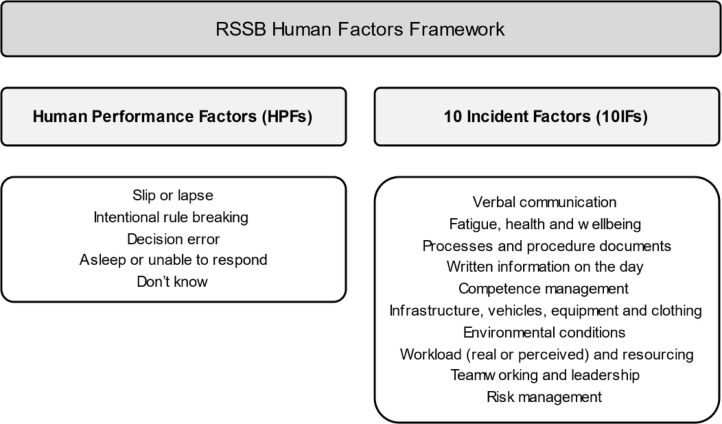
In 2019, the RSSB Human Factors Framework was built into the Safety Management Intelligence System (SMIS) allowing investigators to accurately report immediate and underlying causes of incidents and accidents. SMIS is the GB railway’s online health and safety reporting and business intelligence software, which collects and provides access to information on thousands of safety-related events that happen each year on the railway (RSSB, 2025a). The RSSB Human Factors Framework was integrated into the Rail Industry Standard RIS-3119-TOM (RSSB, 2022a) as best practice and is presented in Figure 1 below:
474 Hyatt and McCulloch
Figure 1: RSSB human factors framework.
Each of these sub-categories have supporting qualitative descriptions described in the SMIS causes user guide (RSSB, 2022c). This is to understand the causes being classified and further support investigators apply the HF Framework consistently across all train and freight operating companies and other railway undertakings.
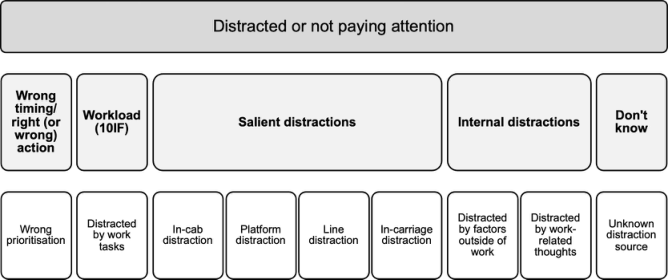
Distraction and Attention Over half of SPADs across the GB railway are reported to be caused by a train driver being either distracted or not paying attention. This prompted the Human Factors team at RSSB to want to understand this category in more detail. The team conducted an in-depth review of event narratives from those SPAD events classified as a slip or lapse error > distracted or not paying attention and decision error > distracted or not paying attention, to identify themes in causation. When combining this operational incident data with knowledge of how other industries classify such events, nine sub-categories were developed shown in Figure 2:
APPLYING THE FRAMEWORK TO RAIL OPERATING INCIDENTS When an unwanted event occurs on the railway, for example a SPAD, the infrastructure manager responsible for the location/ section of track it occurred on will record preliminary details in SMIS. Depending on the risk ranking of the SPAD i.e. whether it is ranked as ‘high risk’ meaning a collision occurred or in different circumstances a collision would have occurred, either the infrastructure manager or the train/freight operating company responsible would investigate. The findings of the investigation are then entered into a cause form that is linked to the original SMIS event. The cause form records the immediate and underlying causes of the SPAD using the Human Factors Framework (HPFs and 10IFs). Recording causal information in SMIS is expected to be completed within 3 months of the
Human Factors in Accident and Incident Investigation and Reporting: A Framework 475
Figure 2: Distracted or not paying attention sub-categories.
event occurring, however depending on the length of the investigation, this could take significantly longer.
To maintain consistency in the application of the Human Factors Framework in recording human and system failures, the human factors team at RSSB review every cause form against event narratives, providing feedback to the teams who input the causal factors into SMIS, who subsequently amend any classifications.
Data entered into SMIS through the cause form is analysed and presented at RSSB’s industry groups, who’s aim is to address key areas of railway risk as set out by RSSB’s Rail Health and Safety Strategy (RSSB, 2025a). Examples of these analyses are included below for managing train accident risk (SPADs) and infrastructure safety.
Train Accident Risk: Signal Passed at Danger (SPAD) The Train Accident Risk Group (TARG) are responsible for managing two significant risks on the GB railway: SPAD risk and overspeed, which is respectively managed by the SPAD Risk Sub-Group (SPAD RSG) and Overspeed Sub-Group (OSG). These are overseen by the System Safety Risk Group (SSRG).
Since 1 April 2021, there have been 965 SPADs across the network (as of 3 February 2025). 739 of these involved passenger trains and 226 involved non-passenger trains such as freight trains and engineering plant (principal contractors). To date, 456 cause forms have been entered into SMIS, meaning RSSB have causal data on just under half of SPADs since April 2021 (47%). This number is continuously increasing as train operating companies submit cause forms in SMIS.
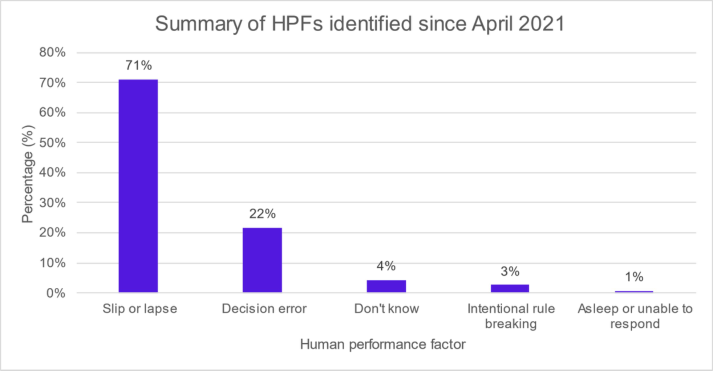
In terms of data quality, there is an average of 1.7 human performance factors (human error) recorded per SPAD event and 1 10 incident factor (system errors). 71% of SPADs are reported to have involved a driver having a slip or lapse error, which are errors that tend to happen in routine tasks that people are doing without much conscious thought. These happen when people know what to do in the situation but do something wrong without realising (RSSB, 2022c). 22% of SPADs are reported to have been caused by a driver making a decision error. These are errors in conscious judgements,
476 Hyatt and McCulloch
decisions or strategies which happen when people are aware that they are making a decision but are not aware that it is somehow ‘wrong’ (RSSB, 2022c). A summary of human performance factors identified is shown in Figure 3.
Figure 3: Summary of human performance factors identified since April 2021.
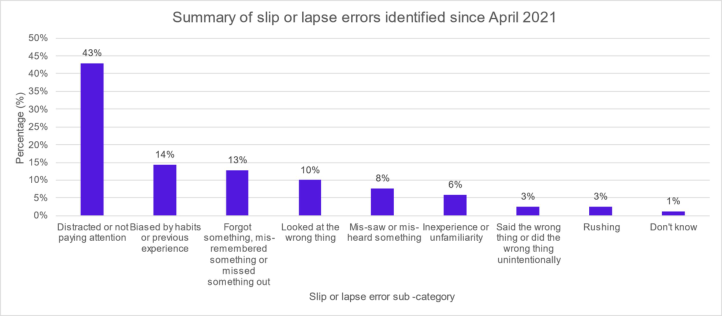
Delving deeper into the reported slip or lapse errors in relation to causes of SPADs, 43% are reported to involve a driver being either distracted or not paying attention, 14% caused by a driver being biased by habits or previous experience and 13% where a driver has forgot something, mis-remembered something or missed something out. Figure 4 shows a summary of reported slip or lapse errors as causes of SPADs since April 2021.
Figure 4: Summary of slip or lapse errors identified since April 2021.
An example of a slip or lapse error where a driver was distracted:
Human Factors in Accident and Incident Investigation and Reporting: A Framework 477
‘Driver was visually distracted by the train on the adjacent line and trying to ascertain if it was an empty coaching stock (ECS) or passenger service. This was important to the driver as a stopping passenger train being routed in front of them would result in them getting back late and, therefore, being late to a prebooked social event.’
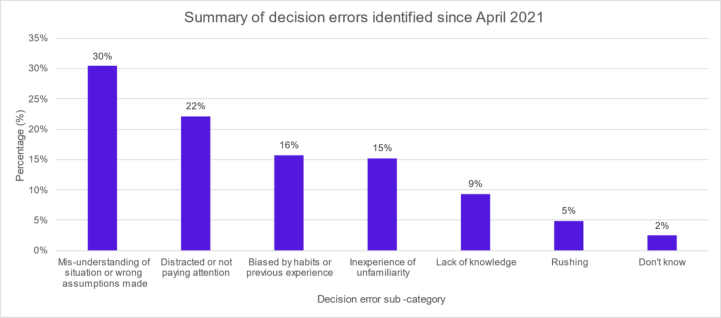
Reviewing the reported decision errors in relation to causes of SPADs, 30% are reported to involve a driver mis-understanding a situation or making a wrong assumption, 22% due to being distracted or not paying attention and 16% where a driver is reportedly biased by habits or previous experience. Figure 5 shows a summary of reported decision errors as causes of SPADs since April 2021.
Figure 5: Summary of decision errors identified since April 2021.
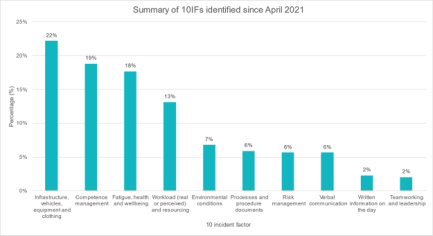
An example of a decision error where a driver made a wrong assumption: ‘The driver decided not to apply the emergency brake because they thought that they would be able to stop in time without it.’ In terms of recording system failures (10 incident factors) or errors at the organisational and job or workplace level, 22% of SPAD events are reported to be attributable to issues with infrastructure, vehicles, equipment or clothing (IVEC), with 19% reported to be due to competence management failures and 18% down to fatigue, health and wellbeing factors. A summary of 10 incident factors identified is shown in Figure 6.
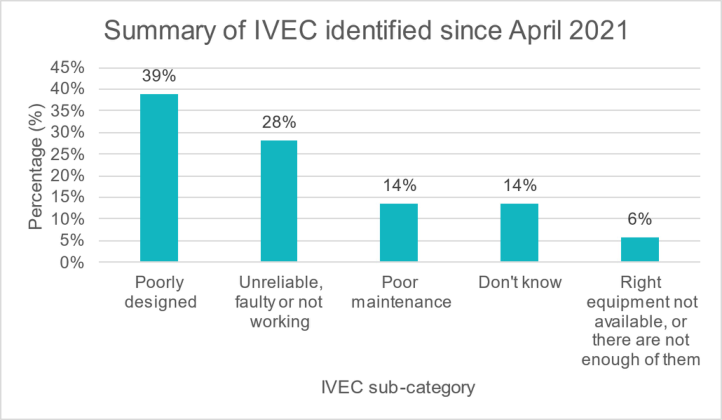
IVEC includes railway signals, train brakes, Driver’s Reminder Appliance (DRA), Automatic Warning System (AWS), European Rail Traffic Management System (ERTMS), Train Protection Warning System (TPWS), controls and displays in cabs, signal boxes or control centres, traction handling characteristics, route drivability, windscreen and view from cab, passenger information displays, PPE, clothing and footwear (RSSB, 2022c). In terms of IVEC, 39% are reported to relate to poor design, 28% where something is unreliable, faulty or not working and 14% due to poor maintenance. Figure 7 shows a summary of reported IVEC as causes of SPADs since April 2021.
An example of an identified system failure under IVEC > poorly designed:
478 Hyatt and McCulloch
Figure 6: Summary of 10 incident factors identified since April 2021.Figure 7: Summary of IVEC factors identified since April 2021.
‘The design and configuration of TPWS equipment on certain locomotives reduces the effectiveness of the braking characteristics of over speed train protection systems on the infrastructure.’ The data reviewed in this section is snapshot of the safety intelligence data the RSSB holds and continues to collect through accident and incident investigation reporting from passenger and non-passenger train operators on the GB railway. It is used to regularly report and present to rail industry safety and operations leaders to make informed decisions about how to address rail safety challenges, as well as guide job design changes where human factors capability can support.
Infrastructure Safety: Engineering Objects Left on the Line The Human Factors Framework has also been used to understand HF challenges on the ground such as why engineering objects on the line are left on the line following engineering works (RSSB, 2023). Over a 5-year period between 2017 and 2022, 147 ‘10 incident factors’ were identified. The most frequent 10 incident factor classified in the accident and incident analysis that accounted for 33% of all 10 incident factor classifications was
Human Factors in Accident and Incident Investigation and Reporting: A Framework 479
verbal communication (n = 48). Verbal communication is the exchange of spoken information and is concerned with how safety-critical information is communicated between staff such as person in charge of possession (PICOP), engineering supervisor (ES), controller of site safety (COSS), and Signaller (RSSB, 2022c).
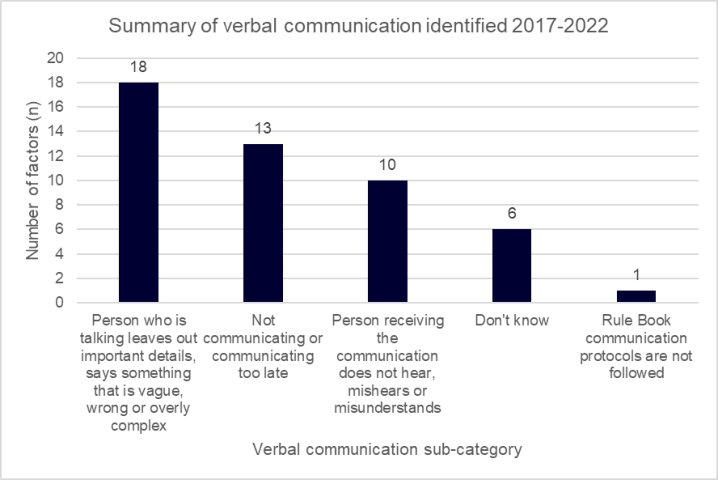
Figure 8: Summary of verbal communication as causes of objects left on the line.
When assessing the verbal communications sub-categories (Figure 8), 38% (n = 18) of the verbal communication classifications were due to the person who is talking saying something wrong. For example: ‘At 2130, the driver of 2Y75 reported striking a work site marker board (WSMB) on the Down Slow line and observed WSMBs on the Up Slow line. The PICOP had verbally given the ES permission to place WSMBs on a portion of line that was not under possession at the time, and therefore open to traffic.’
APPLYING THE FRAMEWORK TO UNDERSTANDING ROAD RISK Additionally, the HF Framework has been used to drive safety improvements in non-rail systems such as driving for work or business, managing occupational road risk. Road risk accounts for 27% of overall risk across the GB rail network according to RSSB’s performance indicator model. Historically, road traffic incidents and accidents have not been investigated further than that required by law through the emergency services. A Road Traffic Collision (RTC) Investigation Toolkit (RSSB, 2022b) was developed, based on underpinning human factors principals, to support managers who are required to ensure RTC investigations are carried out following an
480 Hyatt and McCulloch
incident involving an employee driving for work purposes, as well as trained accident investigators to carry out an effective RTC investigation and report their findings.
USING ARTIFICIAL INTELLIGENCE (AI) TO ADDRESS CHALLENGES Over the past year, RSSB’s data insights and risk and safety intelligence teams have been developing a new platform for reporting safety incident data, in addition to making use of artificial intelligence to improve quality and efficiency of reporting. This is through an AI that will copy information from internal safety reporting systems to SMIS (improved reporting timeliness and accuracy). In addition to this, a system with the ability to pull information using an Application Programming Interface (API) from an incident or accident investigation report and populate a cause form in SMIS (promoting improved consistency in application of the HF Framework in terms of categorising human and system errors that led to an unwanted event). Both aim to support reporting of rail investigation findings and allow industry rail groups to better understanding current challenges in rail safety.
SUMMARY AND NEXT STEPS The RSSB Human Factors Framework sets the foundations for effective accident and incident investigation in not only rail, but other safety critical industries. The proven ability to apply the framework to understand causes of incidents and accidents in transport systems other than its initial implementation (rail operating incidents involving trains) such as infrastructure safety and road risk, shows its inherent flexibility and application within rail and beyond.
Looking ahead, RSSB is in the process of applying the Human Factors Framework to understand three key risk areas to understand how system and human error contributes to incidents and accidents, and overall operational safety. These projects include but are not limited to:
Trespass risk designing signage for stations and level crossings
Train overspeed risk, understanding causes of overspeed; and
The impact of proposed job design changes on train driver workload.
In addition, the revision of RIS-3119-TOM; the rail industry standard for accident and incident investigation (RSSB, 2022a) will incorporate recent findings and the latest addition of distraction sub-categories to help the rail industry better understand causes of distraction in the train driving cab. This paper has provided an overview of the RSSB Human Factors Framework to support transport system operators and safety professionals to better understand causes of incidents and accidents, through identifying human and system level failures. The paper also showcases the value of the framework through safety insights and future projects.
Human Factors in Accident and Incident Investigation and Reporting: A Framework 481
REFERENCES
Cynk, S., Basacik, D., Gibson, H., & Smith, S. (2017). Classifying Human Performance and System Failures in the GB Rail Industry. The Sixth International Human Factors Rail Conference. London. HSE. (2001). The Ladbroke Grove Rail Inquiry Report. Sudbury: HSE Books. RSSB. (2022a). Rail Industry Standard: RIS-3119-TOM Accident and Incident
Investigation. London. RSSB. (2022b). Road Traffic Collision Investigation Toolkit. London: RSSB. RSSB. (2022c). Safety Management Intelligence System: Cause Form User Guide.
London: RSSB. RSSB. (2023). Understanding the Causes of Track Work Objects Left on the Line.
London: RSSB. RSSB. (2025a, 1 Februrary). Rail Health and Safety Strategy. Retrieved from RSSB: https://www.rssb.co.uk/safety-and-health/rail-health-and-safety-strategy. RSSB. (2025b, 1 February). Who We Are: About Us. Retrieved from RSSB: https://
www.rssb.co.uk/about-rssb/who-we-are/about-us. Smith, S. A., & Lowe, E. (2012). Development of GEM-R: Generic Error Model - Rail. London: Network Rail Ergonomics. Weigmann, D. A., & Shappell, S. A. (2003). A Human Error Approach to Aviation
Accident Analysis. Aldershot: Ashgate.
LISTED IN THE AHFE DIGITAL BOOKSTORE CATALOGUE
Explore the complete digital volume
Advances in Human Factors of Transportation
Read this individual research paper free through the original publisher, or explore the full digital proceedings book.
ISBN 978-1-964867-62-5
Explore this ISBN in the AHFE Bookstore ↗Listed in the July 2026 bookstore catalogue; search by ISBN to confirm current availability · Digital book purchase optional