Adam Freed, Heather Colbert, Daniel Blais (2022). Opportunities for Wearable Technology to Increase the Safety of Rail Sector Workers. In: Human Factors and Wearable Technologies. AHFE Open Access, vol. 29, pp. 118–126. https://doi.org/10.54941/ahfe1001482
Transport Canada’s Innovation Centre supports emerging transportation technologies to help ensure Canadians can benefit from a safe, secure, clean, and integrated transportation system. From the standpoint of safety in rail transportation, the Centre is interested investigating the viability of using wearable technologies to increase the safety of rail sector workers. Although wearable technologies have proven to be useful in other industries, their adoption in Canadian rail has yet to gain traction. This study aims to show that wearable technologies have the potential to increase the safety of rail sector workers and that further investigation of specific use cases could be valuable.To achieve the objectives of the study, FactorSafe Solutions, an Ottawa, Ontario based human factors consultancy, was contracted to collect and analyse relevant data from multiple sources and then to report on their findings. The data collection methods were three-fold: a literature and market review of known human factors considerations of trackside and yard workers and existing technologies that may be suited to address those considerations; an analysis of the past five years of reported rail occurrences found on the Transportation Safety Board’s Rail Occurrence Database System to determine the most common types of occurrences where wearable technologies may have mitigated the risk levels; and a series of interviews with subject matter experts from the rail industry as well as researchers in the field of rail safety and associated technologies to validate the previous findings as well as uncover new information.By synthesizing the analysed data from the three data collection tasks, it was concluded that there are 11 relevant occurrence types, the highest priority of which include non-main track derailments, non-main track collisions, and movements exceed limits of authority, for which yard and trackside workers could potentially benefit from the implementation of specific wearable technologies. The 11 occurrence types are spread across both the yard and tracksideenvironments and could potentially be addressed through a variety of different wearable technologies. An important conclusion of the study is that there is not likely to be a single solution to meet the needs of all workers, environments, or tasks.Finally, a research framework is proposed to guide Transport Canada’s Innovation Centre through the potential next steps. The framework includes foundational research to build on the knowledge of the prioritized use cases and technologies, pilot studies conducted in nonoperational simulated settings with small groups of participants, and then larger field trials to assess performance of the wearable technologies during actual operations. A key successfactor to the research framework is to engage with the rail industry to benefit from their knowledge and resources, including incorporating their safety management systems with a human factors risk assessment during pilot studies to ensure that the wearable technologies do not introduce new safety risks.
This paper presents the results of a study carried out by FactorSafe Solutions, an Ottawa, Ontario based human factors consultancy, on behalf of Transport Canada’s Innovation Centre to explore the viability for wearable technology to increase the safety of rail sector workers.
The objective of the study was to identify the potential of wearable tech- nologies to increase the level of safety risk mitigation for yard and trackside workers in the field, with a focus on freight operations. Many industries, including mining, aviation maintenance, defense, and first response have implemented different wearable technologies successfully to improve the safety and efficiency of their operations. Although some small-scale studies have been conducted by certain Canadian rail operators and rail maintena- nce companies, a larger scale study to provide guidance on the use of such technologies has not been conducted in Canada.
To arrive at the results, the methodology of this study was as follows:
1. Conduct a literature and market review of known human factors considerations of yard and trackside workers and existing wearable technologies;
Opportunities for Wearable Technology to Increase the Safety of Rail Workers 119
2. Perform an analysis of the past five years of reported rail occurrences; 3. Conduct a series of interviews with subject matter experts from the rail industry; 4. Synthesize the data from the three collection sources to determine the priority occurrence types and the type of wearable technology that could increase safety.
The following sections will describe in more detail these four elements of the methodology.
LITERATURE AND MARKET REVIEW The literature review provides a high-level overview of the general perfor- mance influencing factors (PIF) associated with yard and trackside operati- ons. Additionally, this review provides insight into commercially available and in-development wearable technologies aimed at safety critical opera- tions. Previous research conducted on similar topics is also reviewed. The review presented in this section identifies only that certain technologies have potential safety benefits.
Overview of Yard and Trackside Rail Worker Roles This study focused on railway workers who participate in yard and trackside operations, specifically yard workers (including conductors), and track- side workers. Tasks conducted by workers in these roles involve significant amounts of work on and around the track, exposing them to significant risks, in particular, the risk of being struck by a train or other rolling equipment (Roth, Rosenhand, & Multer, January 2020).
Yard workers are involved in sorting rail cars and locomotives and include train crews, consisting of conductors and engineers, and yard workers. They have a broad range of responsibilities including crew communication, crew supervision, paperwork management, train inspection, train troubleshooting, train repair, and train makeup and handling (Walsh, Golay, Barnes-Farrell, & Morrow, 2013).
Trackside workers are groups of workers that inspect, maintain, and repair railway facilities and equipment including track, signals, communications, and electric traction systems (Roth, Rosenhand, & Multer, January 2020). The activities of various trackside worker roles can vary significantly but may involve communicating with rail traffic controllers (RTC) and train crews, completing paperwork, and working with physical tools such as rail tongs, spike drivers, spike pullers, rail saws, and sledgehammers (Canadian Pacific Railway, 2020). Trackside workers do not have the direct interaction with the train or locomotive itself as do yard workers (e.g. riding cars, connecting and disconnecting rolling stock). However, the physical and environmen- tal demands are similar for trackside workers and yard workers, and they face similar risks of being struck by a train while working trackside (Roth, Rosenhand, & Multer, January 2020).
Recent research has highlighted the importance of human factors in rail safety. In Canada, the 2018 Railway Safety Act review entitled: Enhancing
Rail Safety in Canada: Working Together for Safer Communities noted: “that the next major challenge in enhancing safety will be to address human and organizational performance factors, which will require enhanced departmen- tal expertise in this area and continuous learning (Paton, Eaton, & Quinlan, 2018). In the United States, the National Transportation Safety Board iden- tified the lack of specific regulations to protect trackside workers as issue. They state that existing train approach warning systems are vulnerable to human errors, such as miscalculating site distance and generally underesti- mating the time needed for workers to clear tracks. They identified that existing systems are insufficient as a primary form of worker protection, and additional technology should be implemented to provide safety redundancy (National Transportation Safety Board, 2021).
Performance Influencing Factors for Yard and Trackside Rail Worker Considering the Performance Influencing Factors (PIF) for yard and trackside work is required to understand the suitability of wearable technology. PIFs are “the characteristics of the job, the individual and the organization that influence human performance. Optimizing PIFs will reduce the likelihood of all types of human failure” (Health and Safety Executive, 2009). The job, individual and organization PIFs for yard and trackside workers are outlined below.
Job-PIFs Yard and trackside work have significant physical, environmental and proce- dural demands that can influence performance. The design and use of any wearable technology should consider these PIFs in their deployment. Job PIFs for conductors and yard workers include: continual communication and observation and guiding the Engineer with the movement of the train; fre- quently standing on the rail bed and beside tracks and extended periods of walking along uneven surfaces of rail beds and alongside tracks; frequent neck movement; occasional reaching, twisting, pushing, pulling, reaching above and below the shoulder, carrying and grasping throughout the shift. Lifting light to medium loads are more common; Climbing ladders, grasping and holding objects while riding the side of a train; Operating various devices on rail cars and locomotives; and bending, stooping, squatting, and kneeling frequently (Canadian Pacific Railway, 2020). There are also environmental job PIFs such as frequent temperature extremes and working outdoors in all weather; visibility challenges; frequent to continuous noise and vibration from railway equipment; and working at heights.
Individual-PIFs There are a number of PIFs that may directly impact individuals perfor- ming yard and trackside work in the rail industry. Specific concerns include distraction leading to reduced situation awareness (SA), increased mental workload, trust in technology and wearability. Technology has great potential to enhance individual and team level SA, but also has potential to cre- ate distraction, develop information silos and increase mental workload.
Opportunities for Wearable Technology to Increase the Safety of Rail Workers 121
Implementing a system that enhances high-level SA requires the identification and proper presentation of information requirements, along with an under- standing of operator and team mental models of the situation (Endsley, Bolte, & Jones, 2006). Trust is another individual PIF that is generally defined by researchers in terms of reliance and risk (Sander, Kaplan, Koch, Schwarz, & Hancock, 2019). End users can be resistant to using systems they believe to be untrustworthy (Parasuraman & Riley, 1997). However, too much trust in an unreliable system is also problematic (Eurocontrol, n.d.). Wearability is an individual PIF that is a unique consideration, not present in the design or selection of other systems such as laptops or smartphones. Wearability has been defined as the “interaction between the human body and the wearable object” (Gemperle, Kasabach, Stivoric, Bauer, & Martin, 1998).
Organizational-PIFs It is important to take into account certain high-level organizational PIFs that are common across the rail industry when considering wearable technology. Organizational PIFs include the “shift work” nature of rail work. Shiftw- ork is well-established to have a correlation with sleep disruption that can impact human performance, including increasing the time it takes to com- plete tasks and the likelihood of errors (Wickens, Hutchins, Laux, & Sebok, 2015) (HSE,1999). Technologies may be beneficial in reducing fatigue in high workload situations; however, they may worsen passive fatigue effects asso- ciated with low workload and lack of direct control over tasks (Neubauer, Matthews, Langheim, & Saxby, 2020). Organizational PIFs also encompass worker experience levels, teamwork, and communication (Roth, Rosenhand, & Multer, January 2020).
Wearable Technologies in Safety Critical Operations Wearable technology has been defined as “a computing device that is small and light enough to be worn on one’s body without causing discomfort … [and] is constantly turned on and is often used to interact with the real-world through sensors that are becoming more ubiquitous each day” (Barfield, 2016).
The ability to increase SA and control aspects of the working environment remotely, and often in a hands-free capacity, can be shown to increase levels of safety (Awolusia, Marks, & Hallowell, 2018), and efficiency (Khakurel, Melkas, & Porras, 2018).
This review provided an overview of three types of wearable technologies, proximity detection systems, fatigue monitoring systems and non-integrated systems.
Proximity detection systems can enhance yard and trackside worker SA of approaching trains and to the proximity of other moving vehicles or machi- nery. These systems tend to provide the additional benefit of also improving train/vehicle operator SA of workers at trackside through an in-cab notifi- cation module. Although there is some variation, what proximity detection systems generally have in common is that once active, workers in a defined safe zone, will receive automated alerts, resulting in a passive warning system
that could have little to no effect on workload. A number of commercially available proximity detection systems are currently on the market however, their effectiveness still lacks conclusive evidence.
Fatigue detection is an area that lends itself well to the use of wearable technologies with their ability to read a variety of biological and physiological measures. Implementing the use of fatigue monitoring wearables could help to mitigate some occurrences. Fatigue detection systems reduce the chances of fatigue related occurrences by determining the user’s level of drowsiness and sending an audible and/or haptic alert.
Non-integrated systems can operate on their own with limited functio- nality, or as part of a larger safety system featuring information sharing and sensor connectivity. Wearable technologies such as smartwatches, smart eyewear, and even smartboots can provide further levels of enhancement to human performance, long-term health, and safety.
There are many potential benefits to wearable technologies including: enhanced safety through proximity detection, location tracking, health moni- toring, fall detection, and fatigue monitoring, but ensuring employee buy-in is a key to successful implementation.
DATA ANALYSIS In order to better understand the viability of wearable technology to increase the safety of rail sector workers, the researchers team undertook a review of occurrences in the Canadian Transportation Safety Board’s (TSB) Railway Occurrences Database System (RODS). The data analysis focuses on occurre- nces where wearable technology, had it been in use, may have mitigated risks. RODS data was restricted to that dealing with operational and maintenance personnel on freight specific assignments from 2015 to 2020.
In conducting this data analysis, the research team made informed assum- ptions to identify incident types with the highest risk for yard and trackside workers and the potential for wearable technology to mitigate those risks. Key assumptions include the absence or presences of workers and the notion that the technologies would work as intended. Further field studies would be required to validate these assumptions.
Methodology
The data analysis was conducted on the 7843 occurrences listed on the RODS database between January 1, 2015 and October 6, 2020. The TSB also provi- ded data from the Safety Communications Tracking System (SCTS) including summaries of investigation findings for a subset of occurrences within the RODS database, where investigations were performed. This provided more insight into the causes, contributing factors, and risks of investigated occur- rences. In addition, the TSB provided a spreadsheet of all RODS occurrences organized to highlight occurrence details more relevant to this study.
The data analysis was conducted in 4 major steps:
1. A self-guided RODS database analysis; 2. An analysis of investigation findings from the SCTS;
Opportunities for Wearable Technology to Increase the Safety of Rail Workers 123
3. An analysis of “near misses” or “close calls”; and 4. Prioritization of occurrence types for future research.
Summary of Data Analysis Results Of the 7843 occurrences, it was determined that 4517, or 57.59% were either confirmed to have yard/trackside worker presence or were assumed to have yard/trackside worker presence based on the available data and knowledge of workflows and environments. Of the 4517 occurrences specified with con- firmed or assumed yard/trackside worker presence, 4447, or 98.45% had risks which could have been mitigated to a certain degree through the use of a wearable technology, assuming that the technology worked as intended. Given the lack of detailed data for most of these occurrences, the degree of mitigation wearable technologies may provide cannot be concluded at this point. Research to provide more clarity on this issue is recommended.
Eleven (11) occurrence types (listed in table 1) from the RODS data were identified as possible risk priorities recommended for future study since they were deemed to have a combination of medium to high likelihood of rail worker presence and a medium to high likelihood of wearable technology mitigating risk.
Table 1. Occurrences, environments and wearables, in order of risk priority.
Table available in the original PDF paper.
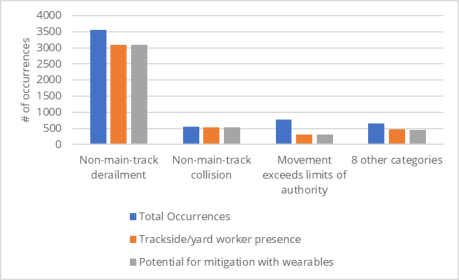
Non-main-track derailments and collisions, and movement exceeds limits of authority are the three most commonly reported occurrence types. The number of total occurrences, occurrences where trackside presence was indi- cated (as per RODS or SCTS) or expected (as per researcher assumptions), and those potentially mitigated using wearables was highly weighted toward the first three on the list compared to the other eight (Figure 1).
Data Analysis Discussion The review of the RODS database identified 25 occurrences where weara- ble technology could have potentially prevented two fatalities, 13 serious injuries, and 13 minor injuries to off-train employees if the technology had
Figure 1: Prioritized occurrence categories for mitigation through wearable technologies.
worked as intended. In addition to the occurrences where injuries and fata- lities were recorded, 4424 close-call occurrences were identified where it is possible that wearable technology could have either mitigated risk or enhanced human performance. The prioritization of occurrence types for future research points to derailments and collisions not occurring on main tracks (i.e., yards, sidings, customer tracks) and “movement exceeds limits of authority” as high priority categories for further study on the use of weara- bles for risk mitigation. These categories of occurrences found in the RODS data occur in environments more generally associated with yard and trackside work, where more complex train movements are required.
The eleven (11) occurrence types identified as priorities for future study are listed in Table 1 along with the environment in which this occurrence type is most likely to occur and the general category of wearables which may reduce risk.
CONSULTATION In order to validate the findings of the literature/market review and the data analysis, consultations were conducted with Subject Matter Experts (SME). SMEs were defined as individuals with field experience in rail work, and researchers.
The results of the consultations were analyzed for common trends and indications of need for solutions to human performance issues with respect to operational safety in yard and trackside work.
Key issues for consideration are that whether in the yard or at trackside, workers are highly vulnerable. Work environments are complex with a wide variety hazards that can affect their performance and impact their overall safety. Although various mitigations are currently in place, many of them are rule based, which may not be the most effective means of reducing risk, given the nature of PIFs. Wearable technologies of various types are viewed as having potential to improve operational safety and efficiency, as long as they are designed to meet the needs of the user, the environment, and the tasks.
Opportunities for Wearable Technology to Increase the Safety of Rail Workers 125
The consultations with SMEs highlighted several challenges and opportu- nities related to the deployment of wearable technology. Challenges include trust/buy-in of the technology and reliability, engagement with workforce, environment/job factors such as extreme weather and harsh conditions, cost of deployment, device management, training, and over reliance on techno- logy. Opportunities include the possibility for improved SA, proven solutions from other high hazard industries, flexibility in system design, a general motivation in the rail sector to improve safety, opportunities to strategi- cally mitigate costs and opportunities to implement user-centered design approaches in the deployment.
CONCLUSION
This exploratory study set out to identify the potential viability of wearable technologies to increase the level of safety risk mitigation for yard and tra- ckside workers, with a focus on freight operations. Based on the successful implementation of wearable technologies to improve safety and efficiency in other industries, it was suspected that similar benefits could be achieved in Canadian rail operations. The data analysis has highlighted risks associated with yard and trackside work and has shown that with further study and pilots, it is possible that yard and trackside workers could benefit from the implementation of wearable technologies.
Various types of wearable technologies, including proximity detection systems, non-integrated wearables, and fatigue monitoring systems, were suggested as having potential to mitigate the risks involved in 11 priority occurrence types spread across both yard and trackside environments.
Based on the variety of tasks, environments, worker types, and wearable technologies specified, there is not likely to be a single solution to meet all the needs. Further research could determine the possibility that a fully customized system consisting of non-integrated wearables could be designed to meet the needs of multiple scenarios, but it is more likely that a hybrid approach with solutions aimed at subsets of tasks and worker types would be a more feasible approach.
ACKNOWLEDGMENT
The authors would like to acknowledge the members of the Project Advisory Committee, which included representatives from: Transport Canada, Metro- linx, VIA Rail Canada, CN Rail, CP Rail and the Railway Association of Canada.
REFERENCES
Awolusia, I., Marks, E., & Hallowell, M. (2018, January). Wearable technology for personalized construction safety monitoring and trending: Review of applicable devices. Automation in Construction, 85, 96–106. Barfield, W. (2016). Fundamentals of wearable computers and augmented reality (2
Canadian Pacific Railway. (2020, August 20). Retrieved from Job Demands Analysis: Conductor- Yard: https://www.cpr.ca/en/employees- site/PublishingImages/en/employees/return-to-work/safety-critical- positions/Conductor%20-%20Yard.pdf Cavuoto, L., & Megahed, F. (2018). Advancing Safety Surveillance Using Individualized Sensor Technology (ASSIST): Final Progress Report. American Society of Safety Professionals. Endsley, M., Bolte, B., & Jones, D. (2006). Designing for Situation Awareness: An
Approach to User Centred Design. Eurocontrol. (n.d.). Impact on Human Performance. Retrieved August 20, 2020, from https://ext.eurocontrol.int/ehp/?q=taxonomy/term/99: Gemperle, F., Kasabach, C., Stivoric, J., Bauer, M., & Martin, R. (1998). Design for
wearability. Second international symposium of wearable computers, (pp. 116– 122). Godfrey, A., Hetherington, V., Shum, H. P., Bonato, P., Lovell, N. H., & Stuart, S.
(2018). From A to Z: Wearable technology explained. Maturitas, 113, 40–47. Health and Safety Executive. (2009). Reducing Error and Influencing Behavious.
Retrieved June 2018, from http://www.hse.gov.uk/pUbns/priced/hsg48.pdf HSE. (1999). Reducing Error and Influencing Behaviour (HSG48). The Stationary Office. Khakurel, J., Melkas, H., & Porras, J. (2018). Tapping into the wearable device
revolution in the work environment: a systematic review. Information Technology & People, 31(3), 791–818. National Transportation Safety Board. (2021, May 3). Improve Rail Worker Safety.
Retrieved from National Transportation Safety Board: https://www.ntsb.gov/saf ety/mwl/Pages/mwl-21-22/mwl-rph-02.aspx Neubauer, C., Matthews, G., Langheim, L., & Saxby, D. (2020, October). Fatigue and Voluntary Utilization of Automation in Simulated Driving. Human Factors, 734–746. Parasuraman, R., & Riley, V. (1997, June). Humans and Automation: Use, misuse,
disuse, abuse. Human Factors, 230–253. Paton, R., Eaton, B., & Quinlan, P. (2018). Enhancing Rail Safety in Canada: Working Together for Safer Communities. The 2018 Railway Safety Act Review. Government of Canada. Roth, E., Rosenhand, H., & Multer, J. (January 2020). Teamwork in Railroad
Operations and Implications for New Technology. United States Department of Transportation. Sander, T., Kaplan, A., Koch, R., Schwarz, M., & Hancock, P. (2019, June). The Relationship Between Trust and Use Choice in Human-Robot Interaction. Human Factors, 614–626. Walsh, B., Golay, L., Barnes-Farrell, J., & Morrow, S. (2013). A Job Analysis
Design for the Rail Industry: Description and Model Analysis of the Job of Freight Conductor. United States Department of Transportation. Wickens, C., Hutchins, S., Laux, L., & Sebok, A. (2015, September). The Impact of Sleep Disruption on Complex Cognitive Tasks: A Meta-Analysis. Human Factors, 930–946.
LISTED IN THE AHFE DIGITAL BOOKSTORE CATALOGUE
Explore the complete digital volume
Human Factors and Wearable Technologies
Read this individual research paper free through the original publisher, or explore the full digital proceedings book.
ISBN 978-1-958651-05-6
Explore this ISBN in the AHFE Bookstore ↗Listed in the July 2026 bookstore catalogue; search by ISBN to confirm current availability · Digital book purchase optional