Claudio Loconsole, Marianna Giardina, Enrica Salvatori (2023). ArchiVico Digitale: a comprehensive and synergistic approach for the preservation and dissemination of local memory to strengthen identity. In: Human Factors in Communication of Design. AHFE Open Access, vol. 90, pp. 89–95. https://doi.org/10.54941/ahfe1003699
The main objectives of the "ArchiVico Digitale" project are the digitization, cataloging and web publication on an Omeka-based platform of the documentary material preserved in the Historical Archive of Vicopisano (HAV) to facilitate the access to several documents and the exploration of thematic discovery paths linked to local historical memory.The result of the publication of this material on the web is a digital archive collecting and enhancing archival documents to allow scholars and the general public to carry out research. Since the HAV keeps a large number of documents gathered in files, a preliminary selection of two types of documents/files was necessary: those in a poor state of conservation and those of extreme interest which bear witness to relations with the territory and historical dynamics. The proposed approach, implemented in synergy between different public and private subjects, provides the restoration of documents in a poor state of conservation, the digitization and archival description of each selected document, the web publication in a digital archive and the dissemination of the contents of the documents relating to local historical dynamics to students of schools of all levels in educational courses aimed at preserving the collective historical memory. The project, conducted in a three-year period, resulted in 12 thematic paths for a total of 194 documents (765 image files), a total of 6 restored archives (5,130 image files) and a dissemination activity of the thematic itineraries involving a total of over 160 students and over 15 teachers.
The Historical Archive of Vicopisano (HAV) is one of the most impor- tant historical archives in the Province of Pisa (Italy), now housed in the premises of the Palazzo Pretorio of Vicopisano (Pisa, Tuscany, Italy), and collects documents spanning over five centuries of history of the communi- ties of Vicopisano, Pontedera, Cascina, Bientina and Calcinaia. It consists of two main documentary cores (Italy pre-unification section and Italy post- unification section) and some minor aggregated archives. In particular, the pre-unification section consists of the judicial archive of the Vicariate of Vico- pisano (1532-1848) and the archive of the Municipality of Vicopisano (16th
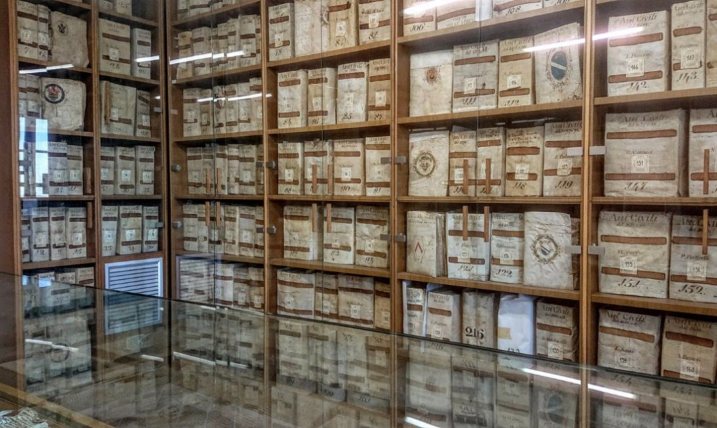
century-1865) (Mori, 2006). In Figure 1, a section of the Historical Archive of Vicopisano is reported.
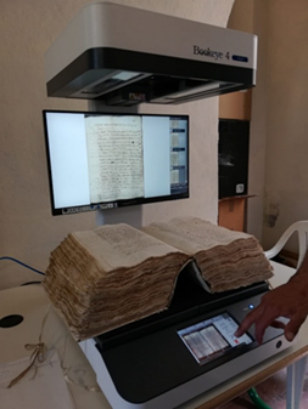
In order to preserve and disseminate the cultural and historical memory preserved in the HAV, the “ArchiVico Digitale” project proposes a compreh- ensive and synergistic approach for the process of digitisation, cataloguing, web publication and dissemination of archival material providing the pos- sibility of continuous interventions over time thanks to the provision of a permanent digitization “station”with a planetary scanner (see Figure 2) dire- ctly in the premises of Palazzo Pretorio in Vicopisano, in order to limit the movement of the files outside of the premises themselves.
Figure 1: A section of the Historical Archive of Vicopisano.Figure 2: The permanent digitization “station” with a planetary scanner in the premises of Palazzo Pretorio in Vicopisano.
ArchiVico Digitale: A Comprehensive and Synergistic Approach 91
THE ARCHIVICO DIGITALE PROJECT The approach proposed by the ArchiVico Digitale project, which falls within the field of computer archiving (Guercio et al., 2010)(Valacchi, 2006), consists of seven phases, each of which is conducted in synergy with diffe- rent subjects (local authorities, Archival and Bibliographic Superintendence, restoration centres, schools). The proposed phases are: i) documentary resea- rch and selection based on the state of conservation or belonging to a thematic path; ii) conservative restoration; iii) digitisation; iv) cataloging and meta- dating with Dublin Core standard1; v) web publishing; vi) production of short explanatory videos; vii) dissemination of local historical content in sch- ools based on thematic paths to preserve the collective historical memory reinforcing identity.
In the three-year period 2019-2022, the ArchiVico Digitale project made it possible to create 12 thematic paths for a total of 194 documents (765 image files) and a total of 6 restored archives (5,130 image files).
The thematic paths, correlated to the territory of influence of the Historical Archive were: arts and crafts; statistical-economic aspects of the Vicariate of Vicopisano; press announcements; games/leisure - habits and customs; justice and sentences; floods; inventories and appraisals of assets in case of conviction and inheritance; plague; silk; Statutes of the Municipality and Podesteria of Vicopisano; parchments found; “Maggi di Buti”.
Furthermore, the dissemination activity of the thematic itineraries involved a total of over 160 students and over 15 teachers.
The “ArchiVico Digitale” web platform2, developed by using Omeka Classic3, offers users various functions including geolocation of documents, contextual reading of documents with the metadata referring to them, short explanatory videos and exploration of thematic paths.
In the following paragraphs, two of the seven proposed phases are descri- bed in more detail since they are representative of the project results: the conservative restoration and the web publishing.
Conservative Restoration The conservative restoration involved paper manuscripts with parchment bindings.
Parchment is a resistant material thanks to the calcination process, but at the same time it is highly hygroscopic and, therefore, is sensitive to the pre- sence of water in the environment. Humidity is a fundamental parameter for the preservation of documents: a low water content can create dehydration with damage to the support such as undulations and shrinkage. On the other hand, a high water content can favor the activity of acid substances contai- ned in the inks, facilitating their degradation action. A high water content can also lead to the development of microorganisms, fungi, bacteria, capable of triggering deterioration processes that are harmful not only to the archives,
but also to human health. Optimal parameters for the correct preservation of ancient documents are temperatures between 14
C and 20
C and relative humidity between 50% and 60%.
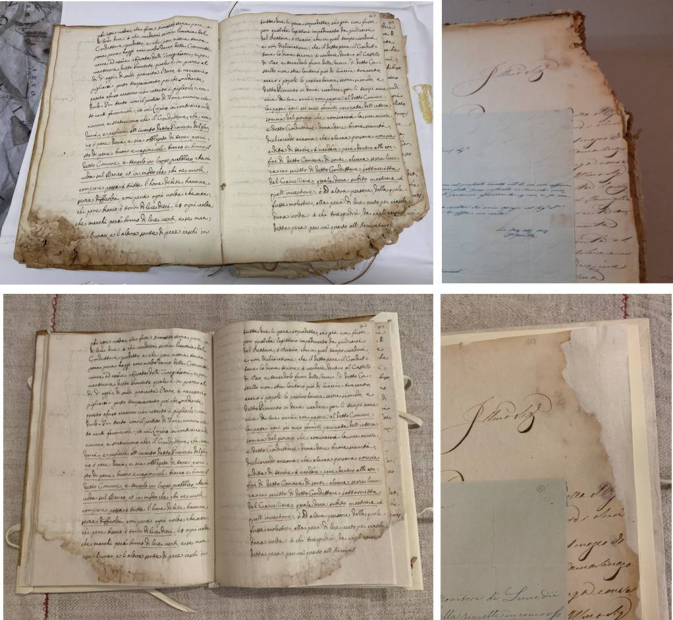
Some paper archives present in the Vicopisano Historical Archive show evident microbial attacks and/or felty and weakened papers. During the pro- ject, six archival units underwent conservative restoration. The restoration consisted of seven phases: i) disassembly of the archival unit by cutting the thread in the center of the sections; ii) dry cleaning of the support to remove surface dirt; iii) washing by immersion in hydroalcoholic solution; iv) inte- gration of gaps and stitching of page tears; v) stitching of the archival unit on three split tabs in alum leather; vi) execution of the spine and capitals; vii) restoration of the bindings.The results of the conservative restoration are reported in Figure 3.
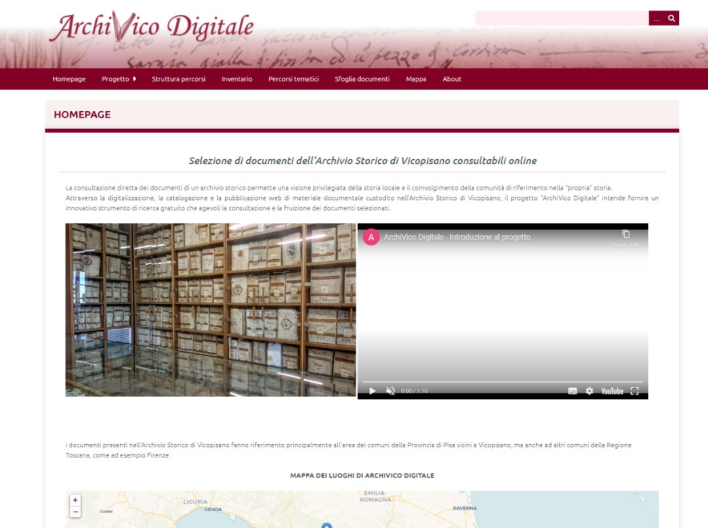
Web Publishing Web publishing of the ArchiVico project documents and materials has allowed us to exhibit in detail all the information and the project development steps and results. The ArchiVico Digitale website homepage is repor- ted in Figure 4. The homepage includes the navigation menu, a picture of the historical archive, a brief project introductory video and a map
Figure 3: A sample document of the Historical Archive of Vicopisano before (above) and after (below) the conservative restoration.
ArchiVico Digitale: A Comprehensive and Synergistic Approach 93
Figure 4: The archiVico digitale website homepage.
with the geo-localized documents. The navigation menu is composed of 8 elements:
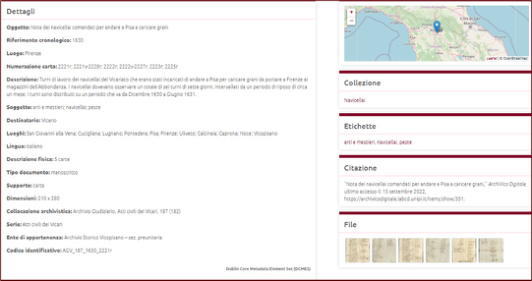
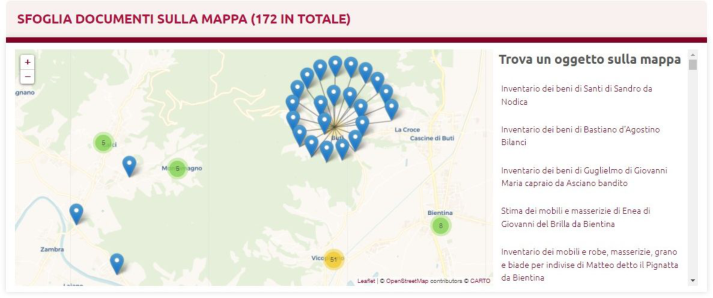
1. homepage link; 2. project information - a sub-menu contains the following info categories: recipients, implementation phases, selection of documents, restoration of archives, archival standards, digital archive platform, tools, working group, funding; 3. structure of the thematic paths – containing the hierarchical tree of the collections that represent the thematic paths; 4. inventory; 5. thematic paths – in this section it is possible to browse collections that represent the thematic paths; 6. browse documents - in this section it is possible to browse documents and view the document tab (see Figure 5); 7. map – in this section it is possible to search for documents on a map thanks to geolocation of the documents (see Figure 6); 8. about – in this section are reported project summary information.
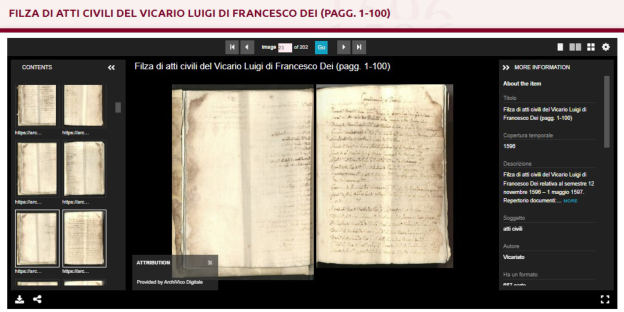
The tab of a document contains: the Universal Viewer (see Figure 7), a tool for virtually browsing documents and quickly displaying their meta- data, the metadata of the documents in extended form, the belonging collection, the citation and the files of the single scanned images of the document.
Figure 5: A (multi-page) document tab including Dublin core based metadata, geolo- calization, collection, labels, citation, image file(s).Figure 6: The geo-localized search page for documents.Figure 7: The universal viewer browsing pages provided with zoom and document metadata.
CONCLUSION
In this paper, we presented a ArchiVico Digitale, a comprehensive and syner- gistic approach for the preservation and dissemination of local memory to
ArchiVico Digitale: A Comprehensive and Synergistic Approach 95
strengthen identity. The proposed approach, implemented for the Historical Archive of Vicopisano (Tuscany, Italy) consists of seven phases, each of which needs to be conducted in synergy with different subjects.
The results of the project are promising: 6 restored archives, 12 thematic paths for a total of 194 documents, one free web platform acting as digital archive, dissemination of local historical content in schools (over 160 invo- lved students) based on thematic paths to preserve the collective historical memory reinforcing identity.
Future works deal with the expansion of the number of thematic paths with the digitization and description of other documents thanks also to the permanent digitization station, the conservative restoration of other archival units and further activities for the dissemination of local memory in both scholastic and non-scholastic environments.
ACKNOWLEDGMENT
The project was funded by the Pisa Foundation (Italy) and the University of Pisa (Italy). The authors would like to thank the Municipality of Vicopisano and the Archival and Bibliographic Superintendence of Tuscany (representing the Italian Ministry of Cultural Heritage) for having recognized the project as a model for the entire Tuscany Region (Italy). The authors would like to thank also Filippo Mori, archivist operator of the Historical Archive of Vicopisano, for his great knowledge of the documentary material and for his precious support.
REFERENCES
Mori, Filippo. (2006). L’archivio storico del Comune di Vicopisano. Tagete. Guercio, M., Pigliapoco, S., and Valacchi F. (2010) Archivi e informatica. Torre del lago: Civita Editoriale. Valacchi, Federico. (2006) La memoria integrata nell’era digitale: continuità archivi-
stica e innovazione tecnologica. Vol. 5. Titivillus.
LISTED IN THE AHFE DIGITAL BOOKSTORE CATALOGUE
Explore the complete digital volume
Human Factors in Communication of Design
Read this individual research paper free through the original publisher, or explore the full digital proceedings book.
ISBN 978-1-958651-66-7
Explore this ISBN in the AHFE Bookstore ↗Listed in the July 2026 bookstore catalogue; search by ISBN to confirm current availability · Digital book purchase optional