Cheng Peng, Siyun Teng (2023). Design Model for Children's Communication Problem in Healthcare based on Systems. In: Human Factors in Communication of Design. AHFE Open Access, vol. 90, pp. 200–210. https://doi.org/10.54941/ahfe1003712
The seven years cooperation project between College of Design and Innovation, Tongji University and Shanghai Children's Medical Center, to create a children's medical franchise brand and related application services. Base on Richard Buchanan’s theory, this paper researches the Systems from the perspective of intersection of communication and design. We attempted to develop a new design model of an communication system for children patients, the parents and the doctors. Therefore, We summarize the problem of communicating information in medical care as a systemic problem. How the complexity of problems in information communication can be solved orderly and harmoniously so that a better experience can be served for children patients will be the subject of this paper.
Research shows that health care providers tell patients the information of diseases and relevant treatment can help patients to participate in treatment actively. Traditional health information and services can be disseminated through electronic media (Eysenbach, G., 2001), which enables doctors, pati- ents and their families to establish a partnership. So they can work together to solve the problem of information transmission in medical services to ensure the accuracy of it and take care of the needs and preferences of the patients. Such forms of service usually require constant design iterations, involving patients and healthcare professionals throughout the process. They will act as information providers, design partners, testers and users at the same time. But, patients are vulnerable, especially children patients has limited cognitive abilities and poor resistance (Imelda, & Coyne, 2006), which leaves a lot of uncertainties in the design mode. The patients and doctors selected during the design mode are clearly targeted and specific to the concrete situation and the resulting product or service can only be designed to solve a specific and concrete problem. Whereas medical service system is supposed to inno- vate constantly to satisfy the needs of patients and health care providers, the original design principles can no longer cope with the complexity of medical
Design Model for Children’s Communication Problem in Healthcare Based on Systems 201
service. Against this background, it’s necessary to rethink new ways to sati- sfy the needs of doctors, patients and their families today (Altman, M., et al., 2018). The design thinking method recognizes that no one discipline can syste- matically solve complex health issues alone. Hospitals need to implement a patient-centered design model while also paying more attention to com- munication during the caregiver and patient meetings (Roberts, J. P., et al., 2016). Health systems involve engaging target populations within their daily lives where and how they live, learn, work and play. In addition to providing medical care, hospitals also need to consider exploring patients’ reasons for visiting the physician, understand medical issues and emotional needs, incre- ase prevention and health initiatives, and enhance the relationship between patients and providers (Steinmair D., et al., 2022).
Social media is a routine activity; using social media websites is among today’s children’s most common activities (Gwenn., et al., 2011). The emer- gence of social media has brought a more diverse experience from the value of visual, aural, oral communication and performance, experimentation, and play. There were only verbal and textual channels. There are now various channels such as graphics, audio, and games (Amaral I., et al., 2020). How- ever, the diversification of information channels has not taken better care of children’s experience of medical care.
Nowadays, the conveyance of information in medical services has become more complex and diverse, which has led to worse communication between children patients and doctors during medical visits. This problem is parti- cularly acute among children patients, who themselves lack the ability to understand.
REFLECTION Achievements and Obstacles
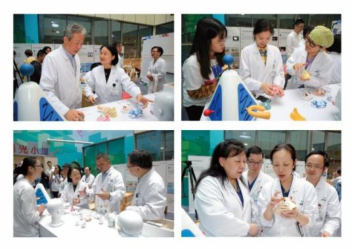
As one of the best hospitals in Shanghai dedicated to children’s medical care, Shanghai Children’s Medical Center (SCMC) was the first to propose the goal of establishing a ‘children’s hospital without crying’, with the purpose of improving children’s healthcare, especially their experience at the hospital (see Figure 1).
Figure 1: “No-cry” hospital exhibition received high compliment and welcome by the doctors. (Photo by the SCMC, non-commercial).
202 Peng and Teng
Driven by great passion of designing for the real world, College of Design and Innovation (D&I), Tongji University, reached out to SCMC in 2014 and established collaboration regarding this plan, as part of D&I’s attempts to tackle DesignX problems (Norman,D., et al., 2015). The senior students of BA Industrial Design program spent remarkable time and efforts researching in the hospital, trying to understand the cause for the ‘crying’ and thus iden- tify what could be done to solve the problems. They treated this project with great seriousness as the topic for their graduation design.
D&I team first visited doctors and parents, and completed 244 questi- onnaires, including 121 from parents and 123 from doctors. According to the parents, preschool children aged 2–6 are the most vulnerable to be infe- cted and frequently go to hospital, accounting for 86.78%. These parents reported that these children had the most obvious resistant reactions when seeing doctors and giving injections, with 23.97% and 58.68%, respectively. Meanwhile, it was found that the fear psyche of children can be effectively pacified by allowing them to see animations and pictures. At present, for the popularization of children’s medical knowledge, most parents teach their babies by themselves, accounting for 66.12%, followed by reading books and popular science animations, accounting for 52.89% and 47.11%. At a mean time, parents hope to add some interactive games in animations or picture books, which children can participate in, with the proportion as high as 80.99%.
Table 1. Reasons of preschool children afraid of seeing doctors.
Table available in the original PDF paper.
Causes of Fear Proportion See the doctor (a stranger) 23.97% Fear for injections (fear for pain) 58.68%
Table 2. Effective ways for parents to comfort children.
Table available in the original PDF paper.
Way Proportion Animations 66.12% Picture books for children 47.11%
According to the doctors, the departments that children often go to include Pediatric Dentistry and Pediatric General Department, accounting for 93.5% and 17.89%. When seeing doctors, it is the most headache for doctors that most children cry and can not be calmed down, which may affects the doctors treatments, accounting for 72.36% and 64.23%. Preschool children aged 2–6 years old are most likely to have resistance during the medical treatment and do not cooperate with doctors for treatments, with the proportion as high as 89.43%. Generally, doctors use some words to encourage children for medical treatment, accounting for 66.67%. Doctors believe that in the visi- ting process, imagery, sketchbooks, television frequency screens, and stories can be effective at shifting children’s attention, accounting for 67.48% and
Design Model for Children’s Communication Problem in Healthcare Based on Systems 203
Table 3. Doctors’ difficulties in treating children.
Table 4. Effective ways for doctors to comfort children.
Table available in the original PDF paper.
Way Proportion Encouraging words 66.57% Interesting images 67.48% Interesting stories 64.23%
64.23%. At present, most pediatric clinics do not incorporate elements pre- ferred by children, accounting for 53.66%. Most doctors are very happy to have a product that can improve children’s medical care, with the proportion of 69.11%.
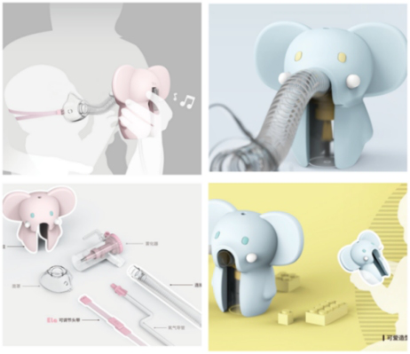
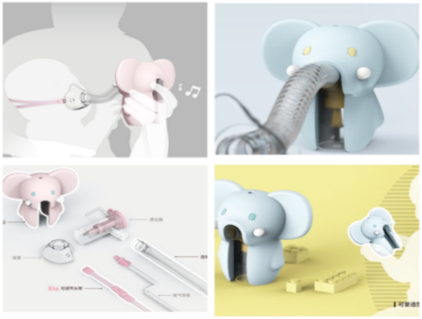
According to the above data, it was found that preschool children aged 2–6 are the most susceptible to infected bacteria and the most likely not to cooperate with doctors and parents during the medical treatment. D&I team developed the corresponding medical design that D&I team take hand draw- ing, modeling, detailing and rendering to design work to be implemented in the daily treatment of the hospital. D&I team believes the collabora- tion was successful in that the hospital was impressed by the designs and believed design could in fact bring improvement and impact to the field of children’s medical care. One of the works, an optimized version of atomi- zer for children, designed like an elephant which could greatly ease the fear and discomfort of children patients, was awarded as ‘Excellent Graduation Work’ among all the design students who graduated that year in Shanghai.
Figure 2: Outstanding design work received award. (Photo by the D&I, non- commercial).
204 Peng and Teng
However, without further investment or involvement of a company, it is very difficult for these designs to become products which could be easily accessed and put into implementation in the hospital. And the collaboration did not lead to direct and visible improvement of the hospital as expected.
The Mode of Design Applied In the early days of industrial design, the work was primarily focused upon physical products. Today, however, designers work on organizational stru- cture and social problems, on interaction, service, and experience design. Many problems involve complex social and political issues (Norman D A., 2011). While further efforts are made to push forward the implementation of the design works for the hospital., The D&I team also began to think about why the design skills acquired in college, such as creativity, sketching and visual sophistication, were not being applied well in design practice.
The reflection starts from reviewing the mode of design applied in the col- laboration, the design expertise we have acquired in the past is usually gained in universities. however,a new knowledge include a big-picture perspective; knowledge of other related disciplines such as marketing, production and distribution; and the ability to facilitate work across organizational silos. These tend to be developed by some more senior designers on the job (Nygren J., et al., 2017).
In particular, the D&I team found in their field research: The team visited the entire hospital including waiting rooms, injection rooms, surgery rooms and wards, and students tended to focus only on existing hospital conditions and system deficiencies to view the “unsatisfied need”of parents and children patients, so that they can develop items which can ease the children’s anxiety and release patients’ pressure psychologically or physically.
On the other hand, during these projects, the hospital is to a certain extent treated as a system of parts, and the students seemed to believe that if these individual parts could be improved, it’s more possible to elevate the patients’ experience. Therefore, they usually started the design process by looking for problems of the parts and delivered the outcome as reso- lutions of the problematic situation. The mode of design applied here is problem-solving.
Analysis of Design Mode for Children’s Well-Being With the development of emerging technologies, the information technology becomes increasingly important in daily life, but the design plays limited role in emerging technologies and social media, so how can the designers respond to these increasingly complex problems we face in communicating information in medical services?
Richard Buchanan proposes a systems theory approach which divides the system into four parts: Arrangement, Set, Group, Condition. From the per- spective of condition, a system is under a harmonious, orderly interaction. On condition is the core property of the whole. The system represents a pattern of assimilation. Assimilation is a process of approaching the truth or principle
Design Model for Children’s Communication Problem in Healthcare Based on Systems 205
of organizational phenomenon. There are no small parts in the system, but rather the harmonious unity of every part (Richard, B., 2019). We summa- rize the problem of communicating information in medical care as a systemic problem. How the complexity of problems in information communication can be solved orderly and harmoniously so that a better experience can be served for children patients will be the subject of this paper.
For children to have a better experience in medical visits, the previ- ous relationship between children, parents and hospitals must be changed. From the parents’ perspective, children are pushed to obey the doctors’ treatments and to cooperate with the doctors in a coercive manner. From the doctors’ perspective, children’s especially preschool children’s reque- sts and feelings are completely ignored as the doctors rarely talk or listen to them. The doctors talks to the child’s parents directly, leaving the child with no decision-making power in the medical process. This treating method directly leads to poor experiences and treatment outcomes for chil- dren and has an adverse impact on their self-esteem and healthy growth (Imelda, & Coyne, 2006).
Not only are children patients not provided with a good experience during their medical visits, but also the pre- or post-visit part is missing. We need to shift the role and perspective of the designer and use an empathetic design thinking mode (Brown, T., 2008). We need to see the children’s health care process as a system, to pay attention to the whole experience. We need to realize that the medical visit is also a part of children’s life and part of the children’s growing awareness of well-being issues.
EXPLORATION OF AITERNATION DESIGN MODES So, how can we make the experience better for our children patients? What design mode can do this? Research has shown that treating children as active participants in healthcare situations can reduce their anxiety. For children, they want more attentions from doctors and parents, and they want to be involved and be able to express their feelings and ideas (Carlsson, I. M., et al., 2020). In the design mode, the relationship between design and healthcare will be rethought, from the monolithic traditional design model to a coherent and universal design, from the original approach of solving specific problems to a universal view of design.
The designer will no longer be confined to the hospital and the medical process, but to think how to combine well-being with design mode in both the medical and non-medical environments. This mode based on the narra- tive tone of storytelling with IP intervened, it can focus on children’s feelings and ideas and effectively connect the conveyance of information across space and time (the role of IP). We look at the role and work of designers from a universal perspective, and IP serves as an ecological tool, so the issue of communicating health information is no longer confines to time and space, or confines to hospitals and medical processes.
In the next chapter, we will introduce our detailed practice and explain how we use IP-based characters to help children establish a positive perception of health care.
206 Peng and Teng
IP-BASED COMMUNICATION SYSTEM Transmedia Storytelling for Children’s Well-Being
The Transmedia Storytelling (TS) theory, developed by Henry Jenkins, is mainly about the operation and development of IP. The theory states that Transmedia Storytelling represents a process whereby the components of a novel are systematically dispersed across multiple communication channels to create a unified and coordinated entertainment experience. Ideally, each medium makes its own unique contribution to the story (Jenkins,H., et al., 2010). This suggests that IP will not be limited by the medium and since each medium is doing its best, so we can satisfy different psychological or physical needs of the audience by evolving the same IP story into an extension of the original story or a new product.
From the perspective of health, we turn our perspectives to the relationship between children, their families, and the hospital. Children are the center of the system. After the research at SCMC, we concluded that the core issue is children’s fear of physical pain and little understanding of the unfami- liar surroundings, which result in resistance and rebellious behavior during injections and inhaled pharmaceutical aerosols treatment.
During the research, a nurse told us: “Actually, the injection process is finished instantaneously and children will not feel any pain. The key is that children are not willing to reach out their hands before the injection. So is the inhaled pharmaceutical aerosols treatment. Children will not feel any pain, but they need to wear a mask. In many cases, the masks are frightening and make children uncomfortable. As a result, children are naturally resistant to the treatment.” So the purpose of sense-making is to enable children to understand the treatment better.
Based on the above research, this paper will build an IP-based ecosystem that review the design problems in children’s hospitals from the intersection of communication and design to connect children, parents and hospitals through the intervention of IP.
IP-Based Communication System and Its Potentials The study found that children are particularly dependent on emotional and social needs in addition to the most basic rehabilitation needs. In particular, the environment and the attention from the doctor and parents will influ- ence the pediatric patients’ situation during the medical visits. The study also found that children at this stage prefer more adventurous games and are curious about bright and rich colours.
Therefore, during the design process, in order to reduce the patients’ fears, creating a warm and comfortable environment, providing social games, set- ting up a storytelling process, and providing a variety of playmates and fun activities are all necessary. The experimental results show that these are effective in reducing patients’ fears during medical visits(see Figure 3).
Storytelling is one of the best ways to understand the world for children. Such narratives will ordinarily include a plot, major characters, and outcome. Stories do not lend themselves equally well to transferring different kinds of knowledge (Swap, W., et al). Through the involvement of IP (Intellectual
Design Model for Children’s Communication Problem in Healthcare Based on Systems 207
Figure 3: Workshops with SCMC team to create IP characters. (Photo by the SCMC, non-commercial).
Property) during children’s life, medical knowledge can be transmitted in a more interesting and acceptable way. IP also helps children develop a posi- tive perception towards medical treatment, and promotes the communication between children, their families, and the hospital.
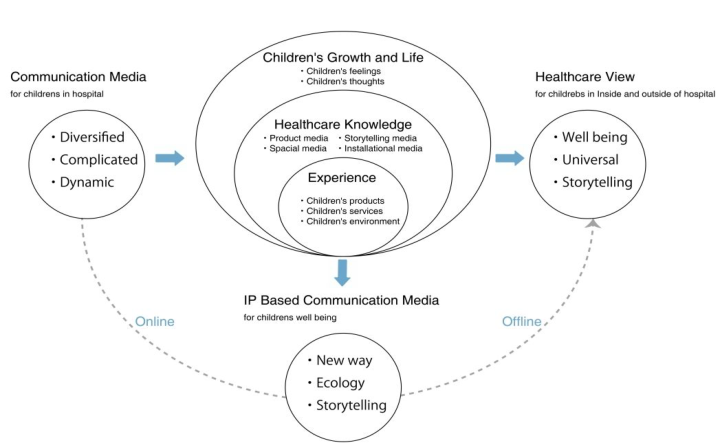
Therefore, the D&I team designs the character of IP, and further builds IP into an ecosystem (see Figure 4). The ecosystem is mainly divided into two parts, online and offline, and children can get access to the system through online and offline. The online part is mainly presented in the form of website, and the offline part operates based on the platform of hospital. In general, the ecosystem can provide good service through IP, whether it is an online way or an offline way.
Figure 4: IP is ecology (system diagram). (Photo by the author).
208 Peng and Teng
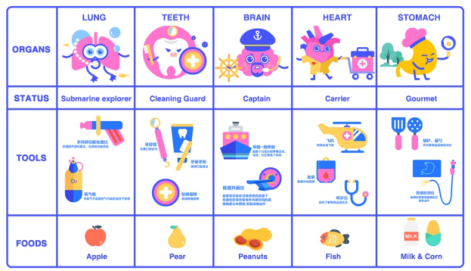
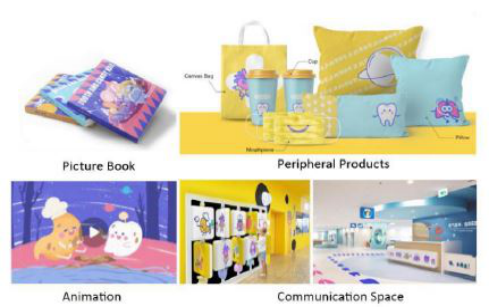
The D&I team created 5 IP (Intellectual Property) characters based on human organs, namely the teeth, the brain, the heart, the lungs, and the sto- mach (see Figure 5). We also produce animation and picture books based on these IP characters to enforce children’s impression about them. It creates a larger environment with IP characters and effectively integrates them into children’s lives and further expands the influence of them on children (Herr- Stephenson, B., et al., 2013). At the same time, we create a communication space of IP characters within the physical environment of the hospital, inclu- ding signs with IP attributes, large interactive devices, and other designs (see Figure 6).
These IP characters have different personalities and stories about them could be developed as an effective media to communicate with the children. This does not only provide a set of tools that enable the parents and the doctors to communicate with the children about medical knowledge, but also help to enlarge the shared context among the children, the parents, and the doctors, so that better understanding could be achieved during the trea- tment process. These IP characters could also be easily used at home for the parents to communicate with the children patients, as an extension of the
Figure 5: Organ as IP design prototype. (Photo by the author).Figure 6: Designs in the IP-based communication system. (Photo by the author).
Design Model for Children’s Communication Problem in Healthcare Based on Systems 209
communication at the hospital, facilitating the treatment or medication at home.
From the perspective of children, IP characters are no longer virtual but also friends in their life. Bringing IP characters into reality makes it easier for children to accept medical facilities and hospital, and reduce their fear during the medical process, and finally have better medical experience.
CONCLUSION
We found that the use of IP to build virtual characters is easier for children to accept and is beneficial to the healthy growth of children. IP steps into the real world and resonates with children, which makes it easier for children to accept medical devices and hospitals by story-telling, and reconstructs the relationship between children patients and doctors. As a medium, IP creates a space for communication in the process of children’s medical treatment, which can convey medical and health knowledge through different ways; IP is an ecology and a design mode. Further, IP can cross the media to narrate and spread through multiple channels, which strengthens children’s cognition of the real world, and is characterized by the narrative and story-telling.
From the perspective of children, IP is no longer a virtual character but a growth partner. Bringing IP into reality makes it easier for children to accept medical devices and hospitals, learn medical knowledge, reduce their fear during the medical process, and finally have better medical experience.
REFERENCES
Altman, M., Huang, T., & Breland, J. Y. (2018). Design thinking in health care.
Preventing chronic disease, 15. Amaral, I., Simes, R. B., & Santos, S. C.. (2020). Transmedia Storytelling and Media Literacy: Learning Through Hybrid Experiences. ICERI 2020. Brown, T.. (2008). Design thinking. harvard business review, 33(6), 84-92. Carlsson, I. M., Arvidsson, S., Svedberg, P., Nygren, J. M., & Larsson, I..
(2020). Creating a communication space in the healthcare context: children’s perspective of using the ehealth service, sisom. Journal of Child Health Care, 136749352090480. Eysenbach, G.. (2001). What is e-health?. Journal of Medical Internet Research, 3(2), E20. Gwenn, Schurgin, O’Keeffe, Kathleen, & Clarke-Pearson. (2011). The impact of
social media on children, adolescents, and families. Pediatrics. Herrstephenson, B., Alper, M., & Reilly, E.. (2013). T is for transmedia: learning through transmedia play. Imelda, & Coyne. (2006). Consultation with children in hospital: children, parents’
and nurses’ perspectives. Journal of Clinical Nursing. Jenkins, H. (2010). Transmedia education: the 7 principles revisited. Norman, D. A., & Stappers, P. J. (2015). Designx: complex sociotechnical systems.
She Ji: The Journal of Design, Economics, and Innovation, 1( 2), 83–106. Norman, D. A. (2011). Wir brauchen neue Designer! Why Design Education Must Change.
210 Peng and Teng
Nygren, J. M., Lindberg, S., Wrnestl, P., & Svedberg, P. (2017). Involving children with cancer in health promotive research: a case study describing why, what, and how. JMIR Research Protocols, 6(2), e19. Richard, B. (2019). Systems thinking and design thinking: the search for principles in
the world we are making - sciencedirect. She Ji: The Journal of Design, Economics, and Innovation, 5( 2), 85–104. Roberts, J. P., Fisher, T. R., Trowbridge, M. J., & Bent, C. (2016). A design thinking framework for healthcare management and innovation. Healthcare, 11–14. Steinmair, D., Zervos, K., Wong, G., & Lffler-Stastka, H. (2022). Importance of com-
munication in medical practice and medical education: an emphasis on empathy and attitudes and their possible influences. Journal of International Psychiatry, 12(2), 15. Swap, W., Leonard, D., Shields, M., & Abrams, L.. Using mentoring and storytelling to transfer knowledge in the workplace.
LISTED IN THE AHFE DIGITAL BOOKSTORE CATALOGUE
Explore the complete digital volume
Human Factors in Communication of Design
Read this individual research paper free through the original publisher, or explore the full digital proceedings book.
ISBN 978-1-958651-66-7
Explore this ISBN in the AHFE Bookstore ↗Listed in the July 2026 bookstore catalogue; search by ISBN to confirm current availability · Digital book purchase optional