Miguel De Andrés Herrero, Victoria Lopez, Matilde Santos, Diego Urgelés, Manuel Faraco Favieres (2025). Design of a video game adapted to the study of motivation in young people with emotional disorders. In: Human Interaction and Emerging Technologies (IHIET-AI 2025): Artificial Intelligence and Future Applications. AHFE Open Access, vol. 161, pp. 419–427. https://doi.org/10.54941/ahfe1005934
For several years now, the impact that mental illnesses such as depression, anxiety or eating disorders have on society has become more evident, and how they are affecting an increasing number of young people. Measuring variables related to motivation, in order to perceive mood disorders, is important for monitoring the disease. There are two types of motivation. On the one hand, intrinsic motivation, which arises from within the individual, awakening interest in carrying out a task without expecting external rewards. On the other hand, extrinsic motivation, which is stimulated by the search for results or external rewards. Regarding the latter, video games and the fields of psychology and psychiatry have been strengthening their ties in recent years, proving the usefulness of this digital product in the study of patients with some type of emotional problem. This work proposes the design specifications of a video game that can measure extrinsic motivation as a psychological variable that helps determine possible behavioral problems in the person, and allows monitoring during treatment. A simple and accessible design is proposed to facilitate its use and make it user-friendly, through an implementation for mobile platforms on the Android operating system. The specifications of the video game are conditioned by the complexity of establishing a balanced workreward system, equipped with simple game mechanics that do not require specific skills on the part of the user. The result is a feasible design that could allow psychologists and psychiatrists to follow their youngest patients, and an attractive tool to promote the collection of information.
The origin of mental disorders has been under study for centuries. One in five adolescents experiences some type of emotional disorder each year (Lehtimaki, Martic, Wahl, Foster, Schwalbe, 2021). Therefore, it is essential to address these types of issues early due to the problems that can arise when these disorders appear at such young ages. One of the most prevalent disorders is depression. According to the DSM-5, depression can be defined
as a mood disorder characterized by a persistent feeling of deep sadness, loss of interest in daily activities, as well as decreased energy and motivation (American Psychiatric Association, 2015). In recent years, the question has been raised whether low state of mind is directly related to the onset of depression, or if it can also be seen as an evolutionary response for individuals to adapt to their environment, which at a certain point becomes harmful due to poor emotional management by the individual.
The difference between being classified as depression or not can be conditioned by motivation. According to self-determination theory, motivation is the psychological process that drives a person to act or maintain a behaviour based on a specific goal or objective (Ryan, Deci, 2017). It involves both internal factors (needs, desires, or interests) and external factors (rewards or incentives) that enhance, direct, and sustain behaviour toward a specific outcome. Motivation has been studied across various theories (Bandhu, Mohan, Nittala, Jadhav, Bhadauria, Saxena, 2024) from the early twentieth century to the present. We could categorize motivation into two subtypes:
Intrinsic: It arises from interest or enjoyment in the task itself, without expecting external rewards.
Extrinsic: It is related to the pursuit of external outcomes or rewards, such as money, recognition, or avoiding punishments.
This paper is focus on extrinsic motivation, like the motivation that drives an animal to search for food to satisfy its nutritional needs. This involves making decisions in an optimal way, influenced by external factors from the environment. In this context, we could define optimal foraging as the maximization of efficiency in the search for food, using a very simple formula: obtaining the largest amount of food with the minimum energy consumption.
An individual performs an action aimed at obtaining a reward; if the reward is adequate, their behaviour is reinforced. Ideally, this leads to what we have previously described as “optimal foraging”. However, when this behaviour becomes unsystematic due to some specific factor, individuals fall into what can be called addiction. In this state, they expend more energy than they gain in the search for food and energy sources.
This work is part of the ACERTA project on computational analysis of risk states in emotional disorders. In this project, preliminary studies have been carried out on the emotional state and motor activity of individuals (Llamocca et al., 2021 and Llamocca et al., 2024). These studies have shown the importance of motivation as a significant variable in the evolution of the emotional state. Therefore, this work highlights the close relationship that has emerged between the fields of psychology and psychiatry and video games, and defines the specifications for the development of a game capable of measuring variables related to motivation in young people, as an indicator for patient monitoring.
The structure of the article is organized as follows: Section 2 explores the relationship between video games and psychology. Section 3 outlines the proposed specifications for the video game, including the main interface.
Design of a Video Game Adapted to the Study of Motivation in Young People 421
Section 4 describes the key parameters to be measured as results of this work. Finally, Section 5 presents conclusions and discusses potential future works.
VIDEO GAMES AND THEIR USE IN PSYCHOLOGY Video games and the fields of psychology and psychiatry have been strengthening their ties in recent years due to the proven usefulness of this digital product in the treatment of patients with various psychological issues. These games can influence multiple aspects of human behaviour, both positively and negatively.
Psychology has approached video games from various perspectives, focusing for a long time on their negative aspects, such as addiction. However, this this approach has been changing as their potential and use in cognitive and social treatments with positive effects have been recognized. Within this group, we could highlight the application of the so-called Serious Games— video games explicitly and carefully created for educational purposes, for the treatment of disorders, etc. (Mihalits, Riboli, Grgic, 2024).
In the survey by Zayeni et al., out of 22 studies that evaluated 14 serious games and 8 commercial games, 18 reported significant improvements in the symptoms of young patients with some type of psychiatric disorder (Zayeni, Raynaud, Revet, 2020). That is, video games may impact the cognitive development of individuals, allowing them to improve in certain areas such as attention, memory, and visual processing. Similarly, it has also been demonstrated that they affect emotional regulation, serving as an escape route that can help regulate stress and negative emotions.
One of the most widely used genres to reduce anxiety levels are the so- called Cozy games—calm games without clear objectives to pursue, which have abundant resources and evoke a feeling of tranquillity (Siváková, 2024). Moreover, the positive use of video games has already been demonstrated to support the recovery of certain diseases or to help motivate and facilitate learning in the face of disabilities, through methods such as gamification applications (Alkhawaldeh, Khasawneh, 2024). Other studies have shown their their usefulness in the treatment of different pathologies, such as strokes, where a key factor has been to encourage patient motivation through the use of video games (Swanson, Whittinghill, 2014).
In this work, a video game has been designed that allows the measurement of motivation as a variable that can help identify possible behavioral problems in individuals, and help in their monitoring during treatment. This video game is parameterized using variables that are measured during the game and that are useful for this monitoring process.
DESIGN SPECIFICATIONS For the design of this video game we have based ourselves on the concepts mentioned above and, more specifically, on replicating the search for food within the game. In this way, we can observe the different patterns and behaviours that individuals present when setting goals, achieving them and managing the available resources. This replica consists of creating a scenario
with an avatar for the player, surrounded by trees. These trees are located at different distances and the player must choose the order in which to visit each tree. To move from their position to a tree, the avatar will consume a certain amount of energy depending on the distance to the tree. In addition, when starting the game, the user has a time to pick fruit and play. Each tree contains 5 fruits (the same amount in all trees), which provide energy to the player, so when the avatar reaches a tree they can replenish the consumed energy up to the maximum, if the tree still has fruit. Following this cycle, the player must continue moving from tree to tree without exhausting their energy for a certain period. Once your energy or time runs out, the game is over.
Definition 0. The information of the game is modelled as a complete undirected weighted graph G = (V, A) of N nodes: V = {V1, …, VN}
Equation reproduced from the original PDF.
2
dij ≥0}, where each node Vi represents a tree and dij represents the distance between nodes Vi and Vj. Besides, a node is defined as a pair Vi = (i, fi) where i is the number of the node and fi is the number of remaining fruits in the tree. Initially every node has F = F0 fruits. Throughout the game, the node state changes dynamically based on the player behaviour.
Definition 1. Player’s progress is defined as a quadruplet PPk = (E, t, F, µ), where E is the energy remaining throughout the game. Initially E = E0 (full of energy, initial conditions); similarly, t is defined as the remaining time. Initially t = T0 (full time, initial conditions); F is the fruit score, initially F = 0; and µ = [Source, V’1, …, V’k] is an ordered sequence of nodes, representing the path taken by the player from the beginning of the game to the current state. Initially µ = µ0 = [Source]. The path µ may contain cycles.
Definition 2. The game is defined as a sequence of progress states starting from PP0 = (E0, T0, 0, µ0 = [Source]) and ending in any state PPM = (EM, TM, FM, µM). If EM = 0, or TM = 0, the game stops because energy and/or time has run out. If FM, = FT (total number of fruits in the graph), then the game ends because the player has collected all the fruits. Otherwise, the player is considered to have quit the game.
The rules of the game are simple. Each time the player moves to a new node, he loses an amount of energy proportional to the distance between the source and destination nodes. Once he has reached the next node, energy is regained based on the number of fruits collected at that node. The following formula is used to update the energy state when moving from a state PPk to the next state PPk+1
Equation reproduced from the original PDF.
Where dij is the distance between nodes Vi, Vj, being Vi the node at state K and Vj the node at state K+1; ef is the energy recovered for each fruit collected; and fk+1 is the number of fruits collected.
Definition 3. Let PPk = (Ek, Tk, Fk, µk) and PPk+1 = (Ek+1, Tk+1, Fk+1, µk+1) be two adjacent progress states, the move is consistent if and only if
Design of a Video Game Adapted to the Study of Motivation in Young People 423
There is a reduction of remaining energy: Ek>Ek+1
There is a reduction of remaining time Tk>Tk+1
Equation reproduced from the original PDF.
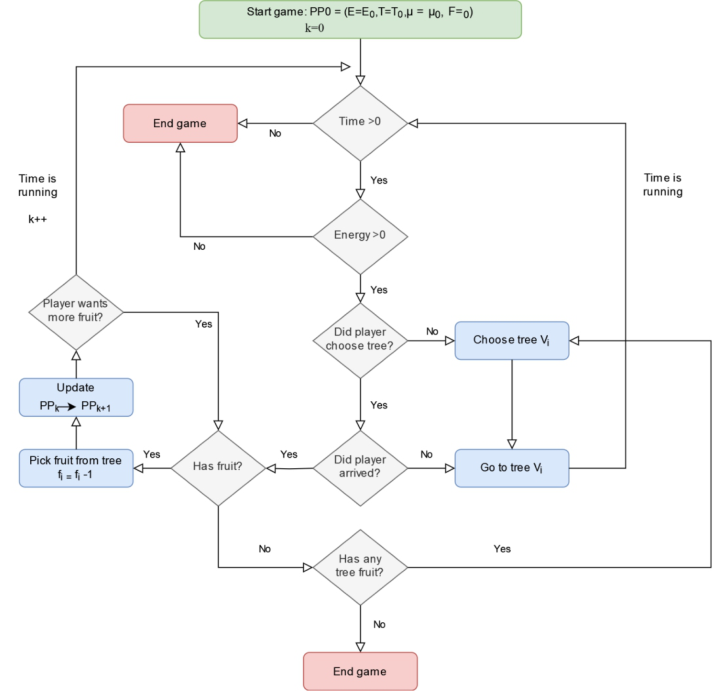
Figure 1 shows the game flow diagram.
Figure 1: Video game flow diagram.
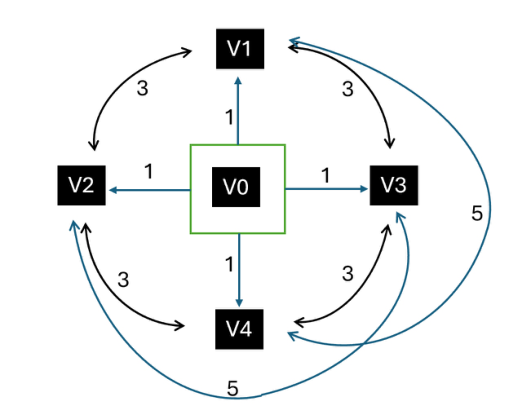
Figure 2 shows an example of a game network with 4 nodes, plus the initial node V0. The graph shows the cost (distance) between nodes, indicated by a value on the bidirectional edges. Edges leaving the node V0 have a cost of 1 and have no return since the game always ends at any node other than the origin. Table 1 shows an example of the game running with the configuration in Figure 1. The parameter µ shows the path taken by the user. In this example the game ends because the energy runs out before the fruit is collected. The activity log contains the decisions that the player has made in each configuration. This information can be very useful to measure the player’s motivation and his playing pattern.
Figure 2: Configuration of a video game with 4 nodes.Table 1. Activity trace example: Game with 4 internal nodes.
In video games, one player may be more skilled than others at games that require quick reflexes, such as a game based on avoiding obstacles. Other players may excel at games that require more logical or rational thinking skills, such as puzzle games. The more complex the game, especially in terms of human-computer interaction, the more skills of this type are required from the player to be able to use it. Therefore, when designing a video game for the purposes proposed here, it is necessary to take into account that its playability does not become a limitation for the player based on their skill level. To do this, the possible barrier of the player’s skill level will be eliminated by choosing a very simple interaction, based on something as easy and common as a touch on the screen.
It is also important to design an appropriate reward system. A reward system is based on the principles of operant conditioning, discussed above, where for each action that the individual performs, he or she is rewarded or punished, depending on the evaluation of the action performed. In this way, his or her behavior is reinforced in one way or another. In the case
Design of a Video Game Adapted to the Study of Motivation in Young People 425
of this video game, we opted for operant conditioning based on positive stimuli. That is, the player will be rewarded when he or she performs the tasks correctly. The game interface must be simple and intuitive. To achieve this, we minimize unnecessary noise, avoiding showing information that is not necessary for the player. In summary, the following basic specifications are established for the design of the video game: 1. Easy to use; 2. Friendly interface; 3. Interaction model based on simple screen touches; 4. A positive reward system based on points for collecting objects (e.g. fruits).
This design focuses on monitoring and tracking a player’s motivation through specific parameters that are measured during gameplay. The design and parameterization have been defined with the help of psychiatry specialists, including risk percentage, number of screen taps, score improvements, or resource waste, among other variables, in order to monitor the player’s decision-making ability.
RESULTS
The set of variables and parameters that are considered useful for the proposed objective are shown in Table 2, indicating their relevance for the study of user motivation in the 3rd column.
Table 2. Variables and parameters of interest.
Table available in the original PDF paper.
Name Type Initial Value Relevance (1-10) Path length Variable 0 10 Initial time Parameter T0 (full) 8 Total node number Parameter Input 2 #Current nodes vs #Initial nodes Variable 0 7 #Initial tokens in nodes Parameter Input 2 #Score Variable 0 8 Remaining Energy Variable E0 (full) 9 Other Variable/parameter Input -
In the table, the distinction between variable and parameter is as follows:
Variables: they will have an initial value assigned by default, and their value at the end of the game will be useful for measuring certain aspects of the user’s behavior.
Parameters: they can be customized for each user and allow testing.
The last column shows the relevance of each variable/parameter. These values can be set by the professional and/or the system, according to the profile of each individual. The set of variables and parameters allows the configuration of different motivation indicators. With the help of experts, customized weights can be determined according to the disorder to be measured. In this way, the designed video game is useful in collecting data for the creation of indicators related to motivation, which can be expressed as a weighted aggregation formula, mot(−→ PP) = P
i∈PP wi ∗xi, where xi is the corresponding measured value and wi is the weight for each PP variable of parameter.
CONCLUSION AND FUTURE WORKS This work proposes the design of a video game that aims to measure player motivation as a key variable to identify potential behavioral issues. The design prioritizes an engaging and simple interaction model, to accommodate players of varying skill levels. By using simple interactions, such as tapping the screen, the game seeks to remove barriers related to specific skills, ensuring that players can focus on the gaming experience rather than struggling with complex controls.
Furthermore, the game implements a reward system based on operant conditioning principles, where players receive positive reinforcement for completing tasks correctly, which enhances their motivation to participate in the game. To measure player motivation, the game will track several parameters including risk percentage, game duration, number of taps, score, and resource management. These metrics will help analyze player behavior and motivation throughout their gaming sessions.
The game interface will be designed to be simple and intuitive, minimizing unnecessary information and focusing on essential elements such as the score indicator and fatigue bar, which aims to create a more enjoyable user experience. Higher scores, longer play times, and efficient resource management will serve as indicators of player motivation.
Ultimately, the design principles emphasized in this work prioritize user engagement, motivation measurement, and an optimized gameplay experience, contributing to the game’s effectiveness in tracking behavioral patterns.
Future work includes the development of an implementation of the video game based on the specifications described above on a mobile phone platform, to carry out tests with individuals, with the aim of determining the practical usefulness of the video game. During these tests, data will be collected that will allow the video game to be iteratively improved.
ACKNOWLEDGMENT
This article is supported by the ACERTA project of CUNEF University in Spain.
REFERENCES
Alkhawaldeh, M. A., & Khasawneh, M. A. S. (2024). Designing gamified assistive apps: A novel approach to motivating and supporting students with learning disabilities. International Journal of Data and Network Science, 8(1), 53–60. https://doi.org/10.5267/j.ijdns.2023.10.018 American Psychiatric Association. (2015). Depressive disorders. Arlington, VA:
American Psychiatric Publishing. Bandhu, D., Mohan, M. M., Nittala, N. A. P., Jadhav, P., Bhadauria, A., & Saxena, K.
K. (2024). Theories of motivation: A comprehensive analysis of human behavior drivers. Acta Psychologica, 234, 104177. https://doi.org/10.1016/j.actpsy.2024. 104177
Design of a Video Game Adapted to the Study of Motivation in Young People 427
Lehtimaki, S., Martic, J., Wahl, B., Foster, K., & Schwalbe, N. (2021). Evidence on digital mental health interventions for adolescents and young people: Systematic overview. JMIR Mental Health, 8(4), e25847. https://doi.org/10.2196/25847 Llamocca, P., Guevara, C., Jiménez, Y., & López, V. (2024). Smartwatches should
facilitate the aggregation of mental health data. Society for Applied and Industrial Mathematics. Retrieved from https://www.siam.org/publications/. Llamocca, P., López, V., Santos, M., & ˇCuki´c, M. (2021). Personalized characterization of emotional states in patients with bipolar disorder. Mathematics, 9(11), 1174. https://doi.org/10.3390/math9111174 Ryan, R. M., & Deci, E. L. (2017). Self-determination theory: Basic psychological needs in motivation, development, and wellness. The Guilford Press. Siváková, V. (2024). Relax and Chill With the Cute Baby Animals: Exploratory
study on relaxing mobile games. [Tesis de maestría, Universidad de Tampere]. Recuperado de https://trepo.tuni.fi/handle/10024/156603. Swanson, L. R., & Whittinghill, D. M. (2014). Intrinsic or extrinsic? Using videogames to motivate stroke survivors: A systematic review. Games for Health Journal, 4(3), 253–258. https://doi.org/10.1089/g4h.2014.0074 Zayeni, D., Raynaud, J., & Revet, A. (2020). Therapeutic and preventive use of
video games in child and adolescent psychiatry: A systematic review. Frontiers in Psychiatry, 11(36), 1–13. https://doi.org/10.3389/fpsyt.2020.00036
LISTED IN THE AHFE DIGITAL BOOKSTORE CATALOGUE
Explore the complete digital volume
Human Interaction and Emerging Technologies (IHIET-AI 2025): Artificial Intelligence and Future Applications
Read this individual research paper free through the original publisher, or explore the full digital proceedings book.
ISBN 978-1-964867-37-3
Explore this ISBN in the AHFE Bookstore ↗Listed in the July 2026 bookstore catalogue; search by ISBN to confirm current availability · Digital book purchase optional