Yada Sriviboon, Arisara Jiamsanguanwong, Ornthicha Suphattanaporn (2025). Preliminary Survey on Trust Levels in AI-Clinical Decision Support Systems Among Medical Professionals. In: Artificial Intelligence and Social Computing. AHFE Open Access, vol. 163. https://doi.org/10.54941/ahfe1006213
1 Human-Robot Collaboration and Systems Integration Research Unit, Department of Industrial Engineering, Faculty of Engineering, Chulalongkorn University, Thailand ↗
Artificial Intelligence-based Clinical Decision Support Systems (AI-CDSS) have the potential to enhance clinical decision-making. However, trust remains a critical challenge influencing their adoption, and the specific direction of trust among medical professionals remains unclear. This study aims to provide empirical evidence on current trust levels in AI-CDSS among medical professionals. A revised version of questionnaire measuring trust in automation was utilized, employing a five-point Likert scale. A total of 29 Thai medical professionals, including both junior and senior practitioners, participated in this study. The findings reveal a spectrum of trust levels, with an average trust score of 3.05 (SD = 0.44). The majority of participants exhibited moderate trust; however, there were tendencies of undertrust and overtrust toward AI-CDSS in 10.34% and 27.59% of participants, respectively. Concerns regarding the capability, reliability, and transparency of AI-CDSS were identified as key barriers to trust. These findings provide valuable insights into trust perceptions, contributing to the development of more trustworthy AI-CDSS solutions and informing strategies for their effective integration into clinical practice.
Healthcare 5.0 is transforming traditional healthcare by integrating advanced technologies to enhance effectiveness, efficiency, and personalization (Wazid et al., 2022). Clinical Decision Support Systems (CDSS) are increasingly incorporating Artificial Intelligence (AI), giving rise to Artificial Intelligence- Clinical Decision Support Systems (AI-CDSS). AI refers to computational processes that makes algorithmic decisions using techniques such as machine learning, natural language processing, and deep learning (Elhaddad & Hamam, 2024). AI-CDSS have the potential to improve disease detection, assessment, and treatment by enhancing clinical accuracy, providing more personalized recommendations, accelerating treatment processes, and supporting complex decision-making (Amann et al., 2022; Bozyel et al., 2024; Sutton et al., 2020). However, despite AI’s significant advancements
Preliminary Survey on Trust Levels in AI-Clinical Decision Support Systems 269
in improving healthcare outcomes, the adoption of AI-CDSS remains limited, primarily due to negative perceptions and biases among medical professionals (Sutton et al., 2020). Additionally, challenges related to trust in AI- generated outputs and recommendations further hinder its acceptance and implementation in healthcare settings.
Trust refers to the trustor’s confidence in the dependability and reliability of the trustee (Tucci et al., 2021). Medical professionals’ trust in AI-CDSS is crucial for its successful integration into clinical practice (Omrani et al., 2022; Tucci et al., 2021). However, medical professionals often struggle to determine whether they should trust AI due to a lack of understanding of the reasoning behind AI-generated decisions (Amann et al., 2022). This challenge arises from inherent characteristics of AI, such as its ‘black box’ nature, self-learning capabilities, lack of transparency, and autonomy, which contribute to uncertainty and impede trust in AI implementation (Minh et al., 2022; Steerling et al., 2023). If trust remains a significant barrier, the effective adoption and utilization of AI-CDSS in healthcare setting may be compromised.
Inappropriate levels of trust in technology can lead to both misuse and disuse (Parasuraman & Riley, 1997). Medical professionals’ trust in AI can be categorized into three types: overtrust, undertrust, and healthy trust. Overtrust, or excessive trust, occurs when medical professionals rely too heavily on AI, consistently accepting its outputs without critical evaluation (Xu, 2018; Zerilli et al., 2022). This overreliance can lead to inappropriate treatment decisions if the AI produces inaccurate recommendations. In contrast, undertrust, or distrust, arises when medical professionals undervalue AI-generated recommendations, even when they are accurate (Omrani et al., 2022; Zerilli et al., 2022). This reluctance often stems from concerns about AI’s transparency, reliability, or decision- making processes. The ideal state, healthy trust, represents a balanced approach in which clinicians maintain a healthy skepticism, critically assess AI recommendations, and effectively integrate them into their clinical decision-making (de Visser et al., 2020; Zerilli et al., 2022).
Given the pivotal role of trust in determining the acceptance and effective use of AI in healthcare, understanding trust levels among medical professionals is crucial. However, the specific direction of trust within this group remains unclear. This study aims to provide empirical evidence on current trust levels, contributing to the broader discourse on human- AI collaboration in healthcare. Moreover, the result from this study will help explores strategies for optimizing the integration of AI-CDSS in clinical settings by focusing on human factors engineering, ensuring that technological capabilities align with human-centered needs and clinical practices. Ensuring that medical professionals adopt, effectively utilize, and sustain the use of AI in CDSS is essential for its successful integration into healthcare systems.
METHOD
Participants A total of 29 Thai medical professionals, representing both junior and senior practitioners, voluntarily participated in this study to ensure a diverse range of clinical experience. The participants’ ages ranged from 25 to 44 years (M = 29.96, SD = 4.25), with 51.72% identifying as females. All participants were recruited through open recruitment and convenience sampling. Eligible medical professionals were invited to participate voluntarily through a professional communication platform.
Participants were employed across various healthcare setting, with 79.31% working in public hospitals, 17.24% in private clinics, and 3.45% in medical schools. Their professional roles encompassed 48.28% interns, 17.24% residents, 10.34% fellows, and 24.14% staff members, reflecting a broad spectrum of medical training and expertise.
In terms of clinical specialties, 41.38% of participants were general practitioners, followed by 17.24% specializing in internal medicine, 13.79% in family medicine, 10.34% in general surgery, 6.90% in obstetrics and gynaecology, and 3.45% each in aesthetic medicine, paediatrics, and radiology.
Regarding prior exposure to AI-CDSS, 20.69% of participants reported previous use, with 66.67% utilizing AI-CDSS for at least six months and 33.33% for more than one year. Conversely, 79.31% of participants had no prior experience with AI-CDSS, indicating a predominantly novice user base.
Stimulus A four-minute conceptual introduction video was utilized to establish a standardized understanding of AI-CDSS among participants. The video covered fundamental concepts of AI in healthcare, with a particular emphasis on its potential applications and benefits. It was adapted from publicly accessible online sources (Victory Education Lounge, 2024) and supplemented with Thai subtitles to ensure linguistic accessibility and comprehension.
Measurement The adapted version of Questionnaire to Measure Trust in Automation (Körber, 2019) was employed as trust questionnaire to assess trust tendencies in this study. The questionnaire was translated into Thai and validated through back-translation technique to ensure linguistic and conceptual equivalence. Participants rated their responses on a five-point Likert scale, ranging from 1 (strongly disagree) to 5 (strongly agree). Reverse-coded items were adjusted accordingly. The average score will be used for further analysis with trust levels classified as: ≥4.5: Extremely over trust, 3.5–4.49: Trend toward over trust, 2.5–3.49: Moderate trust, 1.50–2.49: Trend toward under trust, ≤1.49 Extremely under trust.
Preliminary Survey on Trust Levels in AI-Clinical Decision Support Systems 271
Procedure The assessment was conducted online. Participants were first presented with an informed consent form, which outlined the study’s purpose, emphasized the voluntary nature of their participation, and assured strict anonymity and confidentiality. After providing consent, participants viewed a stimulus video designed to introduce key concepts related to AI-CDSS. Following the video, they were asked to complete a demographic questionnaire to collect relevant background information, followed by the trust questionnaire, which assessed their trust attitudes toward AI-CDSS. Upon completion, participants were thanked for their participation and formally dismissed.
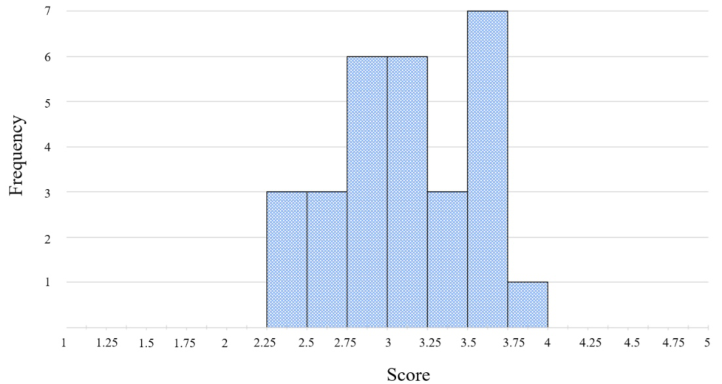
FINDING AND ANALYSIS The results of trust assessment toward AI-CDSS among medical professionals are presented in Figure 1, illustrating the distribution of trust levels. The average trust scores ranged from 2.25 to 3.75, with a mean score of 3.06 (SD = 0.44). The majority of participants (n = 18, 62.07%) exhibited moderate trust in AI-CDSS. A smaller proportion of participants (n = 3, 10.34%) demonstrated a tendency toward undertrust, indicating concerns about the reliability of the AI-CDSS. Conversely, a tendency toward overtrust was observed in eight participants (n = 8, 27.59%), suggesting confidence in specific AI-CDSS capability, such as diagnostic accuracy. Notably, no participants’ average trust score fell within the extremes of overtrust or undertrust. These finding suggest that while medical professionals generally perceive AI-CDSS as trustworthy and capable, their trust does not extend to extreme levels of overtrust or undertrust.
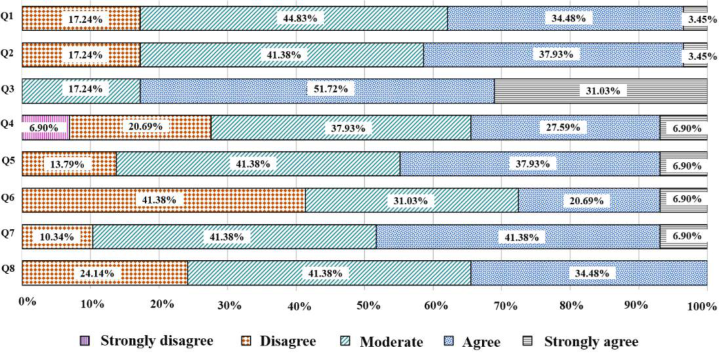
The distribution of responses to each item in the Trust Questionnaire (Questions 1–8) on a five-point Likert scale (ranging from strongly disagree to strongly agree) is presented in Figure 2. For Question 1 (I believe that the AI-based Clinical Decision Support System has the capability to provide diagnoses correctly.), a considerable proportion of participants expressed reservations. Specifically, 17.24% disagreed, and 44.83% responded moderately, indicating uncertainty regarding the system’s diagnostic accuracy. However, 34.48% agreed, and 3.45% strongly agreed, reflecting mixed confidence in the AI-CDSS’s diagnostic capabilities.
For Question 2 (I believe that the AI-based Clinical Decision Support System is reliable), the results indicated that while some medical professionals perceive AI-CDSS as reliable, apprehensions about its reliability persist. These findings highlight the need for enhanced transparency and dependability to foster greater trust and confidence in AI-CDSS among medical professionals.
For Question 3 (I believe that the AI-based Clinical Decision Support System can make error.), the majority of participants acknowledged the possibility of AI-CDSS errors. Specifically, 51.72% agreed, 31.03% strongly agreed, and 17.24% responded moderately. These findings underscore participants’ awareness of the limitations and potential risks associated with AI-based clinical decision support systems, highlighting the need for mechanisms to mitigate errors.
Figure 1: The distribution of average trust scores.Figure 2: The responses of each question (Q1 to Q8).
For Question 4 (I believe that the AI-based Clinical Decision Support System is capable of making complicated diagnosis.), the results highlight a broad spectrum of trust levels among participants. While some medical professionals acknowledge the AI-CDSS’s potential in managing complicated cases, a significant proportion remains expressing concerns about its capabilities. These concerns may lead to scenarios where medical professionals disregard AI-generated recommendations, particularly in complex cases, without fully considering their validity. Addressing these concerns is essential for fostering trust and promoting the effective integration of AI-CDSS into clinical decision-making.
For Question 5 (I believe that I can understand the reason behind the decision of AI-based Clinical Decision Support System.), a significant
Preliminary Survey on Trust Levels in AI-Clinical Decision Support Systems 273
proportion of participants (41.38%) responded moderate, while 37.93% agreed, and 6.90% strongly agreed, reflecting a generally positive perception of AI output transparency. However, 13.79% of participants disagreed, highlighting concerns regarding the explainability of AI-generated decisions. These findings underscore the need for enhanced interpretability and transparency in AI-CDSS to improve user trust and facilitate effective clinical integration.
For Question 6 (I believe that the AI-based Clinical Decision Support System makes unpredictable decisions.), concerns regarding the unpredictability of AI recommendations were evident, with 20.69% of participants agreeing and 6.90% strongly agreeing. Additionally, 31.03% responded moderately, while 41.38% disagreed. These findings suggest that some medical professionals perceive AI-CDSS as lacking transparency, potentially due to the complexity of its underlying models. Such perceptions may negatively impact trust in AI recommendations, thereby hindering its broader adoption in clinical practice. Addressing these concerns by enhancing the transparency and explainability of AI-CDSS is crucial for building trust and fostering greater acceptance among medical professionals.
For Question 7 (I believe that I can rely on the AI-based Clinical Decision Support System), the moderate responses may reflect a cautious but positive approach toward AI-CDSS, recognizing its role as a support tool rather than a replacement for medical expertise. Finding this balance is essential, as both overreliance and underutilization could compromise the intended function of AI-CDSS in clinical practice. Enhancing the transparency and reliability of AI-CDSS may further foster healthy trust and encourage appropriate reliance among medical professionals, ultimately optimizing its integration into clinical decision-making.
For Question 8 (I trust the AI-based Clinical Decision Support System.), trust in AI-CDSS varied among participants 41.38% responded moderately, while 34.48% agreed that they trusted the system. This suggests that although many participants are open to trusting AI-CDSS, they remain cautious, potentially due to concerns regarding reliability, capability, and unpredictability, as identified in previous responses. However, 24.14% of participants disagreed, indicating a notable lack of confidence in the system’s trustworthiness. These findings underscore key barriers to trust, which, in turn, may hinder the broader acceptance and adoption of AI-CDSS in clinical practice. Addressing these concerns through enhanced transparency, reliability, and explainability is essential for fostering greater trust and facilitating integration into healthcare settings.
DISCUSSIONS AND CONCLUSION The objective of this study is to provide empirical evidence on current trust levels in AI-CDSS, contributing to the broader discourse on human- AI collaboration in healthcare. The results reveal a spectrum of trust levels among medical professionals. While some participants expressed confidence in the system’s capabilities and reliability, a significant proportion raised concerns regarding trust, transparency, and the potential for errors. These
insights emphasize the critical need to enhance transparency and address trust-related challenges to facilitate AI-CDSS adoption. Furthermore, the development of effective human-AI collaboration strategies is essential to fostering successful collaboration between medical professionals and AI systems in clinical practice.
Medical professionals exhibiting tendencies toward undertrust expressed concerns regarding the reliability, capability, and transparency of AI-CDSS. For instance, responses to Question 4 indicated that some participants strongly disagreed with the system’s ability to make complex diagnoses. These findings align with Choudhury and Asan (2022), who reported that medical professionals often perceive AI as an unsafe technology, primarily due to the potentially severe consequences of erroneous recommendations, which could lead to patient harm or fatal outcomes. Furthermore, a lack of understanding regarding the AI-CDSS’s capabilities and the underlying mechanisms for generating recommendations may further impede acceptance and trust in the system (Wang et al., 2023).
Conversely, participants who exhibited a tendency toward overtrust, suggesting a cautious optimism rather than blind dependence on AI.However, maintaining this trust at an appropriate and balanced level is crucial. In situations where medical professionals and AI systems provide conflicting recommendations, excessive confidence in AI, combined with low self- assurance in clinical judgment, may lead professionals to overlook critical considerations and uncritically defer to AI-generated recommendations. This finding aligns with Göndöcs and Dörfler (2024), who reported that younger medical professionals tend to trust AI more than their own judgment, thereby increasing the risks associated with over-reliance on AI-based decision support systems. Addressing this issue requires fostering critical thinking skills, reinforcing clinical confidence, and promoting AI-awareness training to ensure appropriate reliance and effective human-AI collaboration in clinical practice.
This study has several limitations that should be addressed in future research. The small sample size, due to recruitment challenges among medical professionals, may limit the generalizability of the findings. Future studies with larger and more diverse samples are needed to enhance applicability.
To improve trust and adoption, AI-CDSS must prioritize transparency and explainability, ensuring that recommendations are accompanied by clear, comprehensible rationales, particularly in complex cases. Strengthening human-AI collaboration is also crucial, emphasizing AI as a supportive tool rather than a replacement for clinical expertise. Additionally, comprehensive training programs should be implemented before AI-CDSS deployment, equipping medical professionals with the knowledge to interpret AI recommendations effectively while maintaining critical clinical judgment. While no extreme overtrust or undertrust was observed, the variation in trust levels underscores the need to address both technical and human-centered barriers. Future efforts should focus on enhancing transparency, targeted training, and reinforcing AI’s complementary role in clinical decision-making.
Preliminary Survey on Trust Levels in AI-Clinical Decision Support Systems 275
ACKNOWLEDGMENT
Authors would like to sincerely thank Chanatip Thongdonnoi, Nattaporn Phongphaew, Passawich Boonnuch, Paloch Chinwattanawongwan, Padsamon Chatriyanuyoke, Watcharaporn Pattanasriroj, and Sakulporn Pornpanom for their invaluable support and encouragement throughout this work.
REFERENCES
Amann, J., Vetter, D., Blomberg, S. N., Christensen, H. C., Coffee, M., Gerke, S., Gilbert, T. K., Hagendorff, T., Holm, S., & Livne, M. (2022). To explain or not to explain?—Artificial intelligence explainability in clinical decision support systems. PLOS Digital Health, 1(2), e0000016. https://doi.org/https://doi.org/10.1371/jo urnal.pdig.0000016 Bozyel, S., ¸Sim¸sek, E., Koçyi˘git Burunkaya, D., Güler, A., Korkmaz, Y., ¸Seker, M.,
Ertürk, M., & Keser, N. (2024). Artificial Intelligence-Based Clinical Decision Support Systems in Cardiovascular Diseases. Anatolian Journal of Cardiology, 28(2), 74–86. https://doi.org/10.14744/AnatolJCardiol.2023.3685 Choudhury, A., & Asan, O. (2022). Impact of accountability, training, and human factors on the use of artificial intelligence in healthcare: Exploring the perceptions of healthcare practitioners in the US. Human Factors in Healthcare, 2, 100021. https://doi.org/https://doi.org/10.1016/j.hfh.2022.100021 de Visser, E. J., Peeters, M. M. M., Jung, M. F., Kohn, S., Shaw, T. H., Pak, R., &
Neerincx, M. A. (2020). Towards a Theory of Longitudinal Trust Calibration in Human–Robot Teams. International Journal of Social Robotics, 12(2), 459–478. https://doi.org/10.1007/s12369-019-00596-x Elhaddad, M., & Hamam, S. (2024). AI-Driven Clinical Decision Support Systems: An Ongoing Pursuit of Potential. Cureus, 16(4), e57728. https://doi.org/10.7759/ cureus.57728 Körber, M. (2019). Theoretical considerations and development of a questionnaire
to measure trust in automation. Advances in Intelligent Systems and Computing, 823. https://doi.org/https://doi.org/10.1007/978-3-319-96074-6\2 Minh, D., Wang, H. X., Li, Y. F., & Nguyen, T. N. (2022). Explainable artificial intelligence: A comprehensive review. Artificial Intelligence Review, 55, 3503– 3568. https://doi.org/https://doi.org/10.1007/s10462-021-10088-y Omrani, N., Rivieccio, G., Fiore, U., Schiavone, F., & Agreda, S. G. (2022). To
trust or not to trust? An assessment of trust in AI-based systems: Concerns, ethics and contexts. Technological Forecasting and Social Change, 181, 121763. https: //doi.org/https://doi.org/10.1016/j.techfore.2022.121763 Parasuraman, R., & Riley, V. A. (1997). Humans and Automation: Use, Misuse, Disuse, Abuse. Human Factors: The Journal of Human Factors and Ergonomics Society, 39, 230–253. Steerling, E., Siira, E., Nilsen, P., Svedberg, P., & Nygren, J. (2023). Implementing
AI in healthcare-the relevance of trust: A scoping review. Front Health Serv, 3, 1211150. https://doi.org/10.3389/frhs.2023.1211150 Sutton, R. T., Pincock, D., Baumgart, D. C., Sadowski, D. C., Fedorak, R. N., & Kroeker, K. I. (2020). An overview of clinical decision support systems: Benefits, risks, and strategies for success. npj Digital Medicine, 3(1), 17. https://doi.org/10. 1038/s41746-020-0221-y
Tucci, V., Saary, J., & Doyle, T. E. (2021). Factors influencing trust in medical artificial intelligence for healthcare professionals: A narrative review. Journal of Medical Artificial Intelligence, 5. https://jmai.amegroups.org/article/view/6664. Victory Education Lounge. (2024). AI in Healthcare Revolutionizing Clinical Decision Support. Retrieved 1 November 2024 from https://www.youtube.com/watch?v=297C7ndPmX4 Wang, L., Zhang, Z., Wang, D., Cao, W., Zhou, X., Zhang, P., Liu, J., Fan, X., &
Tian, F. (2023). Human-centered design and evaluation of AI-empowered clinical decision support systems: A systematic review. Frontiers in Computer Science, 5, 1187299. Wazid, M., Das, A. K., Mohd, N., & Park, Y. (2022). Healthcare 5.0 Security Framework: Applications, Issues and Future Research Directions. IEEE access, 10, 129429–129442. https://doi.org/10.1109/ACCESS.2022.3228505 Xu, J. (2018). Overtrust of Robots in High-Risk Scenarios Proceedings of the 2018
AAAI/ACM Conference on AI, Ethics, and Society, New Orleans, LA, USA. https: //doi.org/10.1145/3278721.3278786 Zerilli, J., Bhatt, U., & Weller, A. (2022). How transparency modulates trust in artificial intelligence. Patterns, 3(4), 100455. https://doi.org/https://doi.org/10. 1016/j.patter.2022.100455
LISTED IN THE AHFE DIGITAL BOOKSTORE CATALOGUE
Explore the complete digital volume
Artificial Intelligence and Social Computing
Read this individual research paper free through the original publisher, or explore the full digital proceedings book.
ISBN 978-1-964867-39-7
Explore this ISBN in the AHFE Bookstore ↗Listed in the July 2026 bookstore catalogue; search by ISBN to confirm current availability · Digital book purchase optional