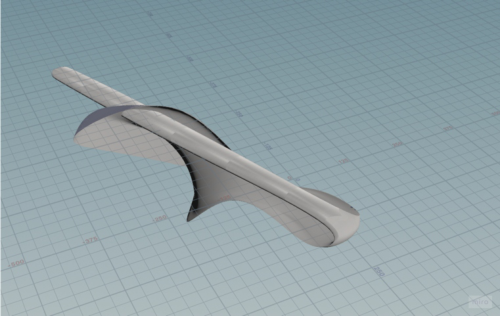
Daishi Iwai (2023). Kneading Design System: 3D Modelling Study Tool with Emotional Value for Non-Specialists. In: Human Factors in Communication of Design. AHFE Open Access, vol. 90, pp. 176–185. https://doi.org/10.54941/ahfe1003709
The purpose of this study is to introduce a Kneading Design System, that is, a design tool that enables "hands" mediated 3D modelling studies, and to explore what kind of value users can perceive by using this tool. Kneading Design System is implemented using parametric design techniques, with a physical interface allowing users to explore the solution by actually touching it with their hands. The tool allows non-experts to intuitively deform the 3D model by providing input through a physical device with clay-like affordances. The physical device can detect the pressure exerted by the user's touch and use the transformed and accumulated parameters in order to change the shape of the drawn object, allowing the user to touch and explore a large solution space. Technically, the tool is a combination of parametric design and a tangible user interface, nevertheless, it is unique in its "direct hand touch" aspect. Experiments were conducted to characterize explored solutions by comparing the proposed tool with a text-based 3D generative model. The experimental results showed that the solutions explored using "hands" were "more unexpectedly shaped for the user" and had "more emotional value" than those explored using text. It was also found that the emotional values explored by the proposed tool are based on internalizations such as selfhood. Although the proposed tool is targeted at 3D modelling, this design methodology can be applied to other domains. This paper we also describe a new design vision for applying the concept of the proposed tool.
The purpose of this study is to introduce a 3D modelling tool for non- professionals to focuses on the value created by human “hands” and to explore what kind of value can be created in modelling by using the proposed tool. In addition, this paper describes the concept and vision of the proposed tool. It is clear that ideas in creation are not necessarily generated in the mind, but are explored and discovered by using one’s hands, and this is what this study focuses on. This study also focuses on creation by individuals. In recent years, the possibility of individual creation has expanded with the advent of 3D printers and other devices, but ideas and design are still in the domain of experts. Yanagi (1936) points out the value of design by unknown artists as “Folk art” and Rudofsky (1997) as “Architecture without architects”. Even
Kneading Design System: 3D Modelling Study Tool With Emotional Value 177
non-specialists have the potential to create new value by connecting with the unique attributes of the land and people, such as culture, climate and history.
Among the tools used in the study of 3D modelling, those with physi- cal interaction which include the following representations by researchers. Kameyama (1997) proposed the Virtual Clay Modelling System, a techno- logy for manipulating virtual clay in VR, which allows intuitive deformation of clay by using visual and tactile feedback in response to actions that serve as inputs. Several similar technologies have been proposed (Ueda et al., 2005) (Yan et al., 2009), but all of them are set-up with experts such as industrial designers as users, and do not assume operation by non-experts. A tool for the study of modelling 3D models that is intended to be used by non-experts is proposed by UNFOLD (2010), l’Artisan Electronique. l’Artisan Electroni- que is a tool for modelling ceramics that imitates a potter’s wheel. The user does not need special knowledge of 3D models, but can explore modelling through the metaphor of turning a potter’s wheel. As described above, tools have been proposed to enable easy study of 3D modelling by narrowing down the subject, making the metaphors and affordances of interaction closer to reality, making them intuitive and limiting the scope of manipulation. On the other hand, there are few proposals focusing on the physical interacti- ons that can actually be touched and are intended for non-specialists without knowledge or experience in 3D modelling. In addition, none of the proposals surveyed addressed what kind of creations will be produced or what value these creations will have.
DESIGN Design Overview
This paper propose a 3D modelling study tool that allow physical interaction through physical devices. The proposed tool enables non-experts to perform 3D modelling intuitively because it uses “hands” to perform the modelling study. The implemented tool is referred to as “Kneading Design System” and the design method using Kneading Design System is referred to as “Kneading Design”. Kneading Design System uses parametric design techniques to allow users to study 3D modelling within a pre-designed range, so that it is possible to study the shape without special knowledge of 3D modelling. In this paper, I refer to the set of shapes designed by AI or parametric design that can be explored by the user as the “candidate space”.
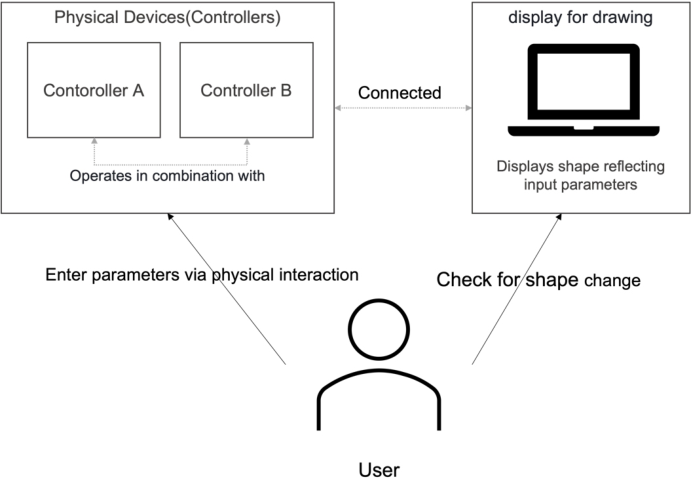
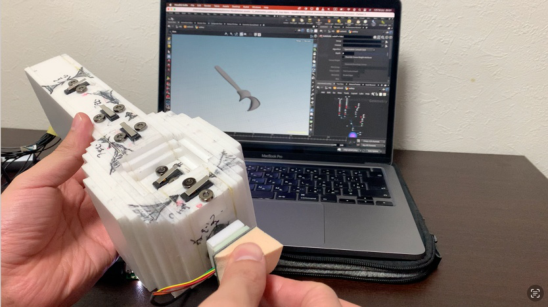
Kneading Design System consists of two main parts: a physical controller for input and an output drawing display that processe the input and displays the 3D model (Figure 1). The parameters of the 3D model implemented by parametric design can be changed using the physical controller. The user can manipulate the controller while checking the shape changes in real time. The input device has clay-like affordance to allow intuitive deformation of the model even by non-specialists with no knowledge or experience in 3D model- ling. Kneading Design System is unique in that it allows physical interaction with physical input devices. In this paper, the selected object of 3D modelling is a spoon.
178 Iwai
Figure 1: Design overview.
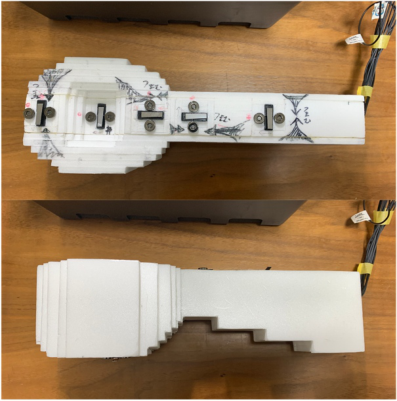
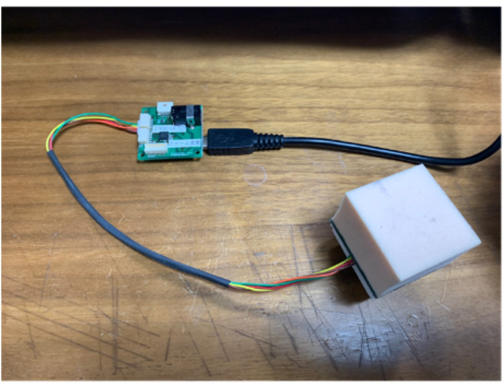
Design Details Hardware Design The physical controller of Kneading Design System consists of two control- lers, Controller A, whose shape mimics the shape of the displayed 3D model, and Controller B, which detects the physical shape displacement and designed to work in combination. The controllers actually used in the experiment are shown in Figure 2 and Figure 3.
Figure 2: Controller A.
Kneading Design System: 3D Modelling Study Tool With Emotional Value 179
Figure 3: Controller B.
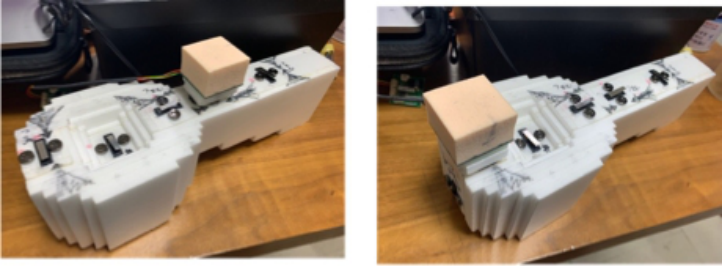
Controller A is a 25cm*10cm*7cm spoon-shaped controller made of sty- rene. Controller A and B can be connected by magnetic force, and Controller A has an embedded microswitch that can detect the position of the conne- ction with Controller B. Controller A transmits the connection position to the drawing display via Arduino. There are six connection points to which Controller B can be connected (Figure 4), each corresponding to a different parameter used to change the shape. To enable intuitive operation, I chose variables that allow “affordance interaction” by making it easy to visually recognize shape changes. “affordance interaction” refers to an interaction in which the physical input has an affordance of deformation so that the shape of the 3D model can be deformed as if one were tweaking clay. For example, objects drawn when a physical device is pressed from above are pressed from above, and objects drawn when twisted are twisted.
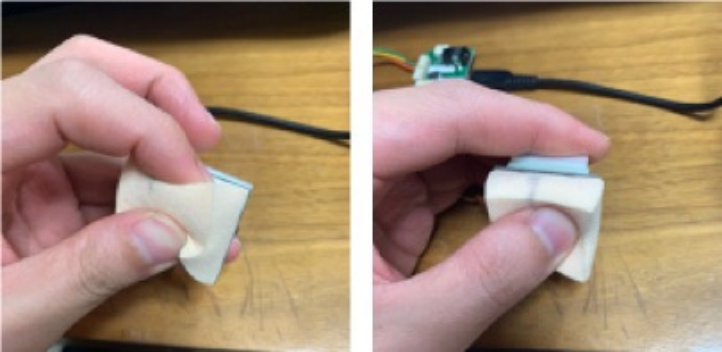
Controller B is a 3cm*3cm*2.5cm block of urethane sponge with embed- ded tactile sensors. Controller B can detect voltage changes in response to the
Figure 4: Examples of controller A and controller B connection.
180 Iwai
displacement of the sponge by using light intensity changes between the LED and phototransistor due to sponge compression, enabling pressure detection in the vertical and horizontal directions. This allows Controller B to detect various physical interactions such as “pulling”, “twisting”, “pinching”, and “pushing” (Figure 5). The detected actions and displacements are sent to the drawing display, and the displacements are converted to correspond to the threshold values of the parameter variables and then used for drawing. Con- troller B uses a different parameter input method depending on the position of the connection with Controller A. For example, if the user wants to make the handle of the drawn spoon thinner, the user connects Controller B to the handle of Controller A, and by “pushing” Controller B, the handle of the drawn spoon will change to thinner. Similarly, if the user wants to change the angle of the bowl of the drawn spoon, the user connects Controller B to the bowl of Controller A, and by “pushing” Controller B, the angle of the bowl of the drawn spoon will change. The input to controller B is cumulative and used for drawing. Thus, for example, if Controller B is actually moved 1 cm, the drawn object will be squashed by 10 cm. This conversion allows the user to explore a wider range of shapes, while maintaining the intuitiveness of operation with affordances.
Software Design Kneading Design System utilize the 3D CAD software “Houdini” to design and draw parametric models of the spoon. The values entered by Controller A and B are read by a Python program and stored in a database. Houdini reads each variable from the database every 0.1 second and displays the model with the read variables applied on the display. An example of the process from input to drawing for a physical device is shown in Figure 6. Figure 6 shows the process of connecting controller B to the bowl of controller A and twisting the bowl of the drawn spoon by twisting controller B.
Figure 5: Examples of input actions that controller B can detect.
Kneading Design System: 3D Modelling Study Tool With Emotional Value 181
Figure 6: An example of the process from input to drawing for a physical device.
EVALUATION The proposed tool is a mechanism for physically and intuitively exploring 3D models of candidate spaces that can be operated by non-experts. Similarly, Text-to-3D technology exists as a way to replace 3D modelling with explo- ration of candidate spaces to enable non-experts to study 3D modelling, as proposed by Google in 2022 with DreamFusion (Poole et al., 2022). In order to characterize the approach of physical exploration from candidate spaces, the researchers conducted an experiment comparing the proposed tool and Text-to-3D. In order to better characterise the users’ subjective evaluation of the modelling, 3D modelling was conducted in three different ways, using the proposal tool, Text-to-3D, plus sketching. The purpose of the evaluation is to identify features of Kneading Design in an exploratory manner.
RESULTS
Preliminary Interview First, four participants with no previous experience in 3D modelling were asked to create a “spoon” using three different creation methods under the title “The ideal spoon that they would like to have”. The different creation methods and the results to be evaluated are as follows.
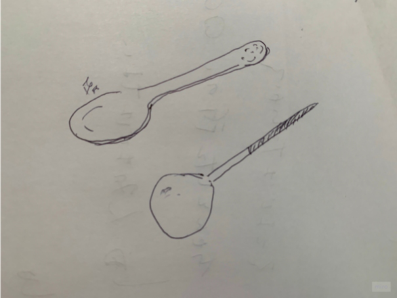
X: Sketch on A4 size paper
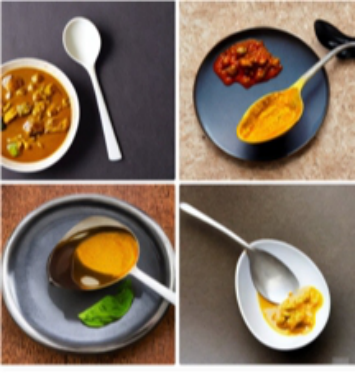
Y: Image generated by Stable Diffusion 2.0 (Hugging Face, 2022)
Z: 3D model of a spoon created by Kneading Design System As for Y, using a “3D model generator” with a 3D model as output would be a valid comparison, when this paper was written, there were no models with high accuracy. Therefore, we used “Stable Diffusion”, which is an image generation model that returns an image output in response to a text input and has high image rendering accuracy. Participants are free to choose the input text for Stable Diffusion multiple times until they are satisfied with the output. Although the methods all have different outputs, this does not affect the scoring because the scoring is done for ideation.
182 Iwai
In that experiment, the following preliminary questions were asked in order to clarify the subjective evaluation of the outputs and what value is placed on the outputs. Examples of outputs are shown in Figure 7-9.
A-1: Do you think the design looks good? (5-point scale from 1∼5, subjective rating)
A-2: Why do you think it is good (or bad)? (subjective evaluation) For the X approach, 3 out of 4 participants recalled spoons they had used or seen before and drew them as ideal. As for the approach of Y, similar to the approach of X, they tended to evaluate spoons they had used or seen in the past. When asked about the reason for their choice, they expressed their attraction to spoons with the same shape as the one they had imagined, specifically, “This is exactly what I was thinking of”and “ I think this is good, because this is what I had in mind”. In the search process, users who used the approach of Y showed a process of searching for a shape similar to the sketch they drew in the approach of X. In the approach of Z, three out of four
Figure 7: Spoons produced by one user using the X approach.Figure 8: Spoons produced by one user using the Y approach.
Kneading Design System: 3D Modelling Study Tool With Emotional Value 183
Figure 9: A spoon produced by one user using the Z approach.
users evaluated a shape that was different from the shape they had imagined before creating it. Each of them had determined the shape based on their own introspection and found a value that could be described as emotional, specifically, “This has a shape that I can say truly be myself”, “This has a shape and colour that I can say is like me”, and “This reminds me of a food I like”. In the process of shape exploration, there was a tendency to find value in discovering a different shape from what was expected as they fiddled with the parameters, specifically, “I got a shape I wasn’t expecting but thought was cool” or “I got a different shape from what I had in mind when I made it”.
Based on the above, we hypothesized that the Z approach would be chara- cterized by “users discovering and evaluating unexpected shapes in the shape search process” and “the factors that users perceive as emotionally valuable are factors that emerge from their introspection, such as their own personality and their own commitment compared to the X and Y approaches.
Interviews for Hypothesis Testing The following additional interviews were conducted. Questions were inclu- ded to clarify that “users discovering and evaluating unexpected shapes in the shape search process” are as follows.
B-1: Does the finished creation (spoon) have emotional value to you? (5-point scale from 1∼5, subjective rating)
B-2: Is the finished creation (spoon) outside of your expectations? (5-point scale from 1∼5, subjective rating) For the X and Y approach, the outputs that gave the highest score on B-1 and the outputs that gave the highest score on B-2 were different for all users. For the Z approach, the output that all users rated highest on B-1 and the output that they rated highest on B-2 were the same. These results suggest that the Z approach allows users to explore unexpected shapes. In addition, given the results of A, the unexpected shapes explored by the Z approach have more emotional value than the expected shapes.
184 Iwai
Next, The following questions were asked to clarify that the factors that users perceive as emotionally valuable are factors that emerge from their introspection, such as “their own personality”and “their own commitment”.
C-1: Can you say that the finished creation (spoon) is unique to you? (5-point scale from 1∼5, subjective rating)
C-2: Does the finished creation (spoon) express your own particularity? (5-point scale from 1∼5, subjective rating) For question C-1, out of the three methods, two out of four users gave the highest score for the output from the X approach, three out of four users gave the highest score for the output from the Z approach, no user gave the highest score for the output from the Y approach, and no user gave the highest score for the output from the C-2 approach. For question C-2, all three of the four users gave the highest score to the output from the Z approach, and one of the four users gave the highest score to the output from the X approach. These results suggest that the Z approach tends to explore introspection- based shapes such as “commitment” and “self” more easily than the X and Y approaches.
Summary of Evaluation Results The results of each evaluation and their implications are as follows.
1. Given the experimental results, emotional values tend to be more likely expressed through non-verbal and intuitive exploration. 2. the factors that lead to the feeling of emotional value for the forms were explored in the Z approach, and tend to be based on one’s own introspection. 3. In the Y approach, where output is obtained by entering text, users tend to find shapes that are close to the imagined shape. 4. Given the output of the Z approach, it was suggested that an explo- ratory approach through physical interactions is more likely to be an approach to finding value that was not anticipated.
DISCUSSION & CONCLUSION The above results suggests that when creating with Kneading Design System, even non-professionals can intuitively and physically search for forms, and can create works with emotional values rooted in their own intuition, such as personal commitment and individuality. Based on the above, I discuss the future of Kneading Design.
Kneading Design is a method for physically searching for a solution from candidate spaces created by designers or design systems. Because the inte- raction is physical, it is possible to handle non-semantic input and search for emotional value. Technical features include intuitive operation by direct touch, interactive interaction, and the ability to search a wide candidate space by extending the input. Kneading Design is unique in that it has affordance interaction, which allows users to pseudo-touch parameters that cannot be physically touched. Actually, Kneading Design system can be used to study
Kneading Design System: 3D Modelling Study Tool With Emotional Value 185
the modelling of a 100 m spoon while actually touching it with the hand. Experiments showed the possibility that a tool with physical interaction can find a shape with emotional value that exceeds the image that was assumed in the mind before the search.
From the above, we discuss the applicability of Kneading Design in various fields other than the modelling of 3D models. While this paper has clarified the characteristics of the proposed tool by contrasting it with “AI” creation, there is room to propose approaches that combine these approaches. Based on the results of this study, it is suggested that incorporating physicality into the solution search by “AI” is also effective. For example, a proposal could be made for a device that uses a brush-like interface for image generation techniques and allows the user to explore the picture interactively.
Although Physical interaction with computers has been discussed primarily in the HCI discipline, the value that can be created by bringing physicality to tools related to creation has been less discussed. It is clear that physical interaction through a physical interface influences the creation process and the created object on several levels. This study clarified the impact in terms of value created. In order to make the operation more intuitive for the user, it is considered effective to make the appearance and interaction of the tool more similar to that of a real tool.
REFERENCES
B. Poole. et al. (2022) DreamFusion: Text-to-3D using 2D Diffusion, arXiv:2209.14988 Hugging Face (2022) Stable Diffusion 2–0 - a Hugging Face Space by stabilityai.
Available at: https://huggingface.co/spaces/stabilityai/stable-diffusion, (Accessed: 12.10, 2022) Kameyama, K. (1997) ‘Virtual Clay Modelling System’, Proceedings of the ACM symposium on Virtual reality software and technology, pp. 197–200. Rudofsky, B. (1987). Architecture without architects a short introduction to non-
pedigreed architecture. Albuquerque: University of New Mexico Press. Ueda, E. et al. (2005) ‘Virtual clay modelling system using multi-viewpoint images’, Fifth International Conference on 3-D Digital Imaging and Modelling (3DIM’05), pp. 134–141. UNFOLD (2010) l’Artisan Électronique - Unfold Design Studio. Available at:
http://unfold.be/pages/l-artisan-electronique.html, (Accessed: 11.19, 2022). Yan, F. X. et al. (2009) ‘Virtual Clay Modelling System with 6-DOF Haptic Feedback’, Materials Science Forum, pp. 155–160. Yanagi, S. (1936). Folk-crafts in Japan. Tokyo: Kokusai Bunka Shinkokai.
LISTED IN THE AHFE DIGITAL BOOKSTORE CATALOGUE
Explore the complete digital volume
Human Factors in Communication of Design
Read this individual research paper free through the original publisher, or explore the full digital proceedings book.
ISBN 978-1-958651-66-7
Explore this ISBN in the AHFE Bookstore ↗Listed in the July 2026 bookstore catalogue; search by ISBN to confirm current availability · Digital book purchase optional