Zhong Wang, Wenya Zhang (2023). Crossover IP Image Design Strategy for the Great White Rabbit Brand Based on AHP Analysis. In: Human Factors in Communication of Design. AHFE Open Access, vol. 90, pp. 137–145. https://doi.org/10.54941/ahfe1003705
To propose a specific plan for the design of cross-border IP image of the old brand Dabai rabbit, and more consideration of user emotional needs when upgrading the brand image. The method is based on Donald Norman's design emotionality theory, using AHP hierarchical analysis to summarize the demand indicators of the cross-border brand IP image upgrade in market research and user evaluation data, and quantify the demand to generate design principles by ranking the importance level, and finally come up with the design scheme of the cross-border IP image of the Great White Rabbit and ledin. Through quantitative and qualitative methods to summarize the user needs, it was found that the top four demand indicators of the crossover IP of the Great White Rabbit were variable modeling, fun, cute style and emotional resonance, and the high demand for external visual and internal emotion reflected the rational consumption cognition of the young generation; and according to the demand indicators, the crossover IP design should focus on three major aspects of user sensitization, brand content and brand value consumption. According to the demand index, the three design principles of user sensitization, brand content and brand value consumption were proposed, and the design practice of cross-border IP image design for the Great White Rabbit brand was completed.
The young group is becoming the main force of consumption, in order to meet the needs of users and aesthetics, how to upgrade the brand towards youth has become an important issue, especially how to upgrade and transform the old national brand (Roy et al., 2022). Take the long-established brand White Rabbit as an example, the brand started to cross the fashion brand agnes.b in 2015, and since then it has frequently relied on novel cross-border creativity to get out of the circle, and brand cross-border association has become one of the important ways for brands to enhance their value and attract more young users (Ahn et al., 2020). In this paper, we will take the cross-border union of the Great White Rabbit Creamy Candy brand and the Ledin clothing brand as the research object, from investigating the visual needs of users, summarizing and ranking specific design indicators, generating specific design practices and evaluating them.
Overview of the Crossover Design of the Old Great White Rabbit Brand Current research around brand crossover design has mainly focused on eva- luating joint brand crossover behavior based on the perspective of firms. Scholars combine literature search and market research perspectives to give theoretical strategies from the perspective of brand crossover marketing. And among the important factors in studying the success of cross-border design, many scholars believe that brand image adaptation is an important factor for success (Qin, 2022). Yu et al. (2021) further suggest that the union of two brands will transfer their respective brand values into the new brand image created (Yu et al., 2021). Paydas Turan C (2021) (Turan, 2021) A synthesis of existing research, investigated from 197 explicit data, found that brand image fit is a more important factor than category matching and brand equity.
The idea that “the role of consumers should be included in the evaluation model”is shared by many scholars. Although consumers’ evaluation of cross- border brands is not easy to predict (Cunha et al., 2015; Zhang et al., 2021), it is one of the factors that brand associates should focus on. Scholars such as Jane Yushang et al. (简予繁et al., 2021) explore the influence on brand crossover from the perspective of consumer inspiration, and experimentally demonstrate that the image difference of crossover brands has a positive effect on users during their inspiration period. Similarly, Pinello et al. (2022) summarized the current situation of brand association through literature col- lection and found that the process of brand association specifically starts from consumers’ perceptions, and the article established an evaluation model of brand association in order to be able to better guide the phenomenon of brand association.
On the whole, although brand cross-border association is one of the hot spots, scholars mostly give some theoretical strategic suggestions, and few studies specifically judge the suitability of brand cross-border IP images from the perspective of users’ emotional needs, and give specific design pra- ctice solutions for reference. How to grasp the advantages of cross-border brand IP in brand marketing like the Great White Rabbit and better meet users’ expectations is worth studying. Taking the first cooperation of the Great White Rabbit’s apparel brand, the Great White Rabbit x Ledin series, as an example, a simple basic apparel version printed with the circular Great White Rabbit logo is equal to a new co-branded model, and This model is also a common form of many other long-established brands, con- sumers are generally more demanding than other products for the aesthetics of clothing, so this kind of association is likely to be risky for the brand itself, after a short period of attracting people’s attention will soon con- sume its own pre-accumulated brand value, and eventually lose the ability to survive as a unique brand. It is true that a short-term sense of conver- sation can attract users’ attention in a short period of time, but in the end, it is necessary to consider long-term strategies to get users’ loyalty, so it is necessary to carefully choose cross-border partners and formulate long-term development strategies, such as creating physical experience sto- res that can be operated for a long time, and attracting users by regularly
Crossover IP Image Design Strategy for the Great White Rabbit Brand 139
changing the theme of activities. Therefore, in this paper, we will take the long-term development of Big White Rabbit x Ledin series as the design premise and conduct design research on the IP image of Big White Rabbit brand.
Construct a Model Based on AHP for the Demand of Brand Cross-Border IP Image From the User’s Perspective (1) Refine demand indicators In this paper, the design of the crossover brand IP image of the Great White Rabbit is based on emotional design theory, combined with the AHP hie- rarchical analysis method to establish the design demand model from the user’s perspective. We filtered out 105 pieces of valid information and orga- nized them by reading a lot of literature and collecting users’ opinions on the cross-border union with the brand of Ledin from official websites such as Taobao. The three principles of emotional design by Donald A. Norman were used as the standard, namely the instinctive layer (related to the first reaction of the user’s first contact with the product), the behavioral layer (the user’s experience of function realization in the process of use), and the reflective layer (involving complex factors such as product culture and mea- ning value, and the user begins to consciously reflect and ask questions). The demand indicators of users for the cross-border IP image of the Great White Rabbit are collated and shown in Table 1. (2) Quantifying demand indicators a. AHP hierarchical model construction Hierarchical analysis (AHP for short) was proposed by American professor T. L. Saaty in the early 1970s. It is designed to treat complex qualitative
Table 1. Designing hierarchical analysis models.
Table available in the original PDF paper.
Part of the sub-criteria level
Target layer Guideline layer sub-criteria level Instinctive layer - IP visual image Variety of shapes
In line with modern aesthetics, styling versatility, now the image is fixed
The Great White Rabbit brand cross-border IP user emotional demand system construction
Comfortable color scheme
New theme The impression of the Great White Rabbit only remains on the packaging
Impressed by the classic color scheme of red, white and blue Lovely style Playful and cute, to convey happiness, no burden Behavioral layer - IP output content Have fun Ability to interact with users in a fun way and output new content Social The concept of keeping up with the times and being relevant to young people Reflective layer - IP cultural value
Ductile Continuous output of new quality content Uniqueness Recognizable, unique temperament Emotional Resonance
Communicate the right brand values, brand vision
140 Wang and Zhang
problems that can be handled in quantitative steps, and is a multi-criteria decision-making scheme organized in a hierarchical structure(Tripathi et al., 2022). It is a multi-criteria evaluation system, in which complex problems are decomposed into multiple indicators according to certain criteria, and the different levels of importance among the indicators are indicated by assigning weights to them(Panchal and Shrivastava, 2022, Ransikarbum et al., 2021). The weight is assigned to show the different levels of impor- tance among the indicators. In order to specifically see the relationship between the indicators, the AHP hierarchical model is constructed based on the previously derived user emotional needs system Table 1, the target layer is A, the criterion layers are B1, B2, B3, and this criterion layer is C1-C9. b. Constructing judgment matrix To determine the n factors of the criterion layer, A={B1, B2, B3, ..., Bn}, in order to determine the importance of each factor to the target layer, two ele- ments are first compared with each other, and here aij is used to represent the importance of indicator i compared with indicator j. Then the judgment [Equation or mathematical symbol available in the original paper PDF]
[Equation or mathematical symbol available in the original paper PDF] a11 . . . a1n matrix A can be obtained: A = aij n×n = [Equation or mathematical symbol available in the original paper PDF]. In order to [Equation or mathematical symbol available in the original paper PDF] ... ... ... an1 · · · ann
make the data more reliable, according to the Delphi method, 10 in-service designers were selected as the expert rating group this time, and a unified opinion was reached after three rounds of discussion, and the unified jud- gment matrix and weights of each layer are as follows, and the weights W are calculated by the data software matlab, and the specific results are shown in Tables 2-6.
Table 2. Calculation results of judgment matrix A.
Table available in the original PDF paper.
A B1 B2 B3 W λmax CI RI CR B1 1 2 4 0.5714 B2 1/2 1 2 0.2857 3 0 0.525 0 B3 1/4 1/2 1 0.1429
Table 3. Calculation results of judgment matrix B1.
Table available in the original PDF paper.
B1 C1 C2 C3 W λmax CI RI CR C1 1 7 3 0.6491 C2 1/7 1 1/5 0.0719 3.065 0.032 0.525 0.062 C3 1/3 5 1 0.2789
Table 4. Calculation results of judgment matrix B2.
Table available in the original PDF paper.
B2 C4 C5 C6 W λmax CI RI CR C4 1 1/5 1/3 0.1047 C5 5 1 3 0.6369 3.039 0.019 0.525 0.037 C6 3 1/3 1 0.2582
Crossover IP Image Design Strategy for the Great White Rabbit Brand 141
Table 5. Calculation results of judgment matrix B3.
Table available in the original PDF paper.
B3 C7 C8 C9 W λmax CI RI CR C7 1 1/2 1/5 0.1125 C8 2 1 1/5 0.1786 3.054 0.027 0.525 0.051 C9 5 5 1 0.7088
Table 6. Judgment matrix weights and ranking at each level of criteria level.
Table available in the original PDF paper.
Sort by
Target layer Guideline layer
Weights sub-criteria level Weights Total weighting
0.6491 0.3709 1
0.5714 Styling versatility C1
IP visual image B1
0.0719 0.0411 6
Color- coordinated comfort C2
Analysis of the emotional design needs of the crossover brand of the Great White Rabbit A
0.1047 0.0299 7
0.2857 Theme novelty C4
Cute style C3 0.2789 0.1594 3 IP Output Content B2
0.1786 0.0255 8
Have fun C5 0.6369 0.1820 2 With social C6 0.2582 0.0738 5 IP Cultural Value B3
0.1428 Ductile C7 0.1125 0.0161 9 There are unique features C8
0.7088 0.1013 4
Emotional empathy C9
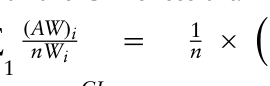
c. Hierarchical single ranking and consistency test The maximum characteristic root of the judgment matrix A is calculated. In order to avoid logical errors, a consistency test is also needed to compare the random consistency ratio CR value with 0.1. Saaty sets the threshold value as 0.10, i.e., if the CR value is greater than 0.10, it fails toreach the confidence level and needs to be modified by continuously modifying the judgment matrix until the CR is less than 0.10 (Pant et al., 2022).
(AW)i
(AW)1
nP
,
λmax =
Equation reproduced from the original PDF.
Wi
W1 + (AW)2
W2 + . . . + (AW)i
i = 1 CI = λmax−n n−1 , CR = CI RI < 0.1 (where n is the number of dimensions and AW is the weight of the judgment matrix* normalized). (RI is the ave- rage random consistency constant indicator, which is a constant calculated by relevant scholars repeated many times, and this paper uses data from Franek and Kresta (2014) (Biard et al., 2022).) d. Hierarchical total ranking and consistency test Because of the presence of sub-criterion level indicators, in order to judge the importance of the sub-criterion level relative to the total target, a hierarchical total ranking and test are required. All of them are satisfied in order to
nP ajCIj j=1 indicate the reliability of the results. CR总= CI RI = nP ajRIj
Equation reproduced from the original PDF.
The three factors in the criterion layer are IP visual image, IP output con- tent and IP cultural value. Firstly, visual image is the most effective means to
142 Wang and Zhang
attract users, followed by IP internal story, both of which are the most direct and frequent elements that users can come into contact with when they are in contact with the joint brand crossover. The order of the nine factors in the sub-criteria tier is variable, interesting, cute style, emotional resonance, social, comfortable color scheme, novel theme, uniqueness, and extensibility. The high requirements for IP to be both visually beautiful and interactively intere- sting can be seen in the rational consumption perception of the younger gene- ration of users. By consuming brands that users identify with (Ahuvia et al., 2022), they can help define their own identity and form a sense of satisfa- ction, so it is extremely important to convey the emotional value of the brand through IP.
Emotional Design Practice of Cross-Border IP Image of the Great White Rabbit Combining the above market research and user demand analysis, three specific design principles are proposed for the design and practice part of the crossover IP image of the Great White Rabbit: focus on user sensory consumption - upgrade the image of the crossover IP, give the IP persona- lity charm, and close the psychological distance with consumers; grasp the brand content consumption -- perfect the brand IP story, create fashion wear concept, close to young people’s pursuit of beauty; optimize brand value consumption -- grasp the core values of the brand, convey the brand emotion, trigger users’ emotional resonance.
(1) Design Positioning This section will re-define the positioning of this cross-border joint brand, and in order to reflect the uniqueness of the IP image, it is necessary to set the character, background, etc., in order to enrich the brand image, and to create a follow-up publicity topic for the cross-border joint brand, which is also more memorable to the users.
User positioning: Ledin belongs to a young women’s brand under Taiping Bird apparel, the target group is designed for women between 18–25 years old, the style is mostly cute and sweet, unique and playful, because of the founding time of the 1950s, the inherent loyal consumer group of the Great White Rabbit Creamy Candy is inclined to the post-70s and post-80s. In order to seize the youthful market, the Great White Rabbit Creamy Candy needs to position this cross-border joint target group as young users aged 18-30.
Core value positioning: The brand concept of Ledin is “be ANOTHER, no joy, no work”, which encourages young girls to explore themselves and freedom bravely, while the concept of the White Rabbit Brand is to bring sweetness and happiness to people, originally the theme of “no joy, no work, happy sharing” was set jointly. However, in the marketing process, we found that it was just a slogan and the impression of the brand was not strong. The pursuit of beauty and personalized expression is the characteristic of young consumers, influenced by social media, network opinion, celebrity dressing,
Crossover IP Image Design Strategy for the Great White Rabbit Brand 143
etc., many people pursue unhealthy aesthetics, thus appearance is not confi- dent, body anxiety and other negative emotions, the cross-border IP image of the Great White Rabbit keywords are basically around cute, happy, sweet, sharing, so the core idea of this joint IP is to guide young people to grasp the concept of healthy aesthetics. The core idea of this joint IP is to guide young people to grasp the healthy concept of aesthetics, to accept themselves bravely, to live confidently, bravely, optimistically, and every side is beautiful. With the cross-border IP to convey the personalized concept of fashion and the diversified concept of aesthetics.
Character positioning: Anthropomorphism is a major trend in IP design, in the preliminary research found that the target users are highly reco- gnized for the rabbit image and classic color scheme, the top three user needs are the expectation of IP modeling versatility, fun and cute style, so here will continue to improve and upgrade the rabbit image, the role is set for 18-year-old youth, continue to convey the style of happiness and fashion.
Brand story setting: In order to enrich the brand content, we can add a brand crossover storyline, i.e. the Great White Rabbit becomes a fashion expert, codenamed “Mr. Le Rabbit”, to provide young consumers with fashionable dressing advice and enlighten people to discover the beauty in themselves.
Activity theme: With the external image and character packaging, it is neces- sary to continuously output high-quality content to make the cross-border IP image more three-dimensional, and this cross-border IP should fully take advantage of Internet publicity, such as the launch of publicity fash- ion wear video: fashion expertise sharing type - on the visual elements of clothing, fashion trend prediction, etc.; actual wear Wearing experie- nce sharing type - based on the user’s identity of office workers, students, young moms and so on to provide advice, or based on dating, class, go camping and other scenarios to provide experience; fashion single pro- duct with sharing type - based on dresses, shoes, shirts and other single product with advice......; for example, a small program can be launched to build up a fashion social area, allowing users to share their experie- nce in dressing and collecting people’s definition of “beauty”. Moreover we can hold regular fashion shows offline, and launch seasonal activi- ties such as “Winter Wear” and “Summer Wear” or daily activities such as “Rabbit Show Your Beauty” and “Enjoy Your Beauty”. Beauty Side” and other daily activities, taking full advantage of the visual image of cross-border IP.
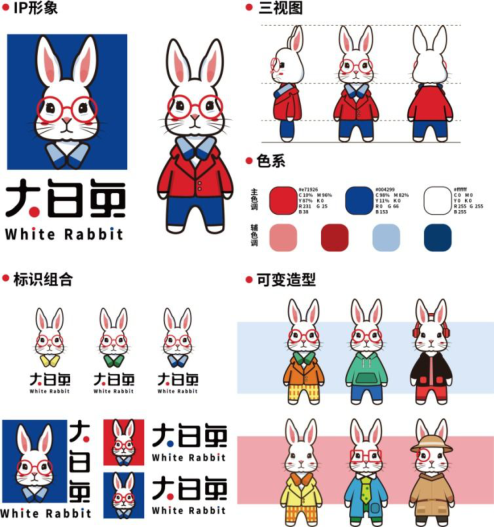
(2) Image Design As the main principle of the IP design, the visual image index analysis of the guideline layer IP is to meet the user’s expectation of “variable modeling”, and the overall image is anthropomorphized on the basis of the original rab- bit, see Figure 1. The impression of the standard characters was normalized to enhance recognition.
144 Wang and Zhang
Figure 1: The great white rabbit brand cross-border IP design. (Source from the author’s homemade, 2023.)
CONCLUSION
Based on the three levels of emotionality theory, the study takes the crossover between the Great White Rabbit and Ledin as an example, combines market research and user evaluation data, summarizes the emotional demand indica- tors affecting the crossover IP user perspective of the Great White Rabbit, the first level indicators are IP visual image, IP output content, IP cultural value. The second level indicators are shape change, color comfort, cute style, novel theme, fun, social, extension, uniqueness and emotional resonance, and use matlab software to rank the important level to propose optimization princi- ples and specific practice solutions, in order to provide suggestions for the upgrade of the Great White Rabbit brand through specific design practice, and also have reference significance for other old brand cross-border design.
Although cross-border brand expression is one of the effective means to attract people’s attention, the quality of brand products is the key to deter- mine the brand’s victory after the heat, so the brand should not only take into account the external but also focus on improving the internal quality when crossing borders, in order to form a strong combination and get twice the result with half the effort. In the future, it is necessary to explore cross-border design methods and application specifications in greater depth.
ACKNOWLEDGMENT
Thanks to the study and teachers of East China University of Science and Technology.
Crossover IP Image Design Strategy for the Great White Rabbit Brand 145
REFERENCES
Ahn, J., Kim, A. & Sung, Y. (2020), “The effects of sensory fit on consumer evaluations of co-branding”, INTERNATIONAL JOURNAL OF ADVERTISING, Vol. 39 No. 4, pp. 486–503. Ahuvia, A., Izberk-Bilgin, E. & Lee, K. (2022), “Towards a theory of brand love
in services: the power of identity and social relationships”, Journal of Service Management, Vol. 33 No. 3, pp. 453–464. Biard, G., Abdul-Nour, G., Komljenovic, D. & Pelletier, S. (2022), “Multi-criteria prioritization of asset management investments in the power industry”, IFAC- PapersOnLine, Vol. 55 No. 10, pp. 1804–1809. Cunha JR, M., Forehand, M. R. & Angle, J. W. (2015), “Riding coattails: When co-
branding helps versus hurts less-known brands”, Journal of Consumer Research, Vol. 41 No. 5, pp. 1284–1300. Panchal, S. & Shrivastava, A. K. (2022), “Landslide hazard assessment using analytic hierarchy process (AHP): A case study of National Highway 5 in India”, Ain Shams Engineering Journal, Vol. 13 No. 3, pp. 101626. Pant, S., Kumar, A., RAM, M., Klochkov, Y. & Sharma, H. K. (2022), “Consistency
Indices in Analytic Hierarchy Process: A Review”, Mathematics, Vol. 10 No. 8, pp. 1206. Pinello, C., Picone, P. M. & Destri, A. M. L. (2022), “Co-branding research: where we are and where we could go from here”, European Journal of Marketing, Vol. 56 No. 2, pp. 584–621. Qin, X. (2022), “Brand Preference Prediction Method of Cross-Border E-Commerce
Consumers Based on Potential Tag Mining”, Mathematical Problems in Enginee- ring, Vol. 2022. Ransikarbum, K., Pitakaso, R., KIM, N. & MA, J. (2021), “Multicriteria decision analysis framework for part orientation analysis in additive manufacturing”, Journal of Computational Design and Engineering, Vol. 8 No. 4, pp. 1141–1157. ROY, S. K., Sharma, A., Bose, S. & Singh, G. (2022), “Consumer - brand relationship:
A brand hate perspective”, Journal of Business Research, Vol. 1441293–1304. Tripathi, A. K., Agrawal, S. & Gupta, R. D. (2022), “Comparison of GIS-based AHP and fuzzy AHP methods for hospital site selection: a case study for Prayagraj City, India”, GeoJournal, Vol. 87 No. 5, pp. 3507–3528. Turan, C. P. (2021), “Success drivers of co-branding: A meta-analysis”, INTERNA-
TIONAL JOURNAL OF CONSUMER STUDIES, Vol. 45 No. 4, pp. 911–936. Yu, Y. A., Rothenberg, L. & Moore, M. (2021), “Exploring young consumer’s decision-making for luxury co-branding combinations”, INTERNATIONAL JOURNAL OF RETAIL & DISTRIBUTION MANAGEMENT, Vol. 49 No. 3, pp. 341–358. Zhang, Q., Chen, J. & Lin, J. (2022), “Market targeting with social influences
and risk aversion in a co-branding alliance”, European Journal of Operational Research, Vol. 297 No. 1, pp. 301–318. 简予繁, 朱丽雅 & 周志民 (2021), “品牌跨界联合态度的生成机制: 基于消费者灵感理论视角”, 南开管理评论, Vol. 24 No. 2, pp. 25–38.
LISTED IN THE AHFE DIGITAL BOOKSTORE CATALOGUE
Explore the complete digital volume
Human Factors in Communication of Design
Read this individual research paper free through the original publisher, or explore the full digital proceedings book.
ISBN 978-1-958651-66-7
Explore this ISBN in the AHFE Bookstore ↗Listed in the July 2026 bookstore catalogue; search by ISBN to confirm current availability · Digital book purchase optional