Alexandra Gabriela Ene, Lucia Secareanu, Ovidiu Iordache, Mirela Blaga, Cristina Lite (2023). Characterization Studies of A Commercial Blue Clay For Cosmetic Textiles With Antibacterial Activity. In: Human Factors for Apparel and Textile Engineering. AHFE Open Access, vol. 86, pp. 71–78. https://doi.org/10.54941/ahfe1003642
Since the beginning of the present century, tests have shown that some types of clay can present antibacterial activity. In addition, the clay considered for pharmaceutical and cosmetic products have been found to be non-toxic and non-irritating materials, therefore, the use of these types of clay for cosmetic and pharmaceutical purposes has increased in recent years. The above being said, different types of clay have been used over time due to their antibacterial properties, but the analytical methods for their characterization are just beginning to develop. This article is part of a study having as main objective the development of multifunctional antimicrobial textile materials to prevent fungal and bacterial proliferation, thus creating an antimicrobial shield for the human body, especially for blemish-prone skin. In this paperwork, a commercial blue clay was characterized through modern techniques. One of these techniques is X-ray Diffraction (XRD). Coupling SEM with an Energy Dispersive X-Ray detector (EDX), complete information of the morphology and elemental composition of the clay powder can be obtained. Additionally, a microbiological characterization was also performed in order to assess the anti fungal properties. Thus, the obtained results provided an overview of the main features of the selected blue clay. Further studies will be directed to the development of different types of clay-based dispersion and also for the characterization of different types of textile materials, in order to choose a "clay-textile" pair with improved antimicrobial activity.
Clays are natural materials made from very small particles (< 2 µm), that pos- sess plastic properties, and are usually composed of small mineral fragments consisting of hydrous-layer aluminum silicates. Occasionally, they may also contain magnesium and/or iron.
An application of mineral clays is the treatment of several health conditi- ons such as dermatological diseases, rheumatic inflammations, arthritis and they also can be used in skin moisturizing products (Carretero et al. 2006, Abdel-Motelib et al. 2011, Carretero 2002; Bergaya et al. 2006).
There are some literature studies that confirm that some clays have antibacterial properties. One study shows that silver and quaternary ammonium surfactant-modified clays inhibited the development of E. Coli (Parolo aet al. 2011).
Another paper investigated the antibacterial effect of white, pink, grey and yellow clays against Staphylococcus aureus and Pseudomonas aeruginosa. The results concluded that all four types of clay have an antibacterial effect against S. aureus and the pink mineral clay was the one that had antibacterial effect against P. Aeruginosa (Lafi and Al-Dulaimy, 2011). Regarding the anti- bacterial effect of blue clay, some studies showed that it has the capacity to inactivate pathogens (Williams et al. 2011; Morrison et al. 2014). A micro- biological study performed on blue clay showed that this type of clay does not present a proper environment for the development of Candida albicans, Pseudomona aeruginosa, Staphilacoccus aureus. Thus, blue clay has a high potential for its use in cosmetics and medicine (Rasma et al. 2017).
XRD analysis is considered to be the most suitable method for quanti- tative analysis for clays, compared to any other technique (Mumme et al. 1996). However, the quantitative analysis remains a major challenge due to the various chemical compositions, preferred orientation, and great structu- ral diversity of clay minerals (Bergaya et al. 2006, ´Srodo´n and ´Srodo´n 2013, Zhou et al. 2018). Different types of clay have been studied over time by cer- tain instrumental techniques. For example, XRD is an important technique used for elemental or chemical analysis of clays (Newman 1987, Mermut and Cano 2001). Several studies have been carried out using XRD to determine the mineralogical composition of clays and the presence of minerals (Preeti and Singh 2007, Aroke and El-Nafaty 2014).
Scanning electron microscopy coupled with Energy Dispersive X-Ray dete- ctor provides results regarding the size and shape of the particles (Sengupta et al. 2008, Chambers et al. 2000).
In this paper, blue clay was characterized using X-ray Diffraction (XRD) and Scanning Electron Microscopy (SEM) coupled with an Energy Dispersive X-Ray detector (EDX). In addition to these, a microbiological characteriza- tion was also performed in order to assess the antifungal properties. Taking into consideration all the mentioned aspects, the obtained results provided an overview on the main features of the blue clay.
MATERIAL AND METHODS Blue Clay
The clay used in the study was purchased from a national supplier and it is known as “Argila Albastra de Raciu” (Raciu Blue Clay).
Scanning Electron Microscopy - Energy Dispersive X-Ray Spectroscopy Scanning electron microscopy was performed using a Quanta 200 Scan- ning Electron Microscope (FEI Company). For the elemental analysis of the
Characterization Studies of a Commercial Blue Clay for Cosmetic Textiles 73
samples, an Element EDS System (EDAX-AMETEK), coupled to the electron microscope was used.
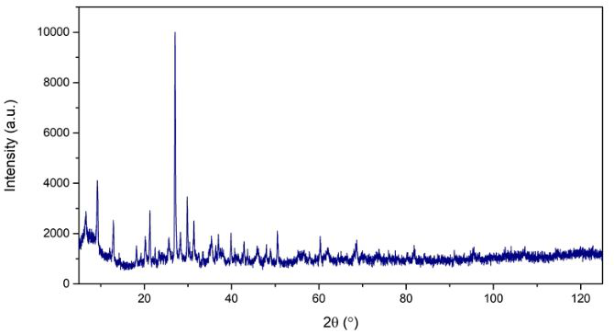
Powder X-ray Diffraction The XRD diffraction analysis of the clay was performed on a Proto AXRD diffractometer, using as X-ray a Cu Kα radiation (λ = 1.54056 Å). The measurement was performed between 2θ angles 5 – 125
. The obtained dif- fractogram was analysed using Match! Software, and the phase identification was obtained by comparison with the Crystallography Open Database.
Microbiological Characterization The commercially available blue clay was firstly submitted to bioburden scre- ening, without preliminary processing (sterilization). The clay was inoculated on four semi-synthetic nutritive media, with high specificity towards cha- racteristic growth for various fungi (Malt Agar-Scharlau, Potato Dextrose Agar-Scharlau, Sabouraud Dextrose Agar-Merck, Czapek-Dox-Scharlau) and one semi-synthetic media, for bacterial growth promotion (Yeas Extract Agar-Merck). Each media was sterilized at 121oC, for 115’, and then let to cool at ∼45oC, then poured in Ø90 sterile Petri plates. A small quantity of blue clay powder was dotted on the surface of each plate without (see Figure 1), and then incubated at 28oC, for 14 days.
Results and Discussions In Table 1 are presented the SEM micrographs and the EDX graph. Table 2 presents the results of the elemental analysis.
SEM images illustrates that the blue clay appear as small aggregates, while EDX results show a high carbon content. Also, significant percentages of oxygen, silicon and aluminium were identified. Magnesium, potassium, and iron are also found in smaller amounts.
The obtained XRD diffractogram is presented in Figure 1. It can be obse- rved that the sample is highly crystalline, having many diffraction peaks. However, it is exceedingly difficult to perform a correct phase identification,
Figure 1: X-ray diffractogram of the clay.Table 1. SEM and EDX results.
Table available in the original PDF paper.
800X 2000X
Table 2. EDX elemental analysis.
Table available in the original PDF paper.
Element Amount [%] C 40 O 27 Mg 3 Al 9 Si 17 K 2 Fe 2
Table 3. Phase composition of the clay.
Table available in the original PDF paper.
Entry Formula Sum Name Quantity (%) Microsommite 52.6 96-900-6344 Al3 Ca Cl1.12 K0.99 Na2.01 O13.76 S0.44 Si3
99-999-9900 Al2 Ca H3.68 O14.13 Si4 Laumontite 24.6 99-999-9904 Al0.58 H0.668 K O6.25 Si1.42 Montesommaite 14.9
due to the many different possible components. To perform some identifica- tion, additional data should be used, such as elemental composition, obtained from EDX measurements. By choosing the appropriate elements, the possible composition from Table 3 was obtained.
As observed in Table 4, the blue clay powder has a high bioburden load, with several microbial structures, specific to filamentous fungi, yeasts, and bacteria. Frequently, clays can be contaminated during the proces- sing and storing stages (strains of Bacillus, Clostridium etc.) (Bubik 1992). Furthermore, several microbial strains were analysed under an Olympus SZ
Characterization Studies of a Commercial Blue Clay for Cosmetic Textiles 75
Table 4. Bioburden screening plates – initial and after the incubation period.
Table available in the original PDF paper.
Initial After incubation period Czapek Dox
Yeast Extract Agar
Malt Agar
Potato Dextrose Agar
Continued
Table 4. Continued Initial After incubation period
Table available in the original PDF paper.
Sabouraud Dextrose Agar
Table 5. Microbial strains stereomicroscopy.
Table available in the original PDF paper.
Czapek Dox
Yeast Extract Agar
Malt Agar
Potato Dextrose Agar
Sabouraud Dextrose Agar
Characterization Studies of a Commercial Blue Clay for Cosmetic Textiles 77
61 stereomicroscope (with Greenough Optical System, magnification level 0.67x) for specific morphology assessment (see Table 5). Microscopy analysis revealed both fungal structures (filamentous and yeast) and bacteria-like structural organizations. Based on specific morph- ological characteristics, it can be noted the presence of microbial structures belonging to Trichoderma and Penicillium species, although, for a proper identification, molecular assessment of the isolated strains is highly required.
CONCLUSION
Blue clay was characterized in terms of morphological and elemental analysis (SEM-EDX and XRD). Blue clay appears as a small aggregate, contai- ning mostly carbon, oxygen, silica and aluminium and small amounts of magnesium, potassium, and iron. Also, a microbiological investigation was performed. The results obtained for blue clay used in this study are not satisfactory as microscopy analysis revealed the presence of both fungal stru- ctures (filamentous and yeast) and bacteria-like structural organizations on the plates. Thus, future studies of this work will be conducted, using a modi- fied blue clay or a different type of clay, as the blue clay powder by itself did not present relevant results regarding microbiological activity.
ACKNOWLEDGMENT
This work was supported by the Ministry of Research and Innovation within Program 1–Development of the national RD system, Subprogram 1.2–Institutional Performance–RDI excellence funding projects, contract no. 4PFE/2021, with contribution from project no. PN-III-P3-3.5-EUK-2017-02- 0084.
REFERENCES
Abdel-Motelib, A., Kader, Z. A., Ragab, Y. A., Mosalamy, M., Suitability of a Miocene bentonite from Northwestern Desert of Egypt for pharmaceutical use, In Applied Clay Science., pp. 140–144, (2011). Aroke, U. O., El-Nafaty, U. A., XRF, XRD and FTIR Properties and Characterization
of HDTMA Br Surface Modified Organo Kaolinite Clay, In International Journal of Emerging Technology and Advanced Engineering, pp. 817–825, (2014). Bergaya, F., Lagaly, G, Chapter 1 General Introduction: Clays, Clay Minerals, and Clay Science, In Developments in Clay Science, pp. 1–18, (2006). Bergaya, F., Theng, B. K. G., Lagaly, G., Clays, environment and health, In Handbook
of Clay Science, pp. 623–717, (2006). Bubik, J. S., Preparation of sterile talc for treatment of pleural effusion, In American Journal of Hospital Pharmacy, pp. 562–563, (1992). Carretero, M. I., Clay minerals and their beneficial effects upon human health, In
Applied Clay Science., pp. 155–163, (2002). Carretero, M. I., Gomes, C. S. F., Tateo, F., Clays and human health, In Handbook of Clay Science, Developments in Clay Science, pp. 717–741, (2006). Chambers, M. H., Lawrence, D. S. L., Sellwood, B. W., Parker, A., Annual layering in
the Upper Jurassic Kimmeridge clay formation, UK, quanti®ed using an ultra-high resolution SEM-EDX investigation, In Sedimentary Geology, pp. 9–23, (2000).
Lafi, S. A., Al-Dulaimy, M. R., Antibacterial effect of some mineral clays in vitro, In Egyptian Academic Journal of Biological Sciences., pp. 75–81, (2011). Mermut, A. R, Cano, A. F, Baseline studies of the clay minerals, In Clays and clay
minerals, pp. 381–386, (2001). Morrison, K. D., Underwood, J. C., Metge, D. W., Eberl, D. D., Williams, L. B., Mineralogical variables that control the antibacterial effectiveness of a natural clay deposit, In Environmental Geochemistry and Health, pp. 613–631, (2014). Mumme, W. G., Tsambourakis, G., Madsen, I. C., Hill, R. J., Improved petrolo-
gical modal analyses from X-ray powder diffraction data by use of the Rietveld method. Part II. Selected sedimentary rocks, In Journal of Sedimentary Research, pp. 132–138, (1996). Newman, A. C. D, Chemistry of clays and clay minerals, In Mineralogical Society Monograph, 6 Longman Scientific and Technical, Harlow, Essex, England, pp. 480, (1987). Parolo, M. E., Fernandez, L. G., Zajonkovsky, Sánchez M. P., Baschini, M.,
Antibacterial activity of materials synthesized from clay minerals, In Science against microbial pathogens: Communicating current research and technological advances, pp. 144–151, (2011). Preeti, S. N, Singh. B. K, Instrumental characterization of clay by XRF, XRD and FTIR, In Bulletin of Materials Science, pp. 235–238, (2007). Rasma, T., Samanta, M. M., Jevgenijs, L., Chemical and Biological Properties of
the Lake Blue Clay, In Environment. Technology. Resources, Rezekne, Latvia, pp. 290–295, (2017). Sengupta, P., Saikia, P. C., Borthakur, P. C., SEM-EDX characterization of an ironrich kaolinite clay, In Journal of Scientific&Industrial Research, pp. 812–818, (2008). ´Srodo´n, J., ´Srodo´n, J., Identification and Quantitative Analysis of Clay Minerals, In
Developments in Clay Science, pp. 25–49, (2013) Williams, L. B., Metge, D. W., Eberl, D. D., Harvey, R. W., Turner, A. G., Prapaipong, P., Poret-Peterson, A. T., What Makes a Natural Clay Antibacterial, In Environmental Science & Technology., pp. 3768–3773, (2011). Zhou, X., Liu, D., Bu, H., Deng, L., Liu, H., Yuan, P., Du, P., Song, H., XRD-based
quantitative analysis of clay minerals using reference intensity ratios, mineral intensity factors, Rietveld, and full pattern summation methods: A critical review, In Solid Earth Sciences, pp. 16–29, (2018).
LISTED IN THE AHFE DIGITAL BOOKSTORE CATALOGUE
Explore the complete digital volume
Human Factors for Apparel and Textile Engineering
Read this individual research paper free through the original publisher, or explore the full digital proceedings book.
ISBN 978-1-958651-62-9
Explore this ISBN in the AHFE Bookstore ↗Listed in the July 2026 bookstore catalogue; search by ISBN to confirm current availability · Digital book purchase optional