Guo Xinrui, Jie Yao, Shumeng Hou (2023). Smartwatch-based persuasive design with tailored competition and cooperation strategies for promoting physical activity. In: Human Factors and Wearable Technologies. AHFE Open Access, vol. 85, pp. 47–54. https://doi.org/10.54941/ahfe1003626
Originating from the concept of “captology”, interactive information technology designed for changing users’ attitudes or behaviors is known as persuasive technology (Fogg, 2002). Based on Fogg's behavioral model, Oinas-Kukkonen & Harjumaa (2008) proposed a framework for designing and evaluating Persuasive System Development (PSD), with specific persuasion principles. Persuasive technology has gained popularity in mobile sports applications as a design approach aiming to change healthy-related attitudes and behaviors among users. Nevertheless, most applications of persuasive design have taken a "one-size-fits-all" approach to design, regarding the users as a whole rather than tailoring personalized content to individual user characteristics (Orji et al., 2014), the former being a less effective design approach than the latter (Yee et al., 2012). Meanwhile, some studies indicated that using strategies proposed in PSD might have positive impacts on behavior change related to physical activity, such as the social support strategies implemented on smartwatches (Wan & Zhang, 2020). Smartwatch, as a wearable device with health monitoring functions, offers a unique opportunity for persuasive design. It will be particularly useful to provide tailored design solutions (Klock et al., 2020) for people with different personal characteristics to enhance exercising motivation and develop sustainable habits.The current study incorporated individual differences into persuasive design related to physical activity, and examined the effects of persuasive strategies with social features (i.e., competition and cooperation) implemented on smartwatches. In particular, we investigated whether intergroup competition, which combines competition and cooperation, could also be an effective persuasive strategy. An online experiment was conducted with 168 participants in China, which collected data on perceived persuasiveness and task enjoyment about four smartwatch-based strategies (i.e., individual, competitive, cooperative, and intergroup competition), as well as participants’ individual characteristics (including competitive and cooperative personality tendencies, exercising habits, demographics and so on). Our results showed that the perceived persuasiveness of intergroup competition was significantly higher than that of the individual strategy. Meanwhile, the competitive personality tendency also significantly affected participants' perceived persuasiveness of different strategies. As consistent with our hypothesis, the more competitive as people, the more likely they were to be persuaded by the competition strategy. Therefore, intergroup competition as a new persuasive strategy can be incorporated into future design approaches for promoting physical activity and health. Considering the significance of individual differences, we also suggest tailored strategies for suiting needs of different users when developing persuasive technology in the physical activity domain.Funding: This study was funded by the Guangdong Social Science Fund (Grant No. GD22CJY05), Shenzhen Social Science Fund (Grant No. SZ2022B008), and the Guangdong Education Science Fund (Grant No. 2022GXJK425).
In recent years, smart wearable devices have come into our lives, including smartwatches that can conveniently monitor health and exercise data, for which new sports and health applications have been developed. At the same time, persuasive design has gained popularity in mobile sports applications as a design approach to change user attitudes and behaviors, yet most of such persuasive applications have taken a “one-size-fits-all”design approach, regarding all users as the same rather than tailoring contents to individual user characteristics. Inappropriate persuasive strategies may lead to negative reactions and even increase the unhealthy behaviours that the intervention
was intended to reduce (Orji et al., 2014), since persuasive techniques wor- king for one person may reduce the motivation of others. Therefore, it is necessary to find effective persuasive design approaches that are suitable for different groups of people to enhance their exercising motivations and develop sustainable habits.
LITERATURE REVIEW
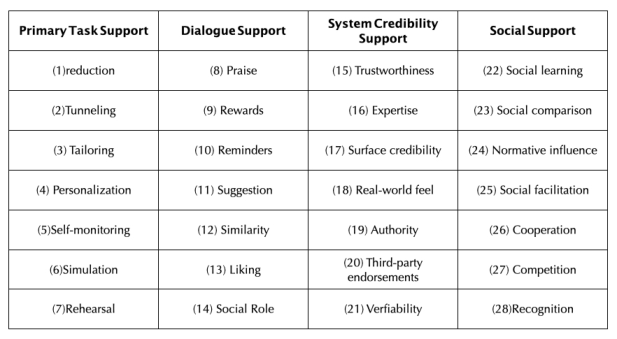
Persuasive Technology and Design The idea of using technology to motivate desirable behaviors has become a popular topic in the design community in recent years. Originating from the concept of “captology” (Fogg, 2009), interactive information technology designed for changing users’ attitudes or behaviors is known as persuasive technology. Related theories have been refined for more than 20 years, as models and guidelines for persuasive technology were developed. In parti- cular, based on Fogg’s behaviour model (Fogg, 2002), Oinas-Kukkonen & Harjumaa (2008)proposed a framework for designing and evaluating Persua- sive System Development (PSD), with specific persuasion principles displayed in Figure 1.
Promoting Physical Activity Through Social Support Strategies Regarding the design principles in Figure 1, some studies have been condu- cted related to social factors and physical activity, as Vallerand & Losier (1999) proposed a motivational sequence in line with the Self-Determination Theory (SDT), i.e., “Social Factors-Psychological Mediators-Types of Motivations-Consequences”. In particular, competition and cooperation as persuasive social factors might affect intrinsic motivation in physical acti- vity. A special type of social strategy has also been found, i.e., intergroup competition, which involves both inter-group competition and intra-group
Figure 1: Persuasive design principles in persuasive system development. (Adapted from Oinas-Kukkonen & Harjumaa, 2008).
Smartwatch-Based Persuasive Design with Tailored Competition 49
cooperation, and can combine the advantages of cooperative and compe- titive strategies for stimulating desired health behavior change. Tauer & Harackiewicz (2004) examined the effects of intergroup competition versus pure cooperation and pure competition on motor tasks, showing that inter- group competition resulted in a higher level of task enjoyment on all measures and led to comparable or higher levels of performance as compared to pure cooperation or pure competition.
Tailored Persuasive Design Persuasive strategies aiming to promote physical activity may lead to posi- tive, neutral, or even negative results, and therefore understanding individual differences is important. Fogg and colleagues (2002) conducted a study to examine the persuasive effects of similarity between people and computers, and found that people were more readily persuaded by technological produ- cts similar to themselves in some way (i.e., principle of similarity). Therefore, compared with traditional user characteristics such as Big Five personality types (Altmeyer et al., 2021), cooperative and competitive personality ten- dencies were more relevant to the social support design strategies (Xie et al., 2006), and could influence the persuasiveness of cooperative and competitive features on smartwatch-based applications.
METHODS
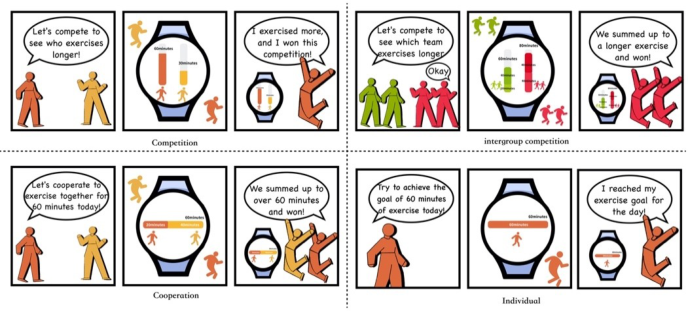
For this study, we chose to focus on three types of social persuasive stra- tegies implemented on smartwatches for promoting physical activity, the first two common ones plus the third as a new strategy: (1) Cooperation: Users and friends exercise as a team, cooperating by combining the efforts of both; (2) Competition: Users and friends exercise as opponents, and the one with higher scores wins. (3) Intergroup competition: Users form teams and compete with one another.
Participants This study was conducted in the form of an online survey experiment in China, and each eligible participant was offered a cash incentive. A screening question was set at the very beginning of the questionnaire, asking about their attitude towards exercise: “Are you willing to share exercise data with others online or offline?” Users who selected “no” to this question were excluded, since competition, cooperation, and intergroup competition all require exe- rcising with others. After data cleaning, a total of 168 participants provided valid responses to the experiment, with ages ranging from 17 to 50 years old and 41% being male. In terms of smartwatch usage, over 65% of the participants had a smart watch or band before.
Study Design The first part of the questionnaire collected background information from the participants, including demographics, smartwatch usage, physical acti- vity, and related attitudes. Then a between-group design was applied in
the experiment regarding the perceived persuasiveness of persuasion strate- gies, as participants were randomly assigned to one of the four groups for evaluating persuasiveness of different strategies, i.e., three social strategies with competitive, cooperative, and intergroup competitive features, and a control group with an individual strategy. Since storyboards have been pro- ved effective at depicting strategies, we followed the approach by Halko & Kientz (2010) to illustrate the persuasive strategies with a common langu- age, by creating storyboards with characters and interactions between them that allowed people from diverse backgrounds to read and understand (see Figure 2).
To elicit feedback on the persuasiveness of the strategies, a validated scale measuring perceived persuasiveness was presented to the participant after each storyboard. The scale was adapted from Drozd et al. (2012) and con- sisted of four, 7-point Likert-scale questions: “This way of exercising would influence me”, “This way of exercising would be convincing”,”This way of exercising is important to me”, and “This way of exercising make me rethink my exercise habits”. An open-ended question followed to allow participants to give reasons for why they liked or disliked each strategy.
We also adopted the scales of cooperative and competitive personality tendencies, which were proposed by Xie et al. (2006) based on in-depth interviews and literature review. Cooperative and competitive personality tendencies were measured respectively by 10 items on the competitive dimen- sion and 13 items on the cooperative dimension, all of which were on a 9-point Likert scale. In addition to personality, the study was also concer- ned with the influence of intrinsic motivation for exercising on the perceived persuasiveness of persuasive strategies. Therefore, the six items measuring the need for relatedness from the Psychological Need Satisfaction in Exercise Scale (PNSE) (Wilson et al., 2006) were also presented to the participants.
Data Analysis We used SPSS to validate our hypotheses with regression analyses and analysis of variance. The main aim of this paper was to examine whether
Figure 2: Storyboards used in the questionnaire.
Smartwatch-Based Persuasive Design with Tailored Competition 51
participants showed significantly higher perceived persuasiveness for the intergroup competition compared to the control group, which would pro- vide evidence for intergroup competition as a persuasive strategy combining competition and cooperation. We also analyzed whether personality traits affected perceived persuasiveness for different strategies, in order to justify tailored persuasive design on smartwatches.
RESULTS AND DISCUSSION
We tested the participants’ competitive and cooperative personality tende- ncies with a total score of 90 on the competitive dimension and a total score of 117 on the cooperative dimension. According to Table 1, the mean values of the cooperative personality traits were excessively high, and therefore the low cooperative personality sample was so small that it was difficult to exa- mine the differences. We speculated that the reason for this situation may well be the fact that China is a country where the collectivist culture stands dominant and the participants are influenced by social desirability to gain a high score on the cooperation dimension. Therefore, in this paper, only the competitive personality trait dimension was further evaluated as the base for tailoring, which was divided into the high competitive personality and low competitive personality.
As mentioned in the study design, a four-item scale was selected for the perceived persuasiveness measurement. However, we found that there was a significant difference when comparing the fourth item (“This way of exerci- sing makes me rethink my exercise habits”) with the other three, which may be due to the fact that changing habits is a better indicator of being persuaded. Therefore, we used this item alone to measure the perceived persuasiveness of the strategies. Controlling for the influences of age and psychological need for relatedness (see Table 2), the perceived persuasiveness of intergroup com- petition was significantly higher than that of the individual strategy (p<0.05), whereas the perceived persuasiveness of competition or cooperation was not significantly higher.
Then, we conducted a one-way ANOVA with the competitive persona- lity as a covariate to examine its effect on perceived persuasiveness of the competition strategy versus others. The results showed that the personality tendency of competition affected perceived persuasiveness, with a signi- ficant main effect (p <0.05) and a non-significant interaction effect (see Table 3). Further pairwise comparisons in Table 4 revealed that among the four groups, the competitive personality did significantly affect perceived
Table 1. Personality of competition and cooperation.
Table available in the original PDF paper.
Types of personality Descriptive Statistics N Minimum Maximum Maximum Mean Mean Std. Deviation
Personality of Competition 168 19.00 90.00 54.8214 14.71092 Personality of Cooperation 168 47.00 117.00 88.3512 13.60879
Table 2. Regression analysis summary for strategies predicting perceived persuasiveness.
Dependent Variable: Perceived Persuasiveness IV: Independent Variables CV: Control Variables
Table 3. Univariate analysis of variance for personality of competition and strategy group in perceived persuasiveness.
Table available in the original PDF paper.
Source Tests of Between-Subjects Effects df Mean Square F Sig.
Type III Sum of Squares
11.739 1 11.739 5.236 .023
Corrected Model 25.307a 7 3.615 1.613 .135 Intercept 3837.485 1 3837.485 1711.793 .000 Personality of Competition
3.178 3 1.059 .473 .702
Strategy Group 8.814 3 2.938 1.311 .273 Personality of Competition *Strategy Group Dependent Variable: Perceived Persuasiveness
persuasiveness of the competitive strategy (p<0.05). Specifically, a higher competitive personality would significantly outperform a lower compe- titive personality when evaluating the persuasiveness of the competitive strategy.
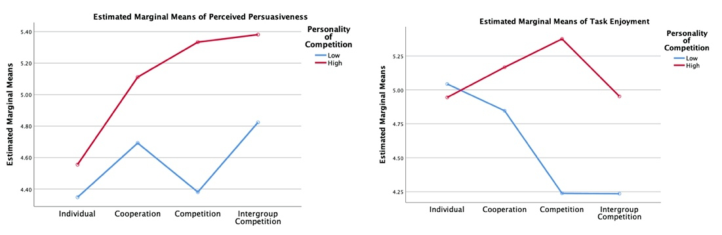
In addition, the personality tendency of competition also influenced task enjoyment with a significant main effect (p =0.022). As shown in Figure 3, pairwise comparisons indicated that participants with a higher competitive personality would score significantly higher on the task enjoyment of the competitive strategy (p<0.05), suggesting the importance of tailored design for improving task enjoyment as well.
Smartwatch-Based Persuasive Design with Tailored Competition 53
Table 4. Pairwise comparisons between personality of competition and strategy group in perceived persuasiveness.
Table available in the original PDF paper.
Random Pairwise Comparisons Sig.b td. Error
(I) Personality of Competition
(J) Personality of Competition
Mean Difference (I-J) Individual Low High −.208 .471 .660 High Low .208 .471 .660 Cooperation Low High −.419 .459 .363 High Low .419 .459 .363 Competition Low High −.952* .447 .035 High Low .952* .447 .035 Intergroup Competition Low High −.557 .488 .256 High Low .557 .488 .256
Dependent Variable: Perceived Persuasiveness Based on estimated marginal means *. The mean difference is significant at the.05 level. b. Adjustment for multiple comparisons: Sidak.
Figure 3: Estimated marginal means of perceived persuasiveness (left) and task enjoyment (right) with different strategies and personality of competition in different levels.
CONCLUSION
This study has contributed to tailored persuasive design in the field of phy- sical activity in two aspects. Firstly, we conducted an online experiment to investigate the perceived persuasiveness of individual, cooperative, compe- titive, and intergroup competition strategies in relation to physical activity. Our results showed that intergroup competition was significantly more per- suasive than the individual strategy. Therefore, intergroup competition as a new persuasive strategy can be incorporated into future design approaches for promoting physical activity and health. Secondly, we investigated the effe- cts of the competitive personality tendency on social strategies, as a test of the necessity of tailored persuasive design in the area of physical activity. Both perceived persuasiveness and task enjoyment of the strategies were eva- luated, which separately represented the extent to which the strategies are persuasive and enjoyable. As consistent with our hypothesis, the competitive personality tendency significantly affected participants’ perceived strategy
persuasiveness. The more competitive as people, the more likely they were to be persuaded by the competition strategy. Given the significance of such individual differences, tailored strategies were required for suiting needs of different users when developing persuasive technology in the physical activity domain.
Limitations of this study were that scores of the cooperative personality were too high among the participants, making subsequent analyses difficult, whereas ideally, we would also tailor persuasive strategies for different levels of the cooperative personality tendency. Nevertheless, this study has laid a foundation for further field research on smartwatch-based social strategies that can promote physical activity in the real world, which is crucial for developing better technological products and advancing the area of tailor persuasive design.
ACKNOWLEDGMENT
This study was funded by the Guangdong Social Science Fund (Grant No. GD22CJY05), Shenzhen Social Science Fund (Grant No. SZ2022B008), and the Guangdong Education Science Fund (Grant No. 2022GXJK425).
REFERENCES
Altmeyer, M., Lessel, P., Jantwal, S., Muller, L., Daiber, F., & Krüger, A. (2021).
Potential and effects of personalizing gameful fitness applications using beha- vior change intentions and Hexad user types. User Modeling and User-Adapted Interaction, 31(4), 675–712. https://doi.org/10.1007/s11257-021-09288-6 Drozd, F., Lehto, T., & Oinas-Kukkonen, H. (2012). Exploring Perceived Persuasiveness of a Behavior Change Support System: A Structural Model. In M. Bang & E. L. Ragnemalm, Persuasive Technology. Design for Health and Safety Berlin, Heidelberg. Fogg, B. J. (2002). Persuasive technology: using computers to change what we think
and do. Ubiquity, 2002(December), 2. Fogg, B. J. (2009). A behavior model for persuasive design. Proceedings of the 4th international Conference on Persuasive Technology, Claremont, California. Halko, S., & Kientz, J. (2010). Personality and Persuasive Technology: An Explo-
ratory Study on Health-Promoting Mobile Applications. https://doi.org/10.1007/ 978-3-642-13226-1_16 Oinas-Kukkonen, H., & Harjumaa, M. (2008). A Systematic Framework for Designing and Evaluating Persuasive Systems (Vol. 5033). https://doi.org/10.1007/ 978-3-540-68504-3_15 Orji, R., Vassileva, J., & Mandryk, R. L. (2014). Modeling the efficacy of persuasive
strategies for different gamer types in serious games for health. User Modeling and User-Adapted Interaction, 24(5), 453–498. https://doi.org/10.1007/s11257- 014-9149-8 Tauer, J. M., & Harackiewicz, J. M. (2004). The effects of cooperation and competition on intrinsic motivation and performance. Journal of personality and social psychology, 86(6), 849. Vallerand, R. J., & Losier, G. F. (1999). An integrative analysis of intrinsic and
extrinsic motivation in sport. Journal of applied sport psychology, 11(1), 142–169. Wilson, P. M., Rogers, W. T., Rodgers, W. M., & Wild, T. C. (2006). The psychological need satisfaction in exercise scale. Journal of Sport & Exercise Psychology, 28(3).
LISTED IN THE AHFE DIGITAL BOOKSTORE CATALOGUE
Explore the complete digital volume
Human Factors and Wearable Technologies
Read this individual research paper free through the original publisher, or explore the full digital proceedings book.
ISBN 978-1-958651-61-2
Explore this ISBN in the AHFE Bookstore ↗Listed in the July 2026 bookstore catalogue; search by ISBN to confirm current availability · Digital book purchase optional