Jinbang Tan, Ranran Liao, Yifan Deng, Fucong Xu, Shaoping Guan (2023). The Power to be Seen: A Study on the Accessibility Design of Live Stream System for the Visually Impaired. In: Human Factors and Systems Interaction. AHFE Open Access, vol. 84, pp. 45–54. https://doi.org/10.54941/ahfe1003589
The career discussion for the visually impaired has long been contentious in China, particularly as social technology advances. The interview result of Guangdong’s first blind mock streamer competition hosted by the Guangdong Association of the Blinds showed that exploring the possibility of live streaming for the visually impaired and enhancing the user experience and efficiency of the current live stream accessibility design is necessary. This study applied field study, roleplay action, and case studies as preliminary research to explore and reprioritize the challenges of streaming operations and experiences for visually impaired streamers. Finally, A-Live an all-in-one stream system with an auto-follow wind camera and accessibility UI design on TikTok was designed to allow the visually impaired complete live streaming independently.
China has a large population of about 17 million people with visual impair- ments (PVI). Blind massage is the only national employment policy for people with disabilities in China, and it remains the dominant occupation for blind people in China (CPDF, 2022). However, studies have shown that the policy has not significantly increased the employment rate of PVI over the past 30 years and that the income of blind masseurs is only about 55% of the ave- rage annual income of the Chinese population (Chen et al., 2018). As a result, blind massage is considered an inefficient, semi-reserved employment policy (Li et al., 2022). Moreover, China’s currently closed and segregated education system for the blind ignores the actual employment intentions of PVI (Li and Fu, 2015). There is an urgent need for more diverse and higher-paying career options for PVI. Live streaming refers to activities such as entertainment per- formances, live commerce, and chatting by using streaming platforms while interacting with audiences for revenue. Live streaming in China has diverse content and a huge revenue market (Lu et al., 2018). Guangdong’s first blind mock streamer competition was hosted by the Guangdong Association of the Blinds (GAB) in 2021. It means that the potential of live streaming for the visually impaired (LVI) as a profession of PVI is being explored. However, in practice, streamers with visual impairments (SVI) encounter problems that
they cannot solve on their own, even with the help of their usual assistance devices (Seo and Jung, 2020). Therefore, research is necessary to enhance the accessibility user experience, and efficiency of LVI.
PVI, like ordinary people, work not only for the purpose of earning a living. Once basic needs are satisfied, people need to meet higher social and psych- ological needs (Brown and Lent, 2013). The popularity of smartphones and other devices among the visually impaired community has rapidly increased in the last 5 years (Locke et al., 2022). The Internet experience provided by smartphones has been shown to facilitate the social inclusion of PVI (Yang and Lin, 2022). Further, there are a growing number of PVI are making a living through live streaming, even in the face of various inequality pressures (Jaeger, 2012). Two benefits of LVI are as follows: the flexible work con- tent and the favorable conditions for working from home. The second is the inclusion of the online community and the opportunity to express themse- lves to others (Johnson, 2018). We believe that LVI is a better career option for PVI. And for SVI to become a popular and viable career, an accessible live-streaming experience is an important step.
Some researchers have noted the challenges faced by SVI. Jun (2021) and Seo (2020) et al. recruited some SVI for interviews. The results of their interviews showed that SVI mainly encountered problems in live chats and multitasking. SVI often needed help from viewers during the live streaming. We initially had doubts about the willingness of PVI to be in front of the camera. In fact, the PVI who are active in media are pleased to film them- selves. Also, they have high expectations about their figures in photos and videos (Bennett et al., 2018). At the same time, showing faces is an important way for streamers to compete and gain revenue on live-streaming platforms. In the results of the related work, the use of a camera was a necessary part of LVI. The study by Jun et al. suggested a gesture-controlled camera, but SVI cannot reliably perceive the camera’s situation through motion gestures. More importantly, the main contribution of current related work remains focused on the accessibility of images and videos on media platforms, and more appropriate UI or navigator. The experience optimization of the overall streaming operation process for LVI is lacking.
This study explores and redefines the challenges faced by SVI and builds an all-in-one stream system for them named A-Live system. The ‘A’ refers to ‘Able’, which means that every PVI is able to access live streaming with- out challenge. The system includes live streaming devices, and accompanying user interface. The auto-follow wind camera and accessible UI on TikTok streaming platform are important innovations in the design. We aimed to further the possibilities of live streaming assistance and enhance the LVI’s user experience and efficiency by building the A-Live system.
METHODS
Interviews, roleplay, and case study are used to explore the challenges faced by SVI. The interview refers to recruiting a number of blind people for a group brainstorming session on a specific topic. Interviews are an effective method for exploratory research on an emerging topic such as LVI. The results will
The Power to Be Seen: A Study on the Accessibility Design 47
crystallize during the interview process (Hrastinski and Aghaee, 2012). Role- play refers to a designer taking on the role of a blind person for the entire process of LVI. Roleplay is commonly used to assess the interaction of resea- rch subjects in the real world (Stokoe, 2011). It helps to make a more accurate definition of decision-making regarding LVI (Armstrong, 2001). The case study refers to selecting cases of Internet-blind interaction relevant to the research as the object to sort out the scenario and key features.
Interview To recruit participants for the interviews, we contacted GAB for help. 22 PVI and 3 assisting volunteers participated in the interviews. The participants were in the age range of 16-28. 8 of the participants were male and 14 were female. They all had at least 2 years of Internet user experience. Each parti- cipant received a small gift of snacks. The researcher conducted open-ended group interviews and brainstorming sessions with the participants around the main topics of live streaming. The results of that interview about live strea- ming were that 20 of 22 participants understood the concept and the process of live streaming. And with the assumption of no barriers to use, 16 of 22 participants expressed a clear intention to try to participate in live streaming.
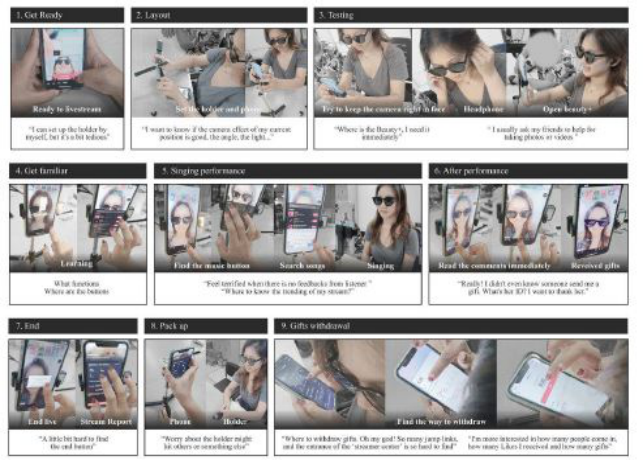
Roleplay Although some barriers to the use of live streaming were mentioned by the participants in the interview, none of the participants had any actual experie- nce with live streaming. The result did not show problematic hotspots. Thus we set a roleplay after referring to previous studies. Talkback is a mainstream screen reading tool for the PVI developed by Google, and the main operati- ons are (1) Read out what one finger touches (the reading speed could be up to 6X). (2) Double-tap to select. (3) Two fingers to scroll. We used Talkback and set up a roleplay. The designer experienced the whole process of LVI (See Figure 1), and recorded, and refined what are the biggest challenges in the live streaming for SVI.
In the roleplay results, we compiled the following three challenges in pri- ority: (1) Cannot perceive feedback timely. (2) Cannot perceive their own image in the camera. (3) Interaction of the current popular stream platform is extremely hard to operate.
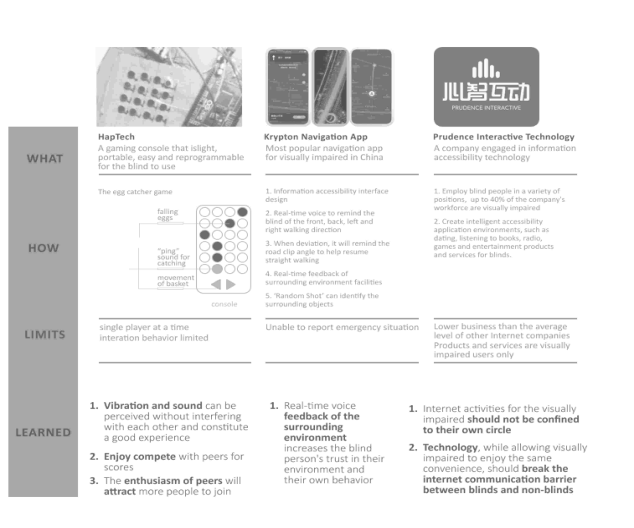
Case Study In the roleplaying result, the challenges of SVI focused on the interactive feedback of all aspects of the live streaming process. Since there is no live streaming product specifically designed for the visually impaired, we colle- cted some successful cases of Internet-blind interaction from three aspects: physical, digital, and human. Three typical cases were analyzed for their basic information and usage. After that, the learnable features of the cases were evaluated (See Figure 2). HapTech uses vibration and sound as the perceptual elements of the game console. These two types of information do not interfere with each other. The Krypton Navigation App’s real-time voice enhances PVI’s trust in their surroundings, making them more willing
Figure 1: Process of the LVI roleplay.Figure 2: Typical cases of internet-blind interaction.
to continue their actions. Prudence Interactive Technology is a good example of PVI communicating with non-blinds outside the blind circle.
The Power to Be Seen: A Study on the Accessibility Design 49
Result
PVI have a positive attitude toward live streaming, although many of them are unaware of the challenges that will arise. Research needs to prioritize addressing SVI’s perception of real-time information and streaming equi- pment, followed by manipulation of the live streaming interface. Perceptual feedback that can be sustained in real-time can greatly enhance the experience for SVI. In addition, haptic feedback, such as vibration, is the most feasible way for SVI to perceive other than hearing. However, it is obvious that haptic feedback for SVI’s fingers has been taken up by terminals with touch scre- ens. Therefore, a new integrated streaming system for SVI is needed. We will discuss the A-Live system in detail in the next section.
SYSTEM DESIGN System Map
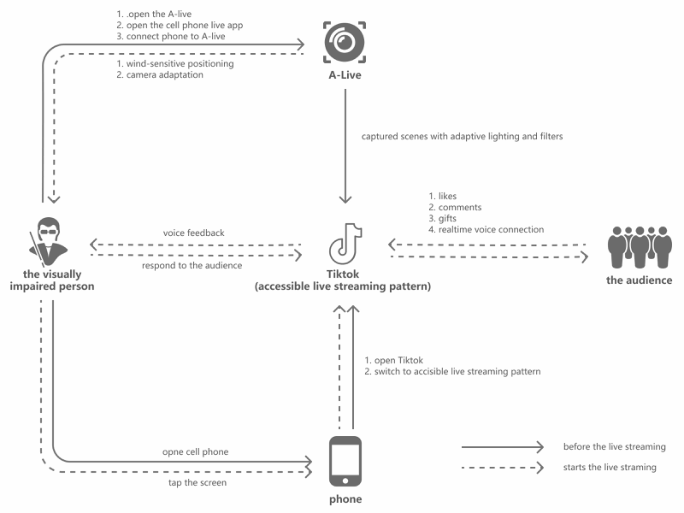
The system was built based on the research results of user interviews, role- play, and the Internet-blind interaction model (See Figure 3). The system is divided into two parts: A-Live streaming device for SVI and an accessible live streaming interface on TikTok. A-Live mainly provides the functions of auto-follow wind camera, and SVI can directly control A-Live through their smartphones and use the accessible interface on TikTok to build high-quality live streaming to the audience.
The Overall Operating Procedure for SVI Is as Follows First, before the LVI, the SVI start the A-Live device and set up it. Thereaf- ter connect the live streaming app to the A-Live device, using smartphone.
Figure 3: System map of A-Live.
Through the app, SVI can control the device to focus on the face and to have adaptive lighting and beauty filter. Next, SVI open TikTok and switch to the accessible live mode. After that, SVI start the live streaming and interact with the audience.
The basic interaction logic between the SVI and the audience during live streaming is to touch the phone screen and get sound or vibration feedback. the SVI’s finger can click somewhere on the screen or stay on the screen, kee- ping moving. The device system reads the touched UI button or text content aloud in real-time. The SVI can use two fingers to select, confirm, or scroll. The above interactions are common to most current smart devices, so they are familiar to most PVI users who are using smart devices. Using the same basic operating logic in the A-Live system avoids additional learning costs for them. SVI get audience feedback by voice broadcast throughout the whole process, such as likes, comments, gifts, and voice chat. SVI can respond to the audience with voice or physical actions.
In the process, the phone function is simplified. As the camera function is transferred from the phone to A-Live device. SVI can continuously tap the phone to get the latest live feedback, without the trouble of losing the sense of shot when adjusting the camera on the phone. Such a simplified interaction process of live streaming is more comfortable for SVI.
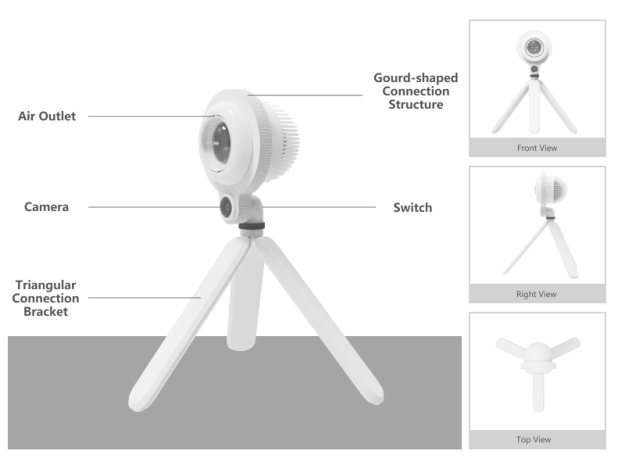
System Construction A-Live is composed of a wind-sensitive positioning unit, a camera, and a triangular connection bracket (See Figure 4). A-Live can be activated by a switch on the back, and then controlled by an app to send wind at a spe- cific moment. SVI can feel the wind direction to determine whether he or
Figure 4: Layout and primary orthographic views of A-Live.
The Power to Be Seen: A Study on the Accessibility Design 51
she is in the scope of the camera. The camera is located below and near the air outlet, and the camera can make intelligent adjustments to the content of the shot and transmit the video to the phone. The wind-sensitive positi- oning unit and the camera make up the auto-follow wind camera. In order to facilitate the operation of SVI, a triangular bracket is designed to ensure that A-Live can stand stable on the desk. The bracket can be adapted to the sitting heights of SVI. Also, when the bracket is retracted, the gourd-shaped connection structure allows the device to remain in a stable triangular posi- tion with the desktop so that the camera and the air outlet will not be easily damaged.
USABILITY AND USER INTERFACE Wind Camera
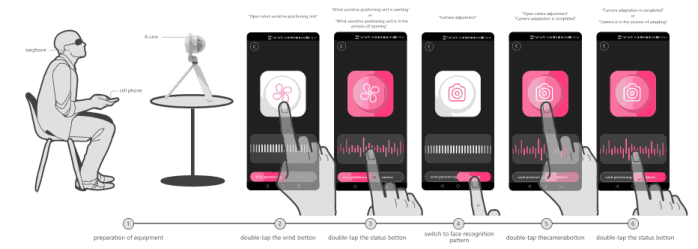
The wind-sensitive positioning function was proposed to solve the problem of SVI’s sense of shot. It results from the multi-sensory information perception analysis at a certain distance. Considering that SVI mostly conduct live strea- ming in a sitting position, A-Live’s use scenario is positioned on the desktop (See Figure 5).
First, SVI turn on the A-Live. Then open the A-Live control app for camera setting, the process of camera setting is composed of two parts. When SVI first enters the app, the interface will jump to the wind-sensitive positioning adjustment mode by default. After double-tap the wind-control button at the top of the screen, SVI will get voice feedback, which means the wind- sensitive positioning unit gets to work. Then, SVI can judge whether they are in the scope of the camera by the feeling of the wind. If SVI cannot make sure of the working status of A-Live, they can double-tap the voice button below the wind-control button to get voice feedback on the system is on /off/ launching.
After the step, SVI double-taps the face recognition button right corner of the screen to switch to face recognition mode. When SVI double-taps the camera button at the top of the screen, they will get voice feedback after opening the camera adjustment. When the camera adaptation is completed, they will get corresponding voice feedback. Similarly, a voice button below
Figure 5: Usage scenarios and APP operation diagram of A-Live.
the camera button is provided for SVI to get the working status of A-Live in real-time. SVI can double-tap the voice button to get voice feedback on the adaptation completed/adapting.
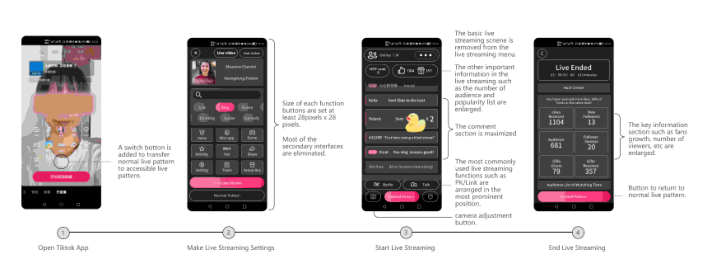
Accessible User Interface Considering the two most common problems of SVI when using live strea- ming apps the function buttons are too close together and too small. Also considering the adaptability of the Talkback mode, the design (See Figure 6) follows the guidelines below:
In the overall live streaming process:
1. Size of each function button is set to at least 28x28 pixels. 2. Most of the secondary interfaces are eliminated so that SVI can do as many operations as possible on one screen.
In the interface where live streaming is performed:
1. A switch button is added to transfer normal live mode to accessible live mode. 2. The basic live streaming scene is removed from the live streaming interface, making the experience more intuitive and user-friendly for SVI. 3. The most used live streaming functions such as PK/Link are arranged in the most touchable area. 4. The other important information in the live streaming such as the number of audience and popularity list are enlarged. 5. The comment section is maximized so that the information can be read by the SVI more fluently. 6. An adjustment button is set therefore SVI can return to A-Live and adjust the interface for resetting the camera at any time.
In the interface after retreating from live streaming:
1. The key information section such as fans’ growth, and the number of viewers are enlarged. 2. A button for returning to normal live mode is set.
Figure 6: The accessible user interface of A-Live.
The Power to Be Seen: A Study on the Accessibility Design 53
CONCLUSION
To address the three main challenges found in preliminary research, the study explored the possibility of PVI becoming live streamers and designed the A- Live streaming system to optimize the current LVI experience and efficiency.
In preliminary research, we found that most of the blind interviewees were aware of the live-streaming social behavior and clearly indicated their willin- gness to participate in live streaming. However, we could not exclude the fact that most of the interviewees were young people, which could lead to a bia- sed result. After the interviews, our designers conducted a roleplay to verify the issues that arose in Guangdong’s first blind mock streamer competition. Three main design challenges to address the SVI experience were identified. Also, the study analyzed three typical cases from physical, digital, and human evidence to guide the subsequent design solutions.
The study’s final solution was an independent external camera coupled with an accessibility interface design. The combination of the auto-follow camera and wind sensing enabled SVI to sense their relative position to the camera. In order to maximize the level of interaction between SVI and vie- wers, our interface design expanded the area for interactive feedback by removing the camera display. The location and size of the buttons on the live streaming interface were also specified. Despite the fact that TikTok was used as an example, the specifics of the designers’ humanized design for SVI were displayed. These details can be used as a guide for the accessibility design of other live streaming platforms. The accessibility design of our study will continue to advance through more practical user tests in future research.
ACKNOWLEDGMENT
We would like to thank the Guangdong Association of the Blinds (GAB) for supporting the interviews in this study and the subsequent first blind mock streamer competition in Guangdong Province, which provided sufficient data to support the design research of the study.
REFERENCES
Armstrong, J. S. (2001). Role Playing: A Method to Forecast Decisions. International Series in Operations Research & Management Science, pp. 15–30. doi:10.1007/978-0-306-47630-3_2. Bennett, C. L., E, J., Mott, M. E., Cutrell, E. and Morris, M. R. (2018). How Teens
with Visual Impairments Take, Edit, and Share Photos on Social Media. Procee- dings of the 2018 CHI Conference on Human Factors in Computing Systems. doi: 10.1145/3173574.3173650. Brown, S. D. and Lent, R. W. (2013). Career development and counseling: Putting theory and research to work. 2nd ed. Hoboken, N. J.: Wiley. Chen, X. M., Luo, Y., Liu, Z. H. & Ding, W. M. (2018). The Study on Vocational
Development Status of Blind Massagist-Take Guangzhou Yuexiu District as an Example. Modern Special Education, 75–79. doi: CNKI: SUN: XDTS.0.2018– 02-016 (In Chinese). Chinese Disabled Persons’ Federation (2022). China Statistical Yearbook on the Work for Persons with Disabilities. Beijing: China Statistical Press.
Hrastinski, S. and Aghaee, N. M. (2011). How are campus students using social media to support their studies? An explorative interview study. Education and Information Technologies, 17(4), pp. 451–464. doi: 10.1007/s10639-011-9169-5. Jaeger, P. T. (2012). Disability and the Internet confronting a digital divide. Boulder,
Colo. Lynne Rienner Publ. Johnson, M. R. (2018). Inclusion and exclusion in the digital economy: disability and mental health as a live streamer on Twitch.tv. Information, Communication & Society, 22(4), pp. 506–520. doi: 10.1080/1369118x.2018.1476575. Jun, J., Seo, W., Park, J., Park, S. and Jung, H. (2021). Exploring the Expe-
riences of Streamers with Visual Impairments. Proceedings of the ACM on Human-Computer Interaction, 5(CSCW2), pp. 1–23. doi: 10.1145/3476038. Li, X. H., Xu, S. Q. and Hu, L. J. (2022). Protection or Restriction: An Analysis of the Blind Massage Policy for Employment Rights of Persons with Visual Impair- ments in China. Journal of Visual Impairment & Blindness, 116(1), pp. 85–95. doi: 10.1177/0145482x211073611. Li, X. H. & Fu, Z. J. (2015). From Isolation to Integration-the History, Features and
Policy Change of People with Visual Impairment Higher Education. Journal of Social Work, 35–46. doi: 10.3969/j.issn.1672–4828.2015.06.004 (In Chinese). Locke, K., McRae, L., Peaty, G., Ellis, K. and Kent, M. (2021). Developing accessible technologies for a changing world: understanding how people with vision impairment use smartphones. Disability & Society, pp. 1–18. doi: 10.1080/09687599.2021.1946678. Lu, Z., Xia, H., Heo, S. and Wigdor, D. (2018). You Watch, You Give, and
You Engage. Proceedings of the 2018 CHI Conference on Human Factors in Computing Systems - CHI, ‘18. doi: 10.1145/3173574.3174040. Seo, W. and Jung, H. (2020). Understanding the community of blind or visually impaired vloggers on YouTube. Universal Access in the Information Society. doi: 10.1007/s10209-019-00706-6. Stokoe, E. (2011). Simulated Interaction and Communication Skills Training:
The ‘Conversation-Analytic Role-Play Method’. Applied Conversation Analysis, pp. 119–139. doi: 10.1057/9780230316874_7. Yang, L. and Lin, Z. (2022). Opportunity or risk? Mobile phones and the social inclusion gap among people with visual impairments. Disability & Society, pp. 1–19. doi: 10.1080/09687599.2022.2060799.
LISTED IN THE AHFE DIGITAL BOOKSTORE CATALOGUE
Explore the complete digital volume
Human Factors and Systems Interaction
Read this individual research paper free through the original publisher, or explore the full digital proceedings book.
ISBN 978-1-958651-60-5
Explore this ISBN in the AHFE Bookstore ↗Listed in the July 2026 bookstore catalogue; search by ISBN to confirm current availability · Digital book purchase optional