Yan Huajie, Jiefeng Lu, Qin Kai (2023). A comparative study of seagoing vessels between China and Europe from early 15th century to early 17th century. In: Ergonomics In Design. AHFE Open Access, vol. 77, pp. 776–786. https://doi.org/10.54941/ahfe1003438
It was a period of high speed development of seagoing vessel from early 15th century to early 17th century. As an important tool for human exploration of the sea, ship decoration not only carry the imagination and reverence of the sea, but also influenced by the times, religion, politics, culture and aesthetics. It aims to compare the ship decoration which base in design pattern, manufacturing techniques and colour between Chin, Spain, Portugal and Britain. This paper use a comparison methodology involving a widespread historical research conducted on historical documents and ancient painting. In this study can identify the influences of different culture elements of ship decoration which has been mapped in this research. By analyzing all outcomes of the research would be beneficial for designer of ocean-going vessel base on historical element context.
The oceans are one of the most important platforms where civilizations col- lide, and seafaring is the vehicle that connects different cultures and societies. The 15th to 17th centuries (during the Ming dynasty in China) were a period of great advances in the history of global seafaring, which also marked the peak of both Chinese and Western shipbuilding technology. Between 1405 and 1433, the Chinese navigator Zheng He made seven voyages to the Atlan- tic Ocean, breaking the oceanic barrier that separated East Asia from West Asia and East Africa, and establishing a direct passage across the Indian Ocean. Prince Henry of Portugal then organized a series of expeditions that established positions in Madeira, the Azores, the Cape Verde Islands, and other islands deep in the Atlantic Ocean. In the late 15th century, Columbus crossed the Atlantic four times to reach the Caribbean islands and coastal areas of Central America. Portugal’s Vasco da Gama was the first to disco- ver a new route around the Cape of Good Hope to India. The expansion of human activity into the ocean changed the scale and nature of political,
A Comparative Study of Seagoing Vessels Between China and Europe 777
economic and cultural linkages between the world’s regional civilizations, marking the earliest beginnings of modern human society.
Ornaments are an important part of ships. People applied their beliefs of the sea and their own customs to the hull shapes and decorative motifs through artistic means, which demonstrates the desire to explore and conquer the sea in the 15th-17th centuries. The integration of painting and carving into ship decorations has greatly enhanced the artistic expression of ship ornaments, which also demonstrates the wisdom of people in aesthetics and craftsmanship back then. As Chinese and Western ship ornaments developed over the years, they also came to bear distinctive national cultural and arti- stic characteristics. As Professor He Hongzhi noted in The History of Arts and Crafts in Sichuan, ‘the decorative content of an era always reflects the social material life and social consciousness of that era’, so too did the ship’s ornaments reflect the political, religious and cultural aspects in both East and West during the Age of the Great Voyage. By analysing and comparing the ornamentation of Chinese and European sea ships from the 15th to the 17th centuries, it is possible to understand the cultural characteristics of ship ornamentation during this period and the reasons for the differences.
Although much has been written in the last century about the Zheng He and the Western ships of the Great Seafaring Period, the focus of discussion has been more on the construction and structure of the ancient ships and less on their ornamentation. During this period, both Western and Chinese sea- going ships were built by their respective countries, and ship decorations were deeply influenced by the art and culture of the time. For modern seagoing ship decoration design, these ships not only served as tools for discovering new continents and routes but also as carriers of 15th-17th century art. The- refore, they can provide new ideas and directions for modern seagoing ship painting and decoration. The article explores the relationship between ship decoration and political, religious, and cultural aspects from an East-West comparative perspective, discusses the reasons for the differences, and, by comparing the differences, identifies the representative elements belonging to ancient Chinese seagoing ships, hoping to provide new ideas for modern Chinese seagoing ship painting and decoration.
CHINESE SEAGOING SHIP DECORATION OF THE MING DYNASTY The Ming Dynasty government had repeatedly organized large-scale over- seas expeditions to Asian countries. The imperial court’s attention to ocean voyages and foreign relations had greatly promoted the development of ship- building at that time. As a result, the shipbuilding industry and seafaring business had reached its golden age. At the same time, the design of seagoing ships gradually began to unify, and the later types of ships were mostly Fu ship, Guang ship, bird ship, and Sha ship (Xi, 2000). Zheng He ship is highly regarded because of its huge size, well-equipped facilities and magnificent shape. The main purpose of Zheng He ship is diplomacy, promotion of nati- onal prestige and expansion of tribute, so its hull decoration pattern is very national and epochal.
Primary Ship Ornament Pattern During the Ming Dynasty, the most important area for decorative patterns on ships was the bow. The decorative patterns were mainly based on auspicious beasts that exerted strong deterrent power. The most common pattern was the roaring head of tigers or lions, usually referred to as the ‘Tiger head Plate’ or ‘Lion head Plate’, which served to manifest imperial power and repel evil spirits. At the same time, the large area of the stern seal plate and the high stern building of some ships make it an important decorative area besides the bow of the ship. The stern design is usually a fierce bird of prey standing above the waves with its wings in the air, sometimes enriched with clouds or floral motifs on the sides. Transoms are often decorated with patterns representing blessings, myths and historical stories about the sea. Sometimes additional characters such as ‘Yong Li Shun’, ‘Shun Feng Xiang Zai’, ‘Shun Feng Gain’ are written under the design to express the ship owner’s wish for a safe and smooth voyage. Comparatively speaking, the hull is decorated with more abstract traditional Chinese decorative patterns, such as water ripples and spirals.
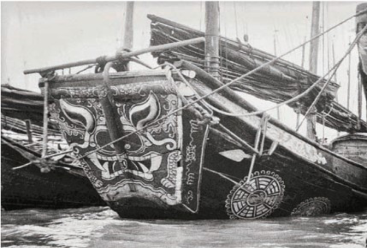
Bow - Tiger Head Pattern The Tiger Head pattern was the most popular pattern painted on the bow during the Ming Dynasty (see Figure 1). It was used not only on ocean-going ships but also on all warships. This is because in ancient Chinese mythology, the tiger not only symbolizes powerful strength, but also serves to ward off away evil spirits. Tiger, the king of the mountain beasts (Xu, 1963). It is considered to have a presence second only to the Long, so it was given a strong political color by the ruling class, symbolizing the relationship of the ruler and his subjects. When the emperor travelled, he would carry a flag with the image of a tiger on it, called the ‘Tiger Banner’, which served as a symbol of the emperor’s authority.
Ancient Chinese theology combined with Taoism recognised the tiger head motif as the embodiment of divine power. As it is written in the Book of Rites: ‘The line is preceded by the Vermilion Bird and followed by the Xuanwu, with the Green Long on the left and the White Tiger on the right’. It is transformed into a White Tiger, which is one of four gods that guards Western lands,
Figure 1: Tiger head pattern (Wang, 2011).
A Comparative Study of Seagoing Vessels Between China and Europe 779
capable of divining luck and devouring ghosts and monsters. The tiger head on the bow of Zheng He’s ship was intended to demonstrate government sovereign power and national strength, and to act as a deterrent to other countries. It was also intended to ward off evil spirits and bless sea voyages for the successful completion of missions.
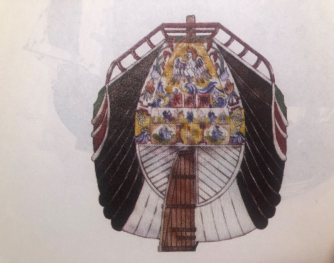
Stern -Yi Bird Motif Seafaring ships are often decorated with a fierce raptor, the Yi Bird, an ancient Chinese bird of prey that resembles a heron and protects the passengers on board. The inherent ability of the Yi Bird to ‘fly well and not fear the wind’ led people to choose it as the repository of their desire for safe navigation. In the illustrations of the ancient Ming Dynasty books Tian Gong Kai Wu and Ancient and Modern Book Collection, the stern of a canal boat is decorated with a flying Yi bird. The Tang Ship Drawing ‘Tang Boat’ in the Nagasaki Prefectural Museum in Japan shows the same motif on the stern of a Japanese seagoing vessel (see Figure 2) (Wang, 2011). The prow is a real water bird that existed in ancient China, as recorded in a number of ancient texts, such as ‘The Jade Book - Ministry of Birds’ writes that: ‘Yi Bird, a water bird, is good at flying high.’ Li Shizhen of the Ming Dynasty in Compendium of Materia Medica - Avian I – Cormorants said that further states that the prow was not only good at flying but also at flying over water, and was often painted on ships’ (He, 2004). At that time, ships still relied heavily on oars and human power to navigate, and were heavily influenced by the natural environment such as wind and waves. The Yi bird’s ability to fly against the wind was very much in line with people’s aspirations of what a ship could do, so it was painted on the stern in the hope that the ship would be able to navigate the sea as freely as the Yi bird.
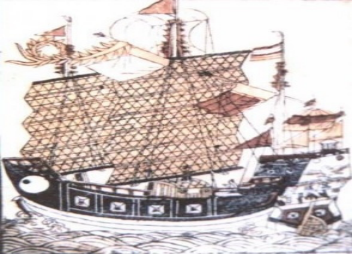
Hull – Long’s Eye Motif The most distinctive feature of the Ming sea-going vessels are the eyes on both sides of the front of the hull, also known as the ‘Long’s eye’ (see Figure 3). It was believed that the sea was a place full of spirits and ghosts. Ships were seen as swimming Long and were called ‘wooden Longs’ as a means of transporting the sea (Ling, 1997).
In China, the Long is the master of the sea. As a ‘wooden Long’, a sea vessel needs eyes to see its course, hence the eyes on both sides of the ship. In Ming Dynasty writings documenting ships and shipyards, such as the South Ship Records, Wu Bei Zhi and Long Jiang Shipyard Zhi, the illustrations accompanying these documents show that both official and civilian ships have motifs resembling fish eyes on both sides of the bowl. The exact style of the Long’s eye varies depending on the purpose of the vessel. Generally, the Long’s eye of a fishing boat looks down to search for prey; the Long’s eye of a cargo boat looks forward to navigate; and the Long’s eye of an official boat looks up to the sky to show its noble status (He, 2019).
Professor Chen Xiyu believes that the meaning of the Long’s eyes is ‘kno- wing the way’. Actually, it means much more than that (Zhang, 1991). For example, the fishermen of Haizhou Bay, Jiangsu Province, believed that ‘the Long’s eye carved on the bow of the boat, after being dotted with chicken blood and benefited from a series of incense sticks, possess a spiritual nature that can indeed make the boat not lose its way at sea, avoid evil spirits and shine wealth’ (Liu, 1999). The coastal people of Fujian believe that ‘if a boat does not have eyes to know its direction, it will easily get lost or run aground’. With the boat’s eyes, ‘it can avoid sand and fog and see’ (Ling, 1997). The fishermen of Chongwu, Huian, share this belief, and it is assumed that if the ‘Long’s Eye’ is not bright, they will not be able to catch fish or navigate (Pan, 1991). While fishermen along the Guangdong coast believe that ‘the two giant eyes are carved on the sea-boats to frighten the sea Longs and for- bid them to do evil.’ Although the interpretation of the ‘Long’s eye’ differs slightly in different parts of China, the ‘Long’s eye’ gives the Chinese seafa- ring vessel a special soul and aura that completes the overall ornamentation of the vessel.
EUROPEAN SHIP DECORATION Between the 15th and mid-16th century, the British, Spaniards, French, Danish and Dutch all made improvements to the Carrack that sailing ships that travelled the Mediterranean, adding multiple decks, moving the fore- peak to the aft of the bow and attaching the bowsprit to the front of the bow.
A Comparative Study of Seagoing Vessels Between China and Europe 781
Genuine acrostolion of the bow and stern also became popular and continued into the 20th century.
Bow Decoration In the mid-16th century, the creation of the Gallic ship made the bow statue a special mark of identity to distinguish a sea vessel, and royalty, nobility and merchants would hire master carvers to create unique designs and the finest carvings for bow statues. With the advent of the Baroque period, bow statues became more elaborate and ornate, often weighing several tonnes, carefully designed and carved by renowned craftsmen and artists, sometimes even gil- ded to show their prestige. Many of the surviving portraits are exquisite works of art. The sculptor’s organic combination of art and faith, inherited and developed from ancient Greek and Roman sculpture, with Gothic figures and Florentine artistic expression, is characteristic of the artistic sculpture of the period.
Regarding the choice of bow decorations, in order to compete with other European nations for land and sea rights, ocean-going ships in the age of great voyages would often carve images of national royal coats of arms, monarchs and monarchical symbols on the bow of their ships, once to swear their sove- reignty. Such as the Mary’s bow, for example, is decorated with the head of a unicorn and the Royal Arms of Scotland, the unicorn being the symbolic image of James I, while the Naseby bow of 1655 depicts Oliver Cromwell, then Lord Protector of England, on horseback.
Stern Decoration In addition to the statues adorning the bow, the tall stern building was often decorated with fine sculptures and paintings, especially on the Galen, which was built after the Clark. The multi-layered transom panels at the stern became the focus of carved and painted decoration, with a signifi- cant proportion of painted sculptures and crests, often depicting religious figures, mythological figures, animals, deities and even prominent figures from Western reality. All the sculptures and decorations on the stern are repe- ated twice in mirror symmetry, with lions, eagles, angels, sea gods and family crests becoming the most common and distinctive decorations, elaborate and ornate in style, extensive and specific in content, with figures, animals and deities coming together. For example, the famous engraver Thomas Shish’s 1679 work on the stern of the 70-gun Grafton shows two cherubs holding crests below a crown of King Charles with the Prince of Wales’ feathers on the reverse. The quartered prince decoration is more common on the stern of Dutch seagoing ships as a way of showing the power of the country (Andy, 2013). Each of the sculptures from this period would be a valuable work of art in its own right. The Age of Sail gave rise to a primordial desire for colo- nisation and expansion in the western world, and to a number of countries and families who rose to prominence on the back of this desire. As a sym- bol of royal and family glory, the coat of arms began to grow in form and sophistication as the history of royal and family glory grew, and such fine and substantial royal or family coats of arms became indispensable in the
decoration of sea-going ships, a fashionable necessity to show the status and wealth of the age. The famous Swedish sailing ship Vasa, built in 1626, and the stern of the sailing ship Poltava, officially sanctioned by Peter the Great in 1709, exemplify the glamour and elegance of painted naval decorations of the Age of Sail.
DIFFERENTS BETWEEN CHINESE AND WESTERN SHIP EDCORATIONS AND THE REASON FOR DIFFERENCES Both Chinese and European shipbuilders originally decorated their ships to bless safe voyages and to act as a deterrent to ghosts and enemies in the sea. Whether it is totem worship or the culture of religious deities, they all reveal a desire and expectation to conquer and exploit the sea, but over time, under the influence of various cultural, religious and political influences, boat deco- rations have taken on greater meaning, and the differences between China and the West have become more pronounced. In the following, the Chinese and Western naval decorations are compared in terms of their location, deco- rative motifs, presentation and cultural significance, and the reasons for the differences are identified in terms of political background, religious culture and artistic influence.
Regarding the position of the boat trim,both China and the West share the tradition of decorating the bow and stern of a ship with carvings, which are not only the most visible parts of the ship, but also carry the people’s reverence and expectations for the sea. Both East and West painted or carved totems and deities to decorate the bow of the ship as an expression of worship and reverence for the gods of the sea, to pray for the protection of the gods of the sea and to scare away the demons and enemies of the sea, thus achie- ving safety and victory in their voyages. Compared to the elaborate carvings on European ships, Chinese hull decoration is much more streamlined, with most ships decorated only with ‘Long’s eyes’ and monochrome colours.
Regarding the style and expression of decorating the boat, although there are significant differences between the West and China in terms of decorative motifs, the expression, like that of China, has evolved from the land-based skills of carving and painting, although in the West the emphasis is more on carving and in China on painting. The decorative motifs on Chinese seagoing vessels are dominated by animals such as tigers, lions and birds of prey, whose images have changed with the development of ancient Chinese boats and have a long history, and are painted in their appropriate positions using the tradi- tional realistic and exaggerated techniques of Chinese painting. The colour scheme is highly contrasting and exaggerated, generally in highly saturated reds, yellows, blues and blacks, with the hull of the boat in large areas of red or black. Differing from the Chinese style of animal face painting, the decora- tive objects on Western seagoing vessels include figurative deities and heroic figures in addition to divine beasts and animals, which are broader and more specific in scope, and the carvings are also more three-dimensional, with tall and imposing images full of conquest, and whether human or animal, they are mostly presented in a three-dimensional, realistic style, highlighting the
A Comparative Study of Seagoing Vessels Between China and Europe 783
heroic temperament of the individual and the outward and spirited aesthe- tic interest, which emphasises the maritime cultural traits of adventure and conquest. In addition, as royalty and nobility travelled the new routes, myth- ology, depictions of important royal deeds and family coats of arms were added to the decoration of ships, such as the Britannia of 1682, which had a statue of Hercules at war on the upper stern and a central decorative motif centred on the royal coat of arms (Andy, 2013).
Reasons for Variability The different reasons, purposes and ways of organising the decision to sail across the seas in China and Europe led to the need for different symbolic and functional representations of the ship’s ornaments, resulting in a huge diffe- rence in the style of the motifs. From the mid-14th to the late-15th century, Chinese society was at the height of its development, pursuing a policy of fri- endship with neighbouring countries and actively engaging in economic and cultural exchanges with foreign countries. Zheng He’s voyages were official overseas missions organised by the central monarchy with a large royal fleet of ships. Before going to sea, the Ministry of Public Security, the Ministry of Works and the local Tiziji were responsible for building a large number of ships in each region. In the case of ocean-going ships, therefore, it was neces- sary to adhere strictly to the social hierarchy, and it was usually the kings or those in authority in the Ministry of Works who determined the range of motifs that could be used in the decoration of ships.
The decoration of European ships was more varied than in China, refle- cting a distinct personal taste and the artistic style of the day. The opening of new routes in Europe was the result of the economic needs of countries to develop trade between East and West. People knew from Marco Polo’s book that China and other eastern countries were rich in gold and silver, and they also began to accept the doctrine of the circle of the earth, believing that by sailing west from Europe they could reach the East and avoid the restrictions on eastern trade imposed by Italy and Arabia. European monarchs, nobles and merchants were driven by economic interests to explore new routes, and they succeeded. In contrast to China, the early navigators of Western Europe travelled to Portugal, Spain, France and the English court to obtain charters, and ships were outfitted with their own equipment, often by merchants or the court. The decoration of ships was more varied than in China, reflecting a distinct personal taste and the artistic style of the day. At the same time, for the royal aristocracy, who loved the Baroque style, and for Europe, which was just emerging from the Renaissance, most of the ship’s decorations were decidedly Baroque and classical in style, and in terms of motifs, along with the traditional wild animals and Greek mythological figures, realistic heroic figures and monarchs were also common on the bow.
Religion, Culture and Politics Although Chinese and Western ship decoration motifs originated in witch- craft and mythology, but differences in cultural traditions and political trends
meant that 15th- to 17th-century naval ship decoration took on different significances.
Since feudal times, Chinese graphic has been a universal and primary means of expressing feeling. It makes art a tool for consolidating the socio- political order, using emotion as a mediator to link art and politics. By 504 B.C, confucianism, with its emphasis on ritual, combined art with class eti- quette and further fostered the psychology and emotions of respectful awe (Li, 2019). In the application of motifs and patterns, the same emphasis is placed on class limitations, and cannot be used other classes. For example, in feudal China, the Long motif was a symbol of imperial power, the reason is that successive rulers called themselves sons of the Long. Therefore, the Long pattern could only be used by the royal family and no one else had the right to use it. In the same way, the Tiger is second only to the Long, and is there- fore only available to the Clan and the Power Sector. The same rule applies to boat decorations. During the Ming dynasty, sea-going vessels mainly served the ruling class and the purpose of the voyage was to demonstrate national power, hence the predominance of tiger motifs on the bow of the vessel. In addition to political reasons, religion also had a strong influence on the deco- ration of boats; as mentioned above, the people of Ming China had an image of the sea and a constant reverence for it, hence the worship of the sea and water gods. The ‘Yi Bird’ mentioned above was the main symbol used in the ritual. For this reason, most ships had to be painted with the ‘Yi Bird’ on prow.
Chinese naval decoration of the 15th to 17th centuries is a continua- tion of the cultural customs of the society that preceded it, European ship decoration is a direct reflection of the major cultural, artistic and political trends of the period. In the early Middle Ages, Europe was influenced by religious movements, Gothic culture became popular and religiously themed sculpture began to appear, with artists expressing their thoughts and emo- tions through religious stories. It was not until the 14th century that the Renaissance brought a major change in European art and a shift in subject matter from Christianity to ancient Greek mythology. The change in cultu- ral, artistic and religious status had a direct impact on the style and design of ship decorations; in the Tudor period (1485–1603) the decorative motifs were mainly Mannerist, while in the Jacobean period (1603–1649) English shipwrights took elements from the Post-Gothic and Mannerist styles and blended them with Renaissance art to create ship decorations. During the Jacobean period (1603–1649), English shipwrights took elements from the Post-Gothic and Mannerist styles and blended them with Renaissance art to create ship decorations (Andy, 2013). The same shift can be seen in the style of hull decoration. Before the Renaissance, the hull was decorated with sta- tues based on stories of Christ and Christianity, and the figures were depicted as religious figures as well as kings and generals, but from the 16th century onwards, the focus was on Greek mythology and mythological figures, inclu- ding the connecting rods and pillars, which were all based on ancient Greek columns.
A Comparative Study of Seagoing Vessels Between China and Europe 785
CONCLUSION
Chinese and Western ship decoration culture is an integral part of the history of the development of ship culture and art, its continuation and development carries the human quest for beauty and records the entire history and transfor- mation of mankind from fear and awe to the use and conquest of the sea. In the course of their respective long-term historical development, Chinese and Western ship decoration culture have been influenced by various aspects such as culture, religion and politics, and gradually formed decorations with their own national cultural characteristics. With the opening of new routes, human activities also shifted from land to sea, changing the world pattern, and the political, economic and cultural relations of various countries became even closer. With this change, ship decorations continue and pass on their own culture, but they also exchange, learn from and integrate with each other. As the materials and techniques used in the construction of modern ships have changed, and as our understanding of the sea has grown, so too have the ship decorations of the past. The heritage of traditional art and culture has become mainstream in the world today, and with the in-depth and extensive study of Chinese and Western boat decoration culture, its artistic and cultural elements are well worthy of designers’ reference.
ACKNOWLEDGMENT
The authors would like to extend their greatest appreciation to the Depar- tment of Science and Technology of Hainan Province and the Sanya Science and Education Innovation Park of Wuhan University of Technology. This research was supported by the Science and Technology special fund of Hainan Province (No. ZDYF2021GXJS214) and the Open Fund of Sanya Science and Education Innovation Park of Wuhan University of Technology (No. 2022KF0023).
REFERENCES
Andy, Peters, ed. (2013). Ship Decoration 1630–1780. Barnsley: Seaforth Publishing. He, Weiguo. (2019). Ancient Chinese boat decorating rich cultural heritage, China Ship Survey No. 3. He, Dun. Cheng, Wenhui. (2004). Colorful Painting, Decoration and Aesthetic Art
of Chinese Ancient Ships, Journal of Wuhan Institute of Shipbuilding Technology No. 2. He, Hongzhi. ed. (1986). History of Chinese arts and crafts. Cheng Du: Sichuan People’s Publishing House. Li, Zehou, ed. (2019). Chinese aesthetics. Wu Han: Changjiang Literature. Liu, Z Haoyuan. (1999). Haizhou Bay Fishing Record, Folklore Studies No. 2. Ling, Guoping, ed. (1997). Fujian Provincial Annals Folklore Annals. Bei Jing:
Fangzhi Publishing House. Pan, Hongli. (1991). The belief world of a fishing village in southern Fujian, Folklore Studies No. 2. Valenlin, A, Sonolott. ed. (2013). Ship of China. Bei Jing: The Ocean Publishing
Company. Wang, Guanzhou, ed. (2011). A pictorial history of ancient Chinese boats. Beijing: Joint Publishing.
Xi, Longfei, ed. (2000). History of ship building China. Wu Han: Hubei Education Press. Xu, Shen, ed. (1963). Origin of Chinese Characters. Bei Jing: Zhonghua Book
Company. Zhang, Xiyu, ed. (1991). Chinese sailing and oversea trade. Xia Men: Xiamen University Press.
LISTED IN THE AHFE DIGITAL BOOKSTORE CATALOGUE
Explore the complete digital volume
Ergonomics In Design
Read this individual research paper free through the original publisher, or explore the full digital proceedings book.
ISBN 978-1-958651-53-7
Explore this ISBN in the AHFE Bookstore ↗Listed in the July 2026 bookstore catalogue; search by ISBN to confirm current availability · Digital book purchase optional