Li Cheng Xie, Chao Zheng, Xinhao Zhan, Yichen Zeng, Xinlei Zhang, Bingkun Qiu (2023). The application of digital art in experimental font design. In: Ergonomics In Design. AHFE Open Access, vol. 77, pp. 755–765. https://doi.org/10.54941/ahfe1003436
The development of digital art has profoundly changed people's reading habits and also affected the design methods and visual presentation of fonts. Meanwhile, the application media, scenes, and fonts' communication modes have become more diverse. Since the development of font design, a font is no longer a two-dimensional symbol that can only be communicated through shape and language. More and more artists create and express words through digital art. At this time, the role of "character" has gone far beyond the communication of sound or ideographic information, but has become the carrier of presenting some new concepts and ideas. "Experimental font" focuses on the visual presentation of font and the exploration of "experimental" behavior itself. It is reflected in the creation of the font itself and includes "character" in various visual situations to explore the boundary of visual form and text meaning. The application of digital art in experimental fonts adds a dynamic dimension to the fonts, which not only enriches the visual perception, but also breaks through the limitations of space and material, and improves the interactive and experiential feeling of experimental fonts. This paper will discuss the above characteristics of experimental font design under digital art, and look forward to the development of Chinese experimental font design.
Font is an element that can convey information, form and culture by itself. As early as the beginning of the 20th century, avant-garde art schools such as Dadaism and Constructivism had tried to use text as the main carrier for creation (Zhu Xiaoqian, 2009). Already the subject of nascent artistic experi- mentation, the design of typefaces developed even more fully over the ensuing century. Today, experimental typeface design has become a means of expres- sing visual forms and artistic concepts with the help of text itself, and text itself has become a unique carrier for presenting new concepts and ideas.
With the development of multimedia technology and the widespread use of electronic media, technological progress in the information field has com- pletely changed the design language and visual presentation (Li Yan, 2012). Under the influence of digital art, the design orientation of experimental typefaces has also changed, from single, flat to multiple, three-dimensional comprehensive forms, and has a new look.
The designer disassembled the stroke structure and semantic meaning of the font itself, and reconstructed it under the means of digital art. By trig- gering perception, interactive feedback, three-dimensional space and other means, it brought viewers a different reading and visual experience than before (Zhu Xiaoqian, 2009). Even mobilize the human body to interact with the experimental font, triggering a deeper sense of “immersion” and “sense of presence”. More and more designers are experimenting with font design and trying to prove that text is still an important and irreplaceable medium for information transmission and an important carrier of artistic expression.
EXPERIMENTING WITH THE CONCEPT OF TYPE DESIGN In a broad sense, “experimental” fonts belong to the category of font experi- mentation, which focuses on the visual presentation of fonts, elongating and adjusting the compression of strokes such as horizontal, vertical, sketchy and downward, or collaging and forming words through objects. In a narrow sense, “experimental fonts” focus on the act of “experimentation”, using characters as a carrier and considering all operations to verify or disprove hypotheses.
Experimental typography aims to go beyond the limitations of the tradi- tional function of words and to challenge the way people perceive textual information (Li Yan, 2012). The finality of typographic experimentation is not necessarily to arrive at a tangible result. The joy of it lies in the par- tial uncontrollability of the process and the result, so that the designers of such works do not know what trend they will follow until the last moment. The spirit of experimentation is in the ‘hypothesis’, that is, the possibility of any redefinition of the world - this is also one of the most enjoyable aspe- cts of the creative process for many designers, and a very important spirit in the age of fragmented information (Zhu Xiaoqian, 2009). Therefore, perh- aps these experimental type designs cannot be immediately put into practical application, but these design processes and results can further broaden the definition of graphic design and gradually become an indispensable system in visual communication design.
THE HISTORY OF EXPERIMENTAL TYPE DESIGN In the early 20th century, the interpretation and expression of art underwent a dramatic change. Many artists’ artworks revolved around the reinterpre- tation of reality, and they used all new visual elements such as graphics, collages, or freely deformed fonts to express the central idea of their works, and the deformed words in the works of these pioneering art schools were the prototype of experimental fonts.
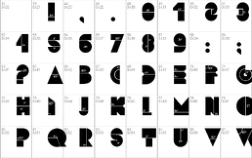
Since the age of computer graphics, the combination of text and digital media, literature often shows the characteristics and forms of images, exten- ding many sophisticated experimental type designs such as the Baskerville typeface inspired by artificially cultivated bacteria (Li Yan, 2012). Designers can also combine various mathematical function processing to assist in design production, created based on mathematical symbols, forming a combination
The Application and Research of Digital Art in Experimental Font Design 757
of mathematics and art design — Roke1984 font (see Figure 1). With the advancement of digital technology, experimental typeface design presents more visuals and forms, and more and more designers choose to use expe- rimental typeface as a carrier for personal creation and commercial project design.
Figure 1: Roke 1984 Font (Adapted from U.S Air Force, 2005).
EXPERIMENTAL TYPE DESIGN UNDER DIGITAL ART Digital art is an art form or artistic process that is created or presented using digital technology and has a certain independent aesthetic value. Using digi- tal technology as an artistic medium, digital artworks are able to take full advantage of the digital platform. The unique characteristics of digital media constitute a unique aesthetic form that is different from traditional media. The interactive and immersive characteristics make digital art works have obvious advantages in the presentation of electronic media, and this art form is also widely used in design works and art creation (Chi Han, 2017).
Experimental typeface design under digital art is a kind of artwork that takes text as its expression form. From the perspective of digital media type- face design, we can find that such design will promote the typeface from static plane to dynamic multi-dimensional transformation. Digital media techno- logy has a rich communication path, and at the same time in the visual effect of information resources dissemination has the advantages that tra- ditional media technology can not be compared, dynamic, interactive, 3D space, impact is commonly used in experimental type design (Rong Shuyun, 2013). Experimental type design under digital art can retain the text form to the greatest extent while attracting the public to read and experience it, effectively improving the utility of text dissemination.
THE DYNAMIC ADVANTAGES OF EXPERIMENTAL FONTS UNDER DIGITAL ART Dynamic is an important way to present experimental fonts under digital art. The rapid development of digital media technology has profoundly changed the design and expression of experimental fonts, making the options of pre- senting works of experimental fonts more diverse. With the support of digital technology, the flat and static Chinese fonts have been transformed into three-dimensional and dynamic experimental fonts, and the text has realized a multi-dimensional development from the previous single character structure to texture, sound and light, etc. The dynamic narrative mobilizes the vie- wer’s sense of touch and emotion, and the semantic meaning of the text itself
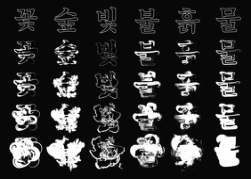
conveys information in a more intense way (Wang Hongyu, 2021). Among such experimental fonts, Korean type designer Mingoo Yoon’s work “Han- geul Type Experimental Series” (see Figure 2) shows the above characteristics in a more complete and comprehensive way.
The designer renders the stroke structure of the text through dynamics, mobilizes people’s perception through changes in texture and effect, combines semantics with visual touch, and strengthens the transmission of the message of the text itself. For example, the shape of the character “花” in this case changes little by little, as the letter organically changes its components to adapt to the width of the strokes in different states, flexibly adapting to the environment, just like the stems and leaves of a plant growing, eventually becoming a blooming flower in form. In the same way, the character “森” is slowly derived from the image, the text becomes distorted and distorted, and eventually the thin text becomes a dense forest, the text loses its function as itself and its readability.
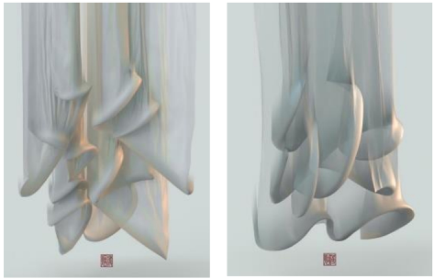
The design work “Hangeul Type Experimental Series”(see Figure 2) makes full use of the dynamic nature of digital media, and through the reconstru- ction and digital generation of points, lines and surfaces, it creates a strong sense of impact of the flat texture. Unlike the flat dynamic experimental fonts above, the artist’s “three-dimensional calligraphy” (see Figure 3) is created through the 3D modeling software Blender, which stretches the typeface and gives the corresponding text material and special effects. Through the com- bination of 3D rendering and kinetic effects, the textures of Chinese ink and jade are presented through the carrier of the text, harboring a strong oriental flavor. Thanks to the development of digital software, artists and designers can more easily change the specific materials and dynamic presentation of text in their creation, experimenting with fonts that are more narrative, and the visual function of text greatly exceeds that of simple textual information transmission (Li Yan, 2012).
Compared with traditional typeface works, the dynamic display of the screen, with the addition of the time factor, raises the level of communica- tion with the reader to a dimension and realm, and the narrative method of the work can be varied. With the control of time, the rhythm of information release can be adjusted. Compared with the finished state of static fonts, the control of information communication is firmly controlled in the carrier, and the reader will receive information in a relatively passive way, and the logic of
Figure 2: Hangeul Type Experimental Series (Mingoo Yoon, 2019).
The Application and Research of Digital Art in Experimental Font Design 759
Figure 3: Experimental type design (BoYan, 2021).
communication will be completely different at this time. The dynamic advan- tage of digital art makes the visual form of experimental fonts more diverse and the dissemination of textual information more efficient (Rong Shuyun, 2013).
THE SPATIAL ADVANTAGES OF EXPERIMENTAL FONTS UNDER DIGITAL ART Experimental fonts under digital art have a graphic spatial construction. Digi- tal technology has changed the experience and relationship between people and words, reducing the time when words are written directly on paper, and most wordsmiths process textual information by tapping on the keyboard or clicking on the screen (Wang Hongyu, 2021). The act of writing itself has changed, so naturally the human experience of text needs to change as well. How to adapt to the change of people’s writing behavior and the change of the text experience has become a topic for discussion. The spatial interpreta- tion of experimental typography has become the answer of some artists and designers.
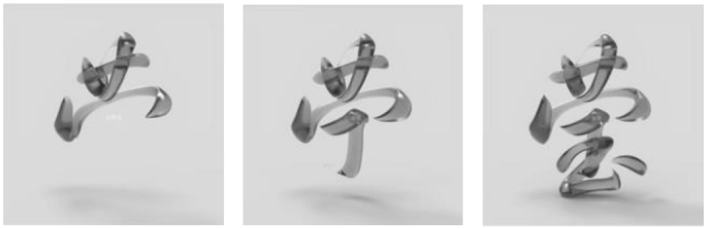
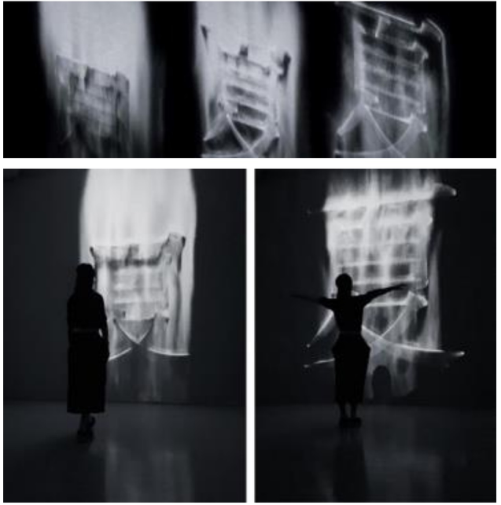
One is to dismantle the text itself and shape the spatial relationship betw- een the strokes. The artist Thin Smoke transforms his writing process on rice paper through software and camera into a crystalline three-dimensional Chi- nese character in motion (see Figure 4). The originally hidden stroke order and flying white rhythm are clearly presented in the virtual space, and the act of writing directly responds to the experience of the text. With the use of digital media technology, the order of the strokes is precisely presented, giving a dynamic image that allows the viewer to experience the impact of visual changes at the sensory level. Such a dynamic, longitudinal three- dimensional calligraphy creates a sense of atmosphere that is very different from traditional calligraphy.
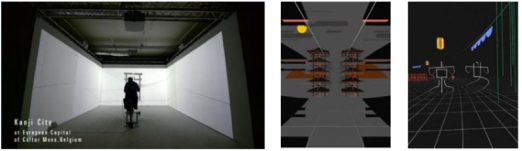
Another direction is to use kanji to form a space where the viewer is immersed in the words. Tokyo-based designer Haota Iguchi disassembled and embedded kanji in images of Tokyo streetscapes, allowing viewers to pedal their bicycles indoors to feel the strokes of the typeface’s composi- tion (see Figure 5). The design cleverly uses actually proportionally elongated
Figure 4: 3D calligraphy and writing motion (BoYan, 2021).Figure 5: Kanji City (Kota Iguchi, 2013).
typefaces in order to fit around the screen and allow people to see the neat text from a driving perspective. Riding through Kanji City, the relationship betw- een human and text changes in a wonderful way. The experience of riding through Kanji City is a wonderful change in the relationship between people and words, as the rider wanders through the inter-frame structure of words and interacts with the city made of words. The mapping of words in space becomes a vehicle for human self-exploration, and the act of movement is closely linked to the movement of the words’ strokes. The connection betw- een “people” and “words” and “movement” is central to the work, and the principle of depicting words in a world of perspective is described by Haota Iguchi as follows. “The ancients actually extracted words from the scenery, and it’s like I’m back in that process now, isn’t it interesting!” The interven- tion of digital media gives the text a real sense of space, an experience that uses modern technology to bring the text back to its original point.
Exploring the spatial structure of words is essentially a retrospective explo- ration of words. New, three-dimensional text forms have driven a change in people’s habits of reading text (Wang Hongyu, 2021). When text has spatial properties, designers can consider more combinations of forms and change the relationship from size, direction, movement and graphics. This multi- faceted and unconventional approach provides numerous possibilities for experimental type design. At the same time, the three-dimensional spatial structure of the text provides a different vision and can allow people to form a deeper understanding of the text itself.
The Application and Research of Digital Art in Experimental Font Design 761
INTERACTIVE ADVANTAGES OF EXPERIMENTAL FONTS UNDER DIGITAL ART Interactivity is the most important characteristic that distinguishes expe- rimental typography from traditional typography, and this characteristic directly influences the way information is conveyed. Traditional typography usually provides information in a linear manner, with a predetermined format to determine the form of communication. In interactive experimental type works, the viewer is no longer a passive recipient of information in the tradi- tional media, but an active participant in the dissemination of information, and the interaction between the participant and the text becomes part of the design. The distance between the viewer and the work is brought wirelessly closer, and the dissemination of information is taken to another level.
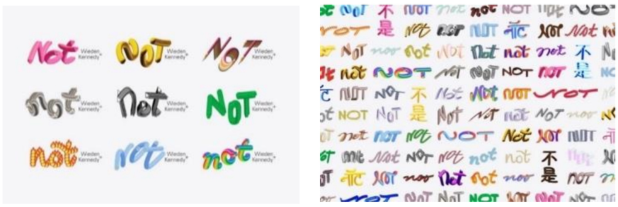
Creative agency Wieden+Kennedy London launched an independent bran- ding and design studio, NOT Wieden+Kennedy, with a new digital generator that uses the variable typeface “Not” as a visual identity for the brand (see Figure 6). The digital generator supports people in customizing typefaces from images and icons, and then animating those typefaces. This means that anyone can easily create an animated logo based on their personal style, a specific client project, an advertisement or popular culture. The advantage of interactive variable fonts is that the weight or style of the same font can be adjusted at will at the user’s discretion, and the number of places it can be applied becomes greater.
The work “Word Waterfall”(Tingan He, 2017), (see Figure 7), on the other hand, explores the relationship between people and words through intera- ction. As a key communicator across all such media, we have constructed an intelligent, dynamic and emotional digital art installation,” says designer Tin- gan He. With a pure and powerfully huge vision, viewers can speak directly to the text through their bodies. They only need to make small gestures to elicit a huge reaction to the typeface and immediately feel the tiniest details in its weight, proportions and condensation.” With classic humanistic design, the raw strokes are replaced with Chinese calligraphic strokes and letterpress design. Through the viewer’s interaction, the text waterfall on the screen begins to morph, the relationship between the strokes is deconstructed, and the text, while maintaining its own semantics and readability, becomes a flo- wing waterfall image through the interactive act of the viewer. The viewer and the work, linked in tandem through interaction, are one without the other.
Figure 6: The not machine (Wieden+Kennedy, 2022).Figure 7: Word Waterfall (Tingan He, 2017).
The interactive experimental fonts can fully mobilize the subjective and active experience of the audience (Rong Shuyun, 2013). Both the digitally generated variable fonts and the interactive fonts installations trigger the cooperation of multiple senses of the audience to obtain information and interact with the fonts, leaving a more profound visual impression. On the one hand, the act of interaction generates more graphic information and enri- ches the thickness of the work. On the other hand, the interactivity makes the audience receive information continuously and give immediate feedback to the information, which is more in line with human thinking habits, and the information will be disseminated better.
CHANGES IN THE LEGIBILITY OF EXPERIMENTAL FONTS UNDER DIGITAL ART Experimental type design under digital art breaks through the functional limi- tation of text legibility (Li Yan, 2012). Once we get rid of the usual perception that text is for reading, we can explore more visually appealing forms of type. People usually think that text is an important carrier to convey information, so they have the preconception that the legibility of text is the most impor- tant, ignoring the expression of text itself. Many experimental type designers believe that the text message itself should not only be transmitted straight- forwardly, but also be read attractively, which requires exploring the form, and thus inevitably affects the legibility of the text (Rong Shuyun, 2013). For experimental typographers, text design needs to be perceived, even heard,
The Application and Research of Digital Art in Experimental Font Design 763
seen, and thought about, while the legibility of the text is relegated to a secon- dary position. With the addition of digital art generation and dynamic design, graphics have a timeline and one can clearly see the process of text to graphic transformation. The shape-shifting text creates different visual atmospheres depending on the needs of the design. Countless experimental type designers have pushed the boundaries of text legibility and functional expression.
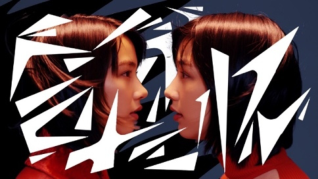
CHANGES IN THE WAY OF READING EXPERIMENTAL FONTS UNDER DIGITAL ART Experimental type design under digital art has transformed from a simple linear functional reading to a deep expression in visual form, becoming a very powerful pictorial language. Experimental type can be used as a sepa- rate creative carrier, or it can form a composite visual with pictures or images. The visual language of experimental type leans toward pictoriality, such as the exaggerated and sharp text design in the case “I AM NON”(see Figure 8) (Kota Iguchi, 2019), where the text is pictorially processed to achieve the pur- pose of enhancing the atmosphere of the film. The readability of experimental fonts has been expanded beyond the original function of simply transmitting information, and experimental fonts have broken through the limits of fla- tness, appearing as images in actual and virtual spaces (Chi Han, 2017) The way people treat experimental fonts has changed from traditional “reading” to “viewing”. The progress of digital technology has expanded the dimen- sion of experimental fonts, and the visual presentation of different carriers is different, corresponding to different viewing methods, so experimental fonts naturally break through the traditional way of reading text (Wang Hongyu, 2021).
Figure 8: I AM NON (Kota Iguchi, 2019).
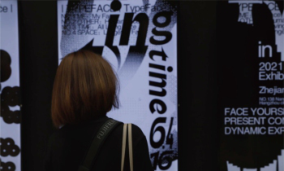
THE CHANGE OF INFORMATION TRANSMISSION METHOD OF EXPERIMENTAL FONTS UNDER DIGITAL ART Experimental typography under digital art challenges the viewer’s perception of information. The presentation of the work becomes more experimental, for example, the work (see Figure 9) “Typeface” (Peitao Chen, 2021) desi- gned by Chinese designer Chen Peitao is a visual experiment in time, where the typeface Type and the human face Face constitute the protagonists of this game, wandering in the parallel concept of time and space with real-time
Figure 9: TypeFace (Peitao Chen, 2021).
dynamics and interaction. By facing my face under the camera, you are allowed to control the temporal changes of the words. The textual “expe- rimentation” never stops, and the work is a state of “present co-creation”, requiring the audience to intervene in the work to finally complete the expe- rience of interaction. In experimental typography under digital art, the means of expressing information are more diverse and the ways of viewing text are also more varied (Li Yan, 2012). The progress in many aspects naturally promotes the development and change of viewers’ perception of information.
CONCLUSION
In experimental typeface design, the role of “word” has actually gone far beyond the communication of information in terms of pronunciation or ide- ograms, and has become a carrier for presenting some new concepts and ideas. Compared with traditional typeface design works, experimental type- face design under digital art has dynamic advantages, interactive advantages and spatial advantages, which are highlighted in the process of adapting to the new digital network media, getting rid of the single form of typogra- phy, and moving towards interdisciplinary and comprehensive design.Digital media brings dynamic advantages to experimental fonts. The addition of the timeline greatly expands the narrative and takes the communication of infor- mation to another level. In the same viewing time, dynamic experimental type is able to convey more information than static print, and the efficiency of conveying information becomes greater. When the interactivity of digital art is applied to experimental type design, the relationship between human and text will be closely linked.As the exploration continues, the boundary of “type” will be reinterpreted, and “text interaction” will provide people with another way of thinking. Traditional font design is mostly presented in a two-dimensional, static way, lacking vitality, creativity and individua- lity, while interactive experimental font design not only meets the diversified needs of the information age, but also stimulates people’s perception through the immediate feedback behavior of interaction, and completes the commu- nication and feedback of information in the process of experience, which makes the effect of information dissemination greatly improved.
The above advantages are the natural development of experimental typo- graphy in the process of adapting to digital media, and experimental fonts have transformed the readability, readability, and information transmission of text. Breaking through the limitations of text readability, experimental
The Application and Research of Digital Art in Experimental Font Design 765
fonts transform to graphic and dynamic. The spatial properties of experimen- tal fonts have also changed the way people read text, transforming the process from “reading” to “seeing”. The interactive experimental fonts change the traditional single information transmission, but form an interactive chain of information transmission, leaving space for the viewer to participate and play, and the connection between people and works becomes closer, and the transmission of information becomes efficient.
Experimental typeface design under digital art was born with the deve- lopment of digitalization and informatization. It retains its identity as a carrier of conveying information and culture, and explores the possibilities of graphic design around the medium of words with an experimental and per- sonalized perspective, breaking the single linear form of traditional typeface design and moving toward a diversified and open typography.
ACKNOWLEDGMENT
This dissertation is the stage result of the 2021 National Social Science Foundation Art Major Project “Research on Chinese Character Inheritance and Innovative Design” (Grant No. 21ZD26) sub-project: “Cross-cultural Communication of Chinese Character Innovative Design.
This dissertation is the stage result of the 2020 General Scientific Research Project Supported by Zhejiang Provincial Education Department (Project No. Y202250504).
REFERENCES
Chi Han. Exploring the interactive space of font design [J]. Art Technology, 2017, 30(08):288. Li Yan. Research on the interactivity of type design on digital media platform [D].
Northwestern University, 2012. Rong Shuyun. The game in space–exploration of experimental type design [J]. Art Technology, 2013, 26(06):16. Wang Hongyu. Exploration of dynamic type design under digital media [J]. Popular
Literature and Art, 2021(09): 66–67. Zhu Xiaoqian. A brief discussion on the experimental spirit of experimental fonts [J].
Design Art (Journal of Shandong Institute of Arts and Crafts), 2009(03): 75–76.
LISTED IN THE AHFE DIGITAL BOOKSTORE CATALOGUE
Explore the complete digital volume
Ergonomics In Design
Read this individual research paper free through the original publisher, or explore the full digital proceedings book.
ISBN 978-1-958651-53-7
Explore this ISBN in the AHFE Bookstore ↗Listed in the July 2026 bookstore catalogue; search by ISBN to confirm current availability · Digital book purchase optional