Yichen Zeng, Chao Zheng, Xinlei Zhang, Bingkun Qiu, Xinhao Zhan, Li Cheng Xie (2023). Analysis of the Interactivity of Font Design Application in User Interface. In: Ergonomics In Design. AHFE Open Access, vol. 77, pp. 374–382. https://doi.org/10.54941/ahfe1003395
Driven by the information age, the development of screen display technology has brought new opportunities and challenges for typeface design. Font design has gradually realized multi-dimensional presentation forms and interactive interaction properties. Starting from the application of fonts in user interfaces, this paper analyzes the factors constituting text interactivity and the basic characteristics of font interactivity. It summarizes the expression form of font interactivity in user interface design and its feedback effect. The study shows that, as a fundamental element of user interface design, standardizing the interactive properties in fonts and reading text can ensure the readability of text and improve the efficiency of information communication. At the same time, the application of new digital technologies further expands people's access to text information. The rich media and information dissemination channels have given rise to new patterns of font interactivity applications, shifting the representation of text from static to dynamic, enriching visual variables and application scenarios, and generally broadening the design field. Finally, this paper believes that immersive and interactive typeface design is the future development trend, and the typeface design in user interface should actively break the barriers to seek boundaries and development. The interactive application of fonts with the intervention of new technologies and devices enables designers to convey information and emotions more fully and completely, thus enabling users to obtain a better reading experience and efficient information resources.
Influenced by the development of information technology, people’s access to information channels and ways has changed, and a considerable amount of information needs to be conveyed through the user interface. Text functio- nality is very prominent, and font design has become an meaningful way to shape the image and spread information.
Fonts play an essential role in designing user interfaces, where the funda- mental goal is to help users read what is on the screen (Kahn and Lenk, 1998). The presentation of text has gradually shifted from static to dynamic, brea- king through the limitations of two dimensions, and the expression of type design has become increasingly prosperous. However, the design of fonts in the interface is often neglected, and most of them are still designed for the
Analysis of the Interactivity of Font Design Application in User Interface 375
font style and layout of the screen display. For the choice of font type, expe- rimental analysis can summarize the advantages of different fonts in terms of reading time, readability, and attractiveness respectively (Bernard et al. 2002). With the advancement of research techniques, some related experiments have taken the form of the eye-tracking experiments to compare the display effe- cts of different fonts. The findings show that the 18-point font size achieves the best readability, comprehension and subjective perception scores in the display of web pages and ensures a certain amount of screen text accom- modation (Rello et al. 2016). In the design of user interfaces, besides the setting of font type, size, and spacing for reading text, there are many dyna- mic and interactive applications of fonts. As the visual symbols that make up information, the text is the most intuitive and effective way to communicate information, and it should also have interactive properties in information dissemination. Faced with the limitations of interactive digital text design methods, Jin (2013) argues that differentiated research should be conducted for digital text based on the principles and guidelines of print text design to ensure that people can understand dynamic interactive digital text intuitively and accurately. Wang (2021) argues that type design based on interactive technologies with visual, motion trajectory, virtual reality and interactivity opens up new ideas for type design.
On the one hand, different interaction design means can present different visual representations to guide users’ operations. On the other hand, users can also interact with the text content through interactive behaviors to get a better user experience. Pioneers of user interface and font design have stu- died the usage specification, user preference, and interactive application of fonts. Attention to the interactive experience between readers and text is the foundation of font design. The interactive design of fonts is crucial in new technologies and devices, which is also an significant development trend of future font design.
In this paper, we first analyze the reasons for interactivity in font design and discuss the factors that drive the development of font design toward intera- ctive applications. Then we propose some methods and forms to reflect the interactivity of typeface design in user interface by combining technology, devices and factors affecting user experience, and provide a reference for the future direction of typeface design.
FACTORS IN THE DEVELOPMENT OF FONT DESIGN TOWARD INTERACTIVITY Transformation of Print Media to Electronic Media
New devices and media provide room for the development of font intera- ctivity applications. Compared with traditional media, there are significant differences in electronic media. The display of electronic media is adjusta- ble, and different pixels, font size, background color brightness, and ambient light will affect the rendering effect of the text. With the increasing screen resolution, the current cell phone screen can match the resolution of traditi- onal printing, creating more space for font design in the user interface. The computer needs a larger font size than the paper display in the screen display.
The browsing habit of reading the matrix text in horizontal combination has prompted designers to extend the width of single characters while redu- cing the word spacing to achieve a smoother and more coherent reading. Different types of screens also differ in terms of display. For example, cell phone screens are displayed closer to computer displays, so there is no need to emphasize reading consistency when using them. Each character has its independence, which is conducive to quick recognition. Therefore, improving the inclusiveness between fonts and different devices is crucial.
In addition, the constant renewal of mobile devices also gives more room for user interface development. With the emergence of folding cell phones, variable fonts will become mainstream in the future. The introduction of wearable devices and context-aware technology makes fonts need to present different font forms in different situations. The use of text is more humani- zed, which can also provide users with more detailed interactive designs and improve their sensory experience.
Interconnection of Design and Technology From three-dimensional dynamic design to artificial intelligence synthesis, the constant updating of technology has enabled more methods and tableaux means of visual design. Diverse technologies are also constantly intervening in typography, changing its way of thinking. Driven by new technologies, real- time, mobile, and interactive ways of visual experience allow text to take on time and motion characteristics and luminous, rotating, and kinetic effects (Wang, 2021). In user interfaces, dynamic 3D visual effects on functional or hovering text can increase the virtual and interactive nature of the typeface. The combination of artificial intelligence technology and some technological fields with typeface design makes the design more efficient and conveni- ent, expanding the typeface design field. Interactive applications bring visual diversity and promote the technical progress of typeface design itself.
The Interactivity, Speed, and Diversity of Information Dissemination in the New Media Era In the era of rapid information change, the volume and form of informa- tion, the dissemination of information, and the way users receive information have gone beyond time and space. As the most intuitive element to convey information, the text has taken on new functions and expressions in the inte- ractive and interactive way of information dissemination. With the advent of the Internet era, people’s reading has turned into quick browsing of infor- mation on a large scale, and the dissemination of information has become fast and diversified. At the same time, compared with the text in traditional media such as books and newspapers, the information in the user interface breaks the relatively fixed reading relationship. It transforms from a linear reading order to an open, fluid, and three-dimensional information space, giving readers the right to choose, reorganize and change information. At the same time, readers and information are interactive, and people are free to construct the content conveyed by textual information and to understand and connect pages of text beyond the meaning of the text itself. Reading is
Analysis of the Interactivity of Font Design Application in User Interface 377
no longer limited to the medium of paper; it is a network of information con- nections above and beyond the text’s narrative, and users can jump around with their own reading habits and quickly search for the information content they want to access. The process of receiving information becomes a flexi- ble space, which also foreshadows the future development trend of dynamic processing information arrangement of fonts.
Multisensory Interaction Between Font Design and Users The progress of technology makes people’s requirements for receiving infor- mation higher and higher, and font design is becoming more and more creative and individual. In digital media, viewers can engage multiple senses and obtain information through effective sensory collaboration. Typography also gradually interacts with multi-sensory experiences to achieve expanded meaning of the text and maximize the effect of the final text application. Therefore, we have to analyze the interaction of typography from different sensory perspectives.
First, the visual is the primary way people receive information, and a sin- gle, dull kinetic effect can no longer meet the psychological requirements of the audience. The interaction of an effective combination of multiple senses plays a pivotal role. After visual acuity, hearing is the most crucial sense and plays a vital role in the type design. Sound effects can convey not only emo- tions but also themes. Different elements of sound effects and expressions can be chosen in different text environments. For example, in Chinese calli- graphy fonts, elements of Chinese style can be chosen in the music to make up for the emotional atmosphere that cannot be created visually. The fonts can also interact and communicate with the audience in the digital medium through touch, sensing, and other technical means. Tactile engagement can fully reflect the audience’s experience, enabling them to derive pleasure and a sense of their existence. In the design of touch fonts, it is possible to change the font’s appearance, its trajectory of movement, and perceive the message conveyed. The change of typeface through the stimulation of sound has been reflected in the design of some art installations. Imagine integrating virtual reality technology with electronic reading, making the text tactile, olfactory, and other multifaceted functions and virtual experience, which is a new kind of text interaction design. In the reading process, we can personally experie- nce the characteristics and charm of the language, the virtual presentation of objects imagined through the text. The multiple experiences of taste, smell, touch, hearing, vision, and other senses based on the connotation of the text make the reader feel the unique reading effect in reading.
Summary Analysis Combined with the above discussion, we can learn that the interactivity of font design is a trend driven by many factors (see Table 1). The develo- pment of the times has led to changes in media, information, technology, and user experience needs, bringing new development space for font design. The design thinking of printed text is no longer sufficient for people to read on the screen. Interactive font design is an integral part of the user interface.
In recent years, many designers have been paying more and more attention to the user experience of font interaction design. After clarifying the reasons for generating interactive attributes, we can better carry out the interactive design of fonts.
Table 1. Factors driving the development of font design towards interactivity.
Table available in the original PDF paper.
Factors Changes Impact on font interactivity Media Electronic media The new generation of mobile devices Technology Animation technology/3D dynamic design/artificial intelligence
Diversity of font design methods/principles/expression- s/application scenarios Information dissemination
Multi-perspective understanding of the text and font design
Change in reading style / information communication Style Multi-sensory experience Multi-sensory interaction of sight/sound/touch
Engagement/multi-dimensional understanding of multiple texts
APPLICATION DIRECTION OF FONT INTERACTIVITY IN USER INTERFACE Interactivity Performance in Interface Font Specification
In interface design, the standardized application of fonts is somewhat intera- ctive. In a GUI, text involves 11 different levels of text categories. Although the interface is designed with different types of text, users can still follow their preferences and habits to choose the right text size or font style to ach- ieve the best reading experience, which reflects interactivity in the interface specification settings. To gain the best reading experience, some text paragra- phs or headings allow users to customize the font shape while maintaining the visual balance of the interface. Content of interest to the user can also be enlarged to a more prominent position on demand. The interactive space in the text specification maintains optimal readability regarding content and the ability to shape the layout to suit the user’s preferences. It enhances the interface’s planning and overall visual effect, making the operation smoother and more straightforward.
Variable Font Design In the digital era of the 21st century, the Internet, mobile multi-screen, arti- ficial intelligence, and other technologies are developing rapidly. Designers hope to achieve high-quality typographic design even on digital carriers, and the demand for variable fonts with high flexibility is increasing daily. The variable shape is not only a simple stretch but also a specific control of the word’s middle palace and inner white to ensure the overall beauty and balance
Analysis of the Interactivity of Font Design Application in User Interface 379
of the font. As a fusion of technology and design art in the screen age, vari- able fonts can make the interface of a website or application more attractive and expressive.
Compared with traditional fonts, variable fonts are more advantageous in document size, usage performance, design flexibility, and screen display adaptability. First of all, variable fonts can effectively reduce the size of docu- ments, making web pages faster. The benefits are not limited to performance optimization. With variable fonts, font design has entered the software realm and is no longer limited by the traditional physical world. Fonts of different widths and thickness combinations can be flexibly transformed in the display of the interface. In 2019, Founder created the “Xiaomi Lanting Pro” variable font for the Xiaomi brand, which enables users to drag the slider to change the size and weight of the font in the mobile interface and supports intelli- gent and infinite adjustment of font thickness. In the combination of variable fonts and mobile terminals, users can make local, personalized adjustments according to font requirements and use the system’s big data to match font size, thickness, and width to the information level. When people use brow- sers with different display sizes, they can adjust the font’s shape to fit the display size and combine touch, sound, and other elements to control some interesting visual effects interactively. Variable fonts can cope with sufficien- tly complex flat spaces and application scenarios in user interfaces and are an essential means of customizing design.
Dynamic Font Design In user interfaces, where information is propagated in the dimension of time and motion, the text also produces different kinds of dynamic effects. The motion dimension of the text is reflected in custom interactive applications, which are heavily used in navigation bars, button controls, icons, hover links, and other parts. Through touch, the form of the font can be adjusted to the user’s preferences, and the texture, orientation, size, and color can be changed. The interactive properties allow people to customize how fonts are presented for the best reading experience. In the design of some web pages, the mouse hovering over the text gives different font states and text effe- cts. The interaction of fonts in the navigation bar or elsewhere on the web page allows people to be drawn in and pay attention to the information. Text gradually moves from a static element in the user interface to something adjustable and interactive and can produce interesting dynamic effects.
Font Design in Virtual Reality Font design in interfaces is constantly being revolutionized, showing a trend toward multi-dimensional crossover. Over the past decade, interface desi- gns have been developed for displays of all sizes and output types. In the high-speed and smooth dissemination of information and data, user interface design is not only enhancing details and beautifying visuals in two- dimensional interfaces, but virtual reality interfaces are opening up new design fields.
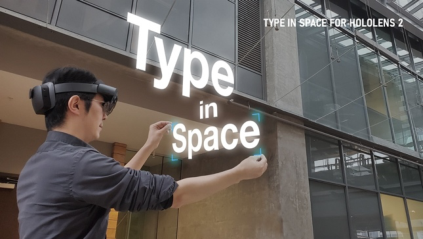
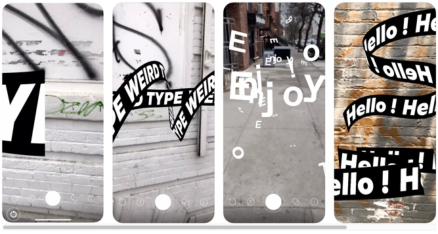
The future of interaction will undergo a whole new transformation, and virtual vision and the natural world are becoming one world. Everything may need to come through the screen, including our work meetings, interactions with clients and students, and even public gathering events. In typographic design, this shift is reflected in several types of design applications with inte- ractivity. Most of them exist in AR or VR, which can adapt and react to the environment in real-time. In recent years, there have been a lot of talks and thoughts about virtual reality technology, and many brands and compa- nies are eager to innovate in this area, either by creating immersive launch events or by developing gaming experiences for navigating the environment. An example is Yoon Park’s Type In Space project, an experimental hologra- phic type project. The ability to grip and manipulate in a natural environment allows fonts to exist in real life and interact very closely with the user (see Figure 1). There is also an AR App by Zach Lieberman and his partner called Weird Type. This app artistically explores augmented reality, enabling users to freely wrap around, break up, or take pictures with text in different modes (see Figure 2). Through the innovation of these design projects, the reader is designed to connect with the natural environment and bring the interaction with people closer. Many brands and companies are exploring and driving scenarios where this technology can be used, and type is one of the critical elements of these experiences.
Figure 1: Type in space for HoloLens 2 (Park, 2022).Figure 2: Weird type (Lieberman and Kuo, 2018).
Analysis of the Interactivity of Font Design Application in User Interface 381
Font Design Under Artificial Intelligence The intervention of artificial intelligence offers a variety of possibilities for font design. Shan Carter of Google Brain and Michael Nielsen of YC Resea- rch believe that artificial intelligence will enhance human intelligence at the “software level,”thus allowing for a significant expansion of the human mind and creative field (Carter and Nielsen, 2017). The interaction between arti- ficial intelligence and text in font design is reflected in several aspects, such as self-learning and self-optimization. Relying on the analysis of data and the integration of intelligent algorithms, fonts will automatically recognize diffe- rent scenes after intelligence, which has already achieved some results in the design field.
In the era of big data, there has been some collaboration between artificial intelligence and designers in the field of font design. Zeng et al. (2019) used neural networks to compute and learn according to the designer’s rules and data to resolve the contradiction between the design and production of Chi- nese characters and the need for large-scale and diverse information. A more desirable family of Chinese fonts was eventually produced through repeated testing and optimization, and the experimental results verified that artifi- cial intelligence could enhance designers’ creativity. Some designers are also experimenting with algorithms to restructure the inscribed symbols in Liang- zhu culture. Intelligent algorithms are grafted and fused with traditional text structures to explore the possibility of transforming carved signs into Chinese characters, which is also the Chinese character type design with the interven- tion of artificial intelligence (Zhao et al., 2022). Computer learning using different software programs, algorithmic models, and importing two sepa- rate databases of Chinese characters of the Thousand Character Classic and Liangzhu engraved symbols can form source data feature symbols that can be computed. In addition, artificial intelligence can replace the tediousness of typeface design and expand new design methods and design forms. In recent years, the Chinese font company Founder’s font has been developing an artifi- cial intelligence learning system and AI-assisted typeface creation to improve efficiency, reduce time and development costs, and meet the application of fonts in different fields. The involvement of artificial intelligence in typeface design is a perfect combination of technology and art, bringing much room for the development of typeface expression (Zhang, 2022).
CONCLUSION
As an essential part of information communication, font design under the screen is also evolving and developing. Therefore, for a good presentation of the text in the user interface, it is necessary to consider the user’s rea- lity and sense of experience. This article focuses on the factors that drive font design toward interactivity, which is the basis of interactive font design. Rele- vant application cases in user interface are also analyzed to have an overall understanding of the development status of the field. With the advent of the information age, the demand for typeface design is growing. The interactive experience of standardized fonts and the dynamic and diverse font intera- ction follow the basic interaction principles. The font design has changed
from static to dynamic, virtual, and interactive, integrating multi-dimensional elements such as sound, text, graphics, and animation. The application of interactivity opens up a new field of thinking for typeface design and provi- des a new space for thinking about the expression of textual meaning. Users can enjoy immersive and intense interactive interaction in an efficient infor- mation communication and reading experience, and designers can realize idealized visual effects more easily and quickly through interactive techno- logy. The application of interactive attributes has gradually become one of the development trends in typeface design.
ACKNOWLEDGMENT
This dissertation is the stage result of the 2021 National Social Science Foundation major project on art, “Research on Chinese Character Inhe- ritance and Innovative Design” (approval number: 21ZD26) sub-project: “Cross-cultural Communication of Chinese Character Innovative Design”.
REFERENCES
Bernard, M., Lida, B., Riley, S., Hackler, T. and Janzen, K. (2002). A comparison of popular online fonts: Which size and type is best. Usability news, 4(1), p. 2002. Carter, S. and Nielsen, M. (2017). Using artificial intelligence to augment human
intelligence. Distill, 2(12), p. e9. Jin, S.-H. (2013). Visual design guidelines for improving learning from dynamic and interactive digital text. Computers & Education, 63, pp. 248–258. Kahn, P. and Lenk, K. (1998) “Design: Principles of typography for user interface
design,” Interactions, 5(6), p. 15. Lieberman, Z. and Kuo, M. (2018) Weird type, App Store. Available at: https://apps .apple.com/us/app/weird-type/id1352785248 (Accessed: January 10, 2023). Park, D. Y. (2022) Designing type in space for hololens 2 – mixed reality now, Mixed
Reality Now – Mixed Reality, Augmented Reality, Virtual Reality, AR, VR, MR, XR Stories by Yoon Park. Available at: https://mixedrealitynow.com/designing-ty pe-in-space-for-hololens-2 (Accessed: January 07, 2023). Rello, L., Pielot, M. and Marcos, M. C. (2016). Make it big! The effect of font size and line spacing on online readability. In Proceedings of the 2016 CHI conference on Human Factors in Computing Systems (pp. 3637–3648). Wang, Y. (2021). “Font design based on Visual Interaction Technology,” The 2021
International Conference on Machine Learning and Big Data Analytics for IoT Security and Privacy, pp. 931–936. Zhang, J. (2022). A study on the interactive properties of font application in user interface design. Beauty and the Times (in Chinese) (09), 4–7. Zhao, Y., Li, Y., Wang W., Wang, Z., Ma, Y., Zhang, H and Zhao, J. (2022). Heritage
and transcendence: Typography in the context of new technologies and digital media. Decoration (05), 69-77. Zeng, Z., Sun, X. and Liao, X. (2019) “Artificial Intelligence Augments Design creativity: A typeface family design experiment,”Design, User Experience, and Usability. User Experience in Advanced Technological Environments, pp. 400–411.
LISTED IN THE AHFE DIGITAL BOOKSTORE CATALOGUE
Explore the complete digital volume
Ergonomics In Design
Read this individual research paper free through the original publisher, or explore the full digital proceedings book.
ISBN 978-1-958651-53-7
Explore this ISBN in the AHFE Bookstore ↗Listed in the July 2026 bookstore catalogue; search by ISBN to confirm current availability · Digital book purchase optional