Karin Ueda, Yohsuke Yoshioka (2023). Effects of design around a window on the mental strain of a person working at a desk. In: Ergonomics In Design. AHFE Open Access, vol. 77, pp. 644–650. https://doi.org/10.54941/ahfe1003424
When working in a room, people may choose to work around a window for a sense of openness and recovery of fatigue. However, design around a window for example the size of a window and the distance from the sidewalk may have a negative effect on the mental strain, such as decreased concentration on work.In this study, we examined the effects of design around a window on the mental burden of person working at a desk through a subjective experiment using both a virtual environment technology and an electrodermal activity measurement method. This study is a part of research aimed at obtaining knowledge about design around a window that does not cause mental strain. We arranged floor-to-ceiling height windows and a moving virtual human avatar in the virtual environment and measured the skin potential response (SPR) of the subjects under each condition.A total of eleven students participated in the experiment. The subject wore an electrodermal activity meter and sat in the middle of a quiet experimental room. They also experienced a virtual rectangular room presented via a head-mounted display. The dimensions of the virtual room were set at 3000 mm in width, 2500 mm in depth, and 3000 mm in height. A 3000 mm high window was created on the front wall. We set the subject sat 800 mm away from the window of the virtual room. Human avatars passed outside the window.There are eighteen experimental conditions with those three parameters: three widths of window (1000, 2000, and 3000 mm), three types of avatars (1. walking, 4. jogging, and 5. striding) and two distance levels between the subject and avatar (1000 and 2000 mm). In one continuous trial, three of the eighteen experimental conditions were presented in random order, resulting in three types of avatars appearing at 30-50 seconds intervals while the window width was fixed at a certain level of three. After a 20-second break, the next trial began with the other condition. The order of the window widths and distance level between the subject and avatar was in random order for each subject. During the experiment, the subjects performed a task to type a key in the same direction as an arrow displayed on a monitor.The results showed that the mental strain of the person working at a desk was significantly higher when the window width was 1000 mm in comparison to a window width of 3000 mm. when 1. walking avatar appeared. Compared to the previous experiment in which subjects had no task, the mental strain was significantly reduced in some factors. From these analyses, we find that the narrower the window width, the higher the mental strain on the person working at a desk. Also, it suggests that the mental strain varies depending on existence of a task.These findings may be useful in creating window designs that make it easier to concentrate on tasks.
One may sometimes chose a window seat in a space as a place to work or study. There are many previous studies on the positive psychological effects of windows. For example, through analysis of living environment evaluations, Muto et al. clarified that the window’s psychological effects can be categori- zed into comfort and introduction of a sense of continuity with the outside world. Also, Won et al. clarified positive emotions increased while negative emotions decreased with windows. However, such studies have generally veri- fied assuming situations in which the scenery outside the window does not change so rapidly. In many cases, various changes occur from time to time outside a window, and the visual stimulation caused by human movement is considered to cause mental strain to the person [seated] in the room.
In a previous report, we constructed multiple window widths and moving human avatars in a virtual environment, and verified the effects of each vari- able combination on the mental strain of a person staying in the room. It was found that changes in window width and the distance between the person
Effects of Design Around a Window on the Mental Strain of a Person Working at a Desk 645
staying in the room and the person passing outside the window affect the mental strain of the former.
In the present study, using virtual environment technology and skin poten- tial measurements, we examined the effects of design around a window, such as changes in window width and the distance between the person passing outside the window and the person in the room, on the mental strain of the person working in the room. The purpose of this study is to obtain data on architectural planning that will lead to a reduced mental strain in the people working, thereby increasing their concentration on their work.
EXPERIMENT Summary
Subjects performed a task in a virtual space. We measured the subjects’ skin potential responses and task performance during this process to verify the relationship between the design around a window and the subjects’ mental strain.
Subjects experienced a virtual environment through a head-mounted display (HMD). A rectangular space with a window created with virtual envi- ronment software (vizard6.0/WorldViz) was presented to the HMD (VIVE PRO EYE/HTC Corporation) via transfer software (Virtual Desktop/Virtual Desktop).
Eleven students participated in the experiment. The experimental site was a virtual environment laboratory at Chiba University, Japan.
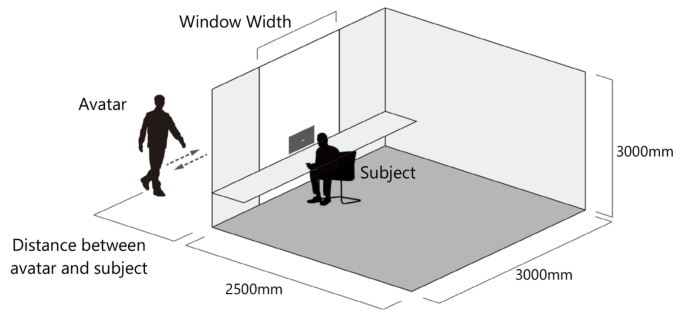
Conditions The size of the rectangular space constructed in the virtual space was 3000 mm wide x 2500 mm deep x 3000 mm high. On the wall of one long side of the space, an opening of 3000 mm in height from the ceiling to the floor was created and designated as a “window”. The subject sat facing the window at a distance of 800 mm from it. A 300 mm x 200 mm screen linked to a laptop computer was also displayed in front of the subject to perform the task.
Figure 1: Experimental environment.
646 Ueda and Yoshioka
Table 1. Image in each condition.
Table available in the original PDF paper.
Table 2. Images of avatar.
Table available in the original PDF paper.
Name 1. walking 2. jogging 3. striding
VR Image Speed 4 km/h 6 km/h 4 km/h
We set three factors: three levels of window width (1000, 2000, and 3000 mm), three types of avatar (1. walking, 2. jogging, and 3. striding), and two levels of distance between avatar and subject (1000 mm and 2000 mm).
Method
After explaining the outline of the experiment, each subject was fitted with a HMD and a skin potential meter TS02 SPL/R-AD (Technonext, Inc.). The skin potential meter was attached to the subject’s left hand at three locations: the base of the thumb, wrist, and back of the hand. The subject was instructed not to move the left hand with the skin potentiometer attached. During the trial, subjects also performed the task with their right hand. The task was in the form of typing arrow keys corresponding to the arrows displayed on the screen.
In one trial, three different avatars (1: after 15 seconds, 2: after 50 seconds, and 3: after 80 seconds) appeared within 90 seconds under certain conditions. Six conditions were presented in random order, including three levels of win- dow width and two levels of avatar-subject distance. There was a 10-second break between each trial, and subjects were asked to close their eyes before restarting.
Effects of Design Around a Window on the Mental Strain of a Person Working at a Desk 647
ECTRODERMAL ACTIVITY Miyata et al. states that “skin potential response (SPR) is the AC component of skin potential activity (SPA), which occurs in response to stimuli such as visual and tactile stimuli caused by external environmental changes.”
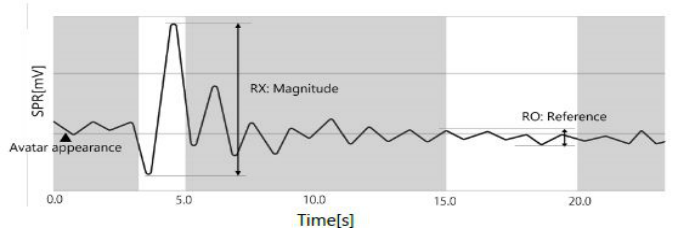
The following method by Kobayashi et al. was employed in the present study to analyze the skin potential response. First, the amount of response of the yin-yang biphasic wave that appeared within 3 seconds of the appearance of the avatar was calculated and named as RX. Then, 15–20 seconds after the appearance of the avatar was set as the measurement time of the reference value. The absolute value of the maximum and minimum values within this reference measurement time was used as the reference value, and named as R0. RX/R0 was calculated for each skin potential response, and this value was defined as the skin potential response ratio. The higher this value is, the more mental strain is imparted on the subject.
Figure 2: Schematic graph of skin potential response.
RESULTS AND DISCUSSION
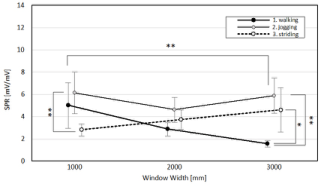
Skin Potential Responses Bonferroni’s multiple comparison tests (t-test, 5% level) were conducted on three factors: window width level, avatar types, and distance level between the avatar’s passing motion line and the subject. First, for each avatar, a signi- ficant difference was found between the window width of 1000 mm and 3000 mm only for avatar 1.walking (Figure 3).
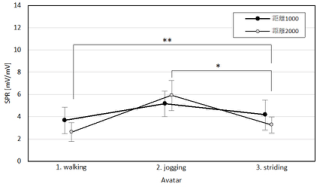
In addition, regarding the avatar level and SPR at each distance, only at 2000 mm distance between subject and passing avatar, significant difference between 1.walking and 3. striding and significant difference trend 2.jogging and 3.striding were found (Figure 4). This indicates that the faster the avatar moved, the greater the skin potential response. For avatars with the same movement speed, the more prominent the movement, the greater the skin potential response. Although both 1000 and 2000 mm distances show similar trends, the difference in values is smaller at 1000 mm distance (Figure 4). This is may be due to the difference in whether the avatar’s entire body is visible or not. The difference in values could be due to the fact that the avatar’s whole body is visible, which makes it easier to see differences in the avatar’s movement and speed.
648 Ueda and Yoshioka
Figure 3: Relationship between window width and SPR in each avatar.Figure 4: Relationship between avatar and SPR in each distance.
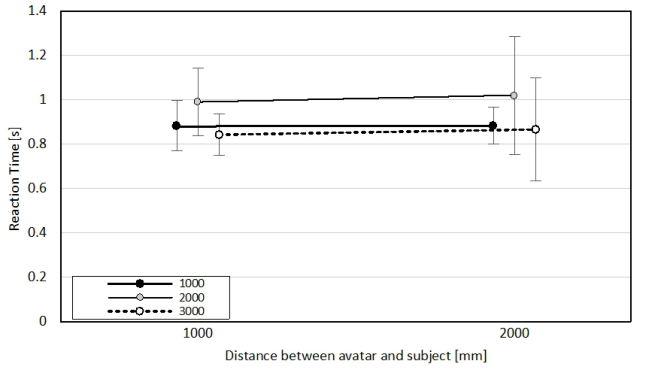
Task Performance In this experiment, reaction speed to the task was evaluated as the work per- formance. Reaction speed refers to the time from when the arrow appears on the monitor until the time that the subject types the arrow key. Figure 5 shows a comparison of reaction speed with the distance between the avatar passing motion line and the subject at each window width level. Bonferroni’s mul- tiple comparison tests (t-test, 5% level) were conducted on the two factors of window width level and the distance between the avatar passing motion line and the subject, but no significant differences were found. However, rea- ction speeds were slower from 1000 mm to 2000 mm distance for all window width levels.
Comparison With Previous Experiments We compared the data of this experiment with those of a previous experiment in which the same procedure was performed but without the task. Bonfer- roni’s multiple comparison tests (t-test, 5% level) were conducted using the window width level, the distance level between the avatar and the subject, and the presence of a task as factors.
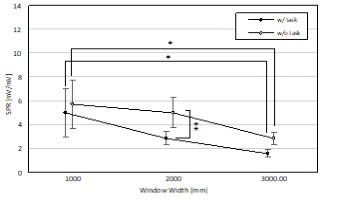
Figure 6 shows the relationship between window width level and skin potential response ratio with and without task. As a general trend, the skin potential response ratios in the tasked condition were lower than those in the non-tasked condition. In addition, the wider the window width, the smaller the mean skin potential response ratio. The test results showed a significant trend between the window widths of 1000 mm and 3000 mm for both the
Effects of Design Around a Window on the Mental Strain of a Person Working at a Desk 649
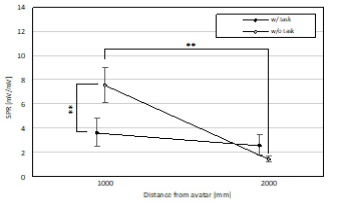
Figure 5: Relationship between distance and reaction time in each window width.Figure 6: Relationship between window width and SPR in each task condition.Figure 7: Relationship between distance and SPR in each task condition.
tasked and untasked conditions. This indicates that regardless of the prese- nce or absence of a task, maximally widening the window width reduces the mental strain of the occupants.
Figure 7 also shows the relationship between the distance level between the avatar passing through and the subject and the skin potential response in the presence and absence of the task. The overall trend is that the shor- ter the distance between the avatar and the subject, the smaller the average skin potential response ratio, regardless of the presence or absence of a task.
650 Ueda and Yoshioka
However, the values changed more significantly in the no-task condition, confirming a significant difference. In the no-task condition, subjects were looking out the window and centered on the avatar. On the other hand, in the tasked condition, subjects gazed at the task monitor, and thus may have had a peripheral view of the avatar. We believe that this difference caused the difference in the amount of change in the skin potential response ratio with and without the task. Significant differences were observed between the task and no-task conditions at 1000 mm distance between the avatar and the subject. No significant difference at 2000 mm distance was identified due to the difference in the area over which the avatar is perceived. Since the size of the avatar perceived at 2000 mm distance was half the size of the avatar perceived at 1000 mm distance, we consider that the amount and frequency of skin potential responses to the avatar were reduced in both conditions and that no difference in skin potential response ratios was observed.
With task is denoted as w task and without task as w/o task.
CONCLUSION
In this study, an experiment was conducted using window width and the movement of pedestrians passing outside the window as variables, to verify how the combination of various variables affects the mental burden of occu- pants performing work. By analyzing the results of the experiment, the following findings were obtained: When a task is imposed, the mental burden of the occupants varies depending on the speed of people passing outside the window.
Widening the window width, regardless of whether or not a task is imposed, leads to a reduction in mental strain.
REFERENCES
Kobayashi, W., Yoshioka, Y. (2021) “Relationship between features of unevenness on side of passage and mental stress of pedestrians,” AIJ Journal of Technology and Design, 27, 65, 378–383. Ko, W. H., Schiavon, S., Zhang, H., Graham, L., Brager, G., Mauss, L., Lin,
Y. W. (2020)”The impact of a view from a window on thermal comfort, emotion, and cognitive performance,” Building and Environment, 175, 106779. Miyata, Y., Fujisawa, K., Kakigi, S., Yamazaki, K. (Kitaohji syobo, 1998) “New Physiological Psychology” Shin Seirishinrigaku (in Japanese), 1. Muto, H., Ujigawa, M., Yasuoka, M,. Hirate, K., Yamakawa, S., Tsuchida, Y. (1995)
“Psychological effects of windows and their compensation related to other interior elements experimental studies on improvement of underground office environ- ment Part 2, “ Journal of Archit and Plann, Environ (Transactions of AIJ), 474, 57–63. Ueda, K., Yoshioka Y. (2023)“Effect of window width and pedestrian passing outside a window on the mental strain of a person inside a room,” AIJ Journal of Technology and Design, 29, 71, 368–372.
LISTED IN THE AHFE DIGITAL BOOKSTORE CATALOGUE
Explore the complete digital volume
Ergonomics In Design
Read this individual research paper free through the original publisher, or explore the full digital proceedings book.
ISBN 978-1-958651-53-7
Explore this ISBN in the AHFE Bookstore ↗Listed in the July 2026 bookstore catalogue; search by ISBN to confirm current availability · Digital book purchase optional