Naoki Takahashi, Keita Kado, Yohsuke Yoshioka (2022). Effect of the Turning Angle of a Curved Passage on Human Sense of Direction. In: Ergonomics In Design. AHFE Open Access, vol. 47, pp. 510–515. https://doi.org/10.54941/ahfe1001977
Recognition of the correct direction is crucial in reaching the desired destination, including the assimilation of the surrounding environmental features while dynamically moving. One of the scenarios where the sense of direction tends to misshift is when passing through a gently curved passage. However, there are few studies that have investigated the relationship between the features of curved passages and sense of direction.In this study, an experiment using virtual environment technology was conducted to evaluate the effect of the turning angle of curved passages on the accuracy of the sense of direction. The purpose of this study includes obtaining useful knowledge for the architectural design of passages to avoid a misshift of the sense of direction by analyzing the experimental results quantitively.Eleven college students participated in the experiment. The subjects were asked to wear a head-mounted display and walk through some curved passages constructed in a virtual environment. The subjects also wore soundproof earmuffs to prevent hearing the surrounding sounds.First, a virtual arrow was displayed and arranged at the beginning point of the passage. The subjects were asked to memorize the direction indicated by the virtual arrow. After memorization was completed, the subjects were asked to walk toward the end of the passage. Upon reaching the end of the passage, the entire passage environment was removed with only the ground left, and two different colored virtual arrows appeared instead. One of the two arrows was black, indicating the traveling direction at the end point of the passage. The other arrow was red, and the subjects could change the direction of the arrow using the trigger of the hand controller.The subject was then asked to adjust the direction of the red arrow to the same direction as that of the first arrow memorized at the beginning of the passage. The difference between the direction of the red arrow adjusted by the subjects and the direction of the arrow arranged at the beginning point of the passage was calculated as the evaluation values of misshift of the sense of direction.In this experiment, a straight passage and twelve curved passages with different total turning angles (15, 30, 45, 60, 75, 90, 105, 120, 135, 150, 165, and 180 degrees) were set as the experimental conditions. Each condition was presented twice in a random order for each subject.The results of the experiment showed that the values of misshift of the sense of direction were significantly larger in the curved passage conditions with total turning angles of 90, 105, 120, 135, 150, and 165 degrees than in the straight-aisle conditions. This result suggested that the sense of direction tends to misshift in a curved passage in which the total turning angle was between 90 and 165 degrees.
A sense of direction plays an important role in moving efficiently from one place to another. For example, people with a good sense of direction have better learning routes than those without (Kato et al., 2003). People with a good sense of direction perform wayfinding faster and incur fewer errors than those with a poor sense of direction (Alycia et al., 2009). There is also a positive correlation between the frequency of experiencing error behaviors such as “getting lost in an underground mall or shopping center,” “passing by the wrong street to turn,” and “losing sight of friend or family who was shopping with,” and the self-assessment of sense of direction (Haga., 2016).
Individual differences in the sense of direction have been found to correlate with personality traits and age (David et al., 2015). In addition, women tend to evaluate their sense of direction more poorly than men (Edward et al., 2003) (Jeanne et al., 2000), and from childhood to adulthood, self-evaluation decreases in women and increases in men (Donald et al., 2002). Moreover, it
Effect of the Turning Angle of a Curved Passage on Human Sense of Direction 511
is difficult to improve the sense of direction through training (Ishikawa et al., 2020). Therefore, to reduce the frequency of daily failures, it is necessary to design spaces that are less likely to misshift one’s sense of direction.
However, there are few studies on the effects of space design on the sense of direction. For example, Yamamoto et al. (2002) conducted a study on dire- ctional judgment in a curved passage (Yamamoto et al., 2002). The subjects were asked to walk along a curved passage, and the changes in their sense of direction while walking were analyzed. The experimental results showed that the turning angle of the curved passage was underestimated, and that the four-direction reference axes (front, back, left, and right) were used to judge the direction. However, only the results for the two levels of the turning angle were obtained. Therefore, no findings were obtained for turning angles other than 45° and 67.5°.
Therefore, in this study, we examined the effect of small differences in the turning angle of a curved passage on the sense of direction.
EXPERIMENT Outline
Eleven students (eight men and three women) participated in the experiment. Curved passages with different turning angles were created using a virtual environment software (Vizard7/World Viz). These passages were presented to the subjects using a head-mounted display (Oculus Quest/Oculus).
The subjects passed through the passages, and changes in their sense of direction were examined. First, the subjects were instructed to move in a spe- cific direction before passing through the passage (instructed direction). After the subjects passed through the passage, they reproduced the instructed dire- ction using arrows (reproduced direction). The difference in angle between the “instructed direction”and the “reproduced direction”was used to extract the change in the sense of direction.
There was a possibility that the participants would look around to confirm the shape of the passage they passed and use it as a cue when reproducing the direction. To prevent this from occurring, the system was programmed to disappear when the subjects finished passing through it. In this case, it is impossible to modify the reproduced direction by referring to the shape of the passage. This would allow us to verify the effect on the sense of direction caused solely by passing through the passage without being affected by infor- mation obtained from the surrounding environment after passing through the passage.
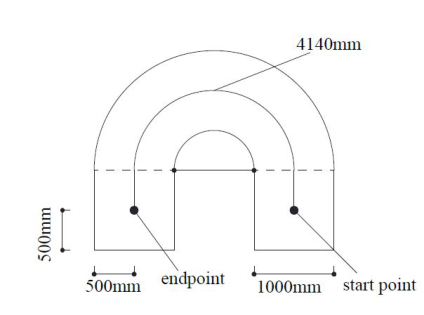
Conditions The passages used in the experiment consisted of curved and straight parts. The width of the passages was 1000 mm, the height was 2500 mm, and the radius of curvature of the curved part was 500 mm inside and 1500 mm outside. The length of the straight part was adjusted such that the distance from the starting point to the endpoint was 4140 mm (Fig 1). The start and endpoint were set 500 mm away from each end of the passage, and spherical
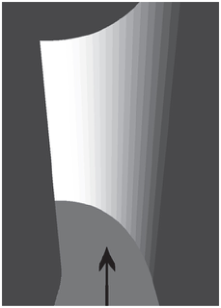
Figure 1: Dimensions of the passage.Figure 2: Inside the passage.
markers were placed on the floor. The floor, walls, and ceiling were white (Fig 2).
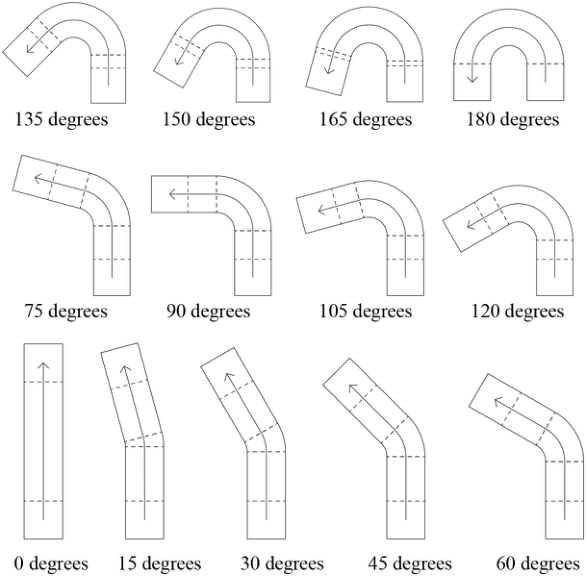
The turning angle of the curved part of the passage was set at 13 levels in 15° increments (0°, 15°, 30°, 45°, 60°, 75°, 90°, 105°, 120°, 135°, 150°, 165°, and 180°) (Fig 3). The effect of different turning angles of the curved part on the subjects’ sense of direction was investigated. The conditions were presented twice for each subject in random order.
The difference in the angle between the “instructed direction” and the “reproduced direction”was used to evaluate the misshift of the subject’s sense of direction. The “instructed direction” was presented to the subject before walking by presenting an arrow in front of the subject facing the direction of travel. The direction of the arrow is the direction of the passage at the starting point (Fig 2).
The “reproduced direction” was created by adjusting the red arrow with the controller at hand. This red arrow was displayed after the passage disap- peared and was programmed to rotate in the direction at which the controller
Effect of the Turning Angle of a Curved Passage on Human Sense of Direction 513
Figure 3: Conditions.
was pointed while the controller button was pressed. The subjects were asked to adjust the direction of the red arrow to what they perceived to be the “instructed direction” presented to them before walking. Because the subject would not be able to localize his own body in an empty space, a non-rotating black arrow was superimposed on the initial position of the red arrow as a cue.
Procedure First, subjects wore a head-mounted display and earmuffs and held a con- troller. Then, they practiced one time. After that, a total of 26 trials were repeated, two for each experimental condition, using the procedures (1) to (5).
1) Memorize the instructed direction at the beginning of the passage. 2) Walk to the end of the passage. 3) When the subject reaches the end of the passage, the entire passage disappears, and only the arrow indicating the traveling direction at the endpoint of the passage appears. 4) Change the direction of the arrow with the controller to reproduce the instructed direction.
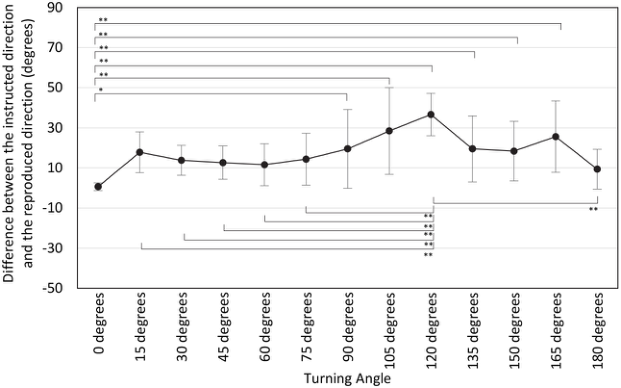
Figure 4: Difference between the instructed direction and the reproduced direction for each condition.
Results and Discussion
Figure 4 shows the differences between the instructed and reproduced directi- ons for each condition. Bonferroni’s multiple comparison test conducted with “turning angle of the passage” as a factor showed that there were significant differences between 0° and 90°, 105°, 120°, 135°, 150°, and 165°; and between 120° and 15°, 30°, 45°, 60°, 75°, and 180°.
The rationale for the significant differences were confirmed between the condition with a turning angle of 120° and all conditions below 75°, it is thought to be related to the instructed direction and the subject’s visual field. The human visual field extends 100–110° laterally (Peter et al., 2012). When the turning angle was between 0°and 75°, the instructed direction existed inside the visual field after passing through the passage. In contrast, when the turning angle was 120° or more, the instructed direction was outside the visual field. This makes it difficult to imagine the instructed direction visually and increases the difference between the instructed and reproduced directions.
The reason for the significant difference between 180° and 120° was confir- med to be related to the orientation of the instructed direction to the subject’s body. Under the condition that the turning angle of the passage was 180°, the instructed direction faced immediately behind the subject after passing through the passage. It can be assumed that this made it easier for the subje- cts to utilize their physical references and reproduce the instructed direction. Therefore, it is conceivable that the difference between the instructed and reproduced directions became smaller in the 180° condition.
In the range of the turning angle of the passage from 15° to 75°, the dif- ference between the instructed and reproduced directions is relatively small. However, the value increases when the angle is greater than 90°. One possi- ble reason for this is the visibility of the passage. For passages with a turning angle of 15° to 75°, the subject could see the end of the passage from the
Effect of the Turning Angle of a Curved Passage on Human Sense of Direction 515
point where the passage began to curve. Therefore, they were able to imagine how much they would turn after passing through the passage before passing through the curved part. By using this as a cue, it is thought that their sense of direction was less likely to misshift. As a result, the subject’s sense of dire- ction was less affected by the change in the turning angle of the passage, and the difference between the instructed direction and the reproduced direction became relatively small in the range of 15° to 75°.
CONCLUSION
In this study, a subject experiment was conducted in a virtual environment, using the turning angle of a curved passage as an experimental variable, to verify the effect of the shape of the curved passage on the sense of direction. The results are summarized below.
The misshift in the sense of direction gradually increased as the turning angle of the passage increased above 90°, reached the maximum at 120°, and tended to decrease as the angle approached 180°.
The sense of direction tends to misshift in curved passages in which the total turning angle is between 90° to165°.
REFERENCES
Alycia M. Hund, and Sadie N. Nazarczuk (2009) “The effects of sense of direction and training experience on wayfinding efficiency” Journal of Environmental Psychology, 29(1), 151–159. C. Donald Heth, Edaward H. Cornell, and Tonya L. Flood (2002) “Self-ratings of
sense of direction and route reversal performance” Applied Cognitive Psychology, 16(3), 309–324. David M. Condon, Joshua Wilt, Cheryl Ann Cohen, William Revelle, Mary Hegarty, and David H. Uttal (2015) “Sense of direction: General factor saturation and associations with the Big-Five traits” Personality and Individual Differences, 86, 38–43. Edward H. Cornell, Autumn Sorenson, and Teresa Mio (2008) “Human Sense of
Direction and Wayfinding” Annals if the Association of American Geographers, 93(2), 339–425. Haga Y. (2016), “A study on the relation of every-day error behavior and the characteristics of spatial cognition.” Journal of Human Environmental Studies, 7, 104–111. Ishikawa T., and Yiren Zhou (2020), “Improving cognitive mapping by training
for people with a poor sense of direction” Cognitive Research: Principles and Implications, 5. Kato Y., and Takeuchi Y. (2003), “Individual differences in wayfinding strategies” Journal of Environmental Psychology, 23, 171–188. M. Jeanne Sholl, Joyce C. Acacio, Rania O. Makar, and Christlan Leon (2000) “The
relations among wayfinding strategy use, sense of direction, sex, familiarity, and wayfinding ability” Journal of Environmental Psychology, 20(1), 17–28. Peter J. Savino, and Helen V. (2012), Danesh-Mayer Color Atlas and Synopsis of Clinical Ophthalmology -- Wills Eye Institute -- Neuro-Ophthalmology. Lippincott Williams & Wilkins. Yamamoto N., and Okabe A. (2002), “An experimental analysis of direction
judgment in a curved corridor” J. Archit. Plann., AIJ, 67(559), 165–170.
LISTED IN THE AHFE DIGITAL BOOKSTORE CATALOGUE
Explore the complete digital volume
Ergonomics In Design
Read this individual research paper free through the original publisher, or explore the full digital proceedings book.
ISBN 978-1-958651-23-0
Explore this ISBN in the AHFE Bookstore ↗Listed in the July 2026 bookstore catalogue; search by ISBN to confirm current availability · Digital book purchase optional