Kazuhiko Yamazaki (2023). Framework for Social Implementation. In: Design for Inclusion. AHFE Open Access, vol. 75, pp. 214–220. https://doi.org/10.54941/ahfe1003342
It is said that in Japan, technological innovation has progressed but social transformation has not. The challenge for Japan is not so much innovation and technology, but rather the lack of progress in implementing them in society and linking them to social transformation. From now on, linking innovation and technology to social transformation and social implementation has the potential to improve life in Japan and restore Japan's competitiveness. And design activities have the potential to contribute to such activities. In this section, we will explain the framework for social implementation, social experiments and experience prototypes as an approach to social implementation.Social experiments and experience prototypes are important for design activities toward social implementation. Here, social implementation is defined as activities to change society. Social experimentation is defined as a small experiment for social implementation. An experiential prototype is defined as a prototype that can be experienced, which is necessary for social experiments. These three elements are defined as the "framework for social implementation. Social implementation, social experiments, and experience prototypes are explained below.Social experiment is "a trial of a new system, technology, or other measure in a limited location and time period to verify its effectiveness, identify problems, and sometimes to determine whether or not to introduce the measure on a full-scale basis. It also serves to exchange opinions with local residents, and to inform the public and build consensus. In some cases, the term "social experiment" is defined as "a social experiment that is implemented in a social context. Here, a social experiment is defined as "a small experiment for social implementation.Experiential prototypes are defined as "prototypes that can be experienced, which is necessary for social experiments. An experience prototype is one of those prototypes that is intended to be experienced by users and citizens. The experience prototype for service design leads to the experience prototype to plan services in an event-like manner and within a limited time frame.From the perspective of the process toward social implementation, there are top-down and bottom-up approaches. There is a top-down approach, in which the vision of what kind of social implementation is desired is first considered, then the necessary social experiments are studied, and the experience prototypes necessary for the social experiments are prepared. There is also a bottom-up approach, in which the vision for social implementation is not clearly defined from the outset, but rather a series of experience prototypes and small social experiments are conducted to the extent that they are feasible, and the vision for social implementation is considered. As a university education for social implementation, we will introduce a case study of the Department of Creative Innovation at Musashino Art University. In this department, the first and second years are based on formative education, and from the third year, an educational program for social implementation begins in earnest. The "Industry-University Project Practice" in the second semester of the third year is an educational program for acquiring practical creative innovation skills through the execution of projects with local communities, governments, and companies.Here, "Framework for Social Implementation," social implementation, social experiments and hands-on prototypes are explained. The case of Musashino Art University was introduced as an example of university education for social implementation. We hope that the discussion will deepen on approaches for social implementation and methods of social experiments in the future.
In Japan, technological innovation has progressed, but social transformation has not. For example, it is clear that social change has not progressed in a variety of areas, including business, government, work styles, healthcare, education, human rights, population, urban and rural areas, agriculture, and forestry. It is also pointed out that Japan’s competitiveness compared to the international community is declining. This is something that many people are becoming more and more aware of, thanks to Corona, which makes it easy to compare Japan with other countries.
Japan’s challenge is not so much innovation and technology as the lack of progress in implementing them and linking them to social transformation. From now on, linking innovation and technology to social transforma- tion and social implementation has the potential to improve life in Japan and restore Japan’s competitiveness. MRI’s Monthly Review feature article, “Innovation is completed in social implementation,” states that “Innovation to social implementation is a series of processes, not something that can be achieved only by genius inventive discoveries or advanced technologies. It is not realized by genius inventive discoveries or cutting-edge technologies alone. It is a process that successfully combines existing (proven) technolo- gies, incorporates elements other than technologies (such as social systems), and takes decades in the long run to realize great fruits, i.e., social change (MRI review, 2020).”
An example of social implementation is the Polar Bear Pitching event, a startup pitching event launched in Oulu, Finland (Polar Bear Pitching, 2020). After Nokia, Oulu’s largest employer, sold its cell phone business to Micro- soft, the town underwent a major restructuring that left many unemployed.
In addition, entrepreneurs in Oulu had excellent ideas, but were not good at expressing them. Therefore, the University of Oulu’s Startup Hub examined ideas to help the town’s unemployed. Weaving in the local custom of cold- weather swimming, the event “Polar Bear Pitching”was socially implemented to appeal to the public by showing them how they could endure the hardship of being submerged in near-freezing sea water while concentrating on their startup pitches. This section describes the framework for social implementa- tion, social experiments and experience prototypes as an approach to social implementation.
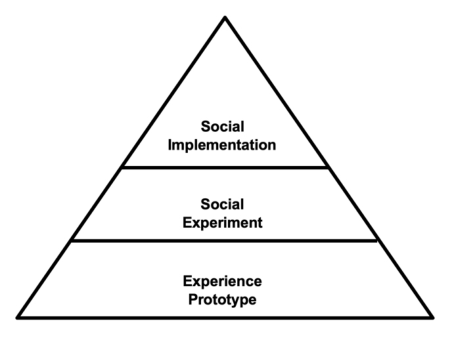
Proposed Approach for Social Implementation Social experiments and experience prototypes are important for design acti- vities for social implementation. Here, social implementation is defined as activities to change society. Social experimentation is defined as a small expe- riment for social implementation. And an experience prototype is defined as a prototype that can be experienced, which is necessary for social experi- mentation (Yamazaki, K., 2022). These three elements are shown in Figure 1 as the “Framework for Social Implementation. Social implementation, social experiments, and experience prototypes are explained below.
Here, social implementation is defined as “the activity of trying to change society,” and can be viewed from three perspectives (See Table 1). The three perspectives are the research perspective, the new business perspective, and the cultural perspective. From the perspective of research, it means to make the results and findings of scientific and technological research available to society. In this case, the term “social implementation” is sometimes used, but in many cases it is more appropriate to refer to the use of research results and science and technology in society. From a business perspective, it is an activity that seeks to change social behaviour through new business. Business is not necessarily limited to corporate business, but also includes government services. From a cultural perspective, it is an activity that seeks to change the culture of a society by spreading new meanings and values through art,
Figure 1: Framework for social implementation. Social implementation.
216 Yamazaki
Table 1. Three perspectives on social implementation.
Table available in the original PDF paper.
mounting Access to amenities subject (of taxation, etc.)
Research Perspective research Utilizing R&D findings in society Business Perspective new business Changing social behaviour through new business Cultural Perspectives New meanings and
values
Changing the culture of a society through new meanings and values
media, and other means. Such activities often come not from specialists but from non-specialists.
There are two types of approaches to social implementation. One is the approach that achieves social transformation in the world, and the other is the approach that achieves transformation in the mindset of the world. The former has an affinity with the business perspective of social implemen- tation. The former has an affinity with the business perspective of social implementation, and in some cases, the perspective of research is utilized in the realization of that business. The latter approach, which realizes a change in the mindset of the world, is an innovation of meaning, and has affi- nity with the perspective of culture. In some cases, both approaches proceed simultaneously.
Social Experimentation and Experience Prototype Social experimentation refers to Experimental Scheme or Social Experiment, which is widely implemented mainly in Europe and the United States for urban development with the participation of residents and citizens (Yama- saki, K., 1999). Author also defines a social experiment as “a trial and evaluation of new ideas, new systems, and new technologies that are not bound by existing frameworks, with the cooperation and participation of residents, businesses, governments, and other related entities, for a limited period and in a limited region, prior to the full-scale implementation of a project or measure (Yamazaki, K., 2021). In Japan, a social experiment is “a trial of a new system, technology, or other measure in a limited location and for a limited period of time to verify its effectiveness, identify problems, and sometimes to make a decision on whether or not to fully introduce the measure. It also serves to exchange opinions with local residents, and to inform the public and build consensus. Social experiments are defined here as “small experiments for social implementation” and include the following experiments involving society.
An experience prototype is defined as “a prototype that can be experie- nced, which is necessary for social experiments. There are various types of prototypes, such as functional prototypes, formative prototypes, and con- textual prototypes, depending on their purpose. Experiential prototypes are prototypes that are intended to be experienced by users and citizens. For example, the Wizard of Oz prototype is a prototype that allows users to experience the computer as if it were moving, even though it is operated like
Framework for Social Implementation 217
a computer by a human behind the scenes. Experience prototyping for service design leads to experience prototyping in an event-like manner, planning services in a limited time frame.
The Process and Three-Way Design Approach From the perspective of the process of social implementation, there are two approaches: a top-down approach and a bottom-up approach. There is a top-down approach, which starts with a vision of what kind of social imple- mentation is desired, considers the social experiments necessary for that vision, and prepares the experience prototypes necessary for the social expe- riments. There is also a bottom-up approach, in which the vision for social implementation is not clearly defined from the outset, but rather the vision for social implementation is developed through a series of experience pro- totypes and small social experiments within the scope of what is possible for the participants. While companies, for example, may have to take a top- down approach because of budgets and plans, a bottom-up approach may be appropriate when starting from the local area or community.
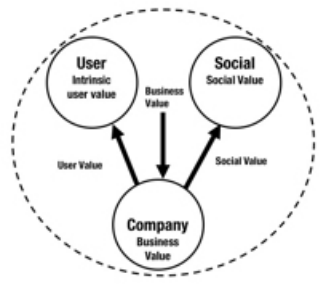
The three-way design approach is fundamental in advancing this social implementation framework (Yamazaki, K., July 2016 and Yamazaki, K., September 2016). While most previous design approaches have focused on the relationship between the user and the company, the sampoyoshi design approach considers the user, the company/organization, and society. Soci- ety here includes the local community, the national government, and the global environment. The key is how society is viewed. From the viewpoint of social implementation, the society targeted here is the target of social implementation and social experiments.
Figure 2: Three-way design approach (Yamazaki, K., September 2016).
Case Study-1 Creative Innovation at Musashino Art University The Department of Creative Innovation (CI) at Musashino Art University is preparing an educational program to acquire practical creative innova- tion skills. In the first and second years, the program is based on education
218 Yamazaki
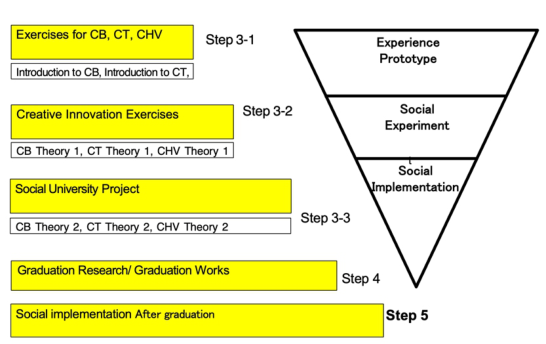
in modeling, and in the third year, an educational program for social implementation begins in earnest (see Fig. 3).
At the beginning of the third year, students begin with the three elements necessary for creative innovation: Creative Business (CB) Overview and Exe- rcise, Creative Technology (CT) Overview and Exercise, and Creative Human Value (CHV) Overview and Exercise. Then, the students will begin lear- ning about social implementation using the Ichigaya area as a subject in the Creative Innovation (CI) Exercise, which synthesizes these three elements.
Figure 3: Educational program for social implementation from the third year.
The “Social University Project Practical Exercise” in the second semester of the third year is an educational program to acquire practical creative innovation skills through the execution of projects with local communities, governments, companies, and other organizations. Specifically, while colla- borating with domestic regions, companies, etc., the program explores issues, formulates project plans, and then actually implements the solution of essen- tial issues that have been narrowed down. For example, in FY2022, 80 third-year students are divided into 13 projects and practice 6-week projects, some of which include long-term stays throughout Japan, from Hokkaido to Kyushu.
Through these exercises in the third year, students will practice social implementation in their graduation research and graduation works in the fourth year.
Case Study-2 Project for Susami Town, Wakayama Prefecture The project in Susami Town, Wakayama Prefecture, will be introduced as a case study of the “Practical Exercise for Local Academia Project. The town of Susami in Wakayama Prefecture is located 30 minutes from Nanki Shirahama Airport, facing the magnificent Pacific Ocean. With agriculture, forestry, fish- ing, and tourism as its main industries, in addition to its rich natural beauty, the town has recently been in the limelight for its marine sports and the Kumano Kodo Ohenji Road, which has been registered as a World Heritage
Framework for Social Implementation 219
Site. Recently, the town has begun planning a health workcation project for the town of Susami in Wakayama Prefecture, and is also considering a virtual town citizen system.
Against this background, the goal of the Susami Town, Wakayama Pre- fecture project is to actually co-create with local people and propose plans and designs for projects that are unique to the town of Susami, centered on “Susami Town, Wakayama Prefecture” and the general incorporated asso- ciation “Nenchu Gakuen” that supports the community. This project will not be a mere design proposal, but will involve co-creation with local peo- ple and places. Activities will include a study of visions, brands, promotions, and proposals for services and products for businesses that are unique to the town of Susami, based on a field survey of the local community. Project members include faculty members in charge, special lecturers, seven gradu- ate students, and seven third-year undergraduate students. Also participating from the region are two people related to the town of Susami and two people related to Nekonaka Gakuen. The duration of the class is 6 weeks, with 2 weeks spent in Susami Town.
A summary of the project is provided below.
1. Receive a briefing from the town of Susami in Wakayama Prefecture and related organizations on current awareness of regional issues. 2. Receive a lecture on co-creation design approaches in the region. 3. Conduct online and on-site surveys to determine local conditions. 4. Examine activity themes and, if necessary, divide into teams to pro- mote co-creation design with local organizations and companies to be co-created. Specifically, promote conception, visualization, proposal, prototyping, and verification. 5. Present proposals and receive feedback at interim and final presenta- tions. Students will receive regular feedback from the town office of Susami Town, Wakayama Prefecture, Enthusiastic Academy, companies co-creating in the region, and special lecturers. Those who wish to conti- nue working on this project will continue to co-create activities with the local community after the class ends to promote the realization of this project.
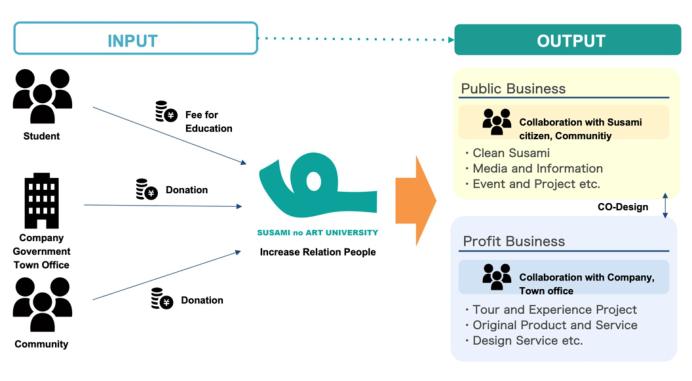
One of the examples of this project’s activities is a proposal called “Univer- sity of Fine Arts in Susami. This proposal is a social implementation proposal to “establish an art university in Susami (a.k.a. “Susabi”) and incorporate it to realize sustainable involvement.” This is a proposal for social imple- mentation. Currently, students participating in the project are studying the business structure and business model of this proposal, aiming for social implementation (see Figure 4).
CONCLUSION
In this section, “Framework for Social Implementation,” social implemen- tation, social experiments and experience prototypes were explained. As examples of university education for social implementation, we introduced the approach of Musashino Art CI Department and the case of the Susami
220 Yamazaki
Figure 4: Business structure and business model for susami art university.
Town project in Wakayama Prefecture. We hope that the discussion on appro- aches for social implementation and methods of social experimentation will deepen in the future.
REFERENCES
MRI review (2020), Innovation is completed in social implementation: Website https: //www.mri.co.jp/knowledge/mreview/202012.html Polar Bear Pitching (2020), Website https://polarbearpitching.com/about/ Yamazaki, K. (2022), Approaches to social implementation”, Conference for
Concept case study, Japan Ergonomics Society. Yamasaki, K. (1999). Social Experiment A Method of City Planning by Citizen Collaboration. Tokyo: Toyokeizai Inc. Yamazaki, K. (2021) “ Social implementation and prototype”, 2021 HCD research
conference, Human Centered Design Organization. Yamazaki, K. (July, 2016) “A design approach considering social experiences” Transactions of the 63rd Annual Conference of Japanese Society for the Science of Design. Yamazaki, K. (September, 2016) “Toward 3-way design and methodization”,
Concept case study, Japan Ergonomics Society.
LISTED IN THE AHFE DIGITAL BOOKSTORE CATALOGUE
Explore the complete digital volume
Design for Inclusion
Read this individual research paper free through the original publisher, or explore the full digital proceedings book.
ISBN 978-1-958651-51-3
Explore this ISBN in the AHFE Bookstore ↗Listed in the July 2026 bookstore catalogue; search by ISBN to confirm current availability · Digital book purchase optional