Taishi Kamiya (2023). Facilitating Knowledge Creation in Innovation Activities with Boundary Media. In: Creativity, Innovation and Entrepreneurship. AHFE Open Access, vol. 74, pp. 70–78. https://doi.org/10.54941/ahfe1003307
Innovation is an essential aspect of contemporary corporate administration. While the co-creation of innovation activities by stakeholders in diverse positions enables the exploration of new value, there are also difficulties, such as conflicts arising from differences in positions and expertise within the organization. Therefore, it is necessary to establish an approach to manage co-creation and create value as an organization. Several cases have reported the function of specific media facilitating collaboration across boundaries among diverse actors in corporate innovation activities, referring to the concept of Boundary Objects introduced in sociology. The mechanism of which media and how they function as boundary objects remain unclear. In this study, we defined Boundary Media as “media intentionally introduced to a group” and conducted an idea creation workshop simulating the early stages of innovation activities. This study aimed to examine how boundary media function as boundary objects in facilitating group knowledge creation. Our findings indicated that two types of boundary media were effective: sculptures that artfully depict keywords for idea creation and idea sketches that describe ideas. In particular, they were especially effective in idea creation for tangible products by evoking creativity through inspiration and facilitating knowledge sharing, thereby facilitating group knowledge creation.
Innovation is becoming increasingly important in modern corporate mana- gement. In a rapidly changing business environment, there is a demand for Ambidexterity in management that balances activities in both Exploitation, which is deepening existing businesses by improving them, and Exploration, which is searching for new technologies and business opportunities (O’Reilly and Tushman, 2016). Indeed, the frequency with which innovation is trea- ted as a topic in papers in management studies has grown dramatically since the 21st century, confirming the growing interest in innovation (Anderson, Potoˇcnik and Zhou, 2014).
Diversity management is essential in innovation activities that are intended to result in an innovation for the firm (OECD/Eurostat, 2018). Innovation
Facilitating Knowledge Creation in Innovation Activities With Boundary Media 71
activities in companies involve co-creation with diverse stakeholders through approaches such as industry-academia collaboration and open innovation to acquire knowledge not possessed by the organization and to search for new value (Chesbrough, 2003; Belderbos, Carree and Lokshin, 2004; Vargo and Lusch, 2014). Collaboration among people with different knowledge and values, as well as respect for different ways of thinking, encourages collective creativity (Stark, 2011; Edmondson, 2012). However, innovation activities involving diverse stakeholders are fraught with difficulties, such as conflicts arising from differences in position and expertise in the organization. As a result, diversity cannot be managed, and individual creativity cannot be har- nessed in the group (Bissola and Imperatori, 2011). Methods to overcome these problems and manage diversity have yet to be established.
Therefore, this study focuses on the media intervening in communication in groups. Generally, various media are used in communication in a group con- sisting of diverse people with different backgrounds. For example, in the idea creation phase in the early stages of innovation activities, engineers use tech- nical information, marketers use customer information, and new business managers use new business proposals to concretize the direction of innova- tion activities. Some of such media could be effective in facilitating innovation activities. In this study, a workshop that simulates idea creation in the early stages of innovation activities in a company is conducted to investigate how media intervening in the communication of a group of diverse members faci- litates group collaboration. Lastly, the effects on group knowledge creation in innovation activities are considered.
Media to Facilitate Multi-Disciplinary Co-Creation An example of media facilitating multi-disciplinary co-creation is the Boun- dary Objects. American sociologists Star and Griesemer, through a case study of museum establishment, reported that some media, such as the speci- mens and the fieldnotes, which existed among diverse actors with different purposes and specialties–such as founder, patron, and hunter–facilitated col- laboration. They described Boundary Objects (BOs) as such media that are both adaptable to different viewpoints and robust enough to maintain iden- tity across boundaries (Star and Griesemer, 1989). The concept of BOs is used in various studies to describe knowledge sharing and multi-disciplinary collaboration through the object (Nicolini, Mengis and Swan, 2012). The concept is also frequently referred to when describing collaboration in inno- vation activities in firms. For example, it has been reported that prototypes and drawings functioned as BO in innovation activities (Carlile, 2002; Rhi- now, Köppen and Meinel, 2012). It has also been reported that BO sheds light on the redefinition of meaning, focusing on the front-end of innovation (Zasa, Artusi and Verganti, 2022).
The KODO sculpture is an example of media that facilitates innovation activities differently from the examples mentioned so far. KODO sculpture is an abstract sculpture created by clay modelers in the design department of Mazda Motor Corporation to explore the form of the future car body design development. It has been used in the development process since around
72 Kamiya
2014 (Mazda Motor Corporation, n.d.). KODO sculptures, created based on keywords obtained from discussions in the design department, are shared with the production department. The engineer or craftsman in the production department resonates with the sense of life and dynamism expressed by the KODO sculpture. This resonance leads to an intrinsic motivation for them to try to reproduce the animated and dynamic feeling of the KODO sculpture through trial and error, resulting in the ‘KODO kezuri (shaving)’ and ‘KODO migaki (polish)’ techniques. The wide range of interpretations by the medium recipient differs from the BO examples introduced so far.
In the cases discussed so far, several media have been used as BOs to facili- tate collaboration. However, it needs to be made clear which media function as BOs and by what mechanism. In this study, Boundary Media (BM) are defined as media that are intentionally introduced to facilitate collaboration in innovation activities. This study aims to examine how BM function as boundary objects in idea creation workshops.
Boundary Media Workshop A “Boundary Media Workshop” is conducted to investigate how BM can function as BOs and facilitate collaboration in the idea creation phase in the early stages of innovation activities. The BM used in the workshop were idea sketches to describe ideas, and sculptures to represent keywords abstractly. Participants in this workshop were those who have experience in innovation activities. This was because participants with experience in innovation activi- ties are more likely to evaluate the impact of BM since they have experience in co-creation with diverse stakeholders and are accustomed to idea creation. Participants were recruited via Google Forms. Company contacts from the top 30 companies in the Innovative Large Companies Ranking 2022 (Innova- tion Leaders Summit, 2022) were asked to cooperate with the survey via email or an inquiry form. At the same time, communities on social networking services (SNS), which were considered to have a high affinity for innovation activities, were asked to participate in the survey.
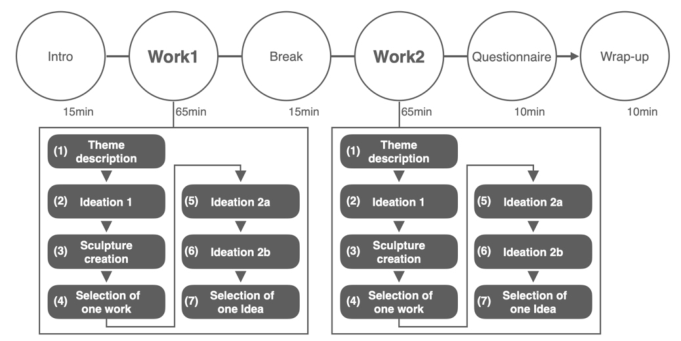
The structure of the workshop is shown in Figure 1. First, the purpose of the workshop was explained in the Intro, followed by an ice-breaker in which
Figure 1: Structure of the boundary media workshop.
Facilitating Knowledge Creation in Innovation Activities With Boundary Media 73
participants created abstract objects and introduced themselves to each other. Next, Work1 and Work2 were conducted to create ideas on two different themes, with a break in-between. Participants were then asked to complete a questionnaire survey, and the workshop concluded with an explanation of the theoretical hypothesis behind the workshop. Each work session was conducted in groups of 2–3 participants, as follows: (1) Explanation of the theme was given, and information for the idea creation was shared. Next, in (2) Ideation 1, participants created ideas on the given theme. In the following step (3), each participant created a sculpture based on the keywords related to the theme, and in step (4), each team was asked to select one sculpture that they thought most accurately expressed the keywords of the theme. Next, in (5) Ideation 2a, the participants created ideas while appreciating the selected sculpture of their own team, and in (6) Ideation 2b, they created ideas while appreciating the sculpture of the other team. Finally, in (7), each team was asked to select one idea they thought was the best among the ideas they had created at that point, presenting it as their final idea.
Table 1 shows the themes of idea creation in Work 1 and Work 2. For example, Work 1 used as its theme a simulated situation in which keyw- ords leading to the concept of “Deep Breath of the Forest” was proposed in the creation of ideas for desk light products in a major manufacturing com- pany. To evaluate the impact of tangible sculpture on idea creation, Work 1 focused on tangible product idea creation, while Work 2 focused on intangi- ble service idea creation. Referring to examples of KODO sculptures created at Mazda Motor Corporation based on keywords such as “dignified ten- sion” and “glossy and deep charm,” abstract keywords were established for creating sculptures in the workshop.
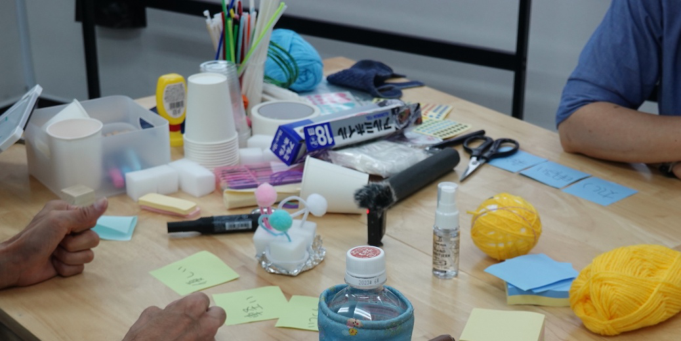
Participants created two types of BM through the workshop process: scul- ptures and idea sketches. They created sculptures based on the keywords given in each work session, and through appreciating the sculptures, they expressed their ideas on idea sketch sheets. On the idea sketch sheet, the ideas conceived in the ideation process were described in words and visu- als. Sculptures were created not to express the idea itself but to express their imagination of the keywords. Materials used to create sculptures were daily necessities such as paper cups, straws, aluminum foil, and yarn, as well as stationery such as pens, markers, and glue, which were available at hundred yen stores, and all of which were prepared and ready to use on the table (see Figure 2). Sculptures were created as three-dimensional works by assembling these materials.
Table 1. The themes of idea creation in Work 1 and Work 2.
Table available in the original PDF paper.
Work1 Work2
Major manufacturing company Regional bank
Theme Desk Lights Financial Services Companies to be simulated Keyword Deep Breath of Forest Happiness of Generation Z Category Tangible Intangible
74 Kamiya
Figure 2: Materials used for creating sculptures.
The following information was recorded for analysis and discussion of the workshop results. The participants’ idea sketches and the sculptures they created based on the keywords were taken in photographs. Participants were asked to fill out an “Explanation Sheet” about their intentions in creating the sculpture. They were also asked to write their impressions on an “Appreci- ating memo” while appreciating the sculptures. Furthermore, at the end of the workshop, participants were asked to answer a questionnaire survey to collect their comments on their impressions and findings during the work- shop process. In addition, with the permission of the participants, their comments during the workshop were recorded with an audio recorder, and a verbatim transcript was made from the audio recordings.
RESULT
The Boundary Media Workshop was conducted at a rented conference room in Chiyoda-ku, Tokyo, on September 23 and 24, 2022, for three hours each day. Four participants on the first day and five participants on the second day attended and were divided into two teams. Through the two-day work- shop, nine sculptures based on the keyword (Deep Breath of Forest) and 29 ideas for desk lights were created in Work 1, and nine sculptures based on the keyword (Happiness of Generation Z) and 28 ideas for financial services were created in Work 2. One of the final ideas presented by each team was based on an idea that was created before the creation of the sculpture, five were based on ideas created while appreciating the sculptures selected by their own team, and two were based on ideas created while appreciating the scul- ptures selected by the other team. In the workshop, there were four cases out of a total of eight trials in which the two BM, the sculpture, and the idea ske- tch, were considered to have facilitated collaboration within the team as well as influenced decision-making and idea development. In one case, only the sculpture was considered to function as a BO. In another case, only the idea
Facilitating Knowledge Creation in Innovation Activities With Boundary Media 75
sketch was considered to function as a BO. In two cases, both were considered to be BOs.
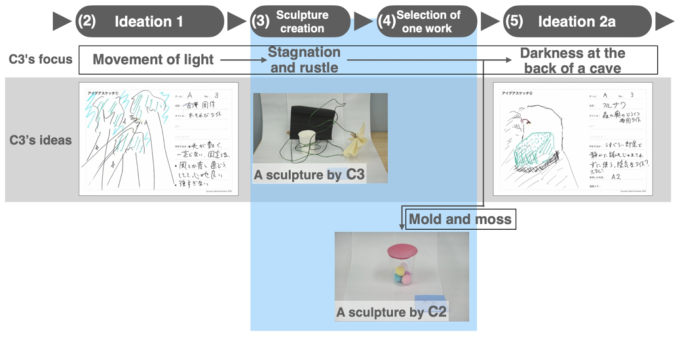
The following is a detailed description of the Work 1 process in Group C, one of the two cases in which both the sculpture and the idea sketch were considered to function as boundary objects. Group C consists of three par- ticipants C1, C2, and C3. Figure 3 illustrates the idea creation process of participant C3 before and after creating and appreciating sculptures. Partici- pant C3 had an idea focused on the “movement of light” in Ideation 1 before creating the sculpture. However, through the creation of the sculpture, he discovered a new perspective of “stagnation and rustle.” It was also con- firmed that appreciating the sculpture created by C2 evoked memories of “mold and moss,” from which C3 gained a perspective that it had not initi- ally possessed: “darkness at the back of a cave.” In Team C, the expression of the sculpture created by participant C2, which opened up the possibility of diverse interpretations, such as mold, moss, life, and spores, attracted the interest of the entire team and was selected as the team’s sculpture. On top of that, the idea created by C3, “a light so faint that it can only be used in the darkness at the back of a cave,” was praised by the team for its connection to the sculpture of C2 and for its perspective that was a great leap forward from the original idea, which stimulated discussion and resulted in a unanimous agreement of that idea.
In the workshops conducted this time, there were two cases in which both the sculptures and the idea sketches were considered to function as BOs in Work 1, which involved idea creation for tangible products. On the other hand, there were many cases in which the creation and appreciation of sculptures influenced the participants’ own ideas. In fact, according to the questionnaire results, eight out of nine participants in Work 1 and seven out of nine in Work 2 responded that their perception of the theme changed before and after the creation.
Figure 3: the idea creation process of participant C3 in Work1.
76 Kamiya
DISCUSSION
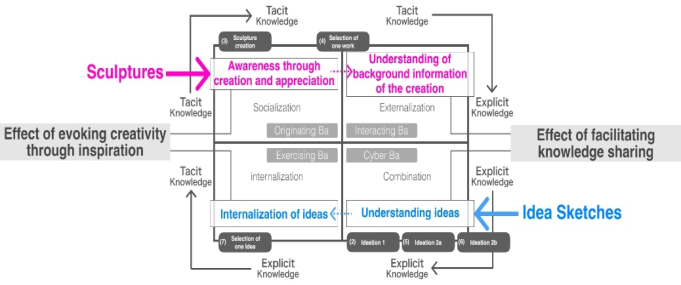
The results of the workshop suggest that the BM evoked creativity through inspiration and facilitated knowledge sharing. Therefore, to exa- mine the BM’s potential to facilitate innovation activities, we will discuss the workshop results using the SECI model (See Figure 4). The SECI model is a process model of knowledge creation in organizations propo- sed by Nonaka and Takeuchi (Nonaka 2009). The SECI model illustrates that the conversion of tacit knowledge to explicit knowledge, and vice versa, is a chain reaction that improves the level of knowledge in an organization.
The sculpture in the workshop was an expression of the creator’s tacit knowledge. Inspiration gained through reflective practice and appreciation during the creation phase of sculpture elicited new tacit knowledge (Schön 1992; An and Youn 2018). In doing so, they tended to function as BOs in cases such as the sculpture by C2. They were moderately abstract and open to interpretation and therefore were perceived to contain the possibi- lity of novel perspectives by the team members. In addition, in the situation where each team selected a sculpture, the creative intention and background knowledge were shared in front of the sculpture, which enabled the sha- ring of explicit knowledge in addition to tacit knowledge. The other BM, idea sketches, described ideas, which are explicit knowledge, and facili- tated mutual understanding by sharing ideas among the team members. In addition, resonating ideas tended to function as BOs, and individual interpretation of the ideas described in the idea sketches allowed the inter- nalization of others’ ideas as tacit knowledge within oneself. Although the SECI model advocates the use of “Ba” for the mutual transformation of tacit and explicit knowledge, the results of this study indicate that it may be possible to turn the cycle of organizational knowledge creation even by using BM.
Figure 4: Mutual transformation of explicit and tacit knowledge by BM on the SECI model.
Facilitating Knowledge Creation in Innovation Activities With Boundary Media 77
CONCLUSION
This study investigated how BM can function as BOs to facilitate group kno- wledge creation by conducting a “Boundary Media Workshop” simulating the idea creation in the early stages of innovation activities. The results indicated that two types of BM were effective for facilitating collaboration: sculptures that artfully depict keywords for idea creation and idea sketches that describe ideas. These BM facilitated group collaboration in four of the eight cases. In particular, they were especially effective in idea creation for tangible products by evoking creativity through inspiration and facilitating knowledge sharing, thereby facilitating group knowledge creation.
The approach to knowledge creation implemented in this study by intro- ducing BM suggests the possibility of avoiding intra-group conflicts and facilitating collaboration because the group’s diversity leads to diversity in the expression and interpretation of BM. Therefore, it can be expected that supporting the creation of BM in communication in innovation activities will also enable more diverse actors to be involved in co-creation. For example, support by a system that converts verbal information into nonverbal infor- mation or by having an artist with high creative ability create sculptures on behalf of group members may also facilitate knowledge creation in innova- tion activities. On the other hand, the results of this study may have been influenced by the fact that the workshop was a simulation of idea creation in a company, which is different from a realistic situation. Therefore, further validation of the results by studying innovation activities in actual companies will be conducted.
REFERENCES
An, D. and Youn, N. (2018) “The inspirational power of arts on creativity”. Journal of Business Research, 85, pp. 467–475 Anderson, N., Potoˇcnik, K. and Zhou, J. (2014) “Innovation and creativity in orga-
nizations: A state-of-the-science review, prospective commentary, and guiding framework”, Journal of management, 40(5), pp. 1297–1333 Belderbos, R., Carree, M. and Lokshin, B. (2004) “Cooperative R&D and firm performance”, Research policy, 33(10), pp. 1477–1492 Bissola, R. and Imperatori, B. (2011) “Organizing individual and collective creativity:
Flying in the face of creativity clichés”, Creativity and Innovation management, 20(2), pp. 77–89 Carlile, P. R. (2002) “A pragmatic view of knowledge and boundaries: Boundary objects in new product development”, Organization science, 13(4), pp. 442–455 Chesbrough, H. W. (2003). Open innovation: The new imperative for creating and
profiting from technology. Harvard Business Press. Edmondson, A. C. (2012). Teaming: How organizations learn, innovate, and compete in the knowledge economy. John Wiley & Sons. Innovation Leaders Summit. (2021) [Innovative Large Companies Ranking 2021]
Inobe-thibu dai kigyou rankingu (in Japanese). https://ils.tokyo/news/202109_01. php (Accessed: 28 January 2023) Mazda Motor Corporation. (n.d.) MAZDA: Takumi co-creation: bringing KODO design to life. Available at: https://www.mazda.com/en/innovation/mazda-storie s/designers/takumi-co-creation-bringing-kodo-design-to-life/ (Accessed: 28 Janu- ary 2023)
78 Kamiya
Nicolini, D., Mengis, J. and Swan, J. (2012) “Understanding the role of objects in cross-disciplinary collaboration”, Organization science, 23(3), pp. 612–629 Nonaka, I. (2009). “The knowledge-creating company.” In The economic impact of
knowledge (pp.175–187). Routledge. OECD/Eurostat. (2018). Oslo Manual 2018: Guidelines for Collecting, Reporting and Using Data on Innovation, 4th Edition, The Measurement of Scientific, Technological and Innovation Activities. OECD Publishing. O’Reilly III, C. A. and Tushman, M. L. (2016). Lead and disrupt: How to solve the
innovator’s dilemma. Stanford University Press. Rhinow, H., Köppen, E. and Meinel, C. (2012) “Design prototypes as boundary objects in innovation processes.”, proceedings of DRS Conferences. Schön, D. A. (1992) “Designing as reflective conversation with the materials of a
design situation”, Knowledge-based systems, 5(1), pp. 3–14 Star, S. L. and Griesemer, J. R. (1989) “Institutional ecology, translations’ and boundary objects: Amateurs and professionals in Berkeley’s Museum of Vertebrate Zoology, 1907–39” Social studies of science, 19(3), pp. 387–420 Stark, D. (2011) “The sense of dissonance.” In The Sense of Dissonance. Princeton
University Press. Vargo, S. L. and Lusch, R. F. (2014) “Evolving to a new dominant logic for marketing.”, In The service-dominant logic of marketing (pp. 21-46). Routledge. Zasa, F. P., Artusi, F. and Verganti, R. (2022) “Through thick and thin: The moment
of meaning as a boundary object” Creativity and Innovation Management.
LISTED IN THE AHFE DIGITAL BOOKSTORE CATALOGUE
Explore the complete digital volume
Creativity, Innovation and Entrepreneurship
Read this individual research paper free through the original publisher, or explore the full digital proceedings book.
ISBN 978-1-958651-50-6
Explore this ISBN in the AHFE Bookstore ↗Listed in the July 2026 bookstore catalogue; search by ISBN to confirm current availability · Digital book purchase optional