The purpose of this study is to propose appropriate adjustment values for individual drivers to promote safe driving behavior by adjusting the driving seat of a car. In this experiment, we focused on the impact on drivers while changing the front and back position of the seat, which is considered important for safe driving behavior, and experimented by paying attention to the movement of the right leg that operates the pedal. We attempted to discover the relationship between them. As a result, no significant difference was observed between the pedal switch time during emergency braking and the amount of right leg movement required for pedal switching obtained from the front and back position of the seat and the movement of the right leg. Therefore, it is considered that the front and back position of the driving seat does not affect emergency braking operation in safe driving behavior.
The driver’s seat of an automobile has various adjustment functions, such as a tilt function to adjust the angle of the steering wheel, telescopic function to adjust the position of the steering wheel forward or backward, and slide function to adjust the position of the seat cushion. In addition, the angle of the backrest and the height of the seat cushion can be adjusted. These functi- ons are installed around the driver’s seat to ensure safe driving behavior, and adjusting them to achieve an appropriate posture while driving is important not only to secure a clear view of safe driving, but also to reduce driver fati- gue and enable comfortable driving operations (Porter, 1998). Similarly, they are important for performing special driving behaviors required in general or emergency situations, such as avoiding obstacles or making sudden stops. Therefore, research has been conducted from various fields and perspectives to investigate the impact of driving posture and behavior on driving. This has been reported to not only lead to a lack of consideration for pedestri- ans while driving owing to driving posture (Tanigo, 2017) and psychological effects, such as an increased likelihood of driving at an inappropriate speed
(Yap, 2013), but also to physical effects, such as an increase in the force required to depress the pedal (Tamai, 2006). However, much of the research on driving seats focuses on modifying existing seats into new seat designs. There are few examples of investigating the impact of driving posture on the driver’s biological information during driving, and research on whether the adjustment values of driving seats are appropriate for individual drivers is still insufficient.
The purpose of this study is to propose appropriate adjustment values for individual drivers to promote safe driving behavior by adjusting the driving seat settings. In this experiment, we focused on the fore-aft position of the driving seat among the adjustment functions of the driving seat, using a dri- ving simulator (DS) consisting of a real car driving seat and a head-mounted display (HMD). We compared how the sudden braking behavior changed when drivers adjusted the driving seat and when they changed the adjustment values, evaluating the relationship between the driving seat and driving beh- avior. Additionally, we considered which biometric information is necessary to determine the adjustment values of the seat based on the obtained results.
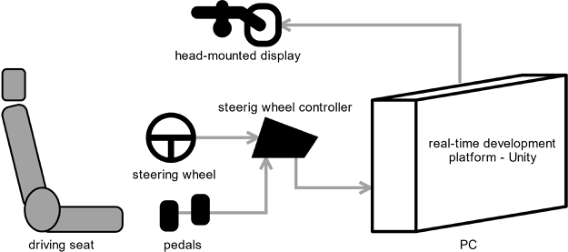
EXPERIMENT To evaluate the effects of changes in the driving seat on the driver, we created a DS using Unity, a game engine. The DS consisted of an HMD, driving seat, ste- ering wheel controller, and pedals. In addition, to investigate the relationship between the driving seat and safe driving behavior, we selected sudden bra- king as a necessary element for safe driving behavior. We implemented a task that required sudden braking. Figure 1 shows the DS used in the experiment. A tracker was also used to measure the driver’s body movements.
The version of Unity used in this experiment was 2021.3.15f1. The HMD was HTC VIVE Pro 2, the tracker was HTC VIVE Tracker (3.0), and the steering wheel controller was Ender AG FANATEC CSL Elite Wheel Base V1.1 with a Ender AG FANATEC CSL Elite Wheel WRC steering wheel and Ender AG FANATEC CSL Elite Pedals. The refresh rate of the HMD was 90 Hz. We matched the refresh rate of Unity to this value, resulting in a measurement update cycle of 90 Hz. Forward and backward movements of the driving seat were measured by attaching a scale sticker to the side of
Figure 1: Driving simulator.
Biometric Information-Based Optimization of Driving Seat Position 41
the frame at the bottom of the seat. When the seat was moved to the farthest forward position, the amount of movement was set to 0 mm, and the amount of movement at the furthest back position was 210 mm.
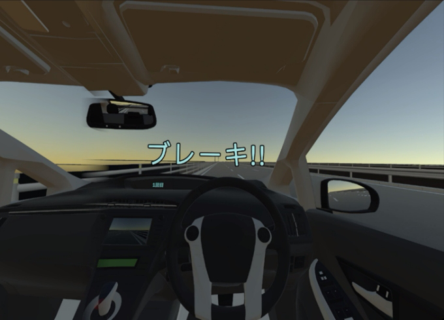
The sudden braking task involved driving the car at a speed of 60 km/h, and when the speed was maintained for a certain period of time, the “brake” indication displayed on the front of the car was used as a cue to apply the bra- kes and stop the car. This was repeated ten times for each condition. Figure 2 presents an overview of the “brake” indications displayed in front of the car.
The experiment was conducted with 11 male participants. Three expe- rimental conditions were used by varying the position of the driving seat: arbitrary, frontmost, and rearmost.
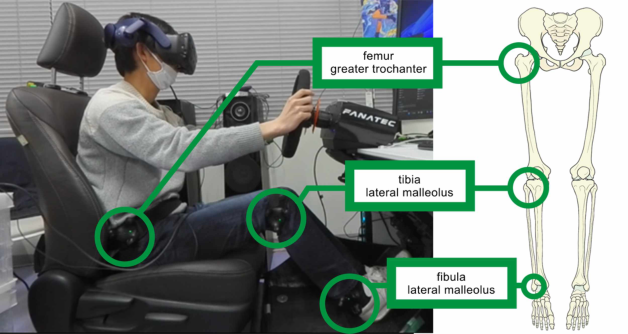
In this experiment, trackers were attached to the right legs of the parti- cipants to measure the movement of the leg operating on the pedal. The trackers were attached to the protruding parts of the lower limb, specifi- cally the femur greater trochanter, lateral malleolus of the tibia, and lateral malleolus of the fibula, and the distance for each individual was measured to consider differences in body size. Figure 3 shows an overview of the positions of the trackers attached to the driver’s right leg.
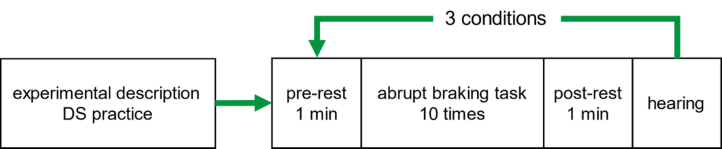
The protocol of this experiment involved measuring the distance between the protruding part of the right leg, namely the femoral condyle and late- ral malleolus, and the proximal end of the fibula and attaching a tracker to the measured location. The position of the tracker was adjusted near the measurement site and aligned such that the center of each tracker was in a straight line while standing upright, as shown in Figure 3. Next, the partici- pants adjusted the position and angle of the driving seat, put on the HMD, and received an explanation of the DS and experimental tasks, followed by a practice run. After the participants understood the DS and experimental tasks, they performed a 1-minute pre-rest with their eyes closed while wearing the HMD. Subsequently, they performed emergency braking tasks. After the task, a 1-minute post-rest was conducted with eyes closed while wearing the HMD, followed by an interview regarding the task and seat conditions. This
Figure 2: Overview of the “brake” indication displayed in front of the car.Figure 3: Overview of the attachment positions of the tracker on the right leg of the driver and an image of the tracker attached to the driver’s leg.Figure 4: Schematic of the experimental protocol.
was performed with the driving seat under different conditions at arbitrary frontmost and backmost positions. An overview of the experimental protocol is shown in Figure 4.
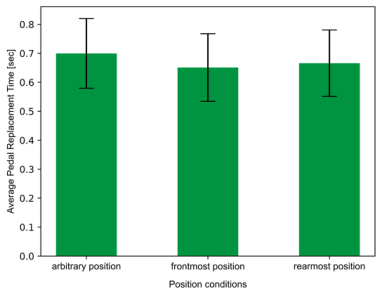
Effect of Driver Seat Position on Pedal-Switching Time In the emergency braking task, the average pedal-switching time was calcula- ted for each condition by measuring the time between the presentation of the “brake” instruction as shown in Figure 2 and the start of moving the brake pedal. The results are presented in Figure 5, with the legend indicating the number of participants. The Wilcoxon signed-rank test was performed for each of the arbitrary, frontmost, and rearmost seat positions. However, no significant differences were observed under any of the conditions.
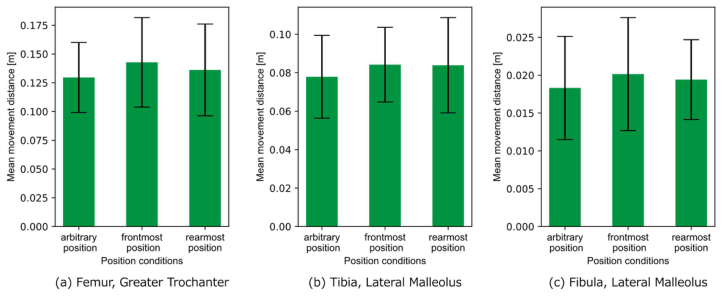
Impact of the Fore–Aft Position of the Driving Seat on the Right Leg Movement During Pedal Switching The displacement of the position where the tracker was attached to the right leg was measured during the pedal-switching task, and the average displace- ment of each condition was calculated. The displacement was calculated by summing the absolute values of the distance from each coordinate to ano- ther every 90 Hz, which is the sampling frequency of Unity. The results are shown in Figure 6, with each legend indicating the respective participants.
Biometric Information-Based Optimization of Driving Seat Position 43
Figure 5: Mean pedal-switching time for each condition.Figure 6: Mean movement trajectory length of various parts of the right leg during pedal switching in each condition.
The Wilcoxon signed-rank test was performed for each of the arbitrary, fron- tmost, and rearmost conditions, and no significant differences were observed in any of the conditions.
DISCUSSION
There was no significant difference observed in the pedal-switching time during emergency braking and the amount of movement of the different parts of the right leg required for operating the pedal in the emergency braking task depending on the front-back position of the driving seat. Therefore, it is expe- cted that the movement speed of the different parts of the right leg is also not influenced by the front-back position of the driving seat. Consequently, it is considered that the front-back position of the driving seat does not affect emergency braking in safe driving behavior.
The lack of significant differences in the experimental results could be attri- buted to the fact that the distance between the pedals did not change. By focusing on the results of each experimental participant, it was found that the time and amount of pedal switching at the front and back ends of the experimental conditions both decreased for experimental participant No. 1,
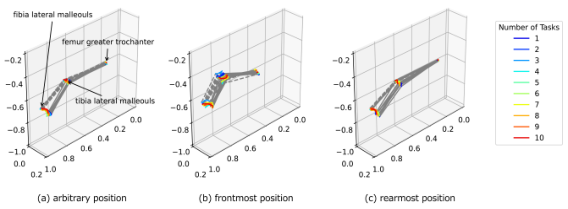
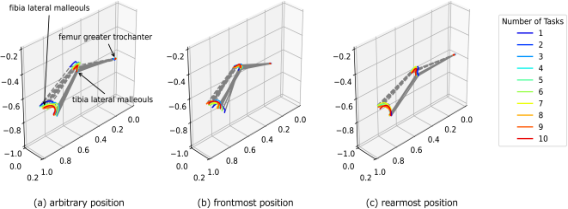
while they both increased for experimental participant No. 8. Figures 7 and 8 show the trajectories of each part of the right leg during pedal switching under each condition. Figures 7 and 8 show the trajectories of the greater trochan- ter of the femur, the lateral malleolus of the tibia, and the lateral malleolus of the fibular during pedal switching, respectively, as seen from the front of the vehicle, and the color of the trajectories indicate the number of tasks per- formed. The gray dashed line connects the starting points of each trajectory of the right leg, while the gray solid line connects the ending points of each trajectory. The plots in Figures 7 and 8 are scaled to be comparable. Even for two experimental participants with different tendencies, no significant changes were observed in the trajectory of the lateral malleolus of the fibular between the conditions, as the lateral malleolus of the fibular is closest to the pedal among all the parts of the right leg measured and depends on the distance between the pedals.
However, a difference was observed in the trajectory of the lateral condyle of the tibia between the frontmost position condition and the other two con- ditions. The trajectory of the lateral condyle of the tibia in Figure 7(b) appears to have increased in displacement compared to the other two conditions. Focusing on the line connecting the trajectories of the lateral malleolus of the tibia and the lateral malleolus of the fibular, this line appears parallel in the frontmost condition. These observations suggest that a movement in which the thigh is lifted during sudden braking occurred under the frontmost condition. In Figure 8(b), although a trajectory of lifting the lateral condyle of the tibia was observed uniformly under the other two conditions, it appears to have decreased in the amount of lifting under the frontmost condition.
Figure 7: Trajectory of each part of the right leg during the pedal operation under each condition for experiment participant 1.Figure 8: Trajectory of each part of the right leg during the pedal operation under each condition for experiment participant 8.
Biometric Information-Based Optimization of Driving Seat Position 45
These observations suggest that the pedal-switching motion was supple- mented by the function of factors that were not considered in this experiment. During the hearing conducted after completing the tasks under the frontmost condition, opinions were heard that the operation of the accelerator pedal became difficult and strong stress was felt in the vicinity of the adductor muscle group of the right leg and around the tibia, including the tibialis ante- rior muscle. Therefore, it is necessary to focus on the muscle load, as an additional factor. By focusing on muscle load, it is expected that the cause of the pain asked about in the hearing and the cause of the behavioral changes observed in Figures 7(b) and 8(b) will be identified.
CONCLUSION
The purpose of this study was to propose appropriate adjustment values for the driving seat for individual drivers, with the ultimate goal of promoting safe driving behavior. We conducted experiments that focused on the move- ment of the right leg when operating the pedal, particularly during emergency braking tasks that included important elements for safe driving behavior, by varying the fore-aft position of the driving seat. As a result, we have deter- mined that there was no significant difference in the time required to step on the pedal during emergency braking or the amount of movement of the right leg required to step on the pedal when adjusting the forward and backward position of the driving seat. This suggests that the adjustment of the driving seat does not affect emergency braking during safe driving behavior. Howe- ver, when we examined the trajectory of the right leg during pedal switching for each participant who had similarly increased or decreased the time requi- red and the amount of movement of each part of the right leg, we observed differences in the behavior of the lateral condyle of the tibia when the dri- ving seat was positioned in the foremost position compared to the other two conditions. In the future, we will conduct experiments focusing on muscle load, to investigate how the pedal operation time, which was not affected by the forward and backward position of the seat, affects the driver. We will also explore the relationship between the adjustment values of the driving seat and the driver’s biometric information during driving to determine the optimal adjustment values for safe driving behavior.
REFERENCES
Ohashi, S., Shionoya, A., Harada, K., Nagamori, M., Uchiyama, H. (2022) “Posture Estimation Using Surface Electromyography during Wheelchair Hand-Rim Ope- rations,” Sensors, 22(9), p. 3296 Porter, J. M. and Gyi, D. E. (1998) “Exploring the optimum posture for driver
comfort,” International Journal of Vehicle Design, 19(3), pp. 255–266 Tanigo, R., Nagai, M., Nishizaki, Y. (2017) “Sheet Position and Driving Behavior,” Proceedings of the Japanese Society for Cognitive Psychology, Volume 2017, Session ID O4-06, p. 30 (in Japanese) Yap, A. J., Wazlawek, A. S., Lucas, B. J., Cuddy, A. J., Carney, D. R. (2013) “The
Ergonomics of Dishonesty: The Effect of Incidental Posture on Stealing, Cheating, and Traffic Violations,” Psychological science, 24(11), pp. 2281–2289
LISTED IN THE AHFE DIGITAL BOOKSTORE CATALOGUE
Explore the complete digital volume
Affective and Pleasurable Design
Read this individual research paper free through the original publisher, or explore the full digital proceedings book.
ISBN 978-1-958651-47-6
Explore this ISBN in the AHFE Bookstore ↗Listed in the July 2026 bookstore catalogue; search by ISBN to confirm current availability · Digital book purchase optional