Kang Xinyan, Luo Hong, Haoying Liu (2023). Design strategies for museum digital games based on emotional interaction. In: Affective and Pleasurable Design. AHFE Open Access, vol. 71, pp. 150–158. https://doi.org/10.54941/ahfe1003254
Background With the development of the digital age, museums are paying more attention to the needs of their audiences, and the relationships they build are gradually transitioning from relationships with people to relationships with everyone in order to meet the attributes of serving the public. Museums take the historical dimension as the timeline to elaborate the spiritual connotation of cultural heritage, and digitalization with its multi-dimensional experience mode becomes the necessary medium and basic condition for the development of museum traditional culture in the information age. In the process of digital expression of museum cultural heritage, the application of gamification thinking can effectively promote the efficiency of the display, people in the activities and tasks through the inner drive to drive themselves to complete the task, under the guidance of relaxing and pleasant elements through the visual, auditory and other sensory organs to effectively receive and understand the information. Therefore, the analysis and refinement of museum digital game expression, the demand for emotional interaction design based on the optimization of user pleasure in the process of museum game experience, and the highlighting of emotional interaction are the keys to the current museum digital game design. Objective In view of the development mode and design strategy of the existing museum digital display, this paper explores the design practice of emotional interaction design in museum digital games, and provides innovative design for the emotional interaction needs of museum digital games. Methodology Firstly, from the perspective of interaction design, the three levels of emotional design are used as a theoretical basis to combine the cultural heritage of museums with the transferability, interactivity and immersion characteristics of emotional interaction design, and propose digital interactive games as a carrier as an effective way of digital innovation for museum cultural heritage. Secondly, based on the case study method, graphical analysis and evaluation experiments, the museum digital games case study is analyzed to explore the main factors that affect the emotional experience of users in the games from the interaction behavior itself. Finally, the main interaction processes and methods of museum digital game design are constructed in four aspects: digital game categories, content and mechanism design, interaction and experience methods, and interface and navigation design.
Design Strategies for Museum Digital Games Based on Emotional Interaction 151
INTRODUCTION
Museums carry out the functions of collecting cultural heritage and dissemi- nating cultural values to the public, and are a carrier of the national spirit, and as the public’s spiritual and cultural needs increase, people’s interactive needs for museums gradually increase. Traditional museums are gradually exposed to problems such as the single way of displaying exhibits, patter- ned experience processes and weak educational knowledge dissemination. Secondly, gamification has become an important part of the museum experi- ence, and the application of gamification can The application of gamification allows visitors to be fully engaged and challenged by reasonable mechanisms and common goals, making museum digital game design an effective way of communicating museum cultural heritage. Emotional design has been widely used in the field of design, which not only focuses on people’s sensory plea- sure, but also on their inner emotions and psychological satisfaction. Based on the three theories of emotional design and the characteristics of museum digital game design, this paper proposes a strategy for designing museum digital games with the aim of enhancing the interactive experience of users.
Museum Digital Game Design Features Digitisation of museum cultural heritage. Based on the current trend of incre- asing spiritual and cultural needs of the public, the traditional “object”-based presentation of museums may not be able to present the cultural values of cultural relics in their entirety in the current context, and the application of digital technology is able to explain the specific form of cultural heritage in a more visual way. The digitalization of cultural heritage is mainly used in the areas of conservation and documentation, display, and dissemination, focu- sing on the interactive experience of the user in its display, guiding the viewer to become a participant in the interaction with the heritage, and encoura- ging the viewer to actively participate in the process of converting the passive acceptance of image information into active communication and an intera- ctive experience, thereby understanding the beauty of the skills behind the heritage across the ages. Museums have a unique advantage in transmitting cultural needs and educational awareness, and the introduction of digital technology will gradually integrate different cultural heritages and build a more complete elaboration system.
Gamification thinking in museums. The concept of gamification was first developed in the Western education sector.According to Rajat Paharia, gami- fication is “the integration of something that already exists and has a certain core and intrinsic value with game mechanics in order to stimulate user enga- gement, involvement, and loyalty, based on an understanding of gamification as the use of game elements, mechanics, and interaction techniques to achieve a fun experience in non-game contexts. Gamification thinking is the intrinsic behavioral motivation that arises in the course of pleasurable play experie- nces, mainly by proposing creative human-centered ideas to motivate people to engage in interaction. Museums are the bearers of cultural heritage and the narrators of the country’s history, presenting each point in the timeline from a narrative perspective during the viewer’s visit, and the use of gamification
integrates the historical history of cultural artefacts into the game mechanics, conceptualising the cultural elements in the game elements and combining them with digital interactive technologies that can be manipulated by the viewer to stimulate the audience to participate in the game mechanics and enhance participation. The gamification of scenes in museums allows players to create their own storytelling spaces and gain a unique cultural experience while learning about the artefacts. Museum gamification is a pivot between traditional culture and modern information, digital information technology as a new way of cultural communication is more easily recognised and recei- ved by the audience, museums as informal learning places, gamification is an important way to break through the traditional model, therefore the process of museum gamification experience whether as a bridge between the museum and the audience or as a medium of educational knowledge popularisa- tion, will be greater to achieve the significance of the museum’s educational function.
Overview of Emotional Interaction Design Donald Arthur Norman, an American cognitive psychologist, first introdu- ced the concept of affective design, which focuses on design works that aim to express emotions, achieve emotional resonance through interaction with the viewer’s sensory organs, and provoke deeper reflection in the process of interaction. Emotional design is based on the study of humanized design and consists of three interrelated but distinct layers, which are, from the bottom up, the instinctive layer, the behavioral layer, and the reflective layer (see Table 1).
The instinctive level of design corresponds to the direct sensory demands of users in terms of hearing, touching, and seeing, and therefore requires desi- gners to complete the design related to the appearance level; the behavioral level corresponds to the demand for good user experience and interaction in the design, and requires designers to pay more attention to the functionality and interaction behavior of the product to enhance the good user experience; the reflective level will further focus on the user’s thoughts and emotional
Table 1. Analysis of emotional interaction design for museums.
Table available in the original PDF paper.
Emotional level
Demand Experience
Design level Design content Hierarchical features Transience
instinctive level
Sensory elements
Sensory experience design
Interface style, information architecture design, six senses design Immediacy
Behavioural layer
Interactive experiences
Interaction design, game content and play mechanics design
Digital interaction technologies, user relationships, stories and scenarios Durability
Reflective layer
Emotional activities
Cultural expressions and emotional resonance of cultural heritage knowledge
Cultural connotations and expressions of popular scientific significance
Design Strategies for Museum Digital Games Based on Emotional Interaction 153
demands, such as In this level, designers will focus on the individual chara- cteristics and needs of the design work itself. In museums, interactive games are often accompanied by a combination of sensory, interactive, and emo- tional experiences, so emotional interactions in museums are mostly linked to the viewer through digital games on three emotional levels, based on the instinctive level of sensory participation and the behavioral level of intera- ction, which allows the viewer to understand the historical significance of the museum’s cultural heritage and resonate with it emotionally.
Emotional Design at the Instinctive Level Norman believes that human instincts are designed at the instinctive level. The emotions generated at the instinctive level are the instinctive and direct reactions of the user when exposed to the game, and their emotional demands are mostly satisfied by the physical characteristics of the design. Therefore, game design needs to effectively mobilize the viewer’s physical senses through the determination of game types, interface styles, and multi-sensory experie- nce design to stimulate the viewer’s emotional needs, so that the viewer can gain a variety of senses through a multi-sensory experience and satisfy the viewer’s emotional demands at the instinctive level.
Game positioning and interface design. Firstly, in terms of game genres, existing game models are combined with the museum’s cultural heritage the- mes to create different game niches. Museums as ‘theatres’ encourage the participation of diverse narrative models, and the Functional Games Indu- stry Report 2020 defines functional games as “games that do not aim to entertain, combine a variety of different applications and scenarios, highlight functionality and application, while still retaining the essential characteri- stics of traditional games.” The first category focuses on the customs, habits, and spiritual beliefs of the cultural heritage itself; the second category recre- ates specific historical periods and events in detail, allowing the viewer to understand the totality of the event; and the third category creates new game mechanics in reality to allow participants to learn and understand the artistic and natural values of the heritage. artistic and natural values. The positio- ning of the game genre in relation to the specific cultural heritage allows the viewer to develop a memory point for the game mode and be drawn to it instinctively. The design of the game interface supports the user in the effi- cient operation of the game, and its consistency with the style of the game stimulates memorable points for the viewer. A clear navigation design helps the user to clearly understand the process and the steps they need to com- plete during the game, so the positioning of the user and the next step in the interface design, and even the prediction of the user’s own behavioral pur- pose, need to be further enhanced to ensure that important information is presented and the visual center is effectively handled.
Multisensory experience design applications. In his book, Norman talks about how the richer the sensory experience consumers receive at the insti- nctive level, the better the psycho-emotional experience is stimulated, and that emotion is one of the main factors that create differentiation in the user experience segment. The multi-sensory organ breaks through the limitations
of a visual-based communication model, as the interface, sound effects, and music of the game are transmitted to the user through visual, auditory, and tactile channels, and the user interacts through the eyes, as well as through physical sensation and voice, bringing together multiple senses to give the experience a more comprehensive perception of objective facts and a multi- dimensional experience. Due to the age of the museum’s cultural heritage, the weakness of its perception, and the limitations of its dissemination, the introduction of sensory elements into the interactive experience of the game can enrich the experience, cognition, and memory. At the same time, digi- tal technology as a carrier in museum game design supports and supplements unrealisable audiovisual phenomena through its inherent visual and auditory characteristics, creating a visual, three-dimensional, and situational atmosph- ere in the game experience with the help of technology, enabling the audience to quickly form a diverse sense of immersion in the game process and build their own unique perception and spiritual connotation.
Design Case Study. Different kinds of interactive games are set up in the digital zone of the Nanjing Museum for specific collections, for example, for the game design of the Nanjing Museum’s collections such as the Ming Hongwu Glazed Red Plum Vase with Cover and the Xuyi Dongyang Han Tomb Divine Beast, the Nanjing Museum firstly gives a video explanation of the historical background and use of the collection, and secondly designs the interaction according to the details of the cultural relics such as extra- cting patterns, designs, textures and colours, visitors Visitors can learn about the development and form of the artifacts in the video and audio explana- tions and complete the puzzle game on the display screen through gestures, taps, and other interactive gestures based on the details and form of the pre- collection introduction. The interactive game is designed around the details of the exhibit’s appearance, satisfying the sensory needs of the viewer in the process of listening, touching, and seeing, and deepening the memory of the collection through thematic interaction.
Emotional Design at the Behavioural Level Behaviour is generated through the process of emotion and expressed through the body. The emotional design of the behavioral layer is the mapping of inner emotions through the behavior of the environment in which it is placed, creating an environment based on the mapping of the theme and emotions of the heritage display in an interactive way where the audience is guided by emotions and logic to produce a specific behavior. Emotional design at the behavioral level tends to be more interactive in the way information is transmitted and received; therefore, emotional expression at the behavioral level requires the use of game mechanics and content settings to stimulate curiosity and generate a deeper understanding of the exhibit, allowing the viewer to link and emotionally engage with the artwork through accessible digital interaction technology.
Gamification application strategy. After the type of game is determined at the instinctive level, the relationship between the user and the game at the behavioral level depends on the system content and mechanism design of
Design Strategies for Museum Digital Games Based on Emotional Interaction 155
the game. From the perspective of game content, the gamification elements are mainly divided into three parts: motivation, mechanism, and forma- tion. In terms of game mechanics, the interaction mode presents the trend of multi-channel and multi-modal fusion interaction, which is more capable of outputting information to the viewer than the operation mode, and the establishment of achievement and challenge modes in the function will also enhance the user’s stickiness and establish the relationship between the user and the game at the same time.
Digita interactive technology applications. The application of digital tech- nology at the behavioral level helps the user perceive the interactive object while also engaging the viewer. With the rise of digital technologies such as computer graphics, virtual reality, and augmented reality, people are beco- ming aware of the properties and advantages of digitalization. Firstly, in the process of emotional design at the behavioural level, the use of digital tech- nology means to express the virtualisation process in static or dynamic form. Secondly, the use of digital media can also serve as a bridge between the viewer and the game’s spiritual needs, as it can handle the game’s scenes, rhy- thms, and details, influencing the viewer’s emotions and memories in many ways, and making them gain a unique gaming experience. In the process of the game experience, the cognitive load caused by the complexity of the game mechanics is reduced through the synergistic display of multiple means, and the user’s ease of operation is increased by the real-time audio-visual feedback during operation.
Design Case Study. The China Grand Canal Museum has taken on the mission of heritage and education in the cultural accumulation and develo- pment of the Grand Canal. The “Canal Mystery of the Da Ming Metropolitan Water Supervisor” is an interactive game for young people aged ten to fif- teen that is an immersive spatial experience in the form of a “secret room escape” game that uses puzzles to drive the development of the plot. The game starts with a youth-friendly interactive design strategy, using the anci- ent technology of the Grand Canal as an entry point for youths to participate as “gamers.” secondly, interactive mechanics and AR technology are used to build an immersive escape room space for users to get vivid real-time feedback during the puzzle-solving process, for example In the dynamic three- dimensional sandbox, AR technology is used to project the flow of river water so that users can understand the direction of the river under the geo- morphological features along the canal, and after successful operation on the three-dimensional sandbox, the relevant knowledge points are triggered in projection mode, and the dynamic map will be presented in front of the audi- ence to obtain key answer information; finally, in the process of solving the comprehensive interactive reasoning questions, the exhibition hall simulates the scenery along the Yangzhou Canal with The 360-degree ring screen is used as a theme to scatter knowledge points on the screen, and the audie- nce interacts with the NPCs in the ring screen to obtain valuable knowledge information. In this process, the ring screen uses digital presentation to enh- ance the audience’s experience, and in the process of restoring the scene, the user focuses on exploratory participation to effectively enhance the sense of fun and interaction.
The interactive game mechanics of “Canal Mystery of the Da Ming Metropolitan Water Supervisor” break through time and space limitations, presenting the game space in the form of a story, simulating ancient technolo- gical achievements, and completing realistic scenes and digital displays, using interactive immersive experience design to help young people. The intera- ctive immersive experience is designed to help young people apply their own abilities to learning and interpreting the culture of the canal.
Reflective Layer Emotional Design The emotional design of the reflective layer of the museum game is the stage of thinking that the viewer enters after completing the game through beha- vioral interaction, requiring the imagination and judgement of information to express their inner feelings. The emotional design of the reflective layer is designed to expand on the dynamism of the appearance and interactive technology, as well as the feelings triggered by the viewer’s deeper reflection during the game and the unique emotional resonance of the cultural heritage displayed during the game experience.
Design Case Study. As a major event in modern American history, the terrorist attacks of “9·11”have received special attention in museums. The National September 11 Memorial Museum’s exhibits begin with a display of the victims’ belongings, as well as videos, interviews, and reports from the scene, including a historical section entitled “Restoring the Rubble,” which shows the staff cleaning up the site of the center after the terrorist attacks. In the history section, the “Debris Recovery” exhibit shows staff cleaning up the site after the terrorist attack and projects images of the debris removal onto the steel wreckage of the destroyed Twin Towers’ giant trident colu- mns, bringing psychological oppression and fear to the viewer with the shock of the exhibits and the oppression of the steel frame; secondly, the design takes into account the oppression of the site, and the designer combines audience experience with scenarios to present the audience with messages on the concrete behind the lightning rod. The presentation of new media technology creates a space for self-judgement, where the viewer can reflect on the theme and connotation of the exhibition through digital displays and understand the emotional expression across forms through interactive images and embodied experiences, thus completing empathy and deepening reflection.
The Shanghai Glass Museum’s The Disappearing Artist game introduces a unique theme and scale to the game with its winning “scripted kill” of plot and reasoning. The game first gives the viewer a virtual role and perso- nal meaning, enhancing the immersion and sense of immersion through the implementation of the suspenseful plot, the spatial curves of the museum’s interior, and the extension of the exhibits in the framework of the narrative; secondly, it completes the narrative expression through real-life interpreta- tion and interaction with the exhibits, conveying a reflection on the spirit of humanity in the thought process of the restored case; and finally, through the different stages of the performance. The game is designed with a humanistic purpose in mind.
Design Strategies for Museum Digital Games Based on Emotional Interaction 157
CONCLUSION
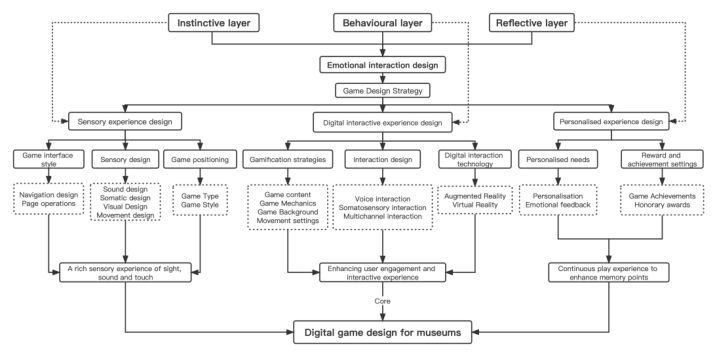
Emotional design is an important way for users to understand museum cul- ture. By combining the theory of emotional interaction design with the design of museum digital games, the study proposes the framing of interactive games from three levels: instinctive level, behavioural level and reflective level, and obtains the design method of museum digital games under emotional intera- ction design, which in turn promotes the interactive communication between museum ideas and culture and people, and integrates the formation of the interaction design strategy for museum digital games (see Figure 1).
Figure 1: Exhibition environment of National Museum and Theater Museum.
REFERENCES
By Kevin Weibach, Dan Hunter; translated by Zhou Kui, Wang Xiaodan. Gamified thinking [M]. Hangzhou: Zhejiang People’s Publishing House, 2014. Donald A. Norman. Design psychology: emotional design [M]. Beijing: CITIC Press,
2012. Hu Wenyu. Research on the digital display design of cultural heritage based on AR technology [D]. Shandong University, 2020. DOI: 10.27272/d.cnki.gshdu. 2020.002767. Li Qianqian. Research on the design of paleontological cultural and creative products
based on multi-sensory experience [D]. Lanzhou University of Technology, 2022. DOI: 10.27206/d.cnki.ggsgu.2022.001282. Li Ziheng. Gamification Intervention in Museum Creative Product Design [D].
Sichuan Academy of Fine Arts, 2021. doi: 10.27344/d.cnki.gscmc.2021.000193. Liu Jun, Liu Fengling. Research on the design of “Internet+” museum public services based on role perception - taking the National Palace Museum as an example [J]. Decoration, 2017(11): 118–119. Miao Ling. Research on the application of emotional design in new media display in
museums [J]. Southeast Culture, 2022(02): 163–168. Wen Jingbo. Museum contextual design under the intervention of digital media: the case of the American Journalism Museum [J]. Art Design Research, 2019(02): 86–90.
Wu Xinyi. A study of suspenseful narrative design of weak functional games in museum contexts: the case of The Vanishing Artist at the Shanghai Glass Museum [J]. Museum, 2022(01): 129–136. Zheng Jing. Exploring the application of game-based education model in museums:
an example of the interactive experience exhibition for young people, “The Canal Mystery of the Great Ming Capital Water Supervisor” [J]. Southeast Culture, 2021(03): 161–166.
LISTED IN THE AHFE DIGITAL BOOKSTORE CATALOGUE
Explore the complete digital volume
Affective and Pleasurable Design
Read this individual research paper free through the original publisher, or explore the full digital proceedings book.
ISBN 978-1-958651-47-6
Explore this ISBN in the AHFE Bookstore ↗Listed in the July 2026 bookstore catalogue; search by ISBN to confirm current availability · Digital book purchase optional