Bryan Lintott (2023). The History and Heritage of the Age of Simulation. In: Human Factors and Simulation. AHFE Open Access, vol. 83, pp. 236–242. https://doi.org/10.54941/ahfe1003581
Simulation of modern technologies has an important and informative history and an inspirational heritage. Simulation was utilised early in the development of aviation. Aircraft are controlled through a coordinated series of inputs from the pilot, similar to riding a horse. The difference is that falling from a horse is not as hazardous as falling from the sky. In response to this steep learning curve, the Antoinette simulator of 1910, operated by humans responding to the trainee´s inputs, was developed. World War I´s Allied and Central Powers utilised simulation to enhance combat effectiveness. Major Lanoe Hawker VC, of the Royal Flying Corp, pioneered British military simulators with a ´Rocking Fuselage´ for firing at a moving target, with a later version in which the ´Rocking Fuselage´ was mounted on a track. Hawker´s distinguished and innovative career abruptly ended when he was shot down and killed by Manfred von Richthofen. The advent of fly-by instruments and navigation by radio-directional beacons provided an ideal opportunity for enhanced simulation. Overcoming initial reluctance, a common historical occurrence with innovative technologies, Edwin Link combined his expertise and experience from the family´s piano and organ company to produce the iconic Link Trainer. The ability to incorporate communication from a ´ground controller´ and record on a map the pilot´s course enhanced the allies´ training programmes. The advent of shipboard radar, during WWII, in the maritime realm enabled operation in low or non-existent light situations, such as fog. However, this new technology resulted in a new class of accidents – misinterpretation of screen information leading to collisions. From the 1950s onwards, simulation has been integral to the training of deck officers in radar technology. In the late-1950s. N.S. Savannah, the United States´ atomic-powered merchant ship, pioneered civilian maritime simulation of a nuclear reactor and propulsion system. During the 1960s, maritime simulation was increasingly utilised to understand operation and crew performance better. In 1976, the use of CGI at the Computer Aided Operations Research Facility (CAORF), US Merchant Marine Academy, demonstrated the value of simulation in deck officer training. Increasingly, computers: analogue, electro-mechanical and digital, drove simulation forward. Early advances enhanced the experience for the operator and monitoring by the supervisor. DARPA´s pioneering role in the integration of ´networking, instrumentation and command and control´ has been transformative. This led to ´… outcomes that were in no way predictable, through after-the-fact were understandable.´ (Thorpe 2010)The material culture of simulation is in the collections of many museums – especially the Link Trainer. Most museum-based simulators are no longer operational due to malfunctions, lack of knowledge and concern about damage by "enthusiastic" public members. However, in a twist, there is interest in simulating simulators. The ´Rocking Fuselage inspires the WW1 Aviation Heritage Trust dogfight simulator´. In recent decades, the software associated with simulation has also gained its own historical archival value. Given the complexity of modern simulators and simulations, the question arises: what will be retained in museums and archives for future generations to engage with, personally or professionally, that records the Age of Simulation?
Mariners and aviators require a fundamental corpus of knowledge and skills to efficiently and safely integrate into an operational environment. Given the inherent costs and risks of operating in the maritime and aeronautical realms, numerous simulation equipment, training techniques and standards for competency have been developed over the years. Beyond the simulation communities’ and related academic interest in its history, the museum com- munity has engaged with simulation in recent decades. This has come from two directions, the first being the ‘interactive’ exhibit, intended to simulate, stimulate and educate. The second is utilising original or replica simulators as initially used or ‘enhanced’ for a modern visitor. The challenge for the archi- val and museum sectors in conserving, recording and interpreting the Age of Simulation is urgent: retaining this increasingly complex material culture and its related documentation, ‘capturing’ knowledge on how the simulation was developed, operated and evolved, and understanding its institutional context. Simulation is now integral to related histories of technology, science, organi- sations, society and psychology, and emerging within heritage studies in the contexts of associated values, narratives, retention and presentation.
The History and Heritage of the Age of Simulation 237 MARITIME SIMULATION, LATE-19TH CENTURY ONWARDS
The increasing technical complexity of 19th-century sailing ships and the advent of steam propulsion increased the demand for skilled mariners. In a broad sense of simulation, physical models that demonstrated various aspe- cts of maritime technology and its operation were displayed in museums such as the Musée des Arts et Métiers in Paris, the Smithsonian Institution in the United States of America, and the precursor of the Science Museum, London. These inspirational models promoted public interest in emerging technologies and encouraged young people to consider associated careers. Operational models of steam engines and other technologies were integral to the numerous societies and schools that offered maritime education. The Royal Navy’s transition from sail to steam included inventors offering a tech- nology or improvement by providing diagrams, plans and, in many instances, a model, enabling better-informed discussions and consideration (Macleod et al., 2000). Late in the 19th century, cadets were still trained on handling a sailing ship, with an example of a shore-based training simulator being the Royal Naval School’s ‘swinging model’ in which nine boys were aboard a ship simulator, with a ship’s wheel that was turned to the selected heading and the yards and sails being trimmed as required (Harland, 1984). The ‘swinging model’ simulator also provided generic team training.
Maritime navigation training, until the advent of electronics, focussed on the instrumentation skills necessary to use a compass in combination with a chronometer and the ability to integrate observations with various calcu- lations and techniques to ascertain a ship’s position. A variety of compass and sighting simulators were developed for training and evaluation. The Deviascope was used to train deck officers to compensate for the ship’s inh- erent magnetism and correct their calculations accordingly (Pearson, 2023). First displayed in 1886, the Deviascope was awarded a gold medal at the Liverpool Exhibition (Harvard University Collection of Historical and Sci- entific Instruments, undated) and can still be purchased. An example, in the collection of the National Maritime Museum, Greenwich includes, a “com- pass rose and heeling quadrant, Pelorus with sight vanes, ships funnel in sheet steel, clinometer, compass gimbals, adjustable brackets for 4” dia. soft iron spheres, Flinders Bar, Dipping Needle and a quantity of magnets.” (RMG, 2023). While the advent of shipborne radar enhanced the safety of ships at sea in low or no visibility situations, it also resulted in a new class of acci- dents: radar misinterpretation leading to collisions. In the late-1950s, radar simulation training was commenced to educate mariners on how to interpret information from radar and integrate this into their situational awareness (Linington, A), becoming compulsory in 1997 with Automatic Radar Plotting Aids training (Muirhead, 2022).
The pioneering nuclear-powered cargo ship N.S. Savannah, launched in 1959, required a crew trained in the operation of a seaborne nuclear rea- ctor. Lynchburg College, VA, was chosen for training the crew in the basic principles of nuclear physics, reactor operation and the ship’s systems. Central to the crew’s training was a “control-panel simulator” that repli- cated the reactor’s operation through a computer. It could be configured by
238 Lintott
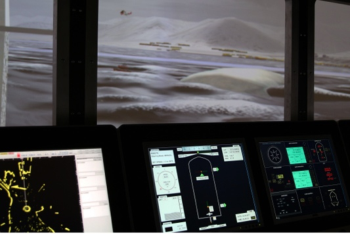
Figure 1: Kongsberg maritime simulator displaying Longyearbyen, Svalbard, with an iceberg being blown past the ship. UiT The Arctic University of Norway. (Lintott, 2023).
an instructor to simulate various scenarios (New York Shipbuilding Corpo- ration, undated). The training programme was structured to include trainees from a range of companies, organisations and institutions, and later classes included students from Denmark, England, Holland and Japan (ibid).
During the late-1960s, maritime simulators focussed on ship handling and ’… were used primarily for research into areas like ship and port design, procedures, and crew behaviour rather than for training.’ (Linington, 2021). In this endeavour, they were being utilised in the context of modern ope- rations management research. During this period, projection technology emerged that allowed other ships, navigation beacons and coastlines to be shown outside the simulated bridge (ibid). A convergence between the upda- ted International Convention on the Standard of Training, Certification and Watchkeeping for Seafarers (STCW 95), in response to a series of maritime disasters, and enhanced simulator technologies (drawing in many instances on developments in digital gaming technologies) has led to today’s environ- ment in which app, desktop, and stationary and – where resources allow - full-motion simulators being integral to maritime training and evaluation.
The Arctic, with its sea ice and dangerous polar low storms, and Antarctica, with the Southern Ocean’s “Roaring 40s, Furious 50s and Screaming 60s” and sea ice are two of the most challenging maritime environments on the planet. Compounding these challenges are the occurre- nces of confusing optical conditions caused by various optical illusions (Rees, 1988). Simulation training has an important role in preparing mariners for these harsh conditions.
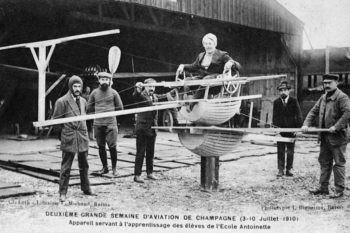
AVIATION Flying an aircraft requires a comprehensive and coherent set of skills for safe and successful operations. Given the unforgiving consequences of an aviation failure, simulation was swiftly developed to provide a safe training environ- ment. An early example is the Antoinette simulator in which a trainee sat in a cockpit replica, with wheels for pitch and roll and a foot bar for yaw. A bar on the trainee’s structure, aligned with the horizon when level. In response to the trainee’s control “inputs”, a person on each of the three axes would respond accordingly. The structure would be moved from the horizontal to
The History and Heritage of the Age of Simulation 239
Figure 2: Antoinette simulator. (Bietmime, 1910).
teach recovery, and the trainee had to apply the correct control inputs to return to the horizontal.
The development of fighters in World War I established a new skill set, the ability to position the plane in the correct position for its guns to strike another moving plane. Lanoe Hawker, VC of the Royal Flying Corp develo- ped the rocking nacelle, allowing the pilot to ’aim’ at a moving target on a wire. This was enhanced when the rocking nacelle was placed on tracks and moved while aiming at the moving target.
Aviation safety and operation were transformed in 1929 when Ameri- can aviator Jimmy Doolittle flew an aircraft in a complete circuit using only a compass, gyroscopic and barometric instruments and radio direction equipment – whilst under a lightproof hood that prevented any external infor- mation (Smithsonian, 2023). In response to this development, during the 1930s, the Link trainer became the leading aviation simulator, continually adapting to new technologies in aerial electronic navigation, and being mass- produced for training pilots during World War II. During the war, in response to the demand for training in aeronautical astronavigation, ’Ed Link, together with aerial navigation expert P. Weems, designed a massive trainer suita- ble for use by an entire bomber crew and which needed to be housed in a 15-metre-high silo-shaped building’ (Page, 1979). The addition of simula- ted radio navigation signals allowed integrated navigational calculations and coordinated crew training.
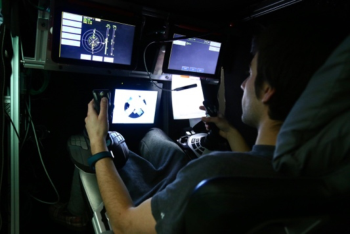
Post-WWII, the use of aviation simulators continued to evolve, with mechanical and pneumatic interfaces being succeeded by analogue and then digitally controlled simulators. These early simulators focussed on instrument readings for the trainee. The Apollo space programme was transformative in developing integrated circuits that allowed future simulators to produce and display increasingly sophisticated visualisations. The Apollo programme’s pioneering fly-by-wire technology provided an example upon which future simulators and air/spacecraft could utilise a common operating architecture (Tomayko, 1988). Whilst simulation occurs typically within the comforta- ble confines of institutions and study areas, there is an interest in simulating the conditions, or psychological state in which equipment may be used. The European Space Agency (ESA) installed a Soyuz - International Space Station docking simulator at the Concordia Base in Antarctica. Located at a high
240 Lintott
Figure 3: Soyuz simulator at Concordia Base, Antarctica. (ESA, 2019).
altitude, hypoxic, and inaccessible during winter, the base crew encounter danger, isolation, and the emotional challenges of overwintering during a polar night that can be analogous to outer space missions.
Comparing results from other simulators on the Antarctic coast and in Europe, it was concluded that ’The significance of the obtained results has been proven by means of statistical models, which show that a one-month training refreshing delivers satisfactory performance for a docking simula- tion, whereas a frequency of 3 months follows to a loss of piloting reliability. Moreover, the effect of isolation and hypoxia aggravates the loss of flight performance.’ (Bruguera et al, 2021).
Heritage Museum artefacts typically have an association with an event, programme or person to whom significance has been ascribed. Contemporary museums, a significant heritage endeavour, have a synergetic relationship with a simula- tion that operates on several levels. The primary one is the material culture in which a simulator, in its entirety or an aspect thereof – usually the human- machine interface, is accessioned to the collection for preservation, research, and potentially to be displayed. In rare instances, this may be demonstra- ted to, or operated by, the public. Size is a significant factor that influences museum collection policies. The small car-sized Link Trainer is frequen- tly seen in museums, while large simulators with large hydraulics are a rarity. There are also large cabinets of early electronic-based simulators with complex arrays of power supplies, circuit boards and, in some instances, elector-mechanical interfaces. These are pivotal examples of past techno- logy, but their display value, “another black box”, can be modest. As for AI, the challenges in interpreting the algorithms utilised will be an ongoing endeavour. The second is the educational function of museums in which simu- lation is a pedagogical tool to inform of universal principles, e.g. in a science museum for principles, how a technology was developed or a piece of equi- pment used. These can range from simple models to sophisticated simulators that include hydraulics. The third is the museum as a community space in which an entertainment component may be incorporated as a social good. In a fusion of education and entertainment, a version of Hawker’s rocking nacelle has been produced in combination with VR technology to convey
The History and Heritage of the Age of Simulation 241
“virtual missions”, rather than the original tin target dangling from a moving wire (World War I Aviation Heritage Trust, 2023).
Curatorially, simulation-based material culture can range from the easily understood to systems of great complexity that, in their operational phase, require several specialists to operate them, let alone the engineers and pra- ctitioners that designed and modified them. Compounding matters is the preservation of software, and the ability to interpret and understand its structure and how it evolved. Artificial Intelligence will pose an additional challenge to historians and curators as the internal process with the ’black box’ may be inscrutable. However, ongoing development in Explainable Artificial Intelligence (XAI) may make the internal processes more understan- dable (Fiok, 2022). Already, current simulation technology has been adapted for use in museums. The Norwegian Maritime Museum, since 2014, has uti- lised a modified version of a Kongsberg simulator to offer visitors a range of scenarios (Bagle, 2023).
Material cultural and related archival material, and simulation, can also be utilised in current scientific and engineering research. An example is an examination of past attempts to simulate sea spray accumulation equipment utilising models and scoops, then using modern simulation programmes better to understand the advantages and limitations of the historic equi- pment. In this way, enhanced simulation of historical simulations is informing contemporary research (Dar, 2023).
CONCLUSION
The Age of Simulation, in which we live, is a time of profound transformation of the human experience: the virtual engagement with ourselves, others and the world around us in which we exist – and those worlds that can be imagi- ned. The challenge is to preserve, understand and communicate the material culture, historical record and heritage dynamics of simulation.
ACKNOWLEDGMENT
The author gratefully acknowledges the expert information and insights offe- red by his colleagues at UiT The Arctic University of Norway, and Dr Michael Pearson AO.
REFERENCES
Bagle, E. 27 January 2023. Per comm. Beall, G. (1913) I. S. O., F. R. G. S., Hand-Book to Beall’s Compass Deviascope Together with a Few Explanatory and Practical Remarks on Magnetism and the Deviation of the Compass in Iron Ships, 4th ed. London: J. D. Potter, Admiralty Agent for Charts. Bruguera, M. B et al. (2021). Assessment of the effects of isolation, confinement
and hypoxia on spaceflight piloting performance for future space missions - The SIMSKILL experiment in Antarctica. Acta Astronautica. Vol. 179; 471–483, ISSN 0094-5765, https://doi.org/10.1016/j.actaastro.2020.11.019.
242 Lintott
Dar, S. (2023) Sea spray measurement tools and techniques in relation to marine icing. Part I – A historical review. Paper in preparation. European Space Agency. (2019) Soyuz Simulator in Antarctica. ESA Website: https:
//www.esa.int/ESA_Multimedia/Images/2019/02/Soyuz_simulator_in_Antarctica. Fiok, K. Farzad Farahani, Waldemar Karwowski, Tareq Ahram (2022) Explainable Artificial Intelligence for Education and Training. Journal of Defense Mode- ling and Simulation: Applications, Methodology, Technology. 19, 133–144. DOI: 10.1177/15485129211028651. Harland, J. (1984) Seamanship in the Age of Sail: an Account of the Sailing Man-
of-War 1600–1860, Based on Contemporary Sources, Conway Maritime Press, London. Harvard University Collection of Historical and Scientific Instruments (30 January 2023). http://waywiser.fas.harvard.edu/objects/19958/magnetic-compass-in- binnacle-for-bealls-compass-deviascope Linington, A. (2021) Simulators: 45 years of development and debate. Nautilus
Institute Website: https://www.nautilusint.org/en/news-insight/telegraph/simulato rs-45-years-of-development-and-debate/. Macleod, C. Jeremy Stein, Jennifer Tann & James Andrew (2000) Making waves: The Royal Navy⣙s management of invention and innovation in steam ship- ping, 1815–1832, History and Technology, an International Journal, 16:4, pp. 307–333. DOI: 10.1080/07341510008581973. Miller, D. C. (2015) SIMNET and Beyond: A History of the Development of Distribu-
tedSimulation. https://www.iitsec.org/-/media/sites/iitsec/link-attachments/iitsec- fellows/2015_fellowpaper_miller.ashx. Muir, P. (2002) A study of the impact of new technology and teaching methodologies on global maritime education and training into the 21st century. Unpublished PhD thesis. Curtin University of Technology, Australia. Page, R. L. (1979) Brief History of Flight Simulation. http://simulationaustralasia.co
m/files/upload/pdf/research/098-2000.pdf Rees, G. (1989) Polar Mirages. Polar Record. 24 (150). pp. 193–98. Royal Museums Greenwich. (23 January 2023) ’Compass deviascope’. RMG Website: https://www.rmg.co.uk/collections/objects/rmgc-object-42715. Smithsonian National Air and Space Museum. (1 February 2023). NASM Website:
https://pioneersofflight.si.edu/content/doolittle-and-first-blind-flight. Technical Press Information. N. S. Savannah. New York Shipbuilding Corporation (31 January 2023). San Francisco Maritime National Park Website: https://mariti me.org/tour/savannah/press/part5.php. Thorpe, J. (2010) Trends in Modelling, Simulation, & Gaming: Personal Observations about the past thirty years and speculation the next ten. Interservice/Industry Training, Simulation, and Education Conference (I/IT- SEC) 2010. https://www.iitsec.org/-/media/sites/iitsec/link-attachments/iitsec-fell ows/2010fellows_thorpe.ashx?la=en Tomayko, G. E. (1988) Computers in Spaceflight: The NASA Experience. NASA.
https://ntrs.nasa.gov/citations/19880069935 World War I Aviation Heritage Trust. (31 January 2023) World War I Aviation Heritage Trust Website: https://ww1aviationheritagetrust.co.uk/index.php/2016/ 06/19/the-waht-ww1-flight-simulator-is-launched/
LISTED IN THE AHFE DIGITAL BOOKSTORE CATALOGUE
Explore the complete digital volume
Human Factors and Simulation
Read this individual research paper free through the original publisher, or explore the full digital proceedings book.
ISBN 978-1-958651-59-9
Explore this ISBN in the AHFE Bookstore ↗Listed in the July 2026 bookstore catalogue; search by ISBN to confirm current availability · Digital book purchase optional