Firdaous Sekkay (2023). Prevention of Work-Related Musculoskeletal Disorders supported by Artificial Intelligence. In: Human Interaction and Emerging Technologies (IHIET-AI 2023): Artificial Intelligence and Future Applications. AHFE Open Access, vol. 70, pp. 204–213. https://doi.org/10.54941/ahfe1002945
In the industry 4.0 era, industrial production is designed to be more efficient, more flexible, and with higher quality. Besides, it is characterized by greater automation and computerization. However, in the industrial field, workers are still involved in many jobs requiring them to lift and move heavy items and other production activities that expose them to the associated risk factors for developing work-related musculoskeletal disorders (WMSDs). In physical ergonomics, studies have shown potential for preventing WMSDs through artificial intelligence (AI). In this regard, this literature review aims to establish the current state of art regarding the use of AI to reduce the risk of developing WMSDs. A literature review was carried out in two databases, and through the combination of keywords, 188 articles were found. Twenty-eight papers were retrieved and analyzed based on dimensions related to WMSDs risk factors, ergonomic criteria, and AI applications.
Physical ergonomics is a discipline that considers a human-centric approach to designing a working environment or a job, by adapting work to the worker - the “Fitting the Job to the Worker” concept (Grandjean, 1986).
In the industrial field, workers are still involved in many jobs that require them to lift and move heavy items and in other production activities that expose them to the associated risk factors for developing work-related musculoskeletal disorders (WMSDs). WMSDs are disorders of the ten- dons, muscles, joints, nerves, and circulatory system that develop over time through overuse and are caused or aggravated by work or the work envi- ronment (Nunes and Bush, 2012). In Canada, WMSDs represent 43% of occupational injuries, 43% of compensation costs, and 46% of days lost (AWCBC, 2018). The annual cost of WMSDs to the Canadian economy is estimated to be approximately $8.7 billion (Public Health Agency of Canada, 2018).
Epidemiological studies generally define three groups of WMSD risk factors (Nunes and Bush, 2012): 1) Physical risk factors that include
Prevention of Work-Related Musculoskeletal Disorders Supported by Artificial Intelligence 205
repetitive work, awkward postures, static postures, physical workload, and exposure to vibration; 2) Psychosocial risk factors that relate to the organiza- tional aspects of work such as low decisional latitude and high psychological demands; 3) Individual risk factors about worker sociodemographic profile (e.g., age, gender) or lifestyle (e.g., obesity, level of physical activity).
Preventing risks associated with WMSDs can be accomplished through the ergonomic redesign of the workplace, work processes, and tools. How- ever, this can only be achieved by identifying the risk factors present, which requires collecting and analyzing relevant work data to perform a proper risk assessment. For this purpose, artificial intelligence (AI) is increasingly used and has shown potential in preventing WMSDs, through the analysis of large amounts of human-related data. Due to the deve- lopment of direct measurement methods, including wearable systems and computer vision-based techniques, new opportunities have emerged for col- lecting a wide variety of relevant muscular, physiological, and kinematic parameters allowing the acquisition of data related to the workers in an automatic, continuous, and non-intrusive way (De Fazio et al., 2023). For example, wearable devices equipped with sensors and AI algorithms have been used to monitor workers’ postures and movements in real-time (Akanmu et al., 2020).
Donisi et al. (2022a) suggested that AI plays an important role in preven- ting WMSDs by providing early warning of potential problems and providing a more detailed understanding of the factors that contribute to the deve- lopment of WMSDs. However, more research is needed to understand the effectiveness of AI in this area. In this regard, this paper aims to conduct a narrative review of the scientific literature to answer the following primary research question: “What is state of the art about the application of AI tech- niques used for the prevention of WMSDs?”. In addition, some secondary research questions are defined to assist this literature review: 1) Which AI techniques have been proposed for the prevention of WMSDs purposes in the scientific literature? 2) Which WMSDs risk factors have been evaluated using these AI techniques? 3) Which ergonomic criteria have been at the basis of these AI applications?
METHODOLOGY
The narrative review described in this paper follows the PRISMA (Prefer- red Reporting Items for Systematic Reviews and Meta-Analyses) statement (Moher et al., 2009). This allowed identify, select, assess, and analyze relevant studies answering our primary and secondary research questions.
Compendex and Inspec were searched for this review from inception to December 2022. Each database was queried using the following keyword structure: (“physical ergonomics” OR “Work-related musculoskeletal disor- der”) AND (“Artificial Intelligence” OR “Machine learning” OR “Deep Learning” OR “Expert Systems” OR “Fuzzy Logic” OR “Natural Langu- age Processing”). The keywords were searched in the titles and abstracts. A title or abstract that contained one term from each group of keywords was eligible for this review.
206 Sekkay
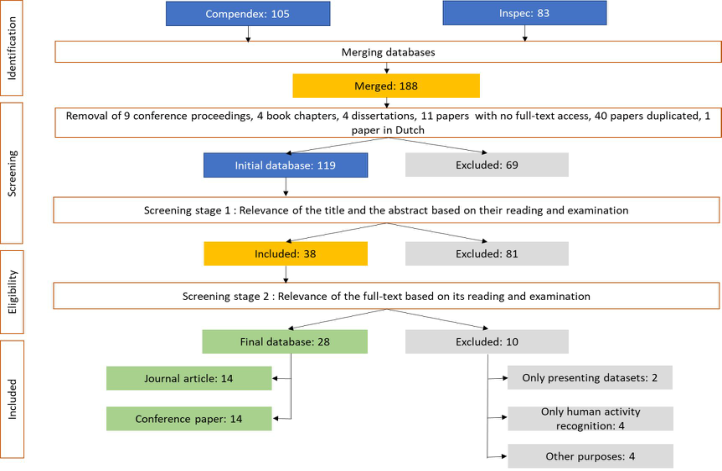
Figure 1: Summary review workflow.
To simplify our research, the exclusion criteria were:
Conference proceedings, book chapters, and dissertation
Papers with no full-text access;
Papers duplicated.
Concerning the screening by title, abstract, and full text, the following exclusion criteria were defined:
Papers focusing on daily living activities, fitness, sports, athletics, and clinical rehabilitation.
Papers proposing only frameworks for activity/posture recognition or body angle or joint torque estimation.
Papers presenting only datasets for working activities/postures.
Papers that were not relevant or out of scope.
Figure 1 summarizes the PRISMA workflow, the exclusion criteria, and the number of studies included in this literature review.
RESULTS AND DISCUSSION
The narrative review includes 28 papers divided into journal articles (14 out of 28) and conference papers (14 out of 28).
Excluding the current year, over 80% of the studies reviewed (23 of 28) were published in the previous five years (2018–2022). This trend confirms a recent and growing interest in this area of research.
The papers were analyzed according to several categories: WMSDs risk factors and data sources for AI development; principles, methods, standards,
Prevention of Work-Related Musculoskeletal Disorders Supported by Artificial Intelligence 207
and guidelines underlying the ergonomic assessment; AI strategy and algori- thms. Table 1 shows the papers in alphabetical order by authors.
WMSDs risk factors: In this review, all papers analyzed physical risk factors, and the most fre- quently assessed factor was the physical workload closely linked to physical fatigue. Recently, AI techniques have been used to classify physical fatigue states and prevent WMSDs. An SVM approach was introduced by Baghdadi et al. (2018) to identify variations in gait parameters recorded by weara- ble sensors and categorize the states into either fatigued or non-fatigued. In Hernandez et al. (2020), deep learning-based models were used to eva- luate the fatigue factor in manual material handling operations using 3D motion capture data. Manjarres et al. (2019) suggested a configuration com- posed of human activity recognition system and heart sensor to track physical workload.
Other studies have examined body posture as a physical risk factor. Some studies used wearable devices to evaluate the adoption of awkward postu- res during different tasks. In particular, the IMU sensors by Akanmu et al. (2022) and Villalobos et al. (2022), the insole sensors by Antwi-Afari et al. (2022), and the Flex sensors by Estrada et al. (2020) were proposed explicitly assessing tasks requiring awkward postures. Computer vision for ergonomic- postural assessment is also used for data collection and analysis. Chan et al. (2020) found classification accuracies of 80 to 90% when extracting and using the key joints of the human body and data augmentation. Chatzis et al. (2022) introduced a novel approach based on DL models for action segmentation in RGB-D images and subsequently for predicting the REBA ergonomic risk score during object manipulation actions. Cai et al. (2022) also evaluated the potential WMSDs in the construction sector by using vision-based extracted 3D skeletal poses of workers to evaluate the OWAS ergonomic risk score. In their study, Papoutsakis et al. (2022) developed a classification system to analyze posture-related risks based on visual data. Additionally, they assessed the relationship between physical load and heart rate activity.
There have been additional studies that shed light on different risk factors. Nath et al. (2017) developed a model that deploys built-in smartphone sen- sors and machine learning algorithms to recognize workers’ activities, and extract duration and frequency information, to evaluate ergonomic risks associated with each activity. Aiello et al. (2022) combined tri-axial accelero- meter data and a machine learning classifier to identify workers’ movements and assess the associated vibration risk exposure.
Ergonomic criteria: The ergonomic criteria quoted in the reviewed studies were heterogeneous. Some studies referred to the Borg Rating of Perceived Exertion (RPE), which is a subjective scale of perceived exertion used to rate the level of physical exertion during physical activity (Borg, 1970). By using the Borg scale to label gait data, Karvekar et al. (2019) developed machine learning models to
208 Sekkay
classify the individuals’ gait into two (no-vs. strong-fatigue) and four levels (no-, low-, medium-, and strong-fatigue). To assess manual lifting tasks, four studies considered the Revised NIOSH Lifting Equation (RNLE), a manual material handling risk assessment method associated with lifting and lowe- ring tasks. Donisi et al. (2022b, 2022c) presented tree-based machine learning algorithms to classify risk according to the RNLE (“No Risk” and “Risk”) by combining height, frequency, and weight variables of lifting tasks. Simi- larly, Zhou et al. (2021) proposed two different risk levels (safe (LI<1); unsafe (LI>1)) determined by the RNLE. They developed a prediction module con- sisting of a logistics regression model capable of distinguishing the injury risk levels induced by different levels of force exertion in common lifting tasks. Trkov et al. (2022) used RNLE to analyze six lifting activities, to demonstrate the ability of the machine learning classifier.
Two studies (Cai et al., 2022; Hida et al., 2022) used the Ovako Work Posture Analysis System (OWAS) as a reference to classify workers’ postures. The OWAS method is used to identify postures that are safe or unsafe and may result in WMSDs.
In this review, another guideline for ergonomics was identified to mitigate the risk of WMSDs, which is proposed by the Occupational Safety and Health Administration (OSHA) (Delp, et al., 2014). Antwi-Afari et al. (2020) asses- sed the ergonomic risk levels (“Low,” “Moderate”, and “High”) using OSHA standards based on the weight of the object. On the other hand, Nath et al. (2017) evaluated the same ergonomic risk levels by considering the duration and frequency of pushing/pulling, carrying/lowering/lifting activities.
Other studies used different principles, methods, standards, and guidelines for ergonomic risk assessment, in particular: Firmat’s score (Manjarres et al., 2019), ISO 5349–2001 (Aiello et al., 2022), ISO 11226–2000 (Antwi-Afari et al., 2021), Key Indicator Method for Manual Handling Operations (KIM- MHO) (Chan et al., 2020), Muri Ergonomic Waste tool (Papoutsakis et al., 2022), Postural Ergonomic Risk Assessment (PERA) (Akanmu et al., 2020), Rapid Upper Limb Assessment RULA (Rivero et al., 2015, Villalobos et al., 2022), Rapid Entire Body Assessment (REBA) (Chatzis et al., 2022). Few studies did not mention any known ergonomic methodology but pro- posed specific principles or categories based on experts’ knowledge: Estrada et al. (2020), Olsen et al. (2009), and Walsh, et al. (2006) classified the sitting posture as ergonomically correct and incorrect by using wearable sen- sors. Steiner, et al. (2009) specified different strain classes, and a respective working scenario has been created for each.
Artificial intelligence strategies: In the included articles, the distribution of the AI strategies adopted is as follows: fourteen studies applied ML, seven studies applied DL, four studies applied both ML and DL, and three studies applied FL. The most frequen- tly employed algorithms were Support Vector Machines (SVM) and Decision Trees (DTs), followed by Random Forest (RaF), k-Nearest Neighbors (KNN), AB AdaBoost tree, Long Short-Term Memory (LSTM), Linear Regression (LR), Gradient Boosted tree (GBT), Rotation Forest (RoF), Gated recurrent
Prevention of Work-Related Musculoskeletal Disorders Supported by Artificial Intelligence 209
Table 1. Analysis of the studies included in the review.
Table available in the original PDF paper.
Auteurs Data source for AI development
WMSDs risk factors
Ergonomic criteria
AI strategy (algorithms) ML (KNN) ISO 5349 (2001)
Aiello et al. (2022)
Tri-axial accelerometer
Hand-arm transmitted vibration
Akanmu et al. (2020)
N.S FL
IMU sensors Body posture PERA ML (Reinforcement learning algo.) Ani et al. (2019) N.S Physical workload Antwi-Afari et al. (2020) Insole sensors Repetition OSHA ML + DL (DT, RaF, KNN, SVM, ANN) Antwi-Afari et al. (2022)
Insole sensors Body posture ISO 11226 (2000) Borg Rating ML (SVM)
DL (LSTM, Bi-LSTM, GRU) Baghdadi, et al. (2018)
IMU sensors Physical workload Body posture KIM-MHO DL Cai et al. (2022) Videos Body posture OWAS DL (LSTM) Chan et al. (2020) Videos (public data collection+ recordings)
RGB images Body posture REBA DL Chatzis et al. (2022) Donisi et al. (2022b) EMG sensors Physical workload RNLE ML + DL (DT, RaF, RoF, AB, GBT) Donisi et al. (2022c)
EMG sensors Physical workload Flex sensors Body posture Experts ML (DT)
RNLE ML + DL (DT, RaF, RoF, AB, GBT) Estrada, et al. (2020) Borg rating DL (LSTM, GRU) Hernandez, et al. (2020)
Physical workload
HR sensors+ marker-based motion capture Body posture OWAS ML (KNN, SVM) Hida e al. (2022) Motion capture system
In terms of accuracy, several algorithms showed high values. Among the ensemble classifiers, RaF was the best algorithm showing accuracy values above 90%. According to Antwi-Afari et al. (2020), the accuracy in iden- tifying activities related to overextension was 97%. On the other hand, Manjarres et al. (2019) reported an accuracy of 97.7% in identifying acti- vities performed by volunteer participants. The best results for KNNs in the classification of hand-arm transmitted vibration exposure in terms of accu- racy (98%) were reached by Aiello et al. (2022). Another strong result is obtained from Antwi-Afari et al. (2022), detecting awkward posture using GRU and reaching an accuracy of 99%. Olsen et al. (2009) achieved an
Prevention of Work-Related Musculoskeletal Disorders Supported by Artificial Intelligence 211
accuracy rate of 99.94% using a KNN algorithm to categorize postures as ergonomically correct or incorrect.
CONCLUSION
This article presents a narrative review of the use of AI for WMSD preven- tion purposes, selecting 28 relevant studies from the scientific literature. The analysis highlighted a deep interest, which has grown in recent years, in using AI algorithms (mainly ML and DL) to monitor the physical risk factors to which workers are exposed during their activities. This review provides the researchers with a summary of the most recent applications of AI to reduce the risks of developing WMSDs.
REFERENCES
Aiello, G., Catania, P., Vallone, M., & Venticinque, M. (2022). Worker safety in agriculture 4.0: A new approach for mapping operator’s vibration risk through Machine Learning activity recognition. Computers and Electronics in Agriculture, 193, 106637. Akanmu, A. A., Olayiwola, J., Ogunseiju, O., & McFeeters, D. (2020). Cyber-
physical postural training system for construction workers. Automation in con- struction, 117, 103272. Ani, M. F., Fukumi, M., RahayuKamat, S., Minhat, M., & Husain, K. (2019). Development of driving fatigue strain index using fuzzy logic to analyze risk levels of driving activity. IEEJ Transactions on Electrical and Electronic Eng., 14(12), 1764–1771. Antwi-Afari, M. F., Li, H., Umer, W., Yu, Y., & Xing, X. (2020). Construction
activity recognition and ergonomic risk assessment using a wearable insole pres- sure system. Journal of Construction Engineering and Management, 146(7), 04020077. Antwi-Afari, M. F., Qarout, Y., Herzallah, R., Anwer, S., Umer, W., Zhang, Y., & Manu, P. (2022). Deep learning-based networks for automated recognition and classification of awkward working postures in construction using wearable insole sensor data. Automation in Construction, 136, 104181. Association of Workers’ Compensation Boards of Canada, (2018). 2014–2016
National Work Injury, Disease and Fatality Statistics. Baghdadi, A., Megahed, F. M., Esfahani, E. T., & Cavuoto, L. A. (2018). A machine learning approach to detect changes in gait parameters following a fatiguing occupational task. Ergonomics, 61(8), 1116–1129. Borg, G. (1970). Perceived exertion as an indicator of somatic stress. Scandinavian
journal of rehabilitation medicine. Cai, J., Li, X., Liang, X., Wei, W., & Li, S. (2022). Construction worker ergonomic assessment via lstm-based multi-task learning framework. In Construction Research Congress 2022 (pp. 215–224). Chan, Y. W., Huang, T. H., Tsan, Y. T., Chan, W. C., Chang, C. H., & Tsai,
Y. T. (2020). The risk classification of ergonomic musculoskeletal disorders in work-related repetitive manual handling operations with deep learning approa- ches. In 2020 International Conference on Pervasive Artificial Intelligence (ICPAI) (pp. 268–271).
212 Sekkay
Chatzis, T., Konstantinidis, D., & Dimitropoulos, K. (2022). Automatic Ergonomic Risk Assessment Using a Variational Deep Network Architecture. Sensors, 22(16), 6051. De Fazio, R., Mastronardi, V. M., De Vittorio, M., & Visconti, P. (2023). Weara-
ble Sensors and Smart Devices to Monitor Rehabilitation Parameters and Sports Performance: An Overview. Sensors, 23(4), 1856. Delp, L., Mojtahedi, Z., Sheikh, H., & Lemus, J. (2014). A legacy of struggle: the OSHA ergonomics standard and beyond, part I. NEW SOLUTIONS: A Journal of Environmental and Occupational Health Policy, 24(3), 365–389. Donisi, L., Cesarelli, G., Pisani, N., Ponsiglione, A. M., Ricciardi, C., & Capodaglio,
E. (2022a). Wearable Sensors and Artificial Intelligence for Physical Ergonomics: A Systematic Review of Literature. Diagnostics, 12(12), 3048. Donisi, L., Capodaglio, E., Pagano, G., Amitrano, F., Cesarelli, M., Panigazzi, M.
(2022b). Feasibility of Tree-based Machine Learning algorithms fed with surface electromyographic features to discriminate risk classes according to NIOSH. In 2022 IEEE International Symposium on Medical Measurements and Applications (MeMeA) (pp. 1–6). IEEE. Donisi, L., Cesarelli, G., Capodaglio, E., Panigazzi, M., Cesarelli, M., & D’Addio, G.
(2022c). Machine Learning and Biosignals are able to discriminate biomechanical risk classes according to the Revised NIOSH Lifting Equation. In 2022 IEEE Inter- national Conference on Metrology for Extended Reality, Artificial Intelligence and Neural Engineering (MetroXRAINE) (pp. 346–351). IEEE. Estrada, J. E., & Vea, L. A. (2020, March). Real-Time Human Sitting Position Recognition using Wireless Sensors. In Proceedings of the 2020 2nd International Conference on Image, Video and Signal Processing (pp. 133–137). Grandjean, E. (1986). Ergonomics in computerized offices. CRC Press. Hernandez, G., Valles, D., Wierschem, D. C., Koldenhoven, R. M., Koutitas, G.,
Mendez, F. A., ... & Jimenez, J. (2020). Machine learning techniques for motion analysis of fatigue from manual material handling operations using 3D motion capture data. In 2020 10th Annual (CCWC) (pp. 0300-0305). IEEE. Hida, T., Okada, T., & Matsumoto, T. (2022). Work postural ergonomic assessment using two-dimensional joint coordinates. Journal of Advanced Mechanical Design, Systems, and Manufacturing, 16(5), JAMDSM0055-JAMDSM0055. Karvekar, S., Abdollahi, M., & Rashedi, E. (2019). A data-driven model to identify
fatigue level based on the motion data from a smartphone. BioRxiv, 796854. Maman, Z. S., Chen, Y. J., Baghdadi, A., Lombardo, S., Cavuoto, L. A., & Megahed, F. M. (2020). A data analytic framework for physical fatigue management using wearable sensors. Expert Systems with Applications, 155, 113405. Manjarres, J., Narvaez, P., Gasser, K., Percybrooks, W., & Pardo, M. (2019). Phy-
sical workload tracking using human activity recognition with wearable devices. Sensors, 20(1), 39. Moher, D., Liberati, A., Tetzlaff, J., Altman, D. G., & Prisma Group. (2009).
Reprint—preferred reporting items for systematic reviews and meta-analyses: the PRISMA statement. Physical therapy, 89(9), 873–880. Nath, N. D., & Behzadan, A. H. (2017). Construction productivity and ergonomic assessment using mobile sensors and machine learning. In Computing in civil engineering 2017 (pp. 434–441). Nunes, I. L., & Bush, P. M. (2012). Work-related musculoskeletal disorders asses-
sment and prevention. Ergonomics-A Systems Approach, 1, 30. Olsen, G. F., Brilliant, S. S., Primeaux, D., & Najarian, K. (2009). Signal processing and machine learning for real-time classification of ergonomic posture
Prevention of Work-Related Musculoskeletal Disorders Supported by Artificial Intelligence 213
with unobtrusive on-body sensors; application in dental practice. In 2009 ICME International Conference on Complex Medical Engineering (pp. 1–11). IEEE. Pancardo, P., Hernández-Nolasco, J. A., & Acosta-Escalante, F. (2018). A fuzzy logicbased personalized method to classify perceived exertion in workplaces using a wearable heart rate sensor. Mobile Information Systems, 2018. Papoutsakis, K., Papadopoulos, G., Maniadakis, M., Papadopoulos, T., Lourakis,
M., Pateraki, M. (2022). Detection of Physical Strain and Fatigue in Industrial Environments Using Visual and Non-Visual Low-Cost Sensors. Techno., 10(2), 42. Public Health Agency of Canada, (2018). The Economic Burden of Illness in Canada, 2010. https://www.canada.ca/content/dam/phac-aspc/documents/servic es/publications/science-research/economic-burden-illness-canada-2010/econom ic-burden-illness-canada-2010.pdf Rivero, L. C., Rodríguez, R. G., Pérez, M. D. R., Mar, C., & Juárez, Z. (2015). Fuzzy
logic and RULA method for assessing the risk of working. Pro. Manufacturing, 3, 4816. Steiner, H., Reinert, D., & Jung, N. (2009). Combined Measurement System for the Evaluation of Multi Causal Strain. In Ergonomics and Health Aspects of Work with Computers: International Conference, EHAWC 2009, Held as Part of HCI International 2009, San Diego, CA, USA, July 19-24, 2009. Proceedings (pp. 186– 194). Springer Berlin Heidelberg. Subedi, S., & Pradhananga, N. (2021). Sensor-based computational approach to
preventing back injuries in construction workers. Automation in Construction, 131, 103920. Trkov, M., Stevenson, D. T., & Merryweather, A. S. (2022). Classifying hazardous movements and loads during manual materials handling using accelerometers and instrumented insoles. Applied Ergonomics, 101, 103693. Villalobos, A., & Mac Cawley, A. (2022). Prediction of slaughterhouse workers’
RULA scores and knife edge using low-cost inertial measurement sensor units and machine learning algorithms. Applied Ergonomics, 98, 103556. Walsh, P., Dunne, L. E., Caulfield, B., & Smyth, B. (2006, August). Marker-based monitoring of seated spinal posture using a calibrated single-variable threshold model. In 2006 international conference of the IEEE engineering in medicine and biology society (pp. 5370–5373). IEEE. Yu, Y., Li, H., Yang, X., & Umer, W. (2018). Estimating construction workers’
physical workload by fusing computer vision and smart insole technologies. In ISARC. Proceedings of the International Symposium on Automation and Robotics in Construction (Vol. 35, pp. 1–8). IAARC Publications. Zhou, G., Aggarwal, V., Yin, M., & Yu, D. (2021, October). Video-based AI Decision Support System for Lifting Risk Assessment. In 2021 IEEE International Conference on Systems, Man, and Cybernetics (SMC) (pp. 275–282). IEEE.
LISTED IN THE AHFE DIGITAL BOOKSTORE CATALOGUE
Explore the complete digital volume
Human Interaction and Emerging Technologies (IHIET-AI 2023): Artificial Intelligence and Future Applications
Read this individual research paper free through the original publisher, or explore the full digital proceedings book.
ISBN 978-1-958651-46-9
Explore this ISBN in the AHFE Bookstore ↗Listed in the July 2026 bookstore catalogue; search by ISBN to confirm current availability · Digital book purchase optional