Jagannath Kallakurchi, Pradipta Banerji (2023). Personalized Learning Path (PLP) – "App" for improving academic performance and prevention of dropouts in India. In: Human Interaction and Emerging Technologies (IHIET-AI 2023): Artificial Intelligence and Future Applications. AHFE Open Access, vol. 70, pp. 108–117. https://doi.org/10.54941/ahfe1002935
Personalized Learning is an evolving trend in many schools in the United States and globally. However, an earlier study showed that personalized tutoring positively affected students' achievement. A tutor can quickly and competently evaluate students' capacities and needs and suggest appropriate instruction, resulting in students' academic performance. Studies have found that digital tools in education are efficient, such as digital tutors, digital assessments, and student-centric curricula can support student achievement similar to what is done by skilled human tutors. A PLP App developed with AI, specifically to address issues relevant to India, is presented in this paper that provides precise help to students from across the spectrum who need additional support in understanding any subject and concepts and wish to improve academic performance. This PLP App helps teachers identify gaps in knowledge and understanding of subjects among students and support them with technology-enabled tools to bridge the gap. This is done using Coherence maps between different levels of learning in concepts in specific subjects, which address gaps in learning that cannot be easily addressed in any other manner by both students and teachers. It doesn't just tailor learning, keeping the differences among learners in mind; it also shifts the weight of students' progress from the teacher and divides it between the students and teachers. The PLP App considers the conditions of Learning, such as the motivation of the student, the associated feelings of autonomy, ability, and relevance of the Learning. Setting goals and receiving feedback are essential parts of the learning process. The learning path created by the Coherence maps is a concrete, visualized, and easily understandable list of goals designed to guide students from their current level of knowledge to a higher level of competence. Self-assessment and peer review, coupled with the learning path, help students better understand their skills and increase their sense of autonomy and ownership in Learning. Students should have personal learning paths to encourage them to set and manage their academic goals. The data relating to each student is captured on an ongoing basis by the PLP App to ensure all student performance data is recorded in the system to provide most accurate understanding of the level of knowledge. The PLP software also supports teachers' plans and students' preferences by keeping past track records. Observation and monitoring of benchmarks allow the teacher to assign additional content to the student for better performance. The drop-out of students from schools in India has many reasons. They include understanding the subject or content, personal reasons, economic reasons, and many other reasons. However, it has been established by earlier studies that a significant part of the reason for drop-outs is a failure in specific courses, such as Mathematics and English. The PLP App at least addresses the understanding of the subject content, which should at least reduce the drop-outs due to failure in specific courses.
Digital tools that customize Learning tasks are apt to provide desired instru- ction in the Zone of Proximal Development (ZPD) (Vygotsky, 1978). The ZPD has a range of tasks based on students’ capabilities to complete in time. The lower limit defines how a student can accomplish the task independently. The upper limit is what a student can achieve with a skilled partner or tutor. Research has shown that learning activities within the ZPD range are ideal for student learning (Clapper, 2015; Clara, 2017; Walshaw, 2017).
Personalized Learning has existed for the past few decades; the engaging strength of technology and powerful tools for assessment and individualizing instruction have added new benefits to modern-day Personalized Learning.
Student-centered Learning is the crux of modern Education. It doesn’t just tailor Learning, keeping the differences among learners in mind; it also shifts the weight of students’ progress from the teacher and divides it between the students and teachers. A student’s development no longer depends on the teacher delivering lectures and students receiving them irrespective of their interest and understanding. Students now get to choose what they learn and how they learn, leading to the emergence of learning pathways that improve students’ cognitive abilities over time.
Personalized Learning is a teaching ideology, a Finnish version of the inter- nationally renowned concept of reversed or ‘flipped’ Learning. It provides a theoretical framework for how each learner can be treated individually at a practical level, despite schools often having large and heterogeneous classes.
The PLP model considers the conditions of Learning. They include aspects such as the student’s motivation, the associated feelings of autonomy, ability, and relevance of the Learning.
The personalized learning model uses practical tools to help students gain more ownership of their Learning. The aim is to increase motivation and commitment to Learning, acknowledging that the students often have a more robust understanding of what they are capable of and what drives them to succeed. An individual learning path and the associated self-assessment are critical to this.
The idea of individual Learning is easiest to implement when one class teacher works with the same group of students throughout an academic year. Classes have multiple teachers, particularly in different subjects and large schools, so long-term and deep-seated learning strategies require close cooperation between teachers themselves and between teachers and students.
The biggest challenges for personalized Learning come from the current institutional culture of schools and organized teaching. The curriculum-based model introduces subjects individually for a short period, two to three times a week. Another challenge is agreeing to a typical standard mastery level in an education system where heterogeneous teaching methodologies are prevalent. If change can bring uniformity to all the education standards present in the country concerning standardizing the mastery levels, it would revolutionize Education for generations to come.
Setting goals and receiving feedback are essential parts of the learning pro- cess. The learning path is a concrete, visualized, and easily understandable list
110 Jagannath and Banerji
of goals designed to guide students from their current level of knowledge to a higher level of competence. Self-assessment and peer review, coupled with the learning path, help students better understand their skills and increase their sense of autonomy and ownership in Learning.
Students should have personal learning paths to encourage them to set and manage their academic goals. While it is daunting for most students to start personalizing their Learning completely, teachers can help by customizing some suggested learning pathways that offer students choice in how they learn. Teachers can also play a pivotal role in assisting students in perso- nalizing their Education by guiding them in creating Personalized Learning Pathways that are suitable to that individual based on their learning pat- terns in the past and their performance across the years of their academic pursuit.
BACKGROUND OF THE STUDY The Personalized Learning Growth Areas
The assessment and response to individual learners’ thinking and personality and other learner states using adaptive technologies (Bernacchi & Walking- ton, 2018). The best practices for personalization are to support Learning, strategies, and balance using technology and non-technology-based learning activities (Patrik, Worthen, 2016). A personalized system is a system of instru- ctional practices which look into the needs and goals of individual students and consists of the following:
Use of competency-based progressions: Students work towards set goals at their own pace and move up competency levels as they demonstrate their knowledge (Paquette, 2007; Popham, 2007).
Personal learning paths: All the students follow a tailor-made path that responds and adapts based on their learning progress, goals, and motiva- tion (Black & William, 1998; Heritage, 2008; Koszalka et al., 2013).
Frequent informal and formal measurement: Students’ progress, area of need, and goals are frequently measured.
Frequently updated student profiles: All students have up-to-date records of their progress, needs, and goals (Pea et al., 2014).
Learners would be more invested in the journey when active participants draft the pathway from start to end. Personalized learning pathways consist of the following:
1. Laying out objectives: With the combined efforts of the teacher and stu- dent, a learning plan and objectives for Learning agree. Clear-cut goals help constitute a clear-cut plan. When laying out objectives in a per- sonalized learning path, students must create timelines to achieve the objectives. 2. Resources: Keeping in mind their interest and understanding levels, tea- chers may suggest the content and learning resources the student decides
Personalized Learning Path (PLP) – “App” 111
to learn. These resources may extend beyond classes to online resources, discussions, and presentations. 3. Flexibility: A personalized learning pathway encompasses flexible lear- ning methods while giving students space and time to learn at their own pace. Students can develop their learning pathways when Learning is flexible, not bound by time or curriculum. 4. Assessment: Timely assessments to take stock of progress made don’t just encourage students to continue the journey with zeal; it also helps make necessary changes to the personalized pathway, ensuring the plan’s effectiveness.
Features of a Good Personalized Learning Pathway
1. Equal participation from the teacher and the student. 2. Objectives and goals are specific, measurable, time-bound, and realistic. 3. All aspects of a student’s well-being as a child are in the plan. 4. The pace of Learning can be flexible with time, depending on the need for development. 5. Easily accessible. 6. The students focus on more than curriculum and year-end examinati- ons. The learnings also last beyond the classroom and the end of the semester. 7. Learning resources are flexible, accessible, and affordable. 8. Pushes students out of their comfort zone for higher performance 9. Timely assessment. 10. Clear and Concise.
Benefits of Personalized Learning Pathways
1. Personalized learning pathways require students to be involved in their learning journey. It encourages students to take charge of their Learning and be active participants instead of passive listeners. 2. Schools get to record learner profiles to help them understand and cater to student needs further. 3. It considers a student’s strengths, weaknesses, interests, and driving factors, making each student feel noticed and understood. 4. Classrooms are not limited to school walls since Learning may occur through any resource or environment. 5. Students get the liberty to pursue their interests. 6. Traditional ideas of Education, limitations to curriculum, and learning choices change. 7. Students develop an increased interest in Learning and learn to lead and compete.
As more and more schools adopt the equity approach in classrooms, there has been a significant increase in personalized learning pathways. With clear-cut objectives and a defined pathway, students take ownership and are encouraged to excel.
112 Jagannath and Banerji
Workflow and Data
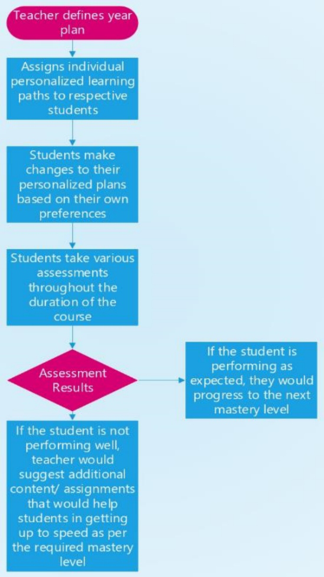
Figure 1: Workflow of Personal learning path.
Data Capture The data relating to each student is captured continuously to ensure all the student performance data is recorded in the system to provide the most accurate readings. All historical data for each student would be loaded befo- rehand to ensure each student’s system can create the most accurate learning path. The PLP software supports teachers’ plans and students’ preferences by keeping past track records. The observation and monitoring of bench- marks allow the teacher to assign additional content to the student for better performance.
Once the resources are assigned, the teacher can regularly assess the stu- dent’s performance to improve in those areas. After reassessing the student’s performance, the teacher can see the student’s current status, keep monitoring the student’s progress continuously & keep making changes to the content and the path based on the need & desires of the student.
Process Followed to Collect the Test Data From the School for Classes 6 to 10 The approach adopted was to reach out to one of the known schools in Hyde- rabad, India, where the school management, teacher, and administration staff
Personalized Learning Path (PLP) – “App” 113
cooperate to share the student information and their examination results. The data collection is of students studying between class 6 to class 10. The school follows the CBSE curriculum. The subject chosen is Mathematics for testing and implementation. The collected data will help to build coherence maps for different topics in Mathematics. The coherence map is part of the software which provides information about a student’s academic performance. It links to ZPD levels of topics above and below the student’s competency level so that the student can manage their competency levels on a topic on an ongoing basis.
The data provided by the school is for 41 students between classes 6 to class 8 and 24 students for classes 9 and 10. The live data is sufficient for testing the software at an alpha level. The software – APP will help evaluate and provide the correct information.
Before software development, a manual process is followed to map each line item of the topics in the syllabus to map the inter-dependency of the knowledge. The mathematics teachers from class 6 to class 10 verified and informed that inter-dependency mapping is correct.
Testing the PLP software with production data is critical for knowing the software’s success at the alpha level before progressing to the beta level. The alpha level is defined as software and test data readiness using real-time data. The beta level is after successful testing with real-time data and before going live in the customer environment.
Challenges in Data Collection The success of PLP software “APP” depends on the data’s quality. In the personalized learning path project, collecting data from school plays a vital role—the primary challenge of collecting the second-level details of data about test results. In the PLP software, the grade book/report card, the asses- sment results use the marks/grades obtained on conducting tests individually on a set of units/concepts/ topics.
Difficulties Faced While Collecting Data The essential premise is that the school follows the CBSE curriculum rules completely and conducts examinations without deviations.
The data required initially has to be accurate for testing purposes and pro- vide insights into students’ academic performance. The process followed is manual initially. The critical element is clarity in communication and patience for the person interacting with the school authorities. The teacher’s under- standing of the need for quality data input into the PLP “APP” is critical. The teacher and administration’s participation in certifying is an essential compo- nent of the process to achieve desired results to benefit the students in their academic performance.
The person interacting with the school administration and teachers must know the correct requirements for the successful implementation of PLP sof- tware at the school level. One must be extremely cautious, as data must be collected in total in their present and past examination results, which are uploaded manually into the software in the first phase. It is essential to train
114 Jagannath and Banerji
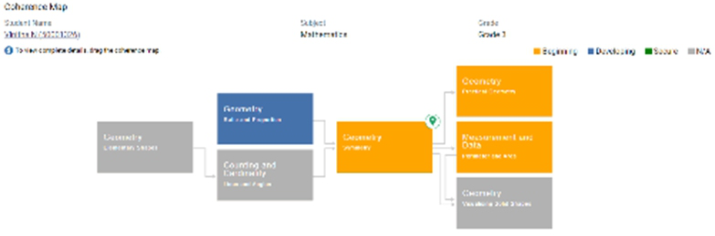
Figure 2: Student’s coherence map.
the teachers regarding the functioning of the PLP software. The training inclu- ded how data needed to be fed into the system. The training is essential before the software implementation, and testing is completed as per agreement.
One of the key observations is that the data quality is compromised when a teacher changes during the academic year or a new teacher is introduced into the system. The understanding of student capabilities and Learning may be different with different teachers. The software implementation team should constantly interact with the teachers for one year until the teacher under- stands implementation and can analyze the data to support students in their Learning. The coherence map displays the previous two related topics and the following two related topics so that the teacher can see a student’s academic progress.
Figure 2 displays the Coherence Map for a specific student. It is a map of all the topics the student has learned & will learn in a particular subject. The coherence map will enable the teacher to identify where the student star- ted to perform below par. The teacher can take remedial actions by making the student understand the essential topics clearly and solving the problem at its roots rather than focusing on the current topic so that the student’s competency is brought to par in partnership between the student and the teacher.
The Criteria for Collecting Data for Analysis for Alpha/Beta Testing of Software – PLP “APP” The criteria adapted to collect the academic performance information are:
Students currently must be attending classes
Examinations are followed as per the CBSE guidelines, as currently only the CBSE curriculum is considered in the APP
The teacher knows the student’s active participation is in synchronization with the examination results during all examinations
The school conducts all prescribed examinations as per CBSE procedures
Requested to provide information and data relating to any deviations to the rule book of CBSE for helping students taking re-examinations
Data is initially captured manually to feed into the student database, and the teacher certifies it to be correct.
Personalized Learning Path (PLP) – “App” 115
Table 1. Possible change in academic performance.
Table available in the original PDF paper.
S. No Band Number No. of topics in a subject Possible change in academic performance with PLP(%) 1 I 1 3 2 II 2–3 9-12 3 III 4–6 13-25 4 IV Seven and above >25
Technical Requirements for Using PLP “APP” - Specifications The software implementation is hosted on the cloud with a service provider with adequate data protection and security services providing 24 × 7 service. The service provider should be able to provide services per the norms defined and required by the school authorities. For example, the service provider should provide 99.99% uptime, data security for any possible viruses, and data hacking on the compromise of information.
The PLP “APP” software is device agnostic as it can be used with mobile phones, laptops, desktops, and handheld devices. The hardware requirement is a device which an i3 processor or an equivalent that has 4MB RAM, 32 GB of storage memory, proper internet connection, and electricity for the network devices to function effectively.
The PLP “APP” is hosted on the cloud and is built on the Microsoft Azure platform. The school must procure adequate software licenses per the requirements for using PLP as per the educational institution’s needs.
PLP – Tangible Benefits on Academic Performance of the Student (Possible Range and Indicators) When the school adapts the PLP-based “APP,” the input data must be accu- rate. The minimum input data for better analysis is six months and above. Better results are expected in a student’s academic performance in a given subject with more input of data and monitoring of the student’s progress. The current context is related to mathematics subject.
As per CBSE guidelines, in mathematics, there are 10 to 12 topics betw- een classes 6 to 10. The minimum assigning weightage per topic is three percent, and the maximum is 12%. The topic may have questions with a mark’s weightage of 1, 2, 3, 4 and 5 for each of the short or long answers.
When the teacher identifies the specific help required for a given student based on the current situation of the student’s performance, and the acade- mic help provided to the student with PLP usage and implementation, there are possible changes in academic performance expected over time, as per Table 1. It is possible only when the student thoroughly follows the teacher’s instructions.
The topics can be further divided into four bands for a given class between 6 to 10. Each band has one or more related topics. The above possible results are expected based on the help required for a given student identified by a trained teacher. The teacher must monitor the progress while the student attempts the quiz at the end of each learning session.
116 Jagannath and Banerji
Limitations of the PLP – “APP”?
PLP cannot replace a teacher.
The student has to follow the teacher’s instruction in a true sense.
The student is provided freedom and a pace of Learning. It should be used properly.
The student must take the quiz(s) and should not skip. It is one of the critical indicators of student learning and gaining knowledge.
Teacher-student interaction should be done in person. If this interaction does not happen periodically, the progress cannot be seen, and the correct data is not captured in the system accurately.
Students must own and be sincere in their Learning and improve their academic performance during the following quiz.
PLP’S Role in Enablement Dropouts Dropouts have many reasons. They include understanding the subject or con- tent, personal reasons, economic reasons, and many other reasons. In the current educational environment, the study of the usage of digital devices and content has gained popularity.
Digital tools have helped students across the segments to be in touch with the desired content remotely. Teachers can help students to create their lesson plans, the pace of Learning, the place of Learning, and the point at which student has been absent.
The current digital content has much pictorial information making stu- dents more interested and generating curiosity, ensuring fewer dropouts, increasing student understanding, and improving performance.
The PLP provides more interaction with teachers with constant atten- tion, enhanced student-teacher interaction, and on-time doubt clarifications, which will help students be more involved than in the current educational environment.
The study also provided that using digital tools and devices during the pandemic has given rise to usage and learning methodologies for better participation of students, understanding of the subject, and privacy.
CONCLUSION
The primary objective of a personalized learning path is to enable the learner (student) to learn the topics as thoroughly as possible, which helps to reach the next level. If a student needs to improve in a higher standard/ class/ topic in a subject, there must be a cascading effect in not having good basics. Under- standing the related topics in the same or previous class-related curriculum leads to a lack of the subject. Hence, it is paramount for the teacher to cor- rect the root level and cement the student’s basics before learning higher-level concepts/topics.
As every student has unique abilities, it is the responsibility of the teacher and school to augment student learning capabilities to match the pace of Learning. The personalized learning solution will fulfill the teacher’s student Learning objective by focusing on individual students’ abilities. The teacher needs to provide students with resources to bring them up to speed while monitoring & adapting regularly.
Personalized Learning Path (PLP) – “App” 117
The PLP software is in no way attempting to replace any of the activities or decisions of the teacher. It facilitates teachers to know every student’s exact position and learning capabilities based on their current and previous years’ assessment results. It suggests relevant learning resources for teachers to make the right decisions for students.
In structured countries, personalized learning paths successfully make the students learn the concepts and master them in their curriculum standards. India is becoming no different from structured countries in the global educa- tion environment. Our New Education Policy is defined, and the demands are similar in raising children’s learning capabilities to international standards.
Given the changing times, the personalized learning path software solu- tions will open the portals of a new learning system through individualized and collaborative teaching and learning for the overall growth of our Indian students.
REFERENCES
Bernacki, M. L., & Walkington, C. (2018). The role of situational interest in personalized Learning. Journal of Educational Psychology, 110(6), 864. Black, P., & Wiliam, D. (2010). Inside the black box: Raising standards through
classroom assessment. Phi delta kappan, 92(1), 81–90. Boekaerts, M. (2007). Understanding students’ affective processes in the classroom.
In Emotion in Education (pp. 37–56). Academic Press. Clapper, T. C. (2015). Cooperative-based Learning and the zone of proximal development. Simulation & Gaming, 46(2), 148–158. Clarà, M. (2017). How instruction influences conceptual development: Vygotsky’s
theory revisited. Educational Psychologist, 52(1), 50–62. Heritage, M. (2008). Learning progressions: Supporting instruction and formative assessment. Washington, DC; Chief Council of State School Officers. Koszalka, T. A., Russ-Eft, D. F., & Reiser, R. (2013). Instructional designer
competencies: The standards. IAP. Patrick, S., Worthen, M., Frost, D., & Gentz, S. (2016). Promising State Policies for Personalized Learning. International Association for K-12 Online Learning. Paquette, G. (2007). An ontology and a software framework for competency mode-
ling and management. Journal of Educational Technology & Society, 10(3), 1–21. Pea, R., & Jacks, D. (2014). The learning analytics workgroup: A report on building the field of Learning analytics for personalized Learning at scale. Retrieved from https://ed.stanford.edu/sites/default/files/law_report_complete_09-02-2014.pdf Popham, W. J. (2007). The lowdown on learning progressions. Educational Leader-
ship, 64(7), 83. Vygotsky, L. S. (1978). Mind in society: The development of higher psychological processes. Harvard university press. Walshaw, M. (2017). Understanding mathematical development through Vygotsky.
Research in Mathematics Education, 19(3), 293–309. Zimmerman, B. J. (2008). Investigating self-regulation and motivation: Historical background, methodological developments, and future prospects. American educational research journal, 45(1), 166–183. Zimmerman, B. J., & Schunk, D. H. (2011). Self-regulated learning and performance:
An introduction and an overview. Handbook of self-regulation of Learning and performance, 15–26.
LISTED IN THE AHFE DIGITAL BOOKSTORE CATALOGUE
Explore the complete digital volume
Human Interaction and Emerging Technologies (IHIET-AI 2023): Artificial Intelligence and Future Applications
Read this individual research paper free through the original publisher, or explore the full digital proceedings book.
ISBN 978-1-958651-46-9
Explore this ISBN in the AHFE Bookstore ↗Listed in the July 2026 bookstore catalogue; search by ISBN to confirm current availability · Digital book purchase optional