Elham Ghorbani, Samira Keivanpour, Firdaous Sekkay, Daniel Imbeau (2024). Fuzzy Ergonomic Expert System for Assembly Line Design Problem. In: Accessibility, Assistive Technology and Digital Environments. AHFE Open Access, vol. 121, pp. 250–260. https://doi.org/10.54941/ahfe1004634
In the era of Industry 5.0, prioritizing ergonomics in manufacturing systems is crucial. Assembly Line Balancing Problems (ALBPs) are integral to efficient manufacturing, optimizing lines to eliminate bottlenecks and enhance productivity. Recent developments emphasize Ergonomic ALBPs (Ergo-ALBPs) and the integration of Human Factors and Ergonomics (HFE) to address ergonomic risks. A research gap exists in applying ergonomic considerations in the design phase known as Ergo-ALDPs as corrective ergonomic interventions cost significantly more than preventive measures taken during the design phase. This study presents a novel approach, the fuzzy Ergo-ALDP, which extends the Ergo-ALBP to handle imprecise task times and ergonomic risks in the design phase.It introduces a fuzzy ergonomic expert system, utilizing fuzzy logic and Digital Human Modeling (DHM) to simulate worker interactions in assembly line optimization. The proposed fuzzy Ergo-ALDP addresses this gap with a constructive heuristic integrated with fuzzy logic, emphasizing feasibility. Our research introduces a unique fuzzy ergonomic assessment method to evaluate task, workstation, and assembly line ergonomics using an expert system. We validate this approach using one synthesized numerical instance. This research contributes to assembly line optimization, aligning with Industry 5.0's human-centric vision. The comprehensive fuzzy ergonomic assessment model bridges gaps and optimizes ALDPs under uncertainty, promising improvements in productivity, worker satisfaction, and operational efficiency. By addressing the intersection of ergonomics, uncertainty, and assembly line optimization, this paper significantly contributes to advancing the field and promoting a safer and more efficient manufacturing environment.
Assembly lines play a crucial role in manufacturing, ensuring efficient pro- duction in response to market demands. Assembly Line Balancing Problems (ALBPs) optimize these lines, aiming to eliminate bottlenecks and enhance productivity. The historical evolution of optimization problems, initially formulated as Linear Programming (LP) models since 1955 by Salveson, wit- nessed the introduction of solution approaches in 1961 by Halgeson and Birnie. After that for decades, historical developments primarily revolved
Fuzzy Ergonomic Expert System for Assembly Line Design Problem 251
around LP models and trial-and-error techniques. In recent times, the emer- gence of Ergonomic Assembly Line Balancing Problems (Ergo-ALBPs) has emphasized the necessity to address ergonomic risks in assembly tasks, expanding the scope beyond traditional optimization approaches.
While traditional ALBPs concentrate on operational efficiency, the repeti- tive nature of tasks introduces ergonomic risks, leading to increased Muscu- loskeletal Disorders (MSDs), errors, and absenteeism, ultimately affecting productivity. The integration of Human Factors and Ergonomics (HFE) becomes essential to prevent injuries, resulting in the inception of Ergo- ALBPs. Gunther et al. (1983) pioneered the consideration of ergonomics risks in ALBPs, and subsequent efforts by Otto and Scholl (2011) have motivated further exploration of Ergo-ALBPs.
Existing Ergonomics Assessment Tools (EATs), including OCRA, REBA, and RULA, have contributed significantly to ergonomic standards. However, these tools face limitations in evaluating cumulative risk at each workstation and the entire assembly line. Despite the growing importance of consid- ering ergonomic aspects during assembly line planning, a critical research gap exists in applying these considerations to assembly line design prob- lems (Ergo-ALDPs). Neglecting ergonomic aspects in the design phase can lead to health-related issues, necessitating corrective actions that can cost significantly more than preventive measures taken during the design phase (Falck and Rosenqvist, 2014). However, the incorporation of ergonomic aspects in ALDP is not a straightforward process, and uncertainties must be addressed during the design phase. Such uncertainties arise from both environmental factors, such as market demand, and system factors, includ- ing task time variability and operator capacity. Furthermore, imprecision in EAT outputs results from subjective evaluations prone to errors due to practitioners’ personal views and workers’ characteristics (Ghorbani et al., 2023b). Limited research has explored Ergo-ALDPs, leaving a gap in addressing uncertainties arising from environmental and system factors (Ghorbani et al., 2023a).
To fill these gaps, this research introduces a fuzzy ergonomic expert system to assess vague ergonomic aspects during the design phase. The proposed system utilizes fuzzy logic to evaluate imprecise ergonomic fac- tors, providing a balanced and ergonomically friendly work environment. Additionally, Digital Human Modeling (DHM) is integrated to simulate worker interactions within assembly lines, offering a comprehensive analy- sis and predictive capabilities to identify ergonomic issues early in the design process.
The DHM plays a crucial role in ergonomic assessment by providing a unique possibility to evaluate risks for a worker before an assembly line is built. It allows for the determination of risk and acceptability of design very early in the product development cycle. DHM software offers a significant number of biomechanical and anthropometrical data, enabling the comparison of different scenarios in a measurable way (Bourret et al., 2021). While DHM has significantly improved human factor engineering and ergonomic risk assessment, most studies focus on DHM for work- place and tool designs, with limited exploration of their application in
ALBPs (Bortolini et al., 2017). Popular DHM software like Dassault Delmia, Siemens, and Jack exist but have limitations, highlighting a research gap in integrating DHM and ergonomic simulation into assembly line optimization (Ozdemir et al., 2021). The proposed fuzzy Ergo-ALDP addresses this gap with a two-phase framework, combining a constructive heuristic approach and a fuzzy ergonomic expert system. The framework assesses ergonomic risks at various levels, categorizing them into three levels (task level, worksta- tion level, and assembly line level) and integrating them into the optimization model.
Validation using a numerical example confirms the proposed method’s capability to identify high-quality solutions, showcasing its potential to enhance productivity, worker satisfaction, and operational efficiency. This study contributes to assembly line optimization by incorporating ergonomic considerations and managing uncertainty through fuzzy logic, aligning with the human-centric vision of Industry 5.0. The comprehensive fuzzy ergonomic assessment model aims to bridge existing research gaps and optimize ALDPs under uncertain conditions.
In the following section of this manuscript, the optimization model is presented. Then, the solution approach is proposed in the next one. After providing a numerical example and explaining the practical perspective of this study, in the final section the concluding remarks are discussed.
PROBLEM CONTEXT In the Ergo-ALDP, the optimization model must account for two types of uncertainty, as discussed earlier. During the design phase, the nature of Cycle Time (CT) is not deterministic, given the imprecision in takt time derived from a variable demand rate. Furthermore, task execution times exhibit vari- ability influenced by the worker’s skill and experience level. Additionally, ergonomic risk factors remain ambiguous due to the lack of precise deter- mination of work situations and task performers during the planning step. Workstation characteristics (e.g., force required for tool usage, lifting parts, types of tools, physical dimensions, task repetition, and frequency) and oper- ator attributes (e.g., age, gender, experience, skill, physical capacity, and training) contribute to the varying ergonomics risk levels for each task. This section outlines the optimization problem that incorporates fuzzy ergonomics parameters to address Ergo-ALDP.
The initial mathematical problem is Simple ALBP (SALBP) that focuses on one-sided straight assembly line that mass-produces a single-type product with a deterministic CT to optimize the desired objective while considering precedence and time constraints. The optimization problem in this study aims to find the minimum ergonomic risk level across all workstations. Further- more, this problem is a sort of Type F, meaning to find Feasible Solutions (FSs) based on defined CT and the number of workstations. Table 1 presents the notations of this optimization model.
Fuzzy Ergonomic Expert System for Assembly Line Design Problem 253
Table 1. Notations of mathematical model of Ergo-ALDP.
Table available in the original PDF paper.
Sets Indexes Set of tasks: I Indices for tasks: i, i’ ∈{1, …, n} Set of stations: W Indices for workstations: j, j’, j” ∈{1, …, m} Set of predecessors of task i: Pi Parameters Fuzzy execution time of task i:eti Fuzzy risk of task i based on the DHM output:eri Fuzzy CT: f CT Decision Variable
Equations and mathematical formulas are available in the original paper PDF.
The constraints of the proposed optimization problem can be defined as follow:
Equation 1 ensures that each task i is assigned to only one workstation. In equation 2, the fixed number of available workstations is checked. Constraint 3 defines the sequence of workstations based on the precedence relations between tasks. Constraints 4 and 5 ensure that the location of workstations adheres to the principles of transitivity and anti-symmetry, resulting in work- stations being in a linear order. Constraint 6 verifies that the total operation time does not exceed the CT. Finally, the last equation indicates that decision variables xij, yj, and zjj’ are binary variables.
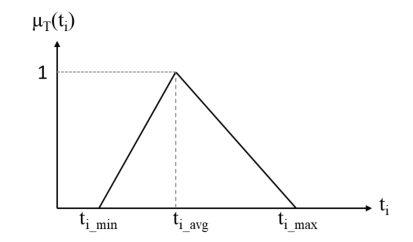
As equation 6 illustrates, in this problem, the execution time of tasks and CT are considered as fuzzy numbers to show the uncertainty of time prediction in the design stage. To develop fuzzy numbers that present the imprecision of task times, we assume three skill levels for future operators (e.g., high, average, and low skilled). Then the execution time for the tasks can be defined as Triangular Fuzzy Numbers (TFNs) and shown as a triplet:
eti = (ti_min, ti_avg, ti_max). Equation 8 and Figure 1 present the membership function of task time.
Equations and mathematical formulas are available in the original paper PDF.
ti−ti_min ti_avg−ti_min if ti_min < ti ≤ti_avg ti_max−ti ti_max−ti_avg if ti_avg < ti ≤ti_max 0 if ti < ti_min or ti_max < ti
Figure 1: The membership function of each task execution time.
After finding FSs based on all mentioned constraints, we try to find the optimum solution that minimizes the ergonomic risks across all workstations. Therefore, at first, the ergonomic risk level of each workstation should be assessed, and then the ergonomic score of the whole line can be calculated to help us compare the FSs and select the optimum one.
In this study, it is assumed that the ergonomic risk level of tasks is eval- uated by DHM, and the output is reported in three levels: low risk (green), medium risk (yellow), and high risk (red). However, to evaluate and compare FSs, cumulative risks are needed to assess the final ergonomic risk of each workstation. By calculating this cumulative ergonomic risk, we will have the proper input to assess the desirability of FSs and find the best one with the minimum ergonomic risk.
In the next section, the solution approach is explained in detail to show how the fuzzy logic approach and expert system based on the knowledge of ergonomic experts can help us find the optimum ergonomic design for the assembly line.
PROPOSED OPTIMIZATION FRAMWORK To solve the optimization problem presented in the previous section, a con- structive randomized search algorithm is developed. This heuristic approach, in the first step finds FSs and then evaluates the ergonomic aspects of each solution through the proposed fuzzy expert system.
In the proposed fuzzy ergonomic expert system, ergonomic evaluation is conducted at three levels:
Task level: In this stage, tasks are assessed by DHM. The assumed that the EAT categorizes the output into three risk levels, akin to a traffic light
Fuzzy Ergonomic Expert System for Assembly Line Design Problem 255
system. Low risk is denoted by green, medium risk by yellow, and high risk by red.
Workstation level: In the next step, the cumulative risk of assigned tasks to each worker is assessed. To address the uncertainty stemming from task time variability, four risk levels—low, minor, medium, and high— are proposed. These ergonomic risk levels are established based on the required interventions to reduce the risk of MSDs. Assignments with higher risk levels need more significant investments of time and resources for the implementation of effective ergonomic interventions, such as pre- ventive measures or redesign, compared to tasks with medium-risk levels, which require more investment than those with minor-risk levels for the implementation of suitable ergonomic interventions.
Assembly line level: In the concluding section of addressing ergonomics within our optimization model, the objective is to assess and prioritize dif- ferent operationally feasible assignments. The goal is to identify the com- bination of assignments that minimizes ergonomic risks, thereby neces- sitating the fewest ergonomic interventions. For this purpose, ergonomic Risk Score (RS) is evaluated based on the risk levels of workstations in each FS.
To determine the risk level at each workstation, an expert system is employed to generate fuzzy rules, using ergonomic experts’ knowledge, to assess cumulative ergonomic risks for individual workers. Fuzzy rules, struc- tured as "If…, Then…" statements, utilize fuzzy logic to evaluate conditions and draw conclusions. The analysis focuses on the interplay between task risk levels and Duty Cycle (DC). For each task i, DC is defined as its execution time (ti) divided by CT, representing the proportion of time allocated to tasks within a CT. For the sake of simplicity, the centroid method (equation 9) is employed to defuzzify the task time and final CT of each solution.
C
eti
3 (9)
eti
This approach is particularly relevant for interpreting risks in assembly tasks involving repetitive and prolonged activities. Recognizing variations in task durations among different workers (referred to as fuzzy task times), the methodology is developed to evaluate risk based on the tasks assigned to each worker. Fatigue in the form of ergonomic risk levels is estimated through fuzzy logic for each task set, leading to the creation of fuzzy rules to compare tasks within each CT. The methodology emphasizes limiting the time allocated to high-risk tasks in each cycle to prevent excessive fatigue, while low-risk tasks could help mitigate cumulative risk levels.
To operationalize this logic, five time-based fuzzy rules are established, drawing upon the expertise of ergonomic professionals. These rules compre- hensively interpret and assess cumulative ergonomic risks at the workstation level. The fuzzy expert system relies on primary thresholds, identified with
the input of ergonomist experts, forming the basis for fuzzy rule formulation. The two crucial thresholds are defined as follows:
Table 2. Set of fuzzy rules for interpreting cumulative ergonomic risk in workstation level.
Table available in the original PDF paper.
No Condition (IF) Risk Level (THEN) Medium (orange) R1 No high-risk tasks are assigned, and the cumulative DC of medium-risk tasks exceeds L%,
Low (green)
R2 No high-risk tasks are assigned, and the cumulative DC of low-risk tasks exceeds L%,
Minor (yellow)
R3 Cumulative DC of high-risk tasks surpasses U%, High (red) R4 Cumulative DC of high-risk tasks is lower than U%, and the cumulative DC of low-risk tasks exceeds L%, Medium (orange) R5 Cumulative DC of high-risk tasks is lower than U%, and the cumulative DC of low-risk tasks is lower than L%,
Based on the stated assumptions, five fuzzy rules, as presented in Table 2, are employed to assess each worker’s potential ergonomic risk level. After evaluating the risk level of each workstation, the risk level of each FS can be calculated by defining a fuzzy RS that shows the cost of ergonomic interven- tions that must be applied to mitigate the potential risks of MSDs. Therefore, in the final ergonomic assessment of the assembly line, assignments catego- rized as low risk at the workstation level are considered with no risk and take RS equal to 0, while those exposing workers to high risk are deemed most risky ones with RS equal to 1. Likewise, assignments with minor and medium risks can receive RS of MI and ME, respectively, representing partial ergonomic risk. Equation 11 is utilized to compute the overall ergonomic RS for each FS.
#low × 0
+ (#minor × MI) +
#medium × ME
+ (#high × 1) #workstation (11)
APPLICATION PERSPECTIVE The incorporation of the suggested fuzzy ergonomic model into the opti- mization framework of ALDP presents significant advantages in practical situations. This model excels in handling uncertain information during the design phase, enabling decision makers to navigate imprecise data challenges. Its value lies in predicting cumulative ergonomic risks during design, partic- ularly when data is incomplete or vague due to environmental and system
Fuzzy Ergonomic Expert System for Assembly Line Design Problem 257
uncertainties. The framework accommodates multiple objectives and con- straints, promoting a balanced decision-making approach applicable across various industries. The adaptable nature of this framework assists in pre- dicting ergonomic risk levels and adjusting the design before establishing assembly lines.
The optimization process follows a two-step approach. Feasible solutions based on operational parameters are identified in the initial step, making the model suitable for various assembly line configurations. In the second step, ergonomic risks are evaluated in a fuzzy environment, allowing for the comparison of different scenarios ergonomically.
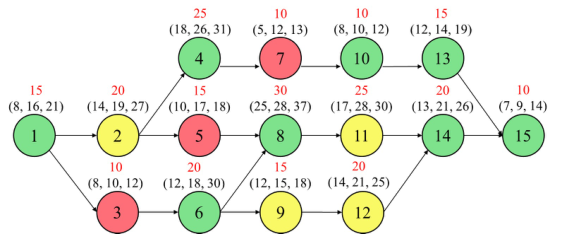
To illustrate the solution’s effectiveness, a numerical example is presented in Figure 2, involving 15 tasks with fuzzy triangular execution times and cor- responding precedence relationships. It is assumed that tasks were assessed through DHM, and any EAT, and their output reported as low, medium, or high risk level that is shown in green, yellow, and red, respectively. This example considers five workstations, and the desired fuzzy CT is equal to (44, 60, 76). As explained before, defuzzified task times are calculated based on equation 9 and written in red on top of each task’s fuzzy time. Defuzzified CT with the same equation is equal to 60 seconds.
Figure 2: Precedence network of a sample assembly line.
Based on previous discussions, insights from research studies, and contri- butions of ergonomist experts, specific thresholds and parameters have been assumed for the solution algorithm when applied to this numerical example. The assigned values are L = 50%, U = 20%, MI = 0.3, and ME = 0.6. Three feasible solutions are identified, and their ergonomic risk scores, assessed using the proposed fuzzy expert model, determine a better solution with a lower RS. As Table 3 presents the first solution is better since its fuzzy ergonomic risk is lower than the second FS.
Table 3. Comparison of two FSs based on fuzzy assessment approach.
While this example is crafted for explanatory purposes, the algorithm’s application to real case studies holds potential for effective and robust solutions in Ergo-ALDPs.
CONCLUSION
In conclusion, this paper introduces a novel approach to tackle the chal- lenges posed by Ergo-ALBPs. While the historical evolution of assembly line optimization, rooted in LP models, has witnessed significant advancements, the emergence of Ergo-ALDPs has added complexity to the optimization landscape.
Traditional approaches, emphasizing operational efficiency, often over- look the ergonomic risks associated with repetitive tasks, potentially resulting in health-related issues and diminished productivity. The proposed fuzzy ergonomic expert system, integrated into the optimization framework, pro- vides a comprehensive solution to navigate uncertainties during the design phase. By utilizing fuzzy logic and DHM, the framework assesses and catego- rizes ergonomic risks at various levels—task, workstation, and assembly line. This holistic approach ensures a balanced consideration of both operational efficiency and ergonomic factors, aligning with the principles of Industry 5.0 and human-centric design.
The application perspective demonstrates the practical advantages of the proposed model. The two-step optimization process identifies feasible solu- tions based on operational parameters, followed by a fuzzy evaluation of ergonomic risks. A numerical example showcases the model’s effectiveness in predicting and comparing different scenarios, considering fuzzy task times, precedence relationships, and ergonomic risk levels.
Moreover, the incorporation of an expert system with fuzzy rules, draw- ing on the knowledge of ergonomic professionals, adds sophistication to the assessment of cumulative ergonomic risks. The proposed fuzzy RS offers a quantifiable measure to compare and prioritize different assembly line config- urations, considering the cost of ergonomic interventions required to mitigate potential risks of MSDs.
In practical applications, this approach equips decision-makers with a valuable tool to handle imprecise data challenges during the design phase. The framework’s adaptability makes it suitable for various assembly line con- figurations across different industries. By predicting ergonomic risk levels and
Fuzzy Ergonomic Expert System for Assembly Line Design Problem 259
allowing for adjustments in the design before implementation, the proposed model contributes to the creation of safer, more efficient assembly lines.
However, it is crucial to acknowledge certain limitations and areas for future study. The model assumes tasks compatibility without explicit consid- eration of potential conflicts or dependencies between different tasks. Future research could explore more sophisticated task compatibility assessments to enhance the accuracy of assembly line design. Additionally, the variability of human operators, encompassing skills, characteristics, and learning curve effects, is a critical aspect that requires further investigation. Integrating more dynamic models that account for individual differences and adapt to chang- ing operator conditions could enhance the model’s predictive capabilities. Moreover, the current model focuses on finding feasible solutions and prior- itizing ergonomic risk as a secondary step. To directly optimize ergonomic outcomes, future work could integrate the ergonomic risk score into the objective function of the optimization model itself. This would enable a more search algorithm inherently driven towards minimizing ergonomic risk.
Furthermore, considering layout and equipment effects is another avenue for future research. The current model focuses on ergonomic risks at the task, workstation, and assembly line levels, but the physical layout and equip- ment configurations may introduce additional variables that impact overall ergonomics. While DHM has been integral to ergonomic risk assessment, it is essential to recognize its limitations. Future studies could delve into refin- ing and expanding the capabilities of DHM, addressing challenges such as more accurate representation of worker movements and interactions with the environment. Moreover, the current model focuses on finding feasible solutions and prioritizing ergonomic risk as a secondary step. To directly optimize ergonomic outcomes, future work could integrate the ergonomic risk score into the objective function of the optimization model itself. This would enable a more search algorithm inherently driven towards minimizing ergonomic risk.
In summary, while the integration of fuzzy logic, DHM, and an expert system in the proposed optimization framework stands as a promising advancement in Ergo-ALDPs, acknowledging these limitations and charting paths for future study is crucial. Addressing these aspects will contribute to the ongoing evolution of Ergo-ALDP optimization, ensuring a more com- prehensive and adaptable framework that aligns with the evolving needs of manufacturing industries. This research not only contributes to the existing body of knowledge in assembly line optimization but also provides a robust solution for industries seeking to align with human-centric design princi- ples and tackle uncertainties inherent in ergonomic considerations during the design phase. The proposed model stands as a promising advancement in the realm of assembly line design, emphasizing the importance of both operational efficiency and worker well-being.
ACKNOWLEDGMENT
We would like to acknowledge our industrial partner (Dassault Systèmes) and Mitacs for funding under Mitacs Accelerate program IT28031.
REFERENCES
Baykasoglu, A., Tasan, S. O., Tasan, A. S., & Akyol, S. D. (2017). Modeling and solving assembly line design problems by considering human factors with a real- life application. Human Factors and Ergonomics in Manufacturing & Service Industries, 27(2), 96–115. Bortolini, M., Faccio, M., Gamberi, M., & Pilati, F. (2017). Multi-objective assembly
line balancing considering component picking and ergonomic risk. Computers & Industrial Engineering, 112, 348–367. Bourret, Q., Charland, J., Imbeau, D., Brouillette, D., & Djire, J. B. (2021, May). Ergo4All: An Ergonomic Guidance Tool for Non-ergonomist. In Congress of the International Ergonomics Association (pp. 382–390). Cham: Springer International Publishing. Falck, A. C., & Rosenqvist, M. (2014). A model for calculation of the costs of poor
assembly ergonomics (part 1). International Journal of Industrial Ergonomics, 44(1), 140–147. Finco, S., Abdous, M. A., Battini, D., Calzavara, M., & Delorme, X. (2019).
Assembly line design with tools vibration. IFAC-PapersOnLine, 52(13), 247–252. Ghorbani, E., Keivanpour, S., Sekkay, F., Imbeau, D. (2023a). Ergonomic Assembly Line Balancing Problems Evolution and Future Trends with Insights into Industry 5.0 Paradigm. Bureau de Montreal, Université de Montreal. Ghorbani, E., Keivanpour, S., Sekkay, F., Imbeau, D. (2023b, July). Optimization
Framework for Assembly Line Design Problem with Ergonomics Consideration in Fuzzy Environment. IFIP 20th International Conference on Product Lifecycle Management, Montreal (PLM23), Montreal, QC, Canada. Gunther, R. E., Johnson, G. D., & Peterson, R. S. (1983). Currently practiced formulations for the assembly line balance problem. Journal of operations management, 3(4), 209–221. Halgeson, W. B., & Birnie, D. P. (1961). Assembly line balancing using the ranked
positional weighting technique. Journal of Industrial Engineering, 12(6), 394–398. Ozdemir, R., Sarigol, I., AlMutairi, S., AlMeea, S., Murad, A., Naqi, A., & AlNasser, N. (2021). Fuzzy multi-objective model for assembly line balancing with ergonomic risks consideration. International Journal of Production Economics, 239(April), 108188. Salveson, M. E. (1955). The assembly-line balancing problem. Transactions of the
American Society of Mechanical Engineers, 77(6), 939–947.
LISTED IN THE AHFE DIGITAL BOOKSTORE CATALOGUE
Explore the complete digital volume
Accessibility, Assistive Technology and Digital Environments
Read this individual research paper free through the original publisher, or explore the full digital proceedings book.
ISBN 978-1-958651-97-1
Explore this ISBN in the AHFE Bookstore ↗Listed in the July 2026 bookstore catalogue; search by ISBN to confirm current availability · Digital book purchase optional