Xiaoqin Zhou, Yunfei Chen (2023). The characteristics of fashion magazine layout design style based on aesthetic measure model. In: Intelligent Human Systems Integration (IHSI 2023): Integrating People and Intelligent Systems. AHFE Open Access, vol. 69, pp. 778–785. https://doi.org/10.54941/ahfe1002901
The design style of a magazine is the key to attract readers. At the same time, the layout design of the magazine is an important factor affecting the style of the magazine. The purpose of this paper is to study the style of fashion magazines, combined with mathematical model to quantitatively analyze the layout of the same style of magazines, and get the quantitative relationship of relevant parameters, so as to provide guidance and help for the layout design of fashion magazines.
As a medium of graphic information, magazines are an important part of people’s cultural life. With the enrichment of people’s daily life, the number and types of magazines are increasing. In this fierce competitive environment, magazine design has become the key to stand out and attract readers’ atten- tion. In many kinds of magazines, fashion magazine is an important reading material to lead the fashion trend and spread the aesthetic concept, and its visual design is the key element of the way of expression. For fashion magazi- nes, each fashion magazine needs to convey its unique fashion concept, so as to distinguish it from other magazines. In addition, fashion magazine form its own unique identification, so as to stabilize its position in the mind of readers. The transmission of fashion concept largely depends on the design style of the magazine. At present, there are a variety of magazine styles on the market. At the same time, there are many elements that can affect the style of the magazine, among which the layout design of the inside page of the magazine is one of the most important factor (Qiang, 2018).
The layout design of the inside page of the magazine includes the text arrangement and the use of pictures. The magazine conveys information to the readers through the text, so the text layout should ensure that it is clear and easy to read, so that the readers can quickly obtain information. As an indispensable visual element of magazines, pictures sometimes convey more information than words. Therefore, the use of pictures plays an irreplaceable role in magazine typesetting, including picture size, picture position and so on (Sun, 2020).
The Characteristics of Fashion Magazine Layout Design Style 779
At present, the traditional method of manual typesetting is time-consuming and laborious, and the layout may not be satisfactory, and its effect is not stable. In this case, we need to find a new typesetting method, so that it can automatically generate a specific style of layout, so as to save labor costs and improve the quality of magazine layout design.
RESEARCH PURPOSE The traditional layout design needs manual typesetting operation, by con- stantly adjusting the position and size of each element on the page to achieve the best effect of visual design, which is time-consuming and labor- consuming, and can not guarantee the stability of the design style. In this paper, by the application of mathematical model, the same layout style of magazine inside page is analyzed quantitatively, and the relevant threshold of influence factors is found out, which is used to help and guide the layout design of this style of magazine inside page, so as to improve the efficiency and effect of magazine inside page layout design.
RESEARCH METHODS Semantic difference method is a research method of Kansei Engineering, which aims to explore the emotional needs of target users to help and guide the design. In the application of this method, first of all, the perceptual words to describe the user’s emotion need to be selected and the evaluation direction need to be clear. Secondly, the appropriate evaluation criteria need to be spe- cified, and finally the relevant adjectives need to be selected. For the subjects, they need to score on the semantic difference scale based on their own subje- ctive feelings. The final experimental data can provide quantitative reference for experimenters.
Aesthetic measure is a method of quantifying visual beauty by using math- ematical modeling, which aims to provide scientific basis for design. In previous studies, David proposed 13 evaluation indexes of interface layout design, which are: balance (BM), equilibrium (EM), symmetry (SYM), seque- nce (SQM), cohesion (CM), unity (UM), proportion (PM), simplicity (SMM), density (DM), regularity (RM), economy (ECM), homogeneity (HM) and rhythm (RHM) (Ngo, et al., 2003). In this paper, the evaluation index related to the magazine layout design are selected to evaluate the magazine layout quantitatively.
To select a magazine style as the research direction, a group of magazine pages with the most prominent style are selected. After selecting experimen- tal samples, the layout design is quantified by using the aesthetic measure method to find the design rules.
Based on the desktop research method, emotional words describing users’ emotions were collected through the internet, magazines and so on, including literature and art, elegant, avant-garde, modern, leisure and other emotional words. In consideration of the fashion magazine is very popular nowadays, its layout design is more important, so fashion magazines were selected to be experimental object, and avant-garde style was selected as the research direction of this topic.
780 Zhou and Chen
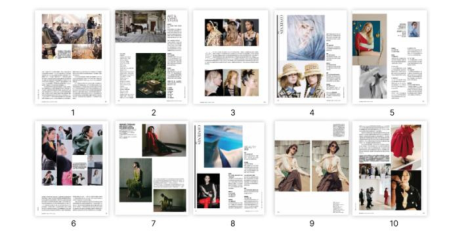
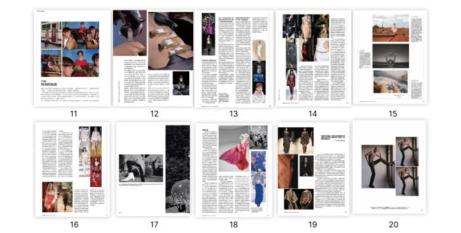
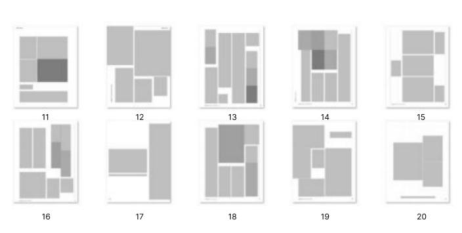
Figure 1: Sample pages.Figure 2: Sample pages.
After determining the avant-garde style as the research direction, the maga- zine named VOGUE was selected to be research objects in this experiment. VOGUE, the world’s best-selling fashion journal, which is founded in 1892, has a long history and is regarded as the world’s fashion Bible (Canon of fashion). Therefore, it is significant to analyze the inside pages of the journal and select it as the experimental samples.
In this experiment, 12 Chinese edition of VOGUE magazine collections published in 2020 were sampled. Firstly, the magazine cover and the non representative inside pages were removed, including the inside pages with only words but no pictures and only pictures but no words. Finally, 20 representative inside pages were selected, as shown in Figure 1 and Figure 2.
In addition, the semantic difference method was used this paper to set the Kansei word pairs, which is avant-garde and backward. According to the word pairs, the subjects were invited to screen the 20 magazine pages to 10 pages.
In this experiment, we invited 10 subjects, all of them were graduate stu- dents of Southeast University, including 5 boys and 5 girls, whose age were range from 22 to 25 years old. The subjects had normal vision or corrected vision, and had not received professional graphic design skills training.
Based on the selected perceptual word pair: avant-garde and backward, 20 samples of magazine inner pages were evaluated in this paper, and 10 subjects were invited to rate the perceptual word pair on the Likert 7-point scale. In the primary selection of 20 magazine pages, 10 of the most avant-garde style fashion magazine pages need to be selected. Control experiments were
The Characteristics of Fashion Magazine Layout Design Style 781
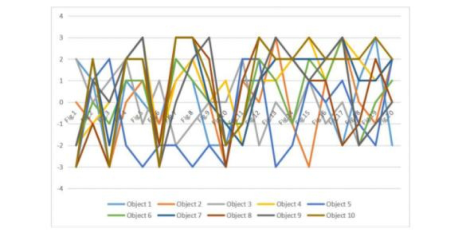
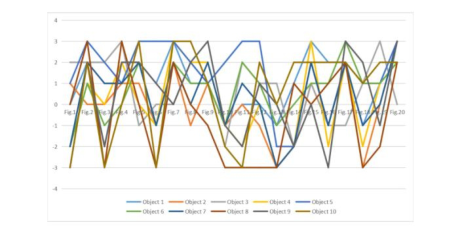
Figure 3: Scoring results of the first group samples.Figure 4: Processed magazine sample.
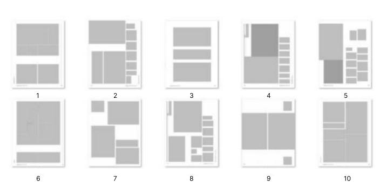
carried out in the paper. In the first group of experiments, the experimental samples were not processed. In the second group of experiments, the selected 20 samples of the inside pages of magazines were processed in order to avoid the influence of the magazine content on the subjects’ scores, and the contents of the pages were replaced by gray rectangular blocks.
In the first group of experiments, firstly, the subjects were asked to browse the 20 pages of magazine samples, and then the 20 experimental samples were randomly displayed to the subjects by using MATLAB as the expe- rimental tool. The subjects were asked to score each sample by the first impression(the scoring time should not be long), and the scoring results would be automatically recorded in MATLAB. The scoring results are shown in Figure 3.
From the results of the first group of experimental scores, we can see that sample 4, 5, 7, 8, 12, 13, 15, 16, 17, 20, the ten sample magazine pages scored the highest, and they were the most avant-garde style magazine pages.
In the second group of experiments, the inside pages of the magazine were processed, and the processing style was shown in Figure 4 and Figure 5. Then the same subjects are invited to carry out the experiment. The experimental process is the same as that of the first group. First, the subjects are asked to browse the 20 pages of processed samples in the magazine. Then, using MATLAB as the experimental tool, the 20 processed samples are randomly displayed to the subjects in turn. The subjects are asked to score the first impression of each sample (the scoring time should not be long), and the scoring results are automatically recorded in MATLAB. The experimental results are shown in Figure 6.
782 Zhou and Chen
Figure 5: Processed magazine sample.Figure 6: Scoring results of the second group samples.
From the results of the second group of experimental scores, we can see that sample 2, 4, 5, 7, 8, 9, 15, 17, 19, 20, the 10 processed sample magazine inner pages scored the highest, which was the most avant-garde magazine layout design.
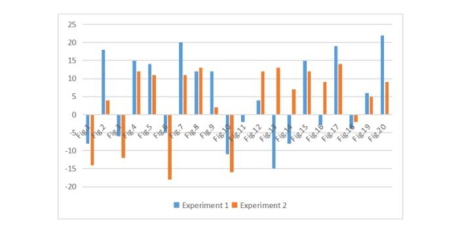
As shown in Figure 7, by comparing the scoring results of Experiment 1 and Experiment 2, it can be seen that for samples 2, 6, 13, 14 and 16, the results of the two experiments are quite different, and the experimental results of the remaining samples are also quite different, which indicates that the experimental results of Experiment 1 are affected by the content of the maga- zine itself, as well as the content of the magazine (including picture content and text letter) will have a certain impact on the design style of the magazine.
Since this project only focuses on the layout design style of the magazine, and does not consider the content of the magazine itself, the top ten inner pages of the magazine from the scoring results of Experiment 2 were selected, which were sample 2, 4, 5, 7, 8, 9, 15, 17, 19 and 20.
The selected 10 experimental samples were calculated by aesthetic measure models. According to the data needed for aesthetic measure, the coordinates of the rectangular box in the inner pages of 10 magazines are determined, and the coordinate values are summarized.
According to previous studies, there are 13 evaluation indexes of interface layout design proposed, some of which have overlapping meanings. There- fore, the indicators were classified according to the book Industrial Design Basis. After removing the measure of regularity which has little correlation with magazine layout design, remaining twelve indexes were classified and
The Characteristics of Fashion Magazine Layout Design Style 783
Figure 7: Comparative analysis of the results of Experiment 1 and Experiment 2.Table 1. Aesthetic measure results.
Average value 0.7743 0.9875 0.4341 0.8250 0.3405 0.0982 Total Average 0.7320 0.4212
divided into four kinds of aesthetic indexes, which are balance aesthetic mea- sure, proportion aesthetic measure, echo aesthetic measure and simplicity aesthetic measure. Among the 12 evaluation indexes, balance (BM), equi- librium (EM), symmetry (SYM) are the representation of interface balance aesthetic measure, sequence (SQM), unity (UM), and homogeneity (HM) are the representation of interface proportion aesthetic measure, simplicity (SMM), density (DM), economy (ECM) are the representation of interface simplicity aesthetic measure, cohesion (CM), rhythm (RHM), proportion (PM) are the representation of interface echo aesthetic measure. The specific calculation results are shown in Table 1 and Table 2.
EXPERIMENTAL RESULTS It can be seen from Table 3 that the total score of subjective evaluation value of sample 1, 4, 8 and 10 are relatively high, which are 18, 20, 19 and 22 scores respectively. Through the calculation results of aesthetic measure, we can see that sample 1, 4, 8 and 10 have relatively high values of simplicity (SMM), density (DM) and economy (ECM). At the same time, the three aesthetic
indexes of simplicity (SMM), density (DM) and economy (ECM) all belong to the characterization indexes of interface simplicity. This shows that for avant-garde style magazines, the simplicity is an important factor in interface design. The layout design of avant-garde style magazines should be concise to some extent.
CONCLUSION
In this paper, we use the Kansei engineering method and the aesthetic measure model studied by predecessors to make a quantitative analysis of the layout design style of inner pages of magazine. The experimental results showed that, for avant-garde style magazines, the simplicity of the layout design is an important factor. In addition, by comparing the scoring results of experiment 1 and experiment 2, it can be concluded that the content of the magazine (including picture content and text information) will have a certain impact on the design style of the magazine.
The Characteristics of Fashion Magazine Layout Design Style 785
However, there are still some defects in this experiment. First of all, the experiment in this paper does not consider the influence of picture color on the aesthetic measure of the interface. The choice of picture color plays a very important role in the design of magazine interior page, and has a great impact on the design style of the magazine. Secondly, the text and picture are taken as a unit as a visual module in the experiment. This method is not suitable for irregular patterns, and there are some restrictions on the selection of experimental samples. Finally, the text is processed as a rectangular visual module in this experiment, and the line spacing of the text is not considered. Based on the above limitations in this experiments, we will put forward the improvement scheme to make the experimental conclusion more rigorous and effective in the future research.
Information Sciences, 152(8), p. 25. Qiang, K., (2018). Discussion on the visual design style of fashion magazines.
Tomorrow’s fashion, 13(23), p. 76. Sun, D.Y., (2020). A brief discussion on the visual style of magazines. Journalist Cradle, 51(11), p. 11. Xue, C.Q., (2004). Fundamentals of industrial design. Nan Jing: Southeast
University.
LISTED IN THE AHFE DIGITAL BOOKSTORE CATALOGUE
Explore the complete digital volume
Intelligent Human Systems Integration (IHSI 2023): Integrating People and Intelligent Systems
Read this individual research paper free through the original publisher, or explore the full digital proceedings book.
ISBN 978-1-958651-45-2
Explore this ISBN in the AHFE Bookstore ↗Listed in the July 2026 bookstore catalogue; search by ISBN to confirm current availability · Digital book purchase optional