Lei Tang, Yunfei Chen, Ziyue Huang, Qian Chen (2022). The interface design of Chinese input keyboard applied to eye movement control system. In: Intelligent Human Systems Integration (IHSI 2022): Integrating People and Intelligent Systems. AHFE Open Access, vol. 22. https://doi.org/10.54941/ahfe1001062
The typing system of eye movement control mainly adopts the layout of QWERTY keyboard, the design of which increases the bimanual alternate operation based on the frequency of letters to relieve fatigue and improve efficiency. Nevertheless, with regard to the eye control operation, such design significantly increases the movement path of the eyes, which in turn hinders the typing efficiency. In view of this, this research firstly makes statistics on the selected Chinese word set and the transition frequency between letters according to Pinyin input method. In an attempt to ensure that users can minimize eye movement while typing, a greedy algorithm is used to generate an irregular letter layout. On the basis of this layout, a new eye-controlled keyboard layout is designed in this research in combination with the principles of interface interaction design and the physiological characteristics of eye movement control. Finally, by virtue of setting the contrasted eye-controlled typing experiment, this research demonstrates that the new eye-controlled keyboard layout presents a certain degree of advantages in input efficiency and relieving user fatigue.
Intelligent Human Systems Integration (IHSI 2022): Integrating People and Intelligent Systems https://openaccess.cms-conferences.org/#/publications/book/978-1-7923-8988-7
INTRODUCTION
The original intention of the traditional QWERTY keyboard layout is to increase the collaborative operation of two-handed operation and reduce users’ fatigue, which is designed based on the frequency of use of English letters (Shumin Zhai, 2002). With the development of human-computer interaction, the way of human input is no longer limited to using a physical keyboard. People realize information input by touching the screen on smart devices and tracking the gaze position of the users' eyes to position on the inter-active interface in an eye movement interactive system. In a new interactive mode, however, which no longer rely on the collaborative input of the users' hands, the lay-out design of the QWERTY keyboard hinders the users' information input rate, especially in the eye control input mode, which significantly increases the movement path and accelerates strain of the eyes. Therefore, it is prerequisite to design a keyboard input interface for eye movement control.
The technology of eye movement control, which tracks the movement of the eyeball and maps the movement data on the display to confirm the gaze position of the eye by utilizing eye movement acquisition instruments such as eye trackers, is gradually improved with the development of equipment for collecting eye movement information. The interactive modes of eye control mainly include gaze triggering, blinking triggering, and eye position. Among them, the gaze triggering technology is the most mature. At present, the mainstream interaction mode for application layer adopts gaze triggering mode, that is, the users gaze at the controls in the interface to reach the set gaze trigger threshold, which determines the successful click trigger. The gaze-triggered interactive mode not only shows current attention direction of the users, but also connects the behavioral instructions issued by the brain through the gaze behavior. Accordingly, when typing input occurs frequently in the interaction of the eye-controlled keyboard, the gaze trigger can reduce the users' brain load (Koesling, 2009).
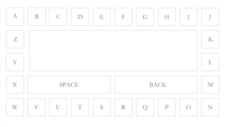
Nowadays, some scholars have carried out research on the layout of the eye- controlled interactive keyboard. Patrik Pluchino believes that users will suffer from visual center deviation when using the eye-controlled keyboard, that is, users will habitually focus their eyes on the center of the screen, causing misoperation. So a circular keyboard is designed that makes all letters evenly distributed on a circle, the center area of which is blank (Patrik Pluchino, 2021). Nevertheless, after conducting a controlled experiment, the results reveal that the circular keyboard layout does not make obvious positive effects. One possible reason is that when users use traditional QWERTY keyboard layouts or layouts in alphabetical order, they rely on the brain's memory where the letters are located, which shortens the time required for users to search for targets. Morimoto, C. H., and Amir sacrificed the space usage of the interface in exchange for a more efficient button triggering method (Morimoto, 2010). He divided the screen into upper and lower parts, and each part is equipped with a QWERTY layout keyboard, which make the users need to find the target on one keyboard and move his eyes to the same letter on the other keyboard, avoiding the
Intelligent Human Systems Integration (IHSI 2022): Integrating People and Intelligent Systems https://openaccess.cms-conferences.org/#/publications/book/978-1-7923-8988-7
Midas contact effect effectively. However, in actual application scenarios, the available interaction area is wasted.
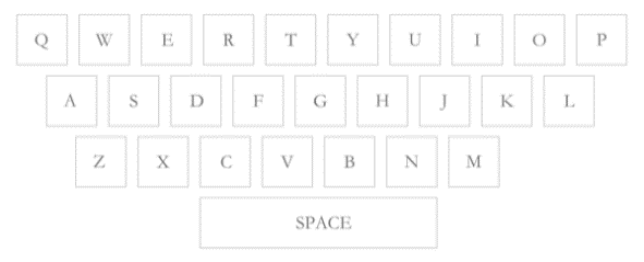
Figure 1. QWERTY keyboard layout
STUDY
DESIGN of LAYOUT Based on previous research summary, the study holds the viewpoint that the design of the eye-controlled keyboard should be considered from the following two dimensions. First, the interaction between human and machine is eye-control interaction, which must meet the basic design principles of eye-movement control interaction interface. Actually, the size of the control is closely related to the accuracy of gaze triggering. Chengzhi Feng pointed out that the size of the elements in the eye control interface should not be less than the 1.5-degree viewing angle (Mowei, 2003). Additionally, Komogortsev found that in the process of eye-computer interaction, the operation accuracy of the central area of the layout is higher, whereas the accuracy of the left and right edges is the lowest (Barea, 2002). According to above mentioned, Xin Yang conducted in depth research to propose the regional advantage theory of eye-controlled interface layout, which has guiding significance for the layout of the keyboard (Xing, 2019). The length of the path of the users' eye movement should be as short as possible during the eye-controlled typing process. Taking the input word ‘but’ as an example, the distance ‘s’ of the users’ eyes move is equal to the linear distance ‘s1’ between the letters ‘b’ and ‘u’ plus the linear distance ‘s2’ between the letters ‘u’ and ‘t’. It can be found that the path‘s’ of eye movement can be made shorter by studying the transition frequency between letters to optimize the order of letters.
Firstly, a large number of Chinese characters are collected from public channels such as news, social networking sites, chat rooms, many of which are reusable. Owing to the dependence of the Pinyin input method for Chinese typing input, all the collected
Intelligent Human Systems Integration (IHSI 2022): Integrating People and Intelligent Systems https://openaccess.cms-conferences.org/#/publications/book/978-1-7923-8988-7
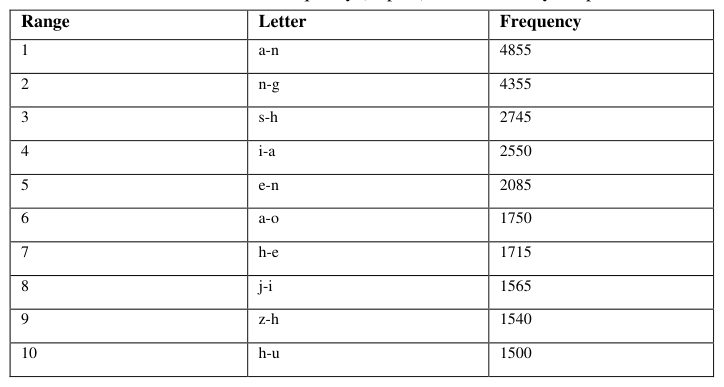
Chinese characters are converted into letters. Then, as shown in the figure, the transition frequency of letters is counted.
Table 1: Table of letter transition frequency (Top 10) in Chinese Pinyin input method Range Letter Frequency
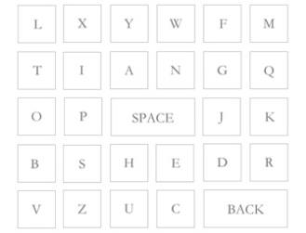
Each condition is constrained through a program, and a greedy algorithm is used to obtain an irregular letter layout. Finally, on the basis of this layout, a new eye- controlled keyboard layout is designed in combination with the interface interaction design principles and the physiological characteristics of eye movement control. As shown in Figure 2, since the center of the interface is the area with the highest eye control interaction accuracy, the most frequently used space bar is set in the center of the layout. Some other frequently used letters are arranged around the space bar. The positions of the remaining letters are set according to the transition frequency between letters.
Figure 2. The new eye-controlled keyboard layout for Chinese pinyin input method
Intelligent Human Systems Integration (IHSI 2022): Integrating People and Intelligent Systems https://openaccess.cms-conferences.org/#/publications/book/978-1-7923-8988-7
EXPERIMENT The purpose of the experiment: a control experiment was set up to evaluate the above three eye-controlled keyboard layouts and verify the effect of the eye-controlled keyboard on input efficiency. Due to the limitation of the display interface, the circular keyboard layout is adapted to the 1920*1080 interface.
Figure 3. Three different keyboard layouts for comparison experiments Subjects: Six industrial design graduate students, familiar with the keyboard input method of Chinese and the input method of eye control, were selected. The naked eye or corrected vision is above 1.0, without any eye diseases. The subjects were required to be proficient in various keyboard layouts before the formal experiment, in order to avoid the influence of the search target time on the experimental results. Key equipment for the experiment: a tobii eye tracker, a 24-inch display screen, and a high-performance laptop. Experiment procedure: In this experiment, 3 interactive interfaces are set up. Participants were needed to utilize tobii's eye tracker to complete the designated typing task through eye movement. The gaze trigger duration is set to 1s, that is, when the subject gazes at a certain control valid for 1s, the trigger is judged to be successful.
(1) Sight line correction of experimental procedures: Participants need to keep a distance of about 64cm from the screen to complete tobii studio's line of sight correction.(2) The task description will appear on the interface, and the subjects will have enough time to read the experiment description and precautions.(3) Participants will be able to practice the input of three interactive interfaces and conduct pre- experiments.(4) 5 daily expressions are set in the experiment, and the sentence length will be about 15-20 Chinese characters. These 5 sentences will be combined with 3 kinds of interactive keyboards, for a total of 15 interfaces, which will appear in the experiment inter-face in turn. The participants need to use the keyboard of the interface which will be shown to input the sentence prompted in the interface. A 20s rest time will be set between the interface and the interface to prevent user eye fatigue.(5) After the experiment, the experimental data will be saved, and in-depth interviews will be conducted to record the subjective evaluation of the subjects.
ANALYZE The experimental data was imported into SPSS for analysis that four parameters are mainly selected as the evaluation indexes: the total time to complete the specified task
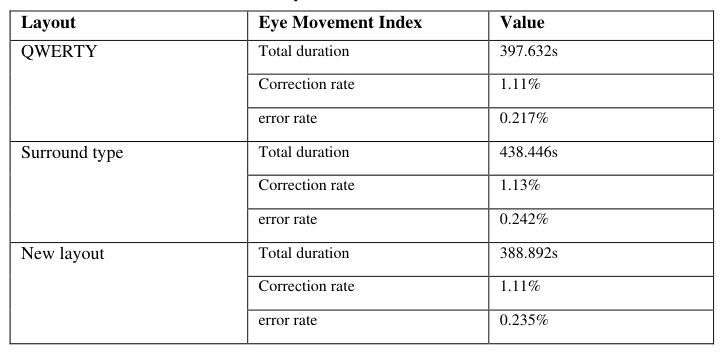
Intelligent Human Systems Integration (IHSI 2022): Integrating People and Intelligent Systems https://openaccess.cms-conferences.org/#/publications/book/978-1-7923-8988-7 in each interactive interface state, the Times of deleting letters and re-entering, the error rate, and the subjective use evaluation score. Surprisingly, there is a small difference in the total time the users needed to complete the task. By analyzing the eye movement trajectory of the same typing task, a reason was found to explain this phenomenon. When the user was using the QWERTY keyboard layout, due to the long-term use of the keyboard with this layout, resulting in long-term memory formed in the brain, his sight would quickly shift to the position of the next letter after completing the click of the first letter, which had almost no time to search for the target. On the other hand, the users' sight would spread around the location of the previous letter to search for the location of the next letter, caused by unfamiliarity with the new layout, which was also confirmed by the in-depth interview after the experiment. If the influence of long-term memory on the experimental results is excluded, the new eye-controlled keyboard will have a certain improvement in interaction efficiency. In the QWERTY layout, the number of times that users deleted letters and re-entered them is higher than the other two layouts, which also supports Patrik Pluchino's research. There is no obvious difference in the error rate index. The users’ subjective evaluation and interview results show that when using the new keyboard layout, they obviously felt the reduction in eye movement distance, and there was no dry eye fatigue caused by long-term use of the eyes during the whole process. However, when using the circular keyboard, every time users completed a letter input, their eyes would have to be shifted in a wide range, increasing the eye fatigue when the last few tasks are carried out.
Table 2: Eye movement test results Layout Eye Movement Index Value
CONCLUSIONS
In this article, the virtual keyboard is redesigned by considering the letter transition frequency of the Chinese pinyin input method and the physiological characteristics of eye movement interaction. Based on the results of the eye movement experiment
Intelligent Human Systems Integration (IHSI 2022): Integrating People and Intelligent Systems https://openaccess.cms-conferences.org/#/publications/book/978-1-7923-8988-7 and the user’s subjective feelings, the study quantitatively evaluated this new interactive interface. Experimental results demonstrate that the new layout shows certain advantages in improving input efficiency and alleviating fatigue. However, the study did not control the effect of long-term memory on the results of the experiment. This requires the subjects to use the new layout for a long time to familiar with the location of each letter.
REFERENCES
Shumin, Z., Michael, H., Barton, A. (2002) “Performance Optimization of Virtual Keyboards”, in: Human–Computer Interaction. Koesling, H., Zoellner, M. (2009) “With a Flick of the Eye: Assessing Gaze-
Controlled Human-Computer Interaction”, in: Human Centered Robot Systems, Springer Berlin Heidelberg. pp. 83-92 Patrik, P., Valeria, O., Giulia, B., Luciano, G. (2021) “Influence of keyboard layout and feedback type in eye-typing tasks: a comparative study”, proceedings of Conference on Cognitive Ergonomics 2021, European. Morimoto, C., Amir, A. (2010) .Context Switching for Fast Key Selection in Text
Entry Applications. Mowei, S., Chenzhi, F., Hui, S. (2003) “Study on temporal and spatial characteristiccs of eye movement for human computer interface design”, in: Aerospace Medicine and medi-cal engineering. pp. 304-306 Barea, R., Boquete, L., Mazo, M., et al. (2002) “System for assisted mobility using
eye movements based on electrooculography”, in: Transactions on Nural Systems & Rehabilitation Engineering. pp. 218 Xing, Y. (2019). Research on eye-machine interaction oriented interface control design method.
Intelligent Human Systems Integration (IHSI 2022): Integrating People and Intelligent Systems https://openaccess.cms-conferences.org/#/publications/book/978-1-7923-8988-7
LISTED IN THE AHFE DIGITAL BOOKSTORE CATALOGUE
Explore the complete digital volume
Intelligent Human Systems Integration (IHSI 2022): Integrating People and Intelligent Systems
Read this individual research paper free through the original publisher, or explore the full digital proceedings book.
ISBN 978-1-7923-8988-7
Explore this ISBN in the AHFE Bookstore ↗Listed in the July 2026 bookstore catalogue; search by ISBN to confirm current availability · Digital book purchase optional