Xingjian Liu, Xingsong Wang (2023). The relationship between the performance of the star and the shape of basketball sneaker and the prediction of the shape design. In: Intelligent Human Systems Integration (IHSI 2023): Integrating People and Intelligent Systems. AHFE Open Access, vol. 69, pp. 638–649. https://doi.org/10.54941/ahfe1002886
With the development of the economy and society, the concept of industrial design has undergone great changes, forming the modern "human-centered" concept. Therefore, the key research topic is how to connect products with users and design customized products for users. This research combines perceptual engineering, analytic hierarchyprocess and experimental calculations, combined with the famous stars of the American Basketball Association, to establish a prediction of the feature recognition and shape design of stars and basketball shoes. Firstly, we use questionnaires, 40 famous fans select the adjectives that best represent basketball shoes. Secondly, evaluate the performance of players from mental and physical dimensions for quantitative analysis; then evaluate the appearance of 20 pairs of basketball shoes (4 stars and each star selects the latest 5 generations of basketball shoes) and modeling analysis, to classify sneakers that match the stars; in SolidWorks CAD, the vector shape is obtained, and the key modeling parameters are calculated. Finally, a rough model is established between player performance and shoe modeling in the modeling index. Qualitative relationship, and when designing the next generation of star signature shoe styling, the product is quantitatively estimated to a certain extent and styling is controlled by star design. This study found that star performance is strongly related to basketball sneaker shape. And it allows designers to grasp the direction of signature shoe design in a short time.
Basketball is one of the most popular sports in the world, and basketball shoes are essential equipment. How to quickly control the relationship betw- een the star and the star, carry out targeted design, design and manufacture a pair of suitable sports shoes has become a major problem in the sports shoe industry. Shoe design is the top priority. The NBA is a professional basket- ball league, and the game is one of the most popular sports events for young people. The use of NBA superstars to increase consumers’ desire to buy a pair of new sports shoes is a well-known marketing strategy. We can com- bine the style performance of stars to create styling connections in the design
of sneakers, and at the same time predict the next generation of stars based on their performance(Wang, C.-C. et al. 2016). The new innovative model is different from the traditional sports shoe design model. The styling of the star will provide consumers with a perceptual connection with idols and pro- vide new models for enterprises, which will motivate consumers by providing more types of sports shoes.
METHODOLOGY
Quantitative evaluation method is used to quantify the performance of the stars, and then subjective evaluation method is used to find out whether the signature shoes of each star are related. By studying the structural focus of the shoe structure, find out whether the key nodes of the side view of the shoes are consistent with the performance of the star court (Park, S.-K. et al. (2017). These rules guide the design of the modeling requi- rements of this series of shoes in the future with the method of kansei engineering (Lai, C.-Y. et al. 2010).
Sample First select five five players with signature shoes, based on the performance of the American professional basketball league stars in the 17–18 season, namely: LeBron James, Kevin Durant, Stephen Curry, Klay Thompson and James Harden. Their stadium performance is shown in Table 1.
Application of Perceptual Engineering Perceptual engineering is a technology that combines consumers’ emotions, passions, knowledge, experience and emotions with manufacturers’ engi- neering disciplines into products. Perceptual is the intuitive psychological behavior of consumers feeling a certain impression from external stimuli. The purpose of Kansei Engineering is to develop products by transforming feelings (adjectives) and needs into product design parameters.
40 Adjectives Selected
Forty fans who are familiar with basketball, used perceptual engineering to select 40 adjectives to show the general style characteristics of the shoes(Hsiao, S.-W. and Chen, C.-H. 1997). The results are shown in Table 2.
Perceptual Cognition of Sneakers Through questionnaires and perceptual engineering subjective evaluation methods, all questionnaires are evaluated based on the five-level Likert scale (Bedie, 1994), and the results of all data are standardized. In the end, five adjectives were selected to evaluate basketball shoes, namely durability (20), explosive (11), strong (21), agility (37) and speed (30).
Five Adjectives are Selected for Corresponding Performance In a questionnaire survey of 40 fans who are familiar with NBA stars and interviews with sneaker designers, 5 adjectives are selected from 40 adje- ctives, which can correspond to 5 important performances of NBA stars. Because the playing time (durability) is determined by the coach, the game situation and the injury. We consider the remaining four parameters. The remaining four types of abilities, namely points, rebounds, assists and ste- als/blocks per game, belong to the style of stars. These emotional adjectives can be equivalent to stadium performance. The corresponding adjectives and court performance are: duration of competition corresponds to durability; performance of scoring ability corresponds to explosiveness; steals and blo- cks correspond to speed; rebound performance corresponds to strong; assist performance corresponds to agility.
Evaluation of the Stars In order to find the relationship between star performance and sneakers, the performance of the sample must first be quantified. Under normal circum- stances, the performance of a star is related to the level of personal skills and tactics, but mental attributes are an important factor. When developing sne- akers, we must also consider the attractiveness of physical performance and spirit to users. Therefore, the performance of the stars is evaluated from the physical level and the spiritual level.
Physical Assessment and Spiritual Attributes The evaluation of physical performance can be reflected through personal data of basketball games, as shown in Table 1, the data source is the official NBA website. For the convenience of comparison and analysis, the data of the stars is converted into the 36-minute data of the stars in the game, that is, the playing time is 36 minutes, the highest data of each item is converted
The Relationship Between the Performance of the Star and the Shape 641
Table 3. Normalized data of stars.
Table available in the original PDF paper.
Name Time Points Rebounds Assists Steal/Block James 1 0.8678 1.0000 0.9921 0.7382 Durant 1 0.8989 0.8531 0.6452 1.0000 Curry 1 0.9607 0.6838 0.7668 0.7425 Thompson 1 0.6790 0.4754 0.2932 0.4885 Harden 1 1.0000 0.6545 1.0000 0.9467
Table 4. Evaluation of the mental attributes of stars.
into one score, and the other data is converted accordingly. The results are shown in Table 3.
The mental attributes have an impact on performance. By looking for forty subjects who often watch NBA games and have a better understanding of the above-mentioned stars, use the analytic hierarchy process to obtain another perceptual scale, and convert it into one score. The specific table is Table 4.
Comprehensive Properties Gooding and Gardner’s study on “The Relationship Between Mindfulness, Pre-shooting Routine and Basketball Free Throw Percentage” found that mental attributes are as important as personal athletic skills. Therefore, the two forms are integrated to obtain the ability to integrate normalization.
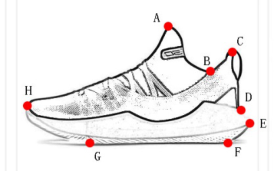
Calculation In order to measure the ratio of the length of the midsole to the overall length, the height ratio of the rear wall to the rear side, the angle of incli- nation of the mouth and the curvature of the front warp (Worobets, J. and Wannop, J.W. 2015). The simplified vector diagram can be imported into solidworks, the coordinates of each node can be calculated, and the incli- nation angle of the unified mouth can be calculated by AB, the height ratio
642 Liu and Wang
Figure 1: Parameter node.
of the back wall and the back wall can be calculated by CDF, and the mid- sole length and the overall length can be calculated by HGFE The ratio is calculated by HG.
Key Modeling Features of Basketball Shoes The side modeling elements of basketball shoes are changeable. Before star- ting to study the relationship between the key modeling features of basketball shoes and the performance of the stars, the key modeling elements of the shoes must be extracted, and the shape analysis and icon method must be used to make a table of morphological elements(Cui, F., Lee, H.P. and Zeng, X. 2009).
Sample Selection The above-mentioned five stars with signature shoes and sneakers, and the sales of each generation of sneakers are very large, so selecting these few sneakers can largely ensure the coverage of the sample. In addition, because Klay Thompson’s signature sneakers have fewer iterations, five pairs of signa- ture shoes could not be found, so the star was eliminated. Therefore, study 20 shoes, that is, there are four stars left, and each star selects the latest five-generation sneakers.
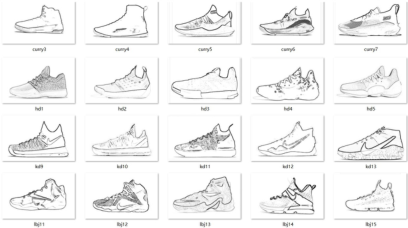
KEY MODELING FEATURE EXTRACTION At this stage, morphological analysis and survey methods are used to extract the key modeling features of the side of the sneaker Select 20 signa- ture sneakers, use Matlab to decolorize, extract the characteristic lines, outline the characteristic elements with the fewest possible lines, and get the two-dimensional line drafts of 20 sneakers.
Through observation and analysis, the appearance frequency of the mode- ling elements is concentrated in the outline of the outsole, the dividing line of the bottom, the shape of the mouth, the shape of the front piece, the shape of the back piece, the wall, the front warp, and the midsole. Finally, six qua- litative key modeling elements were determined: the outline of the outsole, the dividing line of the bottom, the outline of the mouth, the shape of the front piece, the shape of the back piece, and the flying line method. Corre- spondingly reflect the four quantitative elements: the ratio of the length of the midsole to the overall length, the ratio of the height of the rear wall to
The Relationship Between the Performance of the Star and the Shape 643
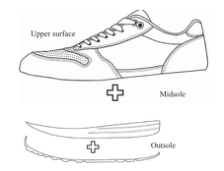
Figure 2: Wireframe of 20 pairs of signature shoes.Figure 3: Shoe structure.
the rear, the inclination angle of the unified mouth and the curvature of the front.
Morphology Extraction Analysis of Key Modeling Features Geometric induction and analysis of professional sports websites have extra- cted four substantive modeling features corresponding to the four parame- ters, and corresponding to one of them. The analysis of the four major modeling elements is as follows:
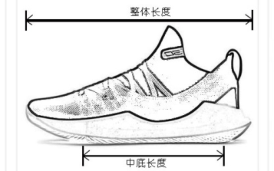
(1) The Ratio of Midsole Length to overall Length Outsole can be regarded as the outline of the outsole. Under normal circum- stances, the outline of the outsole includes the midsole and midsole, which is usually the shock absorber and the air cushion. In addition to personal phy- sical fitness, the explosive power is largely determined by the performance of the air cushion and carbon plate, which is responsible for the explosive shock absorption function (Lam, W.-K. et al. 2017). We can be equivalent to the midsole length. The value is recorded as MWM (midsole whole measure)
MWM = (Fx −Gx)/(Ex −Hx)
Fx is the abscissa of point F, Gx is the abscissa of point G, Ex is the abscissa of point E, and Hx is the abscissa of point H.
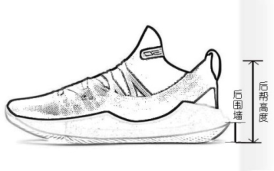
(2) The Height Ratio of the Rear Wall to the Rear Side The fence refers to the parts attached to the periphery of the shoe sole. Its main function is to enhance the bonding strength of the upper and the sole,
644 Liu and Wang
Figure 4: The ratio of midsole length to overall length.Figure 5: The height ratio of the back bottom to the back wall.
and at the same time, it can play a beautiful decorative role. There are a lot of supporting materials on the wall. The stronger the player, the higher the wall. The NBA midfielder is strong and uses high-top sneakers. In the actual calculation, the height points on the contour line of the back side are selected based on the ground level. The value is recorded as UPM (uppers measure)
UPM = (Fy −Dy)/(Fy −Cy)
Fy is the ordinate of point F, Dy is the abscissa of point D, Fy is the abscissa of point F, and Cy is the abscissa of point C.
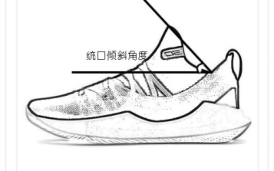
(3) Angle of Inclination of Unified Mouth While protecting the ankle, taking into account the flexibility of the foot movement, the ankle position will be designed to be high in the front and low in the back, and the height of the back is near the ankle (Salinero, J.J. et al. 2014). The angle from the highest point to the lowest point of the rear side is called the front and back tilt angle of the unified mouth, which is generally controlled between 5
and 45
. The value is recorded as angle:
angle = arctan((By −Ay)/(Bx −Ax))
By is the ordinate of point B, Ay is the ordinate of point A, Bx is the abscissa of point B, and Ax is the abscissa of point A.
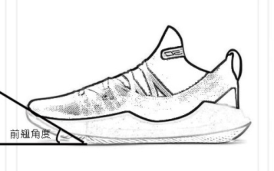
(4) Forward Angle It is normal for the toe to be slightly upturned, and the toes of a normal foot are slightly upturned. If the shoe fits, it can provide perfect support and
The Relationship Between the Performance of the Star and the Shape 645
Figure 6: The tilt angle of the control port.Figure 7: Forward angle.
flexibility for the foot. The value is recorded as qian: qian = arctan((Gy −Hy)/(Gx −Hx))
Gy is the ordinate of G point, Hy is the ordinate of H point, Gx is the abscissa of G point, and Hx is the abscissa of H point.
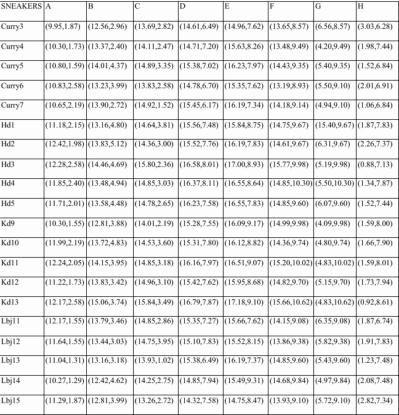
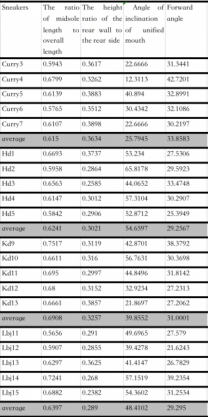
DATA PROCESSING First enter the parameters of 20 sneakers, enter eight parameter points for each sneaker, and then import the program to calculate to obtain the four parameters of 20sneakers in Figure 8.
Through the above parameters, use the formula in part Calculation to calculate the ratio of the length of the midsole to the overall length, the ratio of the height of the rear wall to the back, the angle of inclination of the mouth and the curvature of the front warp. The ratio of the length of the midsole to the overall length of these four modeling indicators, the height ratio of the rear wall to the back, the inclination angle of the mouth and the curvature of the front warp, the corresponding perceptual adjectives should be explo- sive, strong, smart and rapid. These four parameters can be regarded as the shoe styling indicators that affect the performance of the stars, corresponding to scoring ability, rebounding ability, assisting ability, stealing and blocking ability.
Discussion
Judging from the ratio of the length of the midsole of the sneakers to the overall length, Durant’s sneakers are larger than James’ sneakers and Harden sneakers are larger than Curry sneakers; from the perspe- ctive of the height ratio of the back wall to the back of the sneakers,
646 Liu and Wang
Figure 8: Key parameters of sneaker modeling.Figure 9: Shoe styling indicators that affect the performance of stars.
Curry’s sneakers are larger than Du Rand’s sneakers are larger than Har- den’s sneakers and James’s sneakers; from the angle of tilt and forward curvature, Harden’s sneakers are larger than James’s sneakers and Durant sneakers are larger than Curry’s sneakers; ‘S sneakers are bigger than Durant’s sneakers are bigger than James’s sneakers are bigger than Harden’s sneakers.
From the analysis of the player’s comprehensive attributes, because the influencing factors of durability are determined by player injuries, coaching
The Relationship Between the Performance of the Star and the Shape 647
arrangements, and players’ personal wishes, the impact on players’ explosi- veness, strength, agility and speed should be considered separately. From the perspective of players’ explosive power, Harden is greater than Curry and Durant is greater than James; from the perspective of player strength, James is greater than Durant and Harden’s sneakers are greater than Curry; from the perspective of player agility, Curry is greater than Harden is greater than Durant and James.
From the perspective of player speed, Curry is greater than Durant, James is greater than Harden. In the previous analysis, we connected the midsole length and overall length (reflecting the explosive impact of the sneaker on the player) with the explosive connection of the player; comparing the height of the back wall of the sneaker with the height of the back (reflecting the impact of the player on the strength of the sneaker) and the player’s Power connection; link the angle of inclination of the mouth (reflecting the influ- ence of sneakers on the player’s dexterity) with the player’s dexterity; link the forward tilt angle (reflecting the effect of sneakers on the player’s speed) performance in terms of player speed.
Analyzing and comparing, the modeling indicators of sneakers have diffe- rent connection forms to the respective attributes of players. The ratio of the length of the midsole of the sneaker to the overall has no obvious relationship with the player’s scoring ability (explosive attribute). It is guessed that it is due to the arrangement of the games and the influence of the team’s location. Generally speaking, the scoring efficiency with strong shape projection ability is slightly more efficient. high. The smaller the ratio of the rear wall of the sne- aker to the height of the back wall, the stronger the player’s strength attribute (rebound ability). The height difference between the back wall and the back wall will fill a large amount of wrapping material. The greater the strength, the more wrapping material is needed to absorb shock, This is consistent with the phenomenon that players with more volume in the court now prefer high- top sneakers. The smaller the tilt angle of the general mouth, the stronger the player’s agile attributes (assist ability). The tilt angle of the general mouth also forms a package structure. The smaller the tilt angle, the more frequently the ankle moves and the greater the range of movement. As for Harden’s smart (assist) attribute and the sneaker’s inclination angle, we conclude that it does not match, we think it may be due to the error in the subjective evaluation of the comprehensive attributes in the early stage, and the error is within the controllable range. The greater the forward tilt angle, the lower the player’s speed attribute (assist ability); within the acceptable range of humans, the lar- ger the forward tilt angle, the closer it fits the foot structure, which is more convenient for athletes to accelerate. This is also the presence of forward tilt Meaning.
From the perspective of having 5 participating signature shoes, the shape of each sneaker conforms to certain design rules, which can be the inheritance of product style. Three modeling parameters: the ratio of the length of the midsole of the sneaker to the whole, the ratio of the height of the back wall of the sneaker to the height of the back and the forward tilt angle fluctuates in the average attachment of each player’s sneaker, and the variance range is not large, so These three parameters may be the reference indicators for the
648 Liu and Wang
design of sneakers. As for the large changes in the tilt angle of each generation of sneakers, they may be the focus of the design, which can predict the shape of sneakers.
CONCLUSION
The last part of the analysis shows that although the styling index of the ratio of the length of the midsole of the sneaker to the overall has no obvious connection with the player’s scoring ability (explosive attribute), the styling index of the sneaker has an effect on the player’s strength attribute (reboun- ding ability) and smart attribute. There is a strong connection between (assist ability) and speed attribute (steal/block).
The model index of the rear wall and the height of the back of the sneaker, the smaller the ratio obtained, the greater the help to the player’s reboun- ding ability. The overall tilt angle corresponds to the player’s agile attributes. The smaller the sneaker tilt angle, the player’s assist ability will be improved; the forward tilt angle has an impact on the player’s speed. Within a certain range, the greater the forward tilt angle will affect the player. The greater the performance bonus of court speed.
In addition, we can predict the shape of the signature shoe of the snea- ker. The ratio of the length of the midsole of the sneaker to the whole, the ratio of the height of the back wall of the sneaker to the back and the front tilt angle meet a customized specification, and the inclination angle of the mouth will become the design point. This remains to be discovered in future research.
ACKNOWLEDGMENT
The authors would like to acknowledge.
REFERENCES
Cui, F., Lee, H.P. and Zeng, X. (2009) “Impact analysis of shoes using the structural intensity technique,” IFMBE Proceedings, pp. 2081–2084. Available at: https://doi.org/10.1007/978-3-540-89208-3_496. Hsiao, S.-W. and Chen, C.-H. (1997) “A semantic and shape grammar based
approach for product design,” Design Studies, 18(3), pp. 275–296. Available at: https://doi.org/10.1016/s0142-694x(97)00037-9. Lai, C.-Y. et al. (2010) “Computational models and experimental investigations of effects of balance and symmetry on the aesthetics of text-overlaid images,” Inter- national Journal of Human-Computer Studies, 68(1-2), pp. 41–56. Available at: https://doi.org/10.1016/j.ijhcs.2009.08.008. Lam, W.-K. et al. (2017) “Does shoe heel design influence ground reaction
forces and knee moments during maximum lunges in elite and intermediate badminton players?,” PLOS ONE, 12(3). Available at: https://doi.org/10.1371/ journal.pone.0174604. Park, S.-K. et al. (2017) “Effects of forefoot bending stiffness of badminton shoes on agility, comfort perception and lower leg kinematics during typical badminton movements,” Sports Biomechanics, 16(3), pp. 374–386. Available at: https://doi.org/10.1080/14763141.2017.1321037.
The Relationship Between the Performance of the Star and the Shape 649
Salinero, J.J. et al. (2014) “Influence of Dorsiflexion Shoes on jump performance,” Journal of Applied Biomechanics, 30(2), pp. 290–293. Available at: https://doi.org/10.1123/jab. 2013–0189. Wang, C.-C. et al. (2016) “Feature recognition and shape design in snea- kers,” Computers & Industrial Engineering, 102, pp. 408–422. Available at: https://doi.org/10.1016/j.cie.2016.05.003. Worobets, J. and Wannop, J.W. (2015) “Influence of basketball shoe mass, outsole traction, and forefoot bending stiffness on three athle- tic movements,” Sports Biomechanics, 14(3), pp. 351–360. Available at: https://doi.org/10.1080/14763141.2015.1084031.
LISTED IN THE AHFE DIGITAL BOOKSTORE CATALOGUE
Explore the complete digital volume
Intelligent Human Systems Integration (IHSI 2023): Integrating People and Intelligent Systems
Read this individual research paper free through the original publisher, or explore the full digital proceedings book.
ISBN 978-1-958651-45-2
Explore this ISBN in the AHFE Bookstore ↗Listed in the July 2026 bookstore catalogue; search by ISBN to confirm current availability · Digital book purchase optional