Ezekiel Bernardo, Rosemary Seva (2023). Affective Analysis of Explainable Artificial Intelligence in the Development of Trust in AI Systems. In: Intelligent Human Systems Integration (IHSI 2023): Integrating People and Intelligent Systems. AHFE Open Access, vol. 69, pp. 417–427. https://doi.org/10.54941/ahfe1002861
The rise of Explainable Artificial Intelligence (XAI) has been a game changer for the growth of Artificial Intelligence (AI) powered systems. By providing human-level explanations, it systematically solves the most significant issue that AI faces: the black-box paradox realized from the complex hidden layers of deep and machine learning that powers it. Fundamentally, it allows users to learn how the AI operates and comes to decisions, thus enabling cognitive calibration of trust and subsequent reliance on the system. This conclusion has been supported by various research under different contexts and has motivated the development of newer XAI techniques. However, as human-computer interaction and social science studies suggest, these findings might be limited as the emotional component, which is also established from the interaction, was not considered. Emotions have long been determined to play a dominant role in decision-making as they can rapidly and unconsciously be infused in judgments. This insinuates an idea that XAI might facilitate trust calibration not solely because of the cognitive information it provides but of the emotions developed on the explanations. Considering this idea has not been explored, this study aims to examine the effects of emotions associated with the interaction with XAI towards trust, reliance, and explanation satisfaction. One hundred twenty-three participants were invited to partake in an online experiment anchored in an image classification testbed. The premise was that they were hired to classify different species of animals and plants, with an XAI-equipped image classification AI available to give them recommendations. At the end of each trial, they were tasked to rate their emotions upon interaction with the XAI, trust in the system, and satisfaction with the explanation. Reliance was measured based on whether they accepted the recommendations of AI. Results show that users who felt surprisingly happy and trusting emotions reported high trust, reliance, and satisfaction. On the other hand, users that developed fearfully dismayed and anxiously suspicious emotions have a significant negative relationship with satisfaction. Essentially, as supported by the post-interview, the study surfaced three critical findings on the affective functionality of XAI. First, emotions developed are mainly attributed to the design and overall composition rather than the information it carries. Second, trust and reliance can only be developed from positive emotions. Users might not trust and rely on an AI system even if it has a meaningful explanation if it develops negative emotions to the user. Third, explanation satisfaction can be triggered by both positive and negative emotions. The former is mainly from the presentation of XAI, while the latter is because of understanding the limitation of the AI.
Artificial intelligence (AI) has radically changed technology’s role in people’s everyday life. By having – or sometimes exceeding – humans’ capability in doing cognitive-based tasks, acceptance increased and consequently intro- duced the possibility of dependency (Glikson & Woolley, 2020). As such, AI can be seen powering different systems, augmenting humans at varying levels (Haenlein & Kaplan, 2019).
In recent years, however, society’s adoption has become more challenging due to rising transparency concerns (Adadi & Berrada, 2018; Böckle et al.,
2021; Rai, 2020). Fundamentally, this is when humans cannot understand AI’s inner workings (e.g., how it operates and comes to decisions), thus appe- aling less trustworthy and subsequently affecting adoption. This is highly attributable to the complexity of the algorithms being used, which is virtu- ally difficult to comprehend (i.e., hidden layers from machine learning and deep learning) (Chowdhary, 2020). This issue is becoming more pressing as AI is being more targeted for ordinary people who often possess low tech- nical skills in understanding AI and highly critical tasks that demand more convoluted logic (Lewis et al., 2021).
To address the curtailing effects of transparency and subsequently allevi- ate trust, explainable AI (XAI) has been introduced. XAI is a human-level explanation aiming to provide insights into AI’s purpose, process, and per- formance (Barredo Arrieta et al., 2020; Das & Rad, 2020; Gunning, 2017). This is created by drawing key information from the complex algorithm and is often presented in an interface thru the set of rules, a summary of fea- tures used, relative examples, or supplementary information (Das & Rad, 2020; Jin et al., 2021). The running hypothesis is that these explanations calibrate trust cognitively (Madsen & Gregor, 2000), allowing users to think and eventually create conclusions. This results in a research direction focu- sed on improving the cognitive resource, by developing new techniques, for mental model building.
However, trust has long been known to work beyond cognition. Nota- bly, many social sciences and human-computer interface (HCI) scholars have identified that trust from cognitive cues can also be developed via irrational factors like emotions (Lee & See, 2004; Madsen & Gregor, 2000; Riegelsber- ger et al., 2003). Previous studies with similar transparency utility such as for social robots (Gompei & Umemuro, 2018), warning alerts (Buck et al., 2018), intelligent personal assistance (Chen & Park, 2021), security seals (Bernardo & Tangsoc, 2021) had verified this, which profoundly changed how they are managed and used (e.g., focusing on design) to maximize its effectiveness in developing trust or reliance. Unfortunately, as of the time of writing, no study had confirmed the relationship for the case of XAI.
Exploring the possibility of affective calibration is significant, considering that it has been the primary tool for resolving the issue of transparency. If pro- ven, research can be redirected to the affective properties of XAI and how to properly leverage it – opening new ways to use and improve XAI outside the cognitive norm. Considering the seeming gap and significance it may bring, this study is proposed to validate whether affect (i.e., emotions) will allow for trust to be calibrated and potentially increase adoption or reliance on AI.
BACKGROUND AND HYPOTHESIS Trust and Reliance for XAI
The concept of trust has been studied across multiple dimensions. For HCI, contextualization centered on adoption through technology acceptance, with the majority highlighting its significance (Adadi & Berrada, 2018). Studies also identified trust as a predictor for reliance, varied as disuse (rejection), misuse (over-reliance), and abuse (detrimental use) (Dazeley et al., 2021).
Affective Analysis of Explainable Artificial Intelligence in the Development 419
Regarding development, two routes have been validated to generate it: cogni- tive and affective. The former uses information to calibrate mental models, while emotions that diffuse on judgments for the latter (Lee & See, 2004). However, the research stream on affective received lesser exploration betw- een the two. A trend also reflected for XAI (Linardatos et al., 2020; Mohseni et al., 2020).
Affective trust studies for XAI have been limited on viability. For instance, the work of Guerdan et al. (2021) recognized emotion’s potential bias in the decision-making process and perceptions. Because of that, they have analy- zed humans’ facial expressions and developed a feature to embed it to the XAI. Similarly, Kaptein et al. (2017b) created Emotion-aware XAI (EXAI) to leverage emotions on XAI’s effectiveness. Another work by Kaptein et al. (2017a) shows the potential of using simulated emotions to generate explana- tions. Though progress has been made, current studies have yet to understand the total measurement of the affective route. Specifically, trust and reliance change relative to the different emotions developed from XAI.
XAI Emotion Set In general affect studies, different taxonomies for emotions have been used to quantify different behavioral measures (e.g., trust and reliance). There is the PAD model (pleasure, arousal, dominance) (Mehrabian & Russell, 1974), the circumplex model (Russell, 1980), the structural model of affect (Plutchik, 1994), and the nine affects (Tomkins, 1992), to name a few. Varying results have been identified for different contexts of use. Still, the majority have been categorically consistent where individual control emotion and low certainty is significant to trust based on its valence (e.g., anger negatively affects trust, happiness positively affects trust, anxiety negatively affects trust).
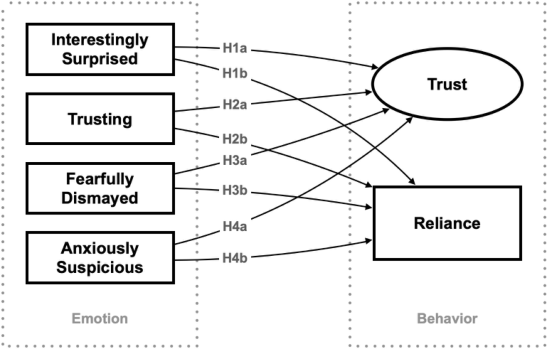
For XAI, taxonomy has already been explored. The work of Bernardo & Seva (2022) has recognized emotions developed from the interaction with XAI. As summarized in their XAI emotion set (XES), there are four main groups: interestingly surprised (e.g., interested, excited, surprised, pleased, and amazed), trusting (e.g., happy, confident, secure, proud, and trusting), fearfully dismayed (e.g., dismayed, afraid, fear, angry, and sad), and anxiously suspicious (e.g., suspicious, concerned, confused, nervous, and anxious). However, XES has not yet been used to measure affective change for XAI, unlike the previously mentioned structure of emotions. Thus, there had been no precise measurement of trust change at multiple emotional dimensions.
Proposed Hypothesis Considering the current delimitation in affect studies, findings from previous emotion taxonomies, and the viability of XES as a potential set to measure affect change, the following hypothesis is proposed. For better understan- ding, XAI affective trust and reliance (XATR) model presented in figure 1 is proposed.
An asynchronous virtual experiment was designed to assess the proposed model. The main goal was to embed an XAI in a controlled AI system to viably measure both the independent (i.e., emotions developed upon exposure to XAI) and dependent variables (i.e., trust and reliance of the user towards the AI) for the hypothesis relationship testing.
Measurement Conceptualization To contextualize the study, a pre-experiment survey was conducted with 52 current AI users. The objective was to determine the most used AI type and most acceptable design template for the XAI setup. Results showed that image classification AI was the optimal choice as almost all have experie- nced or understand its functionality. After the validation with a focus group discussion involving six AI application developers and six user experience (UX) experts, the Google Lens application was unanimously chosen to serve as the design environment’s template for logic and composition.
Participants Convenience sampling was the method followed for the data gathering. Initial leads were generated from social media advertisements, with qualifications specified as being able to communicate in English, being at least 18 years of age, having used any AI-powered system in the recent year, and having a normal or corrected-to-normal vision without any other sight problems. Facilitating requirements were also given for the device they will use and the experiment environment. A reward of 50 PHP (∼1.00 USD) was also
Affective Analysis of Explainable Artificial Intelligence in the Development 421
guaranteed upon their successful participation. For the sample size, the mini- mum number was set at 100 following the priori power computation of Westland (2010) and Cohen (1988) in detecting a significant effect for a model structure. Specifically, the anticipated effect size, desired statistical power level, and alpha level was set at 0.1, 0.8, and 0.05, respectively.
Tools Two measurement tools were created for the study: an online questionnaire and XAI testbed. In terms of purpose, the former handled participant scre- ening, consent confirmation, and acquisition of the subject’s demographical information. The latter was where the main variables were measured. Integral emotion and latent trust construct were assessed using a seven-point unipo- lar slider (1 - strongly disagree, 7 - strongly agree). Emotion was quantified using the four types of emotion proposed by Bernardo & Seva (2022) in their XES (i.e., surprisingly happy, trusting, fearfully dismayed, and anxi- ously suspicious), while trust was explored using three questions developed for this study. As for reliance, it was measured binomially based on the beh- avioral dependency of the user on the recommendation of the AI. For the hosting, the questionnaire and XAI testbed was hosted using Google Forms and Quant-UX, respectively.
For assurance, both tools were pre-tested with 30 participants compo- sed of AI users, language and grammar experts, AI programmers, and UX experts. Also, construct validity for the proposed trust questions was confir- med. All recommendations were incorporated and implemented before the main experiment.
Procedure The experiment started with the participant accessing the online question- naire link provided in the message sent to their social media account. They were initially prompted with the consent clause and screening questions upon opening. Those who agreed and passed were allowed to continue; otherw- ise, the questionnaire would terminate. Demographic information was then asked, along with the AI and XAI experience. After answering, the priming condition for using the XAI testbed was given: “An NGO hired you to reco- gnize pictures of different species in the Philippines. To help you, an image recognition AI system is available for you to use. You may choose to agree with its recognition or provide your own”. In the end, a link was provided to redirect the participants to the XAI testbed.
The XAI testbed started with general instructions on how to use the application and overall task. Each participant was required to recognize 25 random photos available in the application. In every trial, they were asked to rate their emotions on the XAI and trust in the AI. To limit the possible noise in the data, they were given three attempts to test the application and to feel how the sliders work. Once the trial run was up, participants proceeded with the actual experiment. After completing the 25 recognitions, the test- bed ended with a question on the subject’s availability for a post-experiment interview and instructions on how the rewards were to be distributed.
422 Bernardo and Seva
Data Recording and Analysis The area under the curve (AUTC) was used to have representative data for all variables, following the findings of Yang et al. (2017). This was computed by averaging the data across all 25 recognitions. Since reliance was recorded from an observable action, scores above 0.5 were considered reliance on AI and vice versa.
As for analysis, covariance-based structural equation modeling (CB-SEM) was the principal method followed. This was considered given that it: can do simultaneous analysis for the hypothesized relationship, carries the multi- variate techniques needed to confirm and validate the measurement tools, is insensitive to demanding parametric conditions, and can test, interpret, and compare contrasting models providing a more accurate estimate of the effe- cts (Astrachan et al., 2014; Dash & Paul, 2021). IBM Statistical Package for the Social Sciences (SPSS) 23 and Analysis of a Moment Structure (AMOS) Graphics 23 were the primary tools used to do all the computations. For consistency, all statistical tests were measured at a 0.05 significance level.
RESULTS & ANALYSIS The experiment ran for five days. Access mostly happened between 3:00 PM to 11:00 PM. On average, participants finished the whole experiment in 20 minutes, while 10 minutes for the post-experiment interview. No con- sent concern manifested, and the XAI testbed did not encounter any issues on all trials.
Data Screening Overall, 165 participated in the experiment. Of this, 143 were determined usable after removing all those who failed the qualifications and did not finish the experimentation. Descriptively, the majority belongs to the millennial age group (24 to 30 – 31.47% and 31 to 39 – 24.48%), followed by genera- tion X (40 to 47 – 15.38% and 48 to 55 – 6.99%), and generation Z (18 to 23 – 15.38%). Males (45.45%) were more compared to females (38.46%) and the undisclosed group (16.08%). In terms of educational attainment, the majority were college (70.63%) and post-studies (20.98%) graduates (Ele- mentary - 0.81% and Highschooler - 4.88%). For AI-related info, almost all are innovators (More than 5 years - 76.42%, 4 to 5 years - 9.76%, 2 to 4 years - 11.38%, 1 to 2 years - 1.63%, less than one year – 0.81%) and virtually all have an encounter with an XAI (82.93%).
Trust Measurement The introduced reflective trust questions showed outstanding measurement capacity as proven by the meritorious 0.833 Kaiser-Meyer-Olkin (KMO) measure and a significant Bartlett’s test of sphericity (p < 0.001). Commu- nalities also agree on this, given that all extraction was above 0.700. The three questions also exhibit high consistency and reliability, considering that all three proposed questions loaded on a single factor with a high 66.411% explained variance and a Cronbach’s alpha of 0.739. Confirmatory factor
Affective Analysis of Explainable Artificial Intelligence in the Development 423
Table 1. Model fit measures and threshold.
Table available in the original PDF paper.
Type Indices Estimate Threshold Reference Absolute Fit RMSEA 0.075 <0.08 (Westland, 2010) SRMR 0.039 <0.08 Hu & Bentler (1999) Incremental Fit CFI 0.984 >0.95 Schreiber et al. (2006) NFI 0.965 >0.95 Hu & Bentler (1999) Parsimonious Fit χ2/df 1.802 1 to 3 Hu & Bentler (1999)
Table 2. Sample human systems integration test parameters (Folds et al. 2008).
analysis also surfaced high validity with 0.763 and 0.53 composite reliabi- lity and average variance extracted (AVE) at an excellent fit (χ2/df - 1.395, RMSEA - 0.071, CFI - 0.964). With all these outstanding results, the three proposed questions were used to measure the latent variable of trust.
Structural Equation Modeling A clean factored model was concluded from the 2000 bootstrapped SEM results. As presented in table 1, all the fit indices passed the threshold value, highlighting the model’s validity in testing the relationship relative to the pro- posed hypothesis. More so, there were no modification indices, suggesting that no additional structural links or constraints were needed to increase the overall fit.
Of the eight proposed relationships, only three were determined to be significant (p < 0.001) – H1a and H2a for trust and H1b for reliance (see table 2). Notably, the interestingly surprised set relates significantly to trust and reliance, while the trusting set only has a significant link to trust.
DISCUSSION
Three key findings can be drawn from the results. First, if a person felt intere- stingly surprised emotions due to the XAI (e.g., interested, excited, surprised, pleased, and amazed), they would increase their trust in the AI and rely on its functionality. Second, only trust would improve for those who felt tru- sting emotions (e.g., happy, confident, secure, proud, and trusting). Third,
424 Bernardo and Seva
fearfully dismayed (e.g., dismayed, afraid, fear, angry, and sad) or anxi- ously suspicious (e.g., suspicious, concerned, confused, nervous, and anxious) emotions do not translate to a significant change in trust and reliance on the AI.
The findings show that for XAI, using valence as a marking for trust and reliance change is only ideal for positive emotions (i.e., interestingly surprised and trusting). This agrees with the general idea presented by Forgas (1995) in his Affect Infusion Model (AIM), where a person’s integral emotions alter the appraisal of new stimuli parallel to the direction of emotion’s valance. Also, from the insights generated in the interview, trust change from negative emo- tion was anchored by the level of reliability they feel. This follows the control theory discussed by Lerner and Keltner (2001) and Lerner et al. (2007), sug- gesting that high certainty or predictability does little to low change. The interview also highlighted that the reported emotions came from two sou- rces: appealing via design and cognitive appreciation. The former took the composition of XAI as an indicator of trustworthiness, while the latter refle- cted the resource available. These resonate broadly on AIM, where affect can cause behavioral change via operating on the heuristic (appearance) and memory (mental representations) (Forgas, 1995). As for the design, principles of Kansei engineering were heavily observed as design factors in XAI (e.g., form of explanation, communication style) was pinpointed to cause affect change (Gan et al., 2021).
CONCLUSION
This study proved that integral emotions developed from XAI could calibrate trust and reliance on the AI system. Remarkably – as tested using the XATR calibration model – interestingly surprised emotion set positively affects trust and reliance, while the trusting set increases trust. Further, the negative emo- tion set of fearfully dismayed and anxiously suspicious does not significantly contribute to the calibration. These results challenge XAI’s running cognitive calibration hypothesis, highlighting that explanations not only bring infor- mation to better understand how AI works but also diffuse emotions for behavioral change. Moving forward, this opens a new segment on how to improve XAI by leveraging emotions.
RECOMMENDATION Three recommendations are proposed to improve the contribution of this paper. First, as suggested in the post-interview, the XAI design can be manipu- lated to verify the claims of affective change. Understanding this can position a better improvement plan to effectively leverage the benefits of using XAI. Second, the concept of time or usage experience with XAI can be further explored in terms of its comparative moderating effect. This can explain how exposure to XAI can change its impact over time. Lastly, studies can also check the relationship between dependent measures to understand the mediating properties of emotions.
Affective Analysis of Explainable Artificial Intelligence in the Development 425
ACKNOWLEDGMENT
The Department of Science and Technology funded this research under the Engineering Research and Development for Technology grant.
REFERENCES
Adadi, A., & Berrada, M. (2018). Peeking Inside the Black-Box: A Survey on Explainable Artificial Intelligence (XAI). IEEE Access, 6, 52138–52160. https://doi.org/10.1109/ACCESS.2018.2870052 Astrachan, C. B., Patel, V. K., & Wanzenried, G. (2014). A compara- tive study of CB-SEM and PLS-SEM for theory development in family firm research. Journal of Family Business Strategy, 5(1), 116–128. https://doi.org/10.1016/j.jfbs.2013.12.002 Barredo Arrieta, A., Díaz-Rodríguez, N., Del Ser, J., Bennetot, A., Tabik, S., Barbado,
A., Garcia, S., Gil-Lopez, S., Molina, D., Benjamins, R., Chatila, R., & Herrera, F. (2020). Explainable Artificial Intelligence (XAI): Concepts, taxonomies, oppor- tunities and challenges toward responsible AI. Information Fusion, 58, 82–115. https://doi.org/10.1016/j.inffus.2019.12.012 Bernardo, E., & Seva, R. (2022). Explainable Artificial Intelligence (XAI) Emotions Set. Manuscript Submitted for Publication. Bernardo, E., & Tangsoc, J. (2021). Explanatory Modelling of Factors Influencing
Loyalty on Smartphone Shopping Application: A Modification of the Shop- ping Application Adoption Model. In A. M. J. Gutierrez, R. S. Goonetilleke, & R. A. C. Robielos (Eds.), Convergence of Ergonomics and Design (Vol. 1298, pp. 181–191). Springer International Publishing. https://doi.org/10.1007/978-3- 030-63335-6_19 Böckle, M., Yeboah-Antwi, K., & Kouris, I. (2021). Can You Trust the Black Box?
The Effect of Personality Traits on Trust in AI-Enabled User Interfaces. In H. Degen & S. Ntoa (Eds.), Artificial Intelligence in HCI (Vol. 12797, pp. 3–20). Springer International Publishing. https://doi.org/10.1007/978-3-030-77772-2_1 Buck, R., Khan, M., Fagan, M., & Coman, E. (2018). The User Affective Experience Scale: A Measure of Emotions Anticipated in Response to Pop-Up Computer Warnings. International Journal of Human–Computer Interaction, 34(1), 25–34. https://doi.org/10.1080/10447318.2017.1314612 Chen, Q. Q., & Park, H. J. (2021). How anthropomorphism affects trust in intelligent
personal assistants. Industrial Management & Data Systems. Chowdhary, K. R. (2020). Fundamentals of artificial intelligence. Springer. Cohen, J. (1988). Statistical power analysis for the behavioral sciences. Das, A., & Rad, P. (2020). Opportunities and Challenges in Explai- nable Artificial Intelligence (XAI): A Survey. ArXiv:2006.11371 [Cs]. http://arxiv.org/abs/2006.11371 Dash, G., & Paul, J. (2021). CB-SEM vs PLS-SEM methods for research in social sciences and technology forecasting. Technological Forecasting and Social Change, 173, 121092. https://doi.org/10.1016/j.techfore.2021.121092 Dazeley, R., Vamplew, P., Foale, C., Young, C., Aryal, S., & Cruz, F. (2021).
Levels of explainable artificial intelligence for human-aligned conversational explanations. Artificial Intelligence, 299, 103525. https://doi.org/10.1016/j.artint. 2021.103525 Forgas, J. P. (1995). Mood and judgment: The affect infusion model (AIM). Psychological Bulletin, 117(1), 39–66. https://doi.org/10.1037/0033-2909.117.1.39
426 Bernardo and Seva
Gan, Y., Ji, Y., Jiang, S., Liu, X., Feng, Z., Li, Y., & Liu, Y. (2021). Integrating aesthetic and emotional preferences in social robot design: An affective design approach with Kansei Engineering and Deep Convolutional Generative Adver- sarial Network. International Journal of Industrial Ergonomics, 83, 103128. https://doi.org/10.1016/j.ergon.2021.103128 Glikson, E., & Woolley, A. W. (2020). Human Trust in Artificial Intelligence:
Review of Empirical Research. Academy of Management Annals, 14(2), 627–660. https://doi.org/10.5465/annals.2018.0057 Gompei, T., & Umemuro, H. (2018). Factors and Development of Cognitive and Affective Trust on Social Robots. In S. S. Ge, J.-J. Cabibihan, M. A. Salichs, E. Broadbent, H. He, A. R. Wagner, & Á. Castro-González (Eds.), Social Robotics (Vol. 11357, pp. 45–54). Springer International Publishing. https://doi.org/10.1007/978-3-030-05204-1_5 Guerdan, L., Raymond, A., & Gunes, H. (2021). Toward Affective XAI: Facial Affect
Analysis for Understanding Explainable Human-AI Interactions. 2021 IEEE/CVF International Conference on Computer Vision Workshops (ICCVW), 3789–3798. https://doi.org/10.1109/ICCVW54120.2021.00423 Gunning, D. (2017). Explainable Artificial Intelligence (XAI). 36. Haenlein, M., & Kaplan, A. (2019). A Brief History of Artificial Intelligence: On the Past, Present, and Future of Artificial Intelligence. California Management Review, 61(4), 5–14. https://doi.org/10.1177/0008125619864925 Hu, L., & Bentler, P. M. (1999). Cutoff criteria for fit indexes in cova- riance structure analysis: Conventional criteria versus new alternatives. Structural Equation Modeling: A Multidisciplinary Journal, 6(1), 1–55. https://doi.org/10.1080/10705519909540118 Jin, W., Fan, J., Gromala, D., Pasquier, P., & Hamarneh, G. (2021). EUCA: A Pra-
ctical Prototyping Framework towards End-User-Centered Explainable Artificial Intelligence. 51. Kaptein, F., Broekens, J., Hindriks, K., & Neerincx, M. (2017a). Self-explanations of a cognitive agent by citing goals and emotions. 2017 Seventh International Conference on Affective Computing and Intelligent Interaction Workshops and Demos (ACIIW), 81–82. https://doi.org/10.1109/ACIIW.2017.8272592 Kaptein, F., Broekens, J., Hindriks, K., & Neerincx, M. (2017b). The role of emotion
in self-explanations by cognitive agents. 2017 Seventh International Confere- nce on Affective Computing and Intelligent Interaction Workshops and Demos (ACIIW), 88–93. https://doi.org/10.1109/ACIIW.2017.8272595 Lee, J. D., & See, K. A. (2004). Trust in Automation: Designing for Appropriate Reliance. Human Factors, 31. Lerner, J. S., Han, S., & Keltner, D. (2007). Feelings and Consumer Decision Making:
Extending the Appraisal-Tendency Framework. Journal of Consumer Psychology, 17(3), 181–187. https://doi.org/10.1016/S1057-7408(07)70027-X Lerner, J. S., & Keltner, D. (2001). Fear, anger, and risk. Journal of Personality and Social Psychology, 81(1), 146–159. https://doi.org/10.1037/0022-3514.81.1.146 Lewis, M., Li, H., & Sycara, K. (2021). Deep learning, transparency, and trust in
human robot teamwork. In Trust in Human-Robot Interaction (pp. 321–352). Elsevier. https://doi.org/10.1016/B978-0-12-819472-0. 00014–9 Linardatos, P., Papastefanopoulos, V., & Kotsiantis, S. (2020). Explainable AI: A Review of Machine Learning Interpretability Methods. Entropy, 23(1), 18. https://doi.org/10.3390/e23010018 Madsen, M., & Gregor, S. (2000). Measuring Human-Computer Trust. 12.
Affective Analysis of Explainable Artificial Intelligence in the Development 427
Mehrabian, A., & Russell, J. A. (1974). An approach to environmental psychology.
The Mit Press. Mohseni, S., Zarei, N., & Ragan, E. D. (2020). A Multidisciplinary Survey and Framework for Design and Evaluation of Explainable AI Systems. ArXiv:1811.11839 [Cs]. http://arxiv.org/abs/1811.11839 Plutchik, R. (1994). The psychology and biology of emotion (1st ed). HarperCollin-
sCollegePublishers. Rai, A. (2020). Explainable AI: From black box to glass box. Journal of the Academy of Marketing Science, 48(1), 137–141. https://doi.org/10.1007/s11747- 019-00710-5 Riegelsberger, J., Sasse, M. A., & McCarthy, J. D. (2003). The researcher’s dilemma:
Evaluating trust in computer-mediated communication. International Journal of Human-Computer Studies, 58(6), 759–781. https://doi.org/10.1016/S1071- 5819(03)00042-9 Russell, J. A. (1980). A circumplex model of affect. Journal of Personality and Social Psychology, 39(6), 1161–1178. https://doi.org/10.1037/h0077714 Schreiber, J. B., Nora, A., Stage, F. K., Barlow, E. A., & King, J. (2006).
Reporting Structural Equation Modeling and Confirmatory Factor Analysis Results: A Review. The Journal of Educational Research, 99(6), 323–338. https://doi.org/10.3200/JOER.99.6. 323–338 Tomkins, S. S. (1992). Affect, imagery, consciousness. 2: The negative affects (Repr).
Springer. Westland, C. (2010). Lower bounds on sample size in structural equation modeling. Electronic Commerce Research and Applications, 9(6), 476–487. https://doi.org/10.1016/j.elerap.2010.07.003 Yang, X. J., Unhelkar, V. V., Li, K., & Shah, J. A. (2017). Evaluating Effects of User Experience and System Transparency on Trust in Automation. Proceedings of the 2017 ACM/IEEE International Conference on Human-Robot Interaction, 408–416. https://doi.org/10.1145/2909824.3020230
LISTED IN THE AHFE DIGITAL BOOKSTORE CATALOGUE
Explore the complete digital volume
Intelligent Human Systems Integration (IHSI 2023): Integrating People and Intelligent Systems
Read this individual research paper free through the original publisher, or explore the full digital proceedings book.
ISBN 978-1-958651-45-2
Explore this ISBN in the AHFE Bookstore ↗Listed in the July 2026 bookstore catalogue; search by ISBN to confirm current availability · Digital book purchase optional