The German Supervisory Board as intended by the German stock corporation act should not only supervise the Executive Board, but also be able to advise and steer it (not in day-to-day business, but strategically). As part of this task, the Supervisory Board needs adequate information on the risks the corporation faces, in all areas of business, e.g. finance, marketing or human resource. As strategic management is a core responsibility of the executive board and supervisory board and personnel risks are an essential part of strategy development and execution, information on the prevalence and severity of personnel risks are essential for a sound debate on strategic issues in the Supervisory Board. Like all risks, the management of personnel risks must be an integral part of a cyclical and company-specific strategy process. Currently, however, the area of human resource risk management plays only a minor role, which may be due to the supposedly comparatively more complex quantifiability of personnel risks or the complexity of human factor interactions. But risks in the domain of human resources are not only an important part of risk management because of current regulatory developments e.g. in the area of corporate social responsibility (CSR), but also because of the important role human resources play at companies in general. Personnel risks cannot be seen independently of a corporate strategy as humans execute them: Every strategy risk is linked with human resources.We therefore have analyzed existing human resource risk concepts with the aim of how such concepts could be used in Supervisory Boards especially for members of the employee representation to be able to advise and steer the Executive Board. We found a number of existing studies dealing with personnel risks from different angles and a few concepts for managing personnel risks. We also found that evidence is scant for personnel risks as a whole category, not only focusing on one area like motivation or health in general, but more broad categories like management risks or adaption risks. The aim of this paper therefore is to first provide a rationale for human resource risk management, second to provide an overview on existing studies and concepts in this field and third to summarize the various concepts into one for the potential usage in the Supervisory Board. This paves the way for more empirical studies on personnel risks and their relation to strategic management or enterprise risk management.
Personnel risks like the misconduct of individual employees are often noti- ced externally, which can damage a company’s public image and destroy its value, as the example of Barings Bank has shown. This importance was also evident in a 2007 survey by the Economist Intelligence Unit, which polled 218 executives of major companies from every continent. The survey found that human resources (HR) risks were the most significant challenge from the executives’ perspective over the next few years (Economist Intelligence Unit, 2007). The authors wrote that neither human resources management nor risk management strategies had been integrated fully.
However, many countries have regulations in place regarding risk mana- gement and oversight by boards and other bodies. Consequently, decision- makers (and stakeholders) need adequate information on the relevant risks a corporation faces in all business areas such as finance, marketing, ope- rations, or HR. Intangible assets are of considerable importance as much organizational performance is tied to human resources (Bo, 2014). In addi- tion, regulatory developments, e.g., at the European level with the Corporate Sustainability Reporting Directive (CSRD), have stressed the importance of human resource risk management.
Human resources-related risks are not only an essential part of risk mana- gement because of such regulations or single, spectacular events but also because of the vital role human resources play at companies in general. Per- sonnel risks cannot be seen independently from a corporate strategy because humans develop and execute them: Every strategy risk is therefore linked to human resources (Berger et al., 2021). If a company sets out a new stra- tegy, analyzing the linkages to human resources should be the norm. As a functional strategy, HR is on an equal footing with other strategic areas such as finance and research and development, has access to a similar set of instruments, and ideally has at least equally close interfaces with busi- ness and corporate strategy (Berger et al., 2021). In this direct derivation, the HR functional strategy poses the central question of what kind of human capital is needed to implement a corporate strategy, with derivations and concretizations concerning organizational and personnel issues.
Like all risks, the management of personnel risks must therefore be an integral part of a cyclical and company-specific strategy process and part of the usual risk management cycle. Surprisingly, the topic of human resource risk management plays only a minor role in the literature (Bo, 2014), which may be due to the complexity of human factor interactions or stem from the weakened links between human resource management and risk mana- gement in recent years (Berger et al., 2021). In addition, the topics of risk culture and personnel risks are often regarded as “soft” in general and, the- refore, often not adequately addressed and implemented in the context of risk management (Economist Intelligence Unit, 2007).
In this paper, we first cover the concepts for dealing with human resource risks before discussing existing studies on human resource risks. We focus on the risk analysis process step as part of a broader risk management framew- ork and exclude additional risk processes such as risk evaluation, treatment, or reporting. In the last section, we suggest directions for future research.
EXISTING CONCEPTS There are numerous approaches to human risk management, some of which are briefly described below. Many of the articles on the subject discuss how risk management can be integrated into existing HR management practices, such as Becker and Smidt (2016). While this is important, we have a broader understanding of the topic, covering HR-related risks and specific risks for and by employees. Therefore, we include those approaches with regard to the analysis of personnel risks rather than more interaction-theoretical appro- aches or fundamental considerations. In his approach, Brand-Noé (1999) suggests seven categories of risk for discussion: (1) too few staff, (2) too many staff, (3) an aging workforce, (4) failures in personnel development, (5) an outmoded corporate culture, (6) the company’s understanding of ethics, and (7) the incompatibility of corporate cultures.
Wucknitz (2002) proposes a rating system in human resources, with 36 risk factors broken down into ten risk categories for analysis. Bernatzeder and Schütte’s (2005) concept differentiates among various risks in the areas of culture, values, and strategy, with respective subcategories. Klöti (2008)
706 Berger
deals with loss databases and assessment as part of his analysis of personnel risk management. Meyer et al. (2011) provide an overview of potential risks in the South African context and apply the European Foundation of Quality Management Risk Management Model.
However, other researchers rarely implement these conceptualizations, consider sub-fields, or are purely descriptive of potential risks, such as Meyer et al. (2011). Two approaches that have been increasingly adopted in the literature are developed by Ackermann (1999) and Kobi (2002; 2012). Acker- mann is one of the first to create a comprehensive approach that views human resources on the one hand and human resource management on the other hand as potential causes of possible risks for a company, both of which are affected by the effects of risk themselves. This approach results in four fields for analysis: risks for personnel, risks caused by personnel, risks for human resource management, and risks caused by human resource management practices.
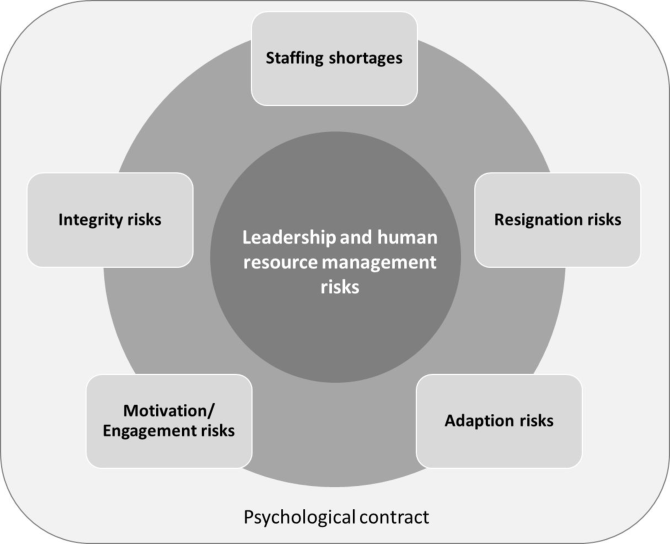
According to our literature review, Kobi’s (2012) conception is the most frequently cited approach (122 citations on Google Scholar compared to 37 citations of Ackermann, 1999). Kobi divides the various personnel risks into four main personnel risk fields. According to the author, these are not exh- austive, but they cover the most relevant risks from practical experience in human resources.
Staffing shortages: The lack of personnel in volume or quality.
Resignation risks: Unwanted resignations of personnel who could not be retained in the organization.
Adaption risks: The failure to adapt to changing market requirements, resulting in outdated qualifications of the workforce or missing compete- ncies among employees.
Motivation/Engagement risks: The withholding of performance by emplo- yees based on low commitment, overwork, or other reasons.
Kobi’s (2012) broader approach adds the following risks to those mentio- ned above:
Leadership risks: Managers do not lead adequately regarding the situation, the people they lead, or the company mission.
Human resource management risks: Human resource management itself represents a risk factor through, for example, inappropriate tools and systems, a lack of alignment with corporate strategy, or unclear role models in human resource management.
Integrity risks: Employees may not behave with integrity, e.g., when handling confidential information or working with entrusted funds.
Kobi also includes psychological employment contracts as a source of risks, referring to “individual beliefs in a reciprocal obligation between the indivi- dual and the organization” (Rousseau, 1989). This risk is especially relevant in countries where co-determination is strong as it forms an integral part of the psychological employment contract and will influence the expectations of employees. In the framework set out in figure 1, we see this contract as the context in which all other risks are embedded, but not as a single risk field.
Human Resource Risk Management Concepts 707
Figure 1: Human resource risk management framework (based on Kobi, 2012).
EXISTING STUDIES A literature analysis led to the identification of several studies dealing with human resource risks. The analysis began with Becker and Smidt (2016), who provide an overview of existing approaches that link HR and risk mana- gement. They group the 81 articles into three broader categories: human resource risks (70%), organizational and HRM practices and risks (26%), and an integrated view (4%). The authors find that the majority of stu- dies consider health risks or specific risks related to HR, and only a few conceptualize HR risk management.
Our analysis confirms this finding: most studies have not been condu- cted to capture or analyze HR risk management as a whole but focus on employee engagement, mostly in the context of health risks for employees, such as Marzec et al. (2013). While these studies offer some insights, they fail to assess personnel risks in a broader sense. Consequently, the following discussion elaborates on those studies that explicitly analyze human resource risks, excluding pure case-study analyses. Table 1 provides an overview of the studies and their methodology.
From their analysis of the annual reports of 22 insurance companies in 2002 and 2003, Kraft and Nolte (2005) find that more than half of the com- panies reported personnel risks. Berger and Gleißner (2007) show for 2005 that personnel risks were among the top categories of reported risks and that 45% of the listed companies in the H-DAX (consisting of all member compa- nies of the DAX, MDAX, and TecDAX) considered risks from this area to be
Survey 105 German SMEs (focus on risks from ratings) Kraft and Nolte (2005)
Content analysis of annual reports
Berger and Gleissner (2007)
Content analysis of annual reports Survey 218 executives from around the globe
German H-DAX-listed companies Economist Intelligence Unit (2007) Angermüller and Berger (2010)
Content analysis of annual reports Survey 100 German SMEs
German H-DAX-listed companies Beditsch et al. (2011) Survey 45 companies from around the world with 1,530 respondents Pricewater houseCoopers (2012)
Wölwer (2016) Interview/Survey 22 German SME
relevant. Similarly, Angermüller and Berger (2010) show for the HDAX in the annual reports from 2007 to 2009 that general personnel risks were menti- oned more and more frequently over the entire period, most recently (2009) by 79% of the companies. The dominant factors were always the possible lack of sufficient employees and fluctuation risks.
One of the few studies with an explicit focus on personnel risks was con- ducted by Führing (2004). He examines the reporting of companies listed on the DAX in relation to human resources, finding that personnel risks accoun- ted for 20 of the 117 risks mentioned. However, the information quality was insufficient in all subcategories, e.g., motivational risks, behavioral risks (in school grades: “poor”).
Similarly, Baumgärtner (2005) conducts a survey of Swiss small and medium-sized enterprises (SMEs); Blum et al. (2005) discuss SMEs in Saxony, and Beditsch et al. (2011) study SMEs in Baden-Württemberg. From these, it emerges that key personnel risks constitute a significant threat for which many companies (44% in Baumgärtner’s study) are not sufficiently prepa- red. The Economist Intelligence Unit study (2007) has comparable findings: about 33% of interviewees were satisfied with the management of human resources risks. At the same time, human capital risks were seen as the most significant risk area in the coming years, a subject reiterated in its 2009 report (Economist Intelligence Unit, 2009). The study by Pricewaterhouse Coopers (2012) similarly reports a large deficit with regard to risks in the area of junior staff and personnel. Finally, Wölwer (2016) investigates the relevance
Human Resource Risk Management Concepts 709
of key personnel for small and medium-sized companies and finds that only about half of key personnel were managers, resulting in severe consequences for the organizations.
CONCLUSIONS AND OUTLOOK When considering personnel risks, an (impending) shortage of skilled wor- kers, in particular, is discussed alongside the topics of white-collar crime or social responsibility. While these are important risks in the HR domain, we have argued that at a strategic level, personnel risks have a significant impact on the performance of companies and, therefore, should be analyzed syste- matically. For example, many core competencies or internal strengths can be significantly attributed to human resources, and all kinds of transformations entail human resource risks. As a noteworthy finding drawn from the studies mentioned above, companies do not yet frequently report on specific human resource risk management, even in annual reports. Moreover, most approa- ches aim to provide concrete risk checklists or risk fields instead of accessing the topic from a broader perspective.
Therefore, we agree with Becker and Smidt (2015), who see “a need for development and testing of more comprehensive human resource risk mana- gement frameworks.” Human resource risk management must be an integral part of risk management and human resource management and be approa- ched from a strategic perspective. More research is needed to derive the status of personnel risk management or the significance of personnel risks empiri- cally and must include stakeholders like board members, HR practitioners, or worker representatives. The studies mentioned above represent initial steps in this direction, and the suggested framework could help approach the topic further. An ongoing research project at the Hans Böckler Foundation is thus trying to identify workable approaches for a practicable system and offer them in a broad stakeholder perspective.
ACKNOWLEDGMENT
The author would like to thank the Hans Böckler Foundation for their fina- ncial support for this research project and Annabell Huber for her help in preparing the literature analysis.
REFERENCES
Ackermann, K.-F. (1999). Risikomanagement im Personalbereich. Reaktionen auf die Anforderungen des KonTraG. Wiesbaden: Gabler Verlag. Angermüller, N.-O. and Berger, T. (2010). Risikosituation der Unternehmen im
HDAX. RISIKO MANAGER, Volume 5 No. 24. Baumgärtner, R. (2005). Risikobewusstsein in schweizerischen Mittelstandsunternehmen. Unpublished thesis at the University of Applied Sciences Konstanz, Konstanz 2005. Becker, K. and Smidt, M. (2016). A risk perspective on human resource manage-
ment: A review and directions for future research, Human Resource Management Review, Volume 26 No. 4.
710 Berger
Beditsch, C., Berger, T. and Reinhard, R. (2011). Abschlussbericht zum Forschungsprojekt Risikomanagement und Wettbewerbsfähigkeit von KMU in Baden- Württemberg. Riedlingen: Riedlingen University of Applied Science publication. Berger, T., Giertz, J., Reinhardt, R. and Schütte, A. (2021). Keine Personalstrategie
ohne Personalrisikomanagement, PERSONALFÜHRUNG 5/2021. Berger, T. and Gleißner, W. (2007). Informationsgehalt und Risiken der Risikoberichte deutscher HDAX-Unternehmen, Zeitschrift für Corporate Governance, Volume 2 No. 1, 62–68. Bernatzeder, P. and Schütte, M. (2005). Risikomanagement des Humankapitals.
Controller Magazin No. 2/2005, 164–167. Blum, U. and Gleissner, W. (2005). Richtig gewichtet – Erkenntnisse aus dem Sachsen- Rating-Projekt. Risk News 1/2005. Bo, H. (2014). Risk management and people management: a critical reflection on
how risk management can be incorporated into current HR practices. Ph.D. thesis, University of Portsmouth, Portsmouth. Available at https://researchportal.port.ac .uk/files/5796948/HONG_BO.pdf Brand-Noé, C. (1999). Das KonTraG und die Risiken des Personalbereichs. Zeitschrift Interne Revision, Volume 34, No. 4, 314–321. Economist Intelligence Unit, ed. (2007). Best practice in risk management: A function
comes of age. A report from the Economist Intelligence Unit Sponsored by ACE, IBM and KPMG. Economist Intelligence Unit, ed. (2009). Beyond box-ticking. A report from the Economist Intelligence Unit Sponsored by ACE, IBM and KPMG. Führing, M. (2004). Risikoberichterstattung über Humanressourcen – Eine empiri-
sche Analyse der DAX 30. Zeitschrift für Personalforschung, Volume 18, No. 2. Klöti, L. (2008). Personalrisiken: qualitative und quantitative Ansätze für das Management von Personalrisiken. Berlin: Haupt Verlag. Kobi, J.-M. (2012). Personalrisikomanagement. Strategien zur Steigerung des People
Value (3rd Edition, 1st edition 2002). Wiesbaden: Gabler Verlag. Kraft, M. and Nolte, A. (2005). Risikoberichterstattung von Versicherungsunternehmen – Analyse der Risikoberichte im Zeitablauf; Zeitschrift für die gesamte Versicherungswissenschaft, Volume 94, No. 3. Marzec, M. L., Scibelli, A. F. and Edington, D. W. (2013). Examining individual
factors according to health risk appraisal data as determinants of absente- eism among US utility employees. Journal of Occupational and Environmental Medicine, Volume 55, No. 7. Meyer, M., Roodt, G. and Robbins, M. (2011). Human resources risk management: Governing people risks for improved performance. Journal of Human Resource Management, Volume 9 No. 1. PricewaterhouseCoopers (PWC), ed. (2012). Die Interne Revision am Scheideweg
(report) Rousseau, D. M. (1989). Psychological and implied contracts in organizations.
Employee responsibilities and rights journal, Volume 2, No. 2. Wölwer, D. (2016). Identifikation und Bewertung von Schlüsselpersonen sowie deren Einflussnahme auf den Unternehmenserfolg kleiner und mittlerer Unternehmen. Ph.D. thesis, University of Wuppertal. Wucknitz, U. D. (2002). Handbuch Personalbewertung: Messgrößen - Anwendung-
Read this individual research paper free through the original publisher, or explore the full digital proceedings book.
ISBN 978-1-958651-44-5
Explore this ISBN in the AHFE Bookstore ↗Listed in the July 2026 bookstore catalogue; search by ISBN to confirm current availability · Digital book purchase optional