David Eager (2026). Investigation of an auto-belay failure within an indoor climbing gym. In: Human Error, Reliability, Resilience, and Performance. AHFE Open Access, vol. 213, pp. 78–83. https://doi.org/10.54941/ahfe1007556
This paper discusses an incident where an 8-year-old girl fell 7 m from a rope ladder on 30 July 2022. The indoor climbing gym operator was charged and pleaded guilty to two breaches of the Occupational Health and Safety Act. The operator was fined AUD60,000 plus costs. The incident occurred within an indoor climbing gym in Melbourne, Australia. The incident involved an 8-year-old girl falling 7 m from a rope ladder while she was attending a friend’s birthday party. She became detached from a self-belay device suffering non-fatal traumatic injuries. It was concluded that the incident was a direct result of inadequate maintenance. Safety Engineering Ltd, the manufacturer of the Self-Belay Device, required all operators to re-certify their devices annually. The Self-Belay Devices are either refurbished and given a one-year additional warranty, or they are discarded and replaced with a new Self-Belay Device. The estimated usage period of the device which failed was 43 months. Excessive wear of the components within the Self-Belay Device allowed sufficient movement of the locking anchors for the device to malfunction. The movement of the locking anchors allowed the key to be removed when the worn connector was not fully engaged which allowed the participant to commence climbing when she was not securely to the auto-belay.
Historically top-roped climbing has relied upon a buddy system where a climber and a belay partner work as a team with the purpose to protect the climber from experiencing a ground-fall.
In more recent times top-rope climbing can achieve climber safety without the need of a climbing buddy by using an auto-belay system.
An auto-belay is a mechanical device used for belaying a climbing within an indoor climbing gym. The auto-belay device enables a climber to ascend pre-set climbs on a tape or wire-rope without the need of a belaying partner. The auto-belay device, which is mounted in a fixed position at the top of the climb, winds up the tape or wire rope on which the ascending climber is attached. When the ascending climber reaches the top of the climb, or falls, the auto-belay device automatically brakes and smoothly lowers the climber to the ground.
The main purpose of an auto-belay is to arrest a falling climber. A secondary purpose is the controlled descent of the climber once the climb has been completed (or after the climber has fallen).
THE INCIDENT The incident occurred at an indoor climbing gym in Melbourne, Australia. The incident involved an 8-year-old girl falling 7 m from a rope ladder while she was attending a friend’s birthday party (Eager, 2025). She became detached from a self-belay device suffering non-fatal traumatic injuries.
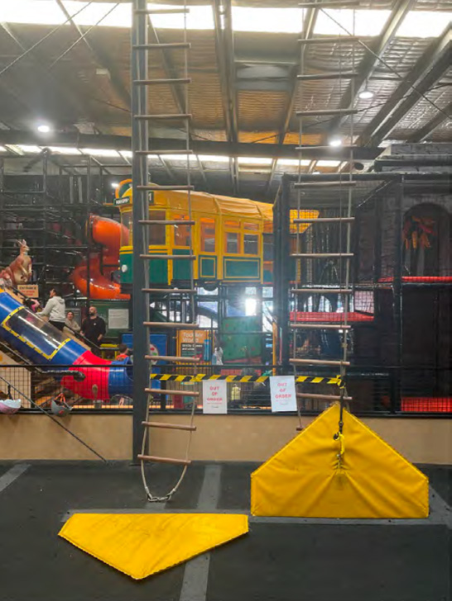
Figure 1 is a photograph taken depicting the configuration of the Commando rope-ladder climbs as they were after the incident. The injured party fell from the top of left-hand ladder which can be seen with the tape fully retracted to the ceiling and out of view.
Figure 1: Commando rope-ladder climbs depicting the tape of the left-hand ladder fully retracted to the ceiling [Eager, 2023].
SELF-BELAY DEVICE Safety Engineering Ltd, the manufacturer of the Self-Belay Device, required all climbing gym operators to recertify their devices annually. The Self-Belay Devices are either refurbished and given a one-year additional warranty, or they are discarded and replaced with a new Self-Belay Device (Safety Engineering, 2022).
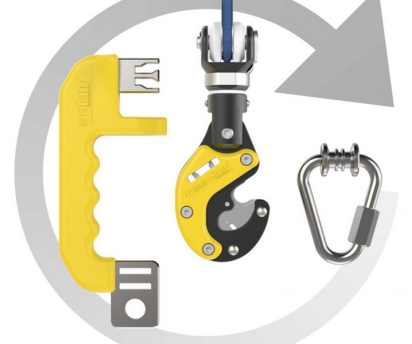
Figure 2 depicts the Self-Belay device components, namely: the Self-Belay Key, the Self-Belay Body, and Self-Belay Maillon (left to right).
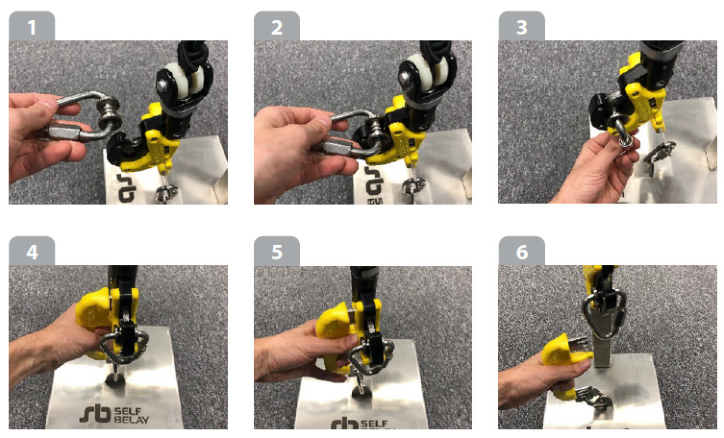
Figure 3 depicts the correct operation of the Self-Belay. Figure 3.1 to 3.3 show the Self-Belay Maillon being inserted into the Self-Belay Body. Figure 3.4 to 3.6 show the key being able to be removed from the Self-Belay Body.
FAILURE OF THE SELF-BELAY DEVICE The estimated usage period of the Self-Belay Device which failed was 43 months.
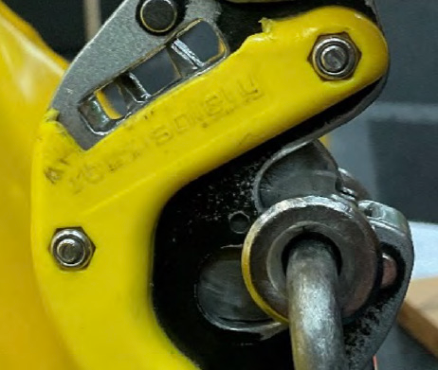
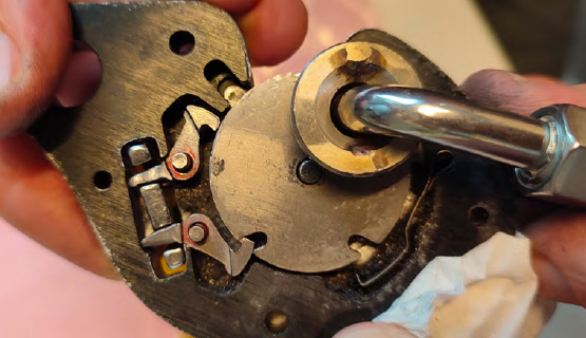
Excessive wear of the components within the Self-Belay Device allowed sufficient movement of the locking anchors for the device to malfunction (Figures 4 and 5).
A significant gap between the pins and locking anchors can be seen in Figure 5. The uncontrolled movement between the pins and locking anchors allowed the key to be removed when the worn connector was not fully engaged which allowed the participant to commence climbing while not secure (Eager, 2023).
Figure 4: Side view of the heavily worn Self-Belay Body which failed depicting the locking key being able to be removed when the Self-Belay Maillon connector was not fully engaged (Eager, 2025).Figure 5: Disassembled and partially reassembled heavily worn Self-Belay Body which failed depicting a single locking anchors engaged within the worn Self-Belay Maillon connector partially engaged (Eager, 2025).
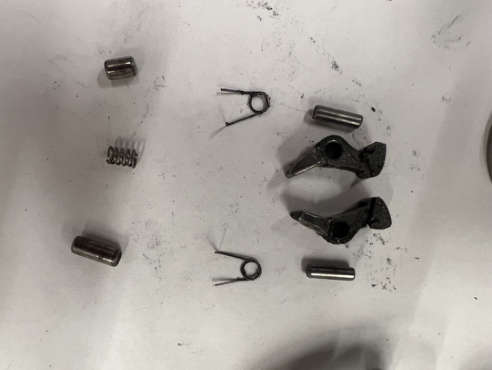
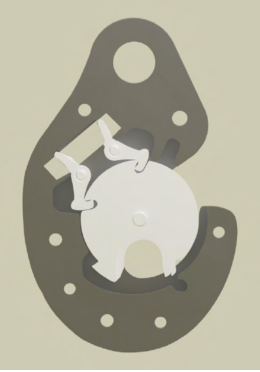
Figure 6 depicts the anchors and pins subcomponents within the Self-Belay Body before they were cleaned, measured and examined using an Olympus 3D LEXT laser microscope. Figure 7 depicts a sectional view of the Self-Belay Body.
Figure 6: Self-Belay Body worn anchors and pins before they were cleaned, (Eager, 2023).Figure 7: Sectional view of the Self-Belay Body: Right: depicting the twin locking levers engaging with the three locking disks as it was designed to operate; and Left: depicting a single locking lever prematurely engaged with the three locking disks before the locking disk have rotated to the locking position (Eager, 2025).
METHOD
The Regulator provided the author with a brief of evidence including the sealed auto-belay device that was recovered from the workplace.
A site inspection of the indoor climbing gym was conducted with the WorkSafe Victoria Inspector and additional evidence was obtained.
The auto-belay device was stripped down to its sub-components, photographed, measured and analysed.
The analysed revealed that the locking lever holes were severely worn and that this wear allowed the device to malfunction.
CONCLUSION
It was concluded that the incident was a direct result of inadequate maintenance. The indoor climbing gym operator was fined AUD60,000 and was also issued with a Court Order to pay costs.
It is critical for the safe operation of indoor climbing gyms that operators strictly comply with the manufacture instructions including scheduled maintenance instructions.
ACKNOWLEDGMENT
The author would like to acknowledge the assistance provided by WorkSafe Victoria.
REFERENCES
Eager, David. (September 3, 2023). Entertainment Velocity ‘Funtopia Maribyrnong’ incident of 30 July 2022, University of Technology Sydney, Australia. Eager David. (15–18 July 2025) Failure of an auto-belay device, IFR2025, 8th
International Conference on Integrity, Reliability and Failure, Porto, Portugal, doi.org/10.24840/978-972-752-323-8 Safety Engineering (November 11, 2022). Premium Self Belay Recertification, https:// safetyeng.eu/product/maintenance-subscription/
LISTED IN THE AHFE DIGITAL BOOKSTORE CATALOGUE
Explore the complete digital volume
Human Error, Reliability, Resilience, and Performance
Read this individual research paper free through the original publisher, or explore the full digital proceedings book.
ISBN 978-1-964867-89-2
Explore this ISBN in the AHFE Bookstore ↗Listed in the July 2026 bookstore catalogue; search by ISBN to confirm current availability · Digital book purchase optional