Heiko Fischer, Sven Seidenstricker, Thomas Berger, Timo Holopainen (2022). Artificial intelligence in B2B sales: Impact on the sales process. In: Artificial Intelligence and Social Computing. AHFE Open Access, vol. 28, pp. 135–142. https://doi.org/10.54941/ahfe1001456
Digitalization is a driving force for innovation in the business-to-business (B2B) environment and profoundly changes the way companies do business. It affects the entire value chain of a company and can be used for automating human tasks. For instance, previous research indicates that 40% of all sales tasks can be automated. Thus the digital transformation in sales has the potential to improve a firm’s performance. Depending on its development level, digitalization in sales can assist or even replace numerous sales tasks. Therefore, using digital solutions in sales can be seen as an essential trigger to competitive advantage. Recent developments in research and practice have revealed that especially artificial intelligence (AI) has gained increasing attention in the sales domain. A challenging issue in this domain is how AI affects the sales process and how it can be applied meaningfully in B2B sales. Thus, our paper aims to investigate how AI can be used along the sales process and how it can improve sales practices.To explore this, we conduct systematic literature research in scientific databases such as Business Source Premier, Science Direct, Emerald, Springer Online Library, Wiley Online Library, and Google Scholar, supplementing the findings with a qualitative research approach. Analyzing this literature focused on digital transformation in sales, we find that the application and benefits of AI depend on the sales process step. For this reason, we conduct research on B2B sales process models, compare them, and choose a reference model for the evaluation of AI in B2B sales. Moreover, we present common definitions of AI and show how this technology is usually applied in B2B sales. Afterward, we combine the sales process with use cases of AI. For each step, we present use cases in detail and explain their benefits for sales. For instance, we find that especially tasks with traditionally high human involvement are challenging to automate. In particular, in complex sales situations, the human salesperson may not be entirely replaced by digital technologies, while routine tasks can be carried out with the help of digital technologies. Our paper closes with a discussion and conclusion. Summing up, the proposed paper analyzes different viewpoints of the sales process in the digital sales literature. We can conclude that the main focus of our paper will be presenting the application of AI along the sales cycle. Our research closes with a discussion and conclusion and gives recommendations for practice and academia.
The megatrend of digitalization is one of the most researched current topics in sales management (Wengler et al., 2021) and influences the buying and selling of organizations (Mattila et al., 2021). It has the potential to systema- tically change B2B sales and interactions between buyers and sellers (Alamäki and Korpela, 2021). Especially the adoption of AI is seen as an important step toward digital sales practices (Alamäki and Korpela, 2021), and the greatest potential value of AI lies in marketing and sales (Davenport et al., 2020). For instance, research estimates that about 40% of sales tasks can be auto- mated (Hunter, 2019) and that AI can be applied in every sales process step (Paschen et al., 2020). AI will change the entire value creation function and infuse sales more and more (Singh et al., 2019). Mainly routine and pre- dictable tasks of human salespeople will be automated in the near future (Hunter, 2019).
However, companies are still unclear on how to benefit entirely from digi- tal transformation (Wengler et al., 2021). That is why we formulated the following question: How can AI be applied in the sales process in B2B sales? We conducted systematic literature research focused on digital sales in B2B to answer this research question.
The paper is structured as follows: we start by presenting sales processes from the literature and describe AI. Then we define the concept of AI and describe application areas along the sales process (section 3). Afterward, our
results are briefly discussed (section 4), and a conclusion of our research follows in section 5.
RESEARCH BACKGROUND Artificial Intelligence
Artificial intelligence is understood as information systems that act rationally based on given information. AI tries to solve problems to achieve the best or the best-expected outcome. Accordingly, its behavior does not have to follow human intelligence, but rather it should have an ideal performance called rationality (Paschen et al., 2020). Moreover, definitions of AI can be divided into two types: narrow intelligence, whose role is to process and identify the acquired data and to perform tasks, and general intelligence, whose intelle- ctual capacity is comparable to that of the human brain. Current tasks of AI perform in the narrow area and use the technologies machine learning, natural language processing, and deep learning (Jarek and Mazurek, 2019).
The AI Index 2021 (Zhang et al., 2021) shows that AI is gaining increasing attention in research: according to this report, the total share of peer-reviewed AI publications increased from about 1% in 2003 to almost 4% in 2019. China is the leading country, having a share of 22.4% of all AI publications, followed by the European Union (16.4%) and the USA (14.6%) in 2019.
Looking at applications at companies, major effects of AI relate to process efficiency, insight generation, and business process transformation as it is either used to automate tasks or augment cognitive capabilities (integrating AI with human expertise) (Enholm et al., 2021; Fischer et al., 2021). In 2020, the application of AI in sales was assessed as the second most relevant use case behind automated customer service agents (Mehta and Senn-Kalb, 2021).
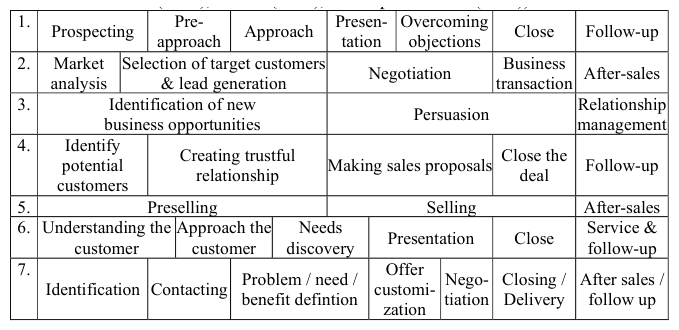
Sales Processes in the Literature A sales process is a series of repeatable steps to create customer value, deliver customer experience, and boost sales performance (Enyinda et al., 2021). Based on our literature analysis, we could identify several sales processes and compile them in Table 1. The sales processes as seen by these researchers vary in their number of steps, reaching from three steps to seven steps.
Previous research indicates that sales processes vary across industries, com- panies, and other circumstances. Most frameworks can be grouped under five broader topics: information acquisition, preliminary negotiation, actual negotiation & value proposition, offering deployment & value verification, and maintain & support customer operations (Rabetino et al., 2018).
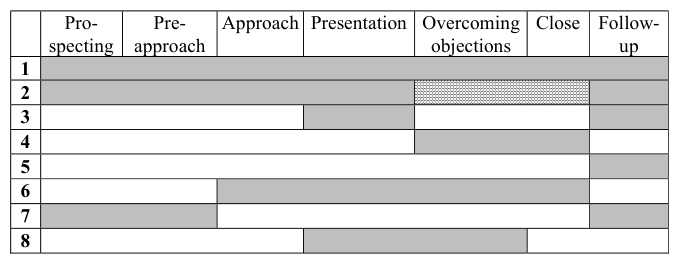
APPLYING ARTIFICIAL INTELLIGENCE IN THE SALES PROCESS This section introduces eight use cases that we could identify through our literature analysis. Table 2 gives an overview of the proposed use cases for each step in the sales process.
1 Profiles. The customer profile can contain what, how, and why a custo- mer made a purchasing decision and which consequences result from this.
Artificial Intelligence in B2B Sales: Impact on the Sales Process 137
Table 1. Sales processes in the literature (1. Paschen et al. (2020), 2. Wengler et al.
For instance, customer profiles can contain, e.g., browsing behavior, demo- graphic characteristics, interactions, past purchases (Paschen et al., 2019), or data from social media profiles (Moncrief, 2017). This knowledge can be used in many ways to support sales functions: Companies can analyze the information and apply it at the beginning of the sales cycle for lead qualification, updating lead data, or predictive qualification of leads (Paschen et al., 2020; Singh et al., 2019). Moreover, the historical patterns ameliorate customer segmentation to evaluate customer performance and future potentials (Davenport et al., 2020; Mattila et al., 2021). Besides that, companies utilize profiles of salespeople to analyze required competencies, create ideal staff profiles and thus improve the teaching of salespeople (Singh et al., 2019; Zoltners et al., 2021). In addition to this, AI can optimize compe- titive intelligence by identifying competitors, creating profiles to understand them better, and building competitive advantages (Huang and Rust, 2021). Following this, customer, sales, and competitor profiles are relevant to the entire sales process.
2 Chatbots. Chatbots can provide first 24/7 support to customers for non- complex issues in online shops. The customer can receive product recommen- dations autonomously without the assistance of a salesperson (Bongers et al., 2021). Especially, chatbots are very useful to answer standard questions immediately and accurately (Singh et al., 2019). In addition, in some cases, they are used to make initial contact with prospects (Davenport et al., 2020). However, chatbots are not only assisting customers but also salespeople. Chatbots can facilitate on-the-go sales simulations and give feedback to sale- speople, e. g., on the effectiveness of their sales presentation (Singh et al., 2019). We can conclude that chatbots can be useful in some parts of the sales process. A limitation applies to the overcoming objection and close stages since research suggests only non-complex issues for chatbots.
3 Personalized recommendations. AI can give personalized recommenda- tions and present adequate products to the customers based on customer
Table 2. Use cases of AI in the sales process. The numbers refer to the explained use case in the text. Grey color indicates that a use case is feasible in the respective sales step, shaded boxes indicate possible applications that might be feasi- ble, while white colors indicate that applications are currently not feasible or plausible.
profiles. Therefore AI analyzes customer behaviors, identifies a suitable pro- duct, and presents it adequately (Bongers et al., 2021; Davenport et al., 2020). This application is beneficial in the presentation and follow-up phase of the sales process.
4 Dynamic pricing. If the price is the main determining factor, AI can partially manage the negotiation with the buyer by proposing buyer-specific prices (Bongers et al., 2021). It is possible to automatically determine the buyers’ willingness to pay and derive customized offers. Moreover, AI can identify customers who should be provided personal incentives to buy a spe- cific product (Davenport et al., 2020; Huang and Rust, 2021; Vieira et al., 2019). However, a human salesperson is still required when it comes to complex sales proposals with more decision criteria (Paschen et al., 2020).
5 Order processing. After the deal is closed, the entire order processing can be managed by AI. This applies to collecting, interpreting, recording, and transmitting orders as well as payment processing (Syam and Sharma, 2018). Additionally, the order status can be tracked and made available to sales and buyers (Bongers et al., 2021).
6 Emotional support. Previously it was not possible to analyze the massive amount of data. Nowadays, a facial coding process can extract the sen- ders’ facial expressions and associate these signals with business outcomes (Bharadwaj and Shipley, 2020). Hence, AI can support sales by providing emotional support (Davenport et al., 2020). This use case could be beneficial between the approach and close stage in the sales process.
7 Marketing strategy. Based on customer preferences, AI can enhance decisions on marketing strategies. The technology can deeply analyze the customer and give real-time advice regarding, e.g., communication style and promotions (Davenport et al., 2020; Huang and Rust, 2021; Paschen et al., 2019; Vieira et al., 2019). Thus this application could be beneficial at the beginning and end of the sales process.
8 Rapid prototyping. The literature reveals that AI can optimize rapid pro- totyping in various ways, e.g., by optimizing the models’ parameters (Syam
Artificial Intelligence in B2B Sales: Impact on the Sales Process 139
and Sharma, 2018). Especially to overcome objections, this could be very useful.
DISCUSSION
Our paper shows that AI can be applied in every sales process phase. Analyzing the use cases deeper shows that the phases from prospecting to presentation and the last phase, follow-up, include more routine tasks than the others. Contacting customers, collecting information about them, and maintaining the relationship after the close seems easier to be automated by AI. Significantly, the use cases for overcoming objections and partially clo- sing the sale do not entirely replace human salespeople but rather support their decision-making. Due to the higher complexity of the sales situation within these two phases, it is more difficult to automate these phases by AI. This challenge is confirmed by previous research stating that it is difficult for AI to manage complex buying centers (Syam and Sharma, 2018) and is (currently) preferably used for routine tasks (Hunter, 2019).
In addition to this, our research indicates that profiles are a use case and important fundament for other use cases. For instance, AI cannot make adequate personal recommendations to customers or propose a price for customers without a customer profile. The same applies to chatbots that can only adequately respond when they have sufficient knowledge about the customer. That is why profiles are the key to the successful application of AI in sales, and that information to complement the customer profile should be collected along the entire sales process. Accordingly, a database with mea- ningful information is required to benefit from AI applications in the sales process.
Following that, an essential trigger of AI in sales is data that can be analy- zed and processed in real-time. AI needs input data from the environment to solve problems and achieve the best outcome (Paschen et al., 2019). Thus, big data and big data analytics need to be applied with AI to gain a competitive advantage. With big data and thus a rich set of customer information, sales decisions can be improved (Fischer et al., 2021; Sinisalo et al., 2015), and companies can uncover what their customers want (Zoltners et al., 2021). Moreover, recent research shows how blockchain technology can improve trust in relationships (Lahkani et al., 2020). For this reason, AI should not be seen as an isolated solution but combined with other digital technologies to meet its full potential. However, managers must not neglect the potential resi- stance of salespeople who are afraid of being made redundant (Paschen et al., 2020) and the customers who could feel discomfort being analyzed by AI (Davenport et al., 2020; Grewal et al., 2021).
CONCLUSION
The detailed study of AI shows how this technology can be applied in the B2B sales process. We gave an overview of sales processes in the literature and depicted how the megatrend of digitalization influences the sales envi- ronment. As this study showed, AI offers meaningful solutions for every
phase in the sales process. Up to now, especially the narrow intelligence of AI is used and preferably replaces routine tasks. However, we could identify applications that already make use of general intelligence. For instance, AI applications can interpret human emotions to give support to salespeople. Despite the enormous advantages regarding efficiency and business outco- mes, introducing AI can disappoint customers and frighten salespeople. Thus an AI application needs to be aligned to these two parties and calls for a proper application framework.
REFERENCES
Alamäki, A. and Korpela, P. (2021) ‘Digital transformation and value-based selling activities: seller and buyer perspectives’, Baltic Journal of Management, vol. 16, no. 2, pp. 298–317. Bharadwaj, N. and Shipley, G. M. (2020) ‘Salesperson communication effective-
ness in a digital sales interaction’, Industrial Marketing Management, vol. 90, pp. 106–112. Bongers, F. M., Schumann, J. H. and Schmitz, C. (2021) ‘How the introduction of digital sales channels affects salespeople in business-to-business contexts: a qua- litative inquiry’, Journal of Personal Selling & Sales Management, vol. 41, no. 2, pp. 150–166. Davenport, T., Guha, A., Grewal, D. and Bressgott, T. (2020) ‘How artificial intelli-
gence will change the future of marketing’, Journal of the Academy of Marketing Science, vol. 48, no. 1, pp. 24–42. Enholm, I. M., Papagiannidis, E., Mikalef, P. and Krogstie, J. (2021) ‘Artificial Intelligence and Business Value: a Literature Review’, Information Systems Frontiers. Enyinda, C. I., Opute, A. P., Fadahunsi, A. and Mbah, C. H. (2021) ‘Marketing-
sales-service interface and social media marketing influence on B2B sales process’, Journal of Business & Industrial Marketing, vol. 36, no. 6, pp. 990–1009. Fischer, H., Seidenstricker, S., Berger, T. and Holopainen, T. (2021) ‘Digital Sales in B2B: Status and Application’, in Markopoulos, E., Goonetilleke, R. S., Ho, A. G. and Luximon, Y. (eds) Advances in Creativity, Innovation, Entrepreneur- ship and Communication of Design, Cham, Springer International Publishing, pp. 369–375. Fraccastoro, S., Gabrielsson, M. and Pullins, E. B. (2021) ‘The integrated use of
social media, digital, and traditional communication tools in the B2B sales process of international SMEs’, International Business Review, vol. 30, no. 4, p. 101776 [Online]. DOI: 10.1016/j.ibusrev.2020.101776. Grewal, D., Guha, A., Satornino, C. B. and Schweiger, E. B. (2021) ‘Artificial intelligence: The light and the darkness’, Journal of Business Research, vol. 136, pp. 229–236. Guenzi, P. and Habel, J. (2020) ‘Mastering the Digital Transformation of Sales’,
California Management Review, vol. 62, no. 4, pp. 57–85. Holopainen, T., Rantala, J., Virtanen, M. and Korhonen, T. (2020) ‘Sales Process Evolution’, in Kantola, J. I., Nazir, S. and Salminen, V. (eds) Advances in Human Factors, Business Management and Leadership, Cham, Springer International Publishing, pp. 174–179. Huang, M.-H. and Rust, R. T. (2021) ‘A strategic framework for artificial intellige-
nce in marketing’, Journal of the Academy of Marketing Science, vol. 49, no. 1, pp. 30–50.
Artificial Intelligence in B2B Sales: Impact on the Sales Process 141
Hunter, G. K. (2019) ‘On conceptualizing, measuring, and managing augmented technology use in business-to-business sales contexts’, Journal of Business Research, vol. 105, pp. 201–213. Jarek, K. and Mazurek, G. (2019) ‘Marketing and Artificial Intelligence’, Central
European Business Review, vol. 8, no. 2, pp. 46–55. Lahkani, M. J., Wang, S., Urba´nski, M. and Egorova, M. (2020) ‘Sustainable B2B E- Commerce and Blockchain-Based Supply Chain Finance’, Sustainability, vol. 12, no. 10, p. 3968. Mattila, M., Yrjölä, M. and Hautamäki, P. (2021) ‘Digital transformation of
business-to-business sales: what needs to be unlearned?’, Journal of Personal Selling & Sales Management, vol. 41, no. 2, pp. 113–129. Mehta, D. and Senn-Kalb, L. (2021) In-depth: Artificial Intellige- nce 2021: Statista Digital Market Outlook [Online]. Available at https://de.statista.com/statistik/studie/id/50489/dokument/artificial-intelligence/ (Accessed 10 January 2022). Moncrief, W. C. (2017) ‘Are sales as we know it dying … or merely transforming?’, Journal of Personal Selling & Sales Management, vol. 37, no. 4, pp. 271–279. Paschen, J., Kietzmann, J. and Kietzmann, T. C. (2019) ‘Artificial intelligence (AI)
and its implications for market knowledge in B2B marketing’, Journal of Business & Industrial Marketing, vol. 34, no. 7, pp. 1410–1419. Paschen, J., Wilson, M. and Ferreira, J. J. (2020) ‘Collaborative intelligence: How human and artificial intelligence create value along the B2B sales funnel’, Business Horizons, vol. 63, no. 3, pp. 403–414. Rabetino, R., Ogundipe, S. J. and Kohtamäki, M. (2018) ‘Solution sales process
blueprinting’, International Journal of Business Environment, vol. 10, no. 2, p. 132. Rodríguez, R., Svensson, G. and Mehl, E. J. (2020) ‘Digitalization process of complex B2B sales processes – Enablers and obstacles’, Technology in Society, vol. 62, p. 101324. Salo, J. (2017) ‘Social media research in the industrial marketing field: Review of lite-
rature and future research directions’, Industrial Marketing Management, vol. 66, pp. 115–129. Singh, J., Flaherty, K., Sohi, R. S., Deeter-Schmelz, D., Habel, J., Le Meunier- FitzHugh, K., Malshe, A., Mullins, R. and Onyemah, V. (2019) ‘Sales profession and professionals in the age of digitization and artificial intelligence technolo- gies: concepts, priorities, and questions’, Journal of Personal Selling & Sales Management, vol. 39, no. 1, pp. 2–22. Sinisalo, J., Karjaluoto, H. and Saraniemi, S. (2015) ‘Barriers to the use of mobile
sales force automation systems: a salesperson’s perspective’, Journal of Systems and Information Technology, vol. 17, no. 2, pp. 121–140. Syam, N. and Sharma, A. (2018) ‘Waiting for a sales renaissance in the fourth industrial revolution: Machine learning and artificial intelligence in sales research and practice’, Industrial Marketing Management, vol. 69, pp. 135–146. Vieira, V. A., Almeida, M. I. S. de, Agnihotri, R., Da Silva, N. S. D. A. C. and Arunachalam, S. (2019) ‘In pursuit of an effective B2B digital marketing strategy in an emerging market’, Journal of the Academy of Marketing Science, vol. 47, no. 6, pp. 1085–1108. Wengler, S., Hildmann, G. and Vossebein, U. (2021) ‘Digital transformation in sales
as an evolving process’, Journal of Business & Industrial Marketing, vol. 36, no. 4, pp. 599–614.
Zhang, D., Mishra, S., Brynjolfsson, E., Etchemendy, J., Ganguli, D., Grosz, B., Niebles, J. C., Sellitto, M., Shoham, Y., Clark, J. and Raymond, P. (2021) The AI Index 2021 Annual Report [Online], AI Index Steering Com- mittee, Human-Centered AI Institute, Stanford University, Stanford, CA. Availa- ble at https://aiindex.stanford.edu/wp-content/uploads/2021/11/2021-AI-Index- Report_Master.pdf (Accessed 10 January 2022). Zoltners, A. A., Sinha, P., Sahay, D., Shastri, A. and Lorimer, S. E. (2021) ‘Practical
insights for sales force digitalization success’, Journal of Personal Selling & Sales Management, vol. 41, no. 2, pp. 87–102.
LISTED IN THE AHFE DIGITAL BOOKSTORE CATALOGUE
Explore the complete digital volume
Artificial Intelligence and Social Computing
Read this individual research paper free through the original publisher, or explore the full digital proceedings book.
ISBN 978-1-958651-04-9
Explore this ISBN in the AHFE Bookstore ↗Listed in the July 2026 bookstore catalogue; search by ISBN to confirm current availability · Digital book purchase optional