Jimmy Petit, Jose Rouillard, Francois Cabestaing (2022). Design and study of two applications controlled by a Brain-Computer Interface exploiting Steady-State Somatosensory-Evoked Potentials. In: Human Interaction & Emerging Technologies (IHIET 2022): Artificial Intelligence & Future Applications. AHFE Open Access, vol. 68, pp. 632–643. https://doi.org/10.54941/ahfe1002787
Brain-Computer Interfaces (BCI) allow users to interact with machines without involving muscles. Patients with heavy motor impairment can benefit from these systems. Different states of mind of a user are discriminated to translate them into basic commands (left, right, etc.). But traditional BCI are mainly based on visual attention, and users can be quickly tired (eye fatigue, repetitive tasks, etc.). In some cases, the sight is not available for a relevant BCI, while the sense of touch can remain usable.We have implemented an electroencephalography-based BCI using the user's sense of touch. This paper describes the design and study of two BCI applications controlled by an Steady-State Somatosensory-Evoked Potentials (SSSEP), over a control group of 10 healthy subjects.We use two mechanical vibrators (C2 tactors) taped to each wrist. When they vibrate at a specific frequency, SSSEP are measurable on the electroencephalography. A somatosensory gating is the capacity of the brain to filter out stimuli perceived as redundant or irrelevant during a goal-oriented activity. This phenomenon is exploited in our BCI by asking users to imagine themselves moving their arms (motor imagery) while they are perceiving vibrations on them. These intentions are detectable in 4 possible classes (idle, left arm, right arm, and both arms simultaneous).The first application is a 2-level puzzle called SokoBCI, in which the user controls the motion of a 3D avatar and have to reach different locations to plant trees. The second application consists of driving a go-kart around a figure-of-eight track. For both applications, the main instruction given to the users is to perform the task as fast as possible. The major difference between these applications is inertia, present in the kart model, and not in SokoBCI. SokoBCI levels design and the road circuit are designed to balance the use of turns and forward commands. The "idle" command is used as a default state of mind command, therefore, it should be avoided during active control of the application. The rhythm of the command during a block, and therefore the presence of mechanical stimulations, as well as the feedback and breaks, are cued using a three-colour light.Each participant performed 4 blocks of recordings, for each application. Each block lasts around 7 minutes, except in SokoBCI if the levels are finished before, and have a fixed Sham feedback accuracy. Sham feedback is used to artificially fix the performance of the system. The accuracy is fixed during a block and could take the values: 45%, 60%, 75% and 90%. The four possible accuracies are tested once for each application during the session. Applications and tested accuracies order are pseudo-random. The applications (design and goal), as well as the given instructions are designed so that one or two (max) commands are "good" at each step, depending on the current state of the applications.We measure two kinds of data:- Quantitative: at the beginning and end of each series of 4 blocks, i.e. beginning and end of one application, a questionnaire about the awakeness, fatigue, mood orientation or experienced pain level from the stimulation of the vibration is given to the participant.In addition, at the end of every block, a NASA Task Load Index and System Usability Scale questionnaire are filled up by the users.- Qualitative: at the end of the session, a short interview is also conducted.We collect the user's perception of the experiment and Sham feedback.Using the SUS scores (0-100), we build a model of the relationship between the accuracy of the system and the perceived usability of each application. Therefore, we can predict a range of accuracies to reach, in order to achieve a specific degree of perceived usability. For example, thanks to our model, an accuracy of 80% is matched to a SUS Score of 70, which itself could be qualified as "Good", according to the well-known mapping between SUS Score and adjectives.
We implemented a Motor Imagery based BCI which provides four com- mands. We conducted a user experiment to evaluate our applications over a group of ten healthy subjects. This user experience is the last session of a four-session-long experiment (ethical comity of Lille University, reference: 2020-417-S81). The other three sessions are more focused on studying the neurophysiological aspects of the BCI. Describing these sessions and their results is out of the scope of this paper dedicated to the Computer-Human Interaction aspect.
For the user experiment, we have developed two applications. Howe- ver, BCI using Motor Imagery and four different commands tends to have
Design and Study of Two Applications Controlled by a Brain-Computer Interface 633
a low accuracy, which greatly improves with a lot of training. Since the users had no time to train themselves, we used sham feedback to simu- late various levels of performance (Park, et al., 2021). The sham feedback has various advantages compared to testing the real performances of the system:
1. The classifier used by the BCI has already been trained before the user experiment session. However, within one or two weeks between the two sessions, the mental activity may have drastically changed, and it would be likely that the classifier would produce the same output to any given input, resulting in a succession of commands like Turn Left, Turn Left, Turn Left, … Sham feedbacks avoid locking the user in that situation. 2. A consequence of implementing sham feedback is that we must set the desired command (a “Good”action) for any given state of the application using a combination of level design and instructions. This allows us to then perform an offline relevant test of different classification algorithms and build on a dataset where the number of commands is reasonably balanced. For example, without sham feedback, the subject could be stuck in a state where they must use the same command repeatedly, which seriously unbalances data set. 3. For the user experiment, we use various levels of sham, ranging from 45% to 90%, which allows us to study the relationship between the system accuracy and various measured aspects in the questionnaires, which is not possible otherwise.
The objective of this article is to provide the details of the applications and how we encourage the user to use a balanced number of commands. In addition, we study the effect of the applications and the user experiment on the users themselves using questionnaires investigating fatigue, mood orien- tation, or mental workload, for example. Finally, we study the correlation between the perceived usability of the system, assessed with a System Usa- bility Scale, and the performance of the system. Therefore, for a given BCI performance, we can predict what mean degree of perceived usability will be achieved, and vice versa.
APPLICATIONS DESIGN In this section, we present in detail the applications, to allow their reproduci- bility. In addition, as our user experiment uses sham feedback, we introduce definition of “Good” and “Bad” commands in the applications.
Description The first application is a kart-driving application. The kart is controlled with the four available commands provided by the BCI: Move Forward (MF), Turn Left (TL), Turn Right (TR), and Do Nothing (DN). To balance the number of “active” commands, i.e., MF, TL and TR, the kart moves on an eight-shaped road. During a left turn of the road the user is instructed to perform a TL command, and vice-versa. In a straight part, the user is instructed to perform the MF command. Instructions are given using a sheet at the beginning of
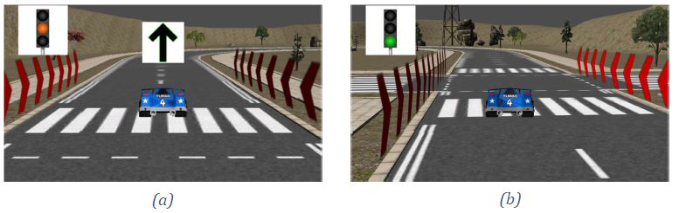
Figure 1: Screenshots of the kart (a) on a straight line (b) at the cross section of the eight shaped road.
the experiment. A Turning command performs two actions on the kart: the vehicle turns and receives an additional pushing force. Therefore, one TL or TR command will make the kart follow a curved trajectory. To help stay on tracks, semi-transparent walls, with red arrows on them, follow the kart and apply a repulsive force to it as soon as it gets too close to them. Figure 1 shows two screenshots of the application. Figure 1 (a) shows the feedback given to the user: the kart moves or gains speed and an image is displayed on top of the kart. The kart is on a straight line, therefore, it has a fixed percentage, like 60%, of doing MF according to the sham feedback. If a “Bad” action must be performed, then the action is randomly and uniformly selected between TL, TR, and DN.
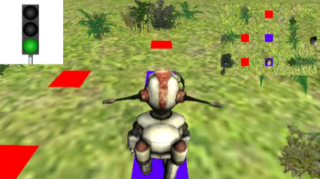
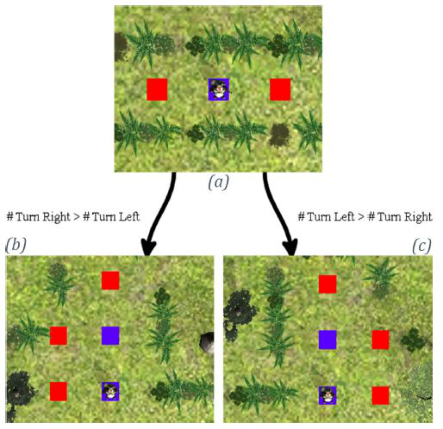
The second application is a puzzle-solving type of game called SokoBCI, inspired by the game Sokoban (Hiroyuki Imabayashi, 1982). The user con- trols the movement of a 3D avatar who must plant trees. The user must solve the levels using the smallest number of commands. To balance the number of active commands, one run of the application is composed of 2 levels. The first level is a simple symmetric level that forces the user to use an uneven number of TL and TR commands. During the solving of the first level, the system counts the number of TL and TR commands. Level 2 is chosen to encourage the user to use the command least used during level 1. The actual vision from the user’s point of view during level 2 is displayed in figure 2. The level designs and the aforementioned process are displayed in figure 3, which is a top view of the levels. When the user plants a tree, the tree appears on the red square and the red square turns green. During a run of the appli- cation, as soon as the user finishes level 1, the appropriate level 2 appears on the screen and the loop of commands starts again. To give time to the user to think about the best solution, the first command of level 2 is completely ignored by the computer, during a dozen seconds of break.
For both applications, a three-colour light is displayed at the top-left corner of the screen. The green light gives the cue to the user to start the Motor Imagery task to send a command to the BCI. After six seconds, the light turns to orange, indicating the feedback period, during which the kart or the avatar will react accordingly to the given command. After three seconds of feedback, a short break with random duration, between three to four seconds, is given to the subject with the red light.
Design and Study of Two Applications Controlled by a Brain-Computer Interface 635
Figure 2: User view at the beginning of a level 2 (Turn Left induced-design).
Definition of “Good” or “Bad” Command: Specific Case of SokoBCI The description of the Kart driving task is quite clear about the instructi- ons given to the subject. We believe that the definition of “Good” or “Bad” command is straightforward in this case. However, for the SokoBCI it is less clear. In our user experiment, the user is instructed to “use the least number of commands to plant all the trees. If the system does an unwanted action, [example given], you might need to change your initial plan.”When observing the level design, one can verify that the solution for level one is to rotate once; left or right, and plant a tree, then rotate twice, in the same direction, to plant the second one. In this situation, the commands TL and TR are considered equally “Good” commands, the commands MF and DN, will have the same effect which is leaving the avatar motionless and are “Bad”. However, during the U-turn, the initial rotation will dictate the next choice of the user, the first rotation will be either an error or not, depending on the user’s mental deci- sion. Given the instruction, the user will adjust their mental plan to pursue the rotation, end therefore the “Good” action becomes predictable.
In the first level, the avatar can face four different directions and the tree planting can have four different states (no tree planted, the left tree only, the right tree only, and both trees planted): there are thus twelve (4 * (4 −1)) different possible game states, the game state where all trees being planted being naturally ignored. Four of the game states have two “Good” actions. In the second level, left or right, the avatar can face four different dire- ctions, through two different locations, and the tree plantation can have eight different states (23 possible situations). Therefore, we have fifty-six (4 * 2 * (23 −1)) possible states of the game, of which thirteen states have two simultaneously “Good” actions.
Inertia and “Punitiveness” The first difference between applications is in inertia. The kart continues to move forward during the green light period. It is a vehicle that gains momen- tum by receiving the TL, TR, and MF commands. The user must analyse the road and speed to decide when to send the next command, even during the red-light periods which represent the breaks. The second difference is the punishment for mistakes, which we call “punitiveness”. In the kart applica- tion, the semi-transparent walls follow the kart as it moves along the track, pushing the kart in the opposite direction as it gets closer. In this case, even mistakes tend to move the kart forward, however slowly. In the SokoBCI, on
Figure 3: Top view of the SokoBCI levels. (a) level 1. Depending on the number of TL or TR used to solve the level 1, one level 2 is chosen (b) or (c). The blue squares show the possible location of the avatar, accessible with the Forward command while facing the proper direction. The red squares show the targets. The user has to orient the avatar towards a target and use the command MF to plant a tree.
the other hand, a mistake can be much more frustrating as the user will have to make a correction move in most cases.
TEST OF THE APPLICATIONS We conducted a user experiment with a group of ten healthy participants, seven males and three females. The average age of the participants is 23.8 years (std: 3,2 years, min: 19, max: 28). In this section, we present the experimental protocol.
Protocol The subject sits in front of the computer and fills out a pre-session question- naire. Then, the experimenter gives an instruction sheet to the subject, who reads it and can ask any questions needed for good comprehension. Afte- rwards, the experimenter installs the brain-computer interface device on the user, as well as the devices that deliver the mechanical stimulations to the wrists. After this installation step, the proper tests can begin. We start by demonstrating one of the applications, chosen with a pseudo-random order across subjects, we remind the user the objective of the application and the instructions. After that, the user performs four blocks of recording with the application. Each block has a specific accuracy for the sham feedback, the four chosen accuracies are 45%, 60%, 75%, and 90%. The order is also pseudo-random. After four blocks of recordings, the demonstration and test steps are repeated for the other application. The subject has a mandatory break of 3 minutes (minimum) between each recording block.
Design and Study of Two Applications Controlled by a Brain-Computer Interface 637
Table 1. Interview guide for the experimenter.
Table available in the original PDF paper.
1) What did you think of the experiment? 2) What did you think about the difficulty to adjust your mental plan to the system’s error during the SokoBCI? 3) Inform the subject about the sham feedback: what is it about, how is it done, and why we do it. 4) Did you ever suspect the sham feedback? [If yes, when?] 5) Did you suspect different levels of performance/accuracy? 6) Did you discuss about performances during the previous session [which also had sham feedback] with your friend/colleague? [Question optional, question asked only if the friend/colleague also participates in the experiment.]
The subject fills out questionnaires after each block and the experimenter conducts a debriefing interview with the subject at the end of the experiment. The experimenter asks the subject to fill out the questionnaire independently from one block to another. We have three different questionnaires. The first one is about behaviour measurement, the second one is a NASA Task Load IndeX without the pairwise comparison of the questionnaire’s dimensions, called Raw TLX (Hart, 2006), and the last one is the System Usability Scale (Brooke, 1996) (Brooke, 2013), or SUS. The last two are given to be comple- ted at the end of each block. The first questionnaire is given as a pre-session questionnaire and after the first block, the fourth block (i.e., four blocks of the first application), the fifth block and the eighth block (i.e., four blocks of the second application), to measure changes in behavioural data during each application.
The Behavioural questionnaire contains four items assessing “Awakeness”, Tiredness, Mood Orientation, and Emotion Intensity with a five-point Likert scale. Additionally, a space for comments is left for subjects to express themse- lves on the application they have just tried. The Raw TLX aims at measuring the mental workload of the application with six items: Mental Demand, Physical Demand, Temporal Demand, Performance, Effort, and Frustration measured on a twenty-point Likert scale. The SUS aims at measuring the usa- bility of the system with a ten-item long questionnaire, also using a five-point Likert scale.
In the debriefing interview at the end of the session, we discuss with the subject different aspects of the whole experiment. Table 1 presents the diffe- rent questions asked, and their order. At the end of the session, some subjects had strong time constraints, which led us to shorten some interviews.
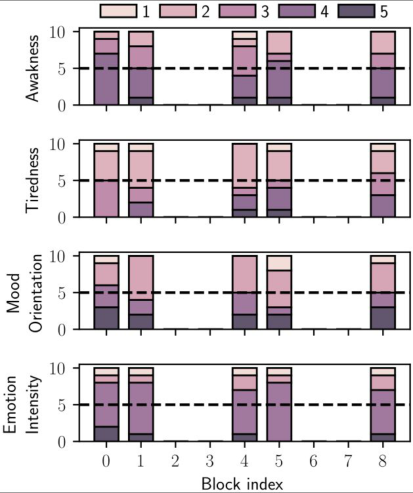
Behavioral Data - Results Results of the Behavioural data analysis are displayed in figure 4. We can observe that, “Awakeness”, Mood orientation (positive to negative), or Emo- tion Intensity do not seem to evolve during the session. However, Tiredness tends to increase, indeed the majority mention (the mention that crosses the 50% threshold) became three (out of five) by the end of the session. A few subjects filled out the mention number four during the session too, which they did not at the beginning of the session. To conclude in a few words, the
Figure 4: Stacked bar plots showing the distribution and evolution of Behavioural data over the subjects.
eight blocks of recording seem to cause a little fatigue to our subjects and additionally, the three other dimensions do not evolve much.
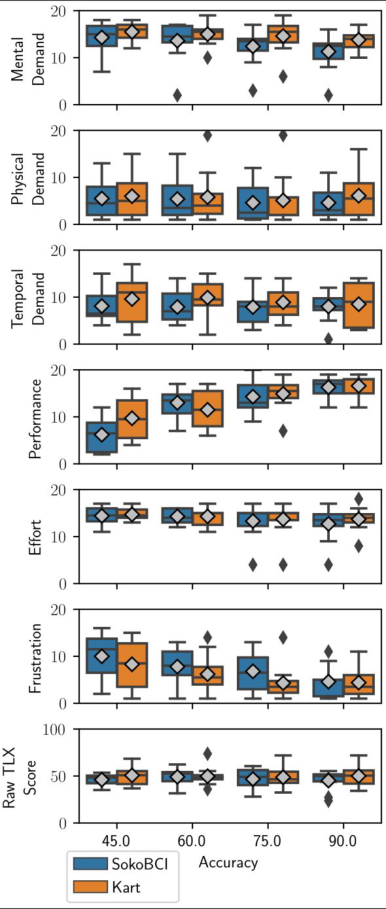
The Raw TLX results are presented in figure 5. When observing the distri- bution of the Raw TLX score against the sham accuracy, no trends seem to appear. No difference can be observed between applications either. How- ever, the individual dimensions of Performance and Frustration are highly inversely proportional to the sham accuracy. It seems to hold for the Effort dimension of the questionnaire too, however to a lesser extent than the previous two dimensions. The subjects seem to have well experienced the dif- ference in the BCI performances and the frustration level diminished as the performance increased, likely caused by the decreasing number of mistakes performed by the system. Interestingly, as the accuracy increases, we measure a difference in Mental Demand between the applications. With sham accu- racy at and above 75%, the subjects seem to experience a Kart application more mentally demanding than the SokoBCI application. This is confirmed using a dependent samples t-tests1: at 75% a p-value of 0.0012 (< 0.05) and at 90% a p-value of 0.019 (< 0.05) are computed. At 75%, the mean diffe- rence in Mental Demand between the Kart and the SokoBCI is at 2.2 points (std: 1.6) while being at 2.5 points (std: 3.1) at 90% of sham accuracy. This difference can be explained by the difference in inertia between the two appli- cations. In the kart, when the three-colour light is red, the kart is still moving, and the user must think to anticipate the movement of the kart. Additionally, 1We failed to reject the hypothesis of normality of the four samples using Shapiro-Wilk tests and a rejection threshold of 5%, therefore we assumed the normality of the samples.
Design and Study of Two Applications Controlled by a Brain-Computer Interface 639
Figure 5: Box plots of the Raw TLX results, grouped by the application type. The six first lines show the individual dimension of the questionnaire, while the seventh line show the score of it.
the effect does not occur for low accuracies since multiple errors tend to slow down, or even stop, the kart. Finally, a weak difference between the applica- tion in the Frustration level is also observable for the lowest accuracy as the mean and median are systematically higher in the SokoBCI than in the Kart. This could be explained by the “punitiveness” of the SokoBCI, an error being much more costly in this application than in the Kart-driving one.
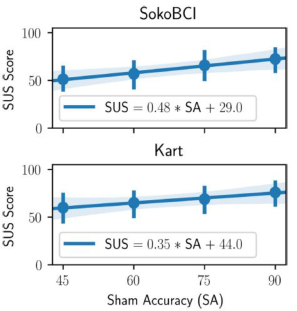
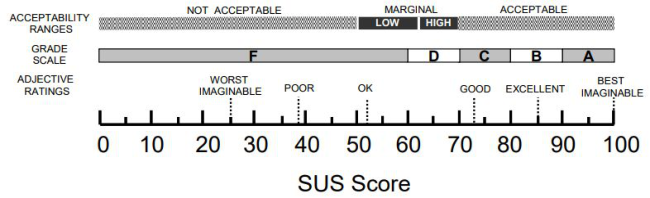
Figure 6: Mean and 95% Confidence Interval, computed by bootstrap, of the SUS Score in regard to sham accuracy.Figure 7: Relationship between the adjective ratings, acceptability scores, and school grading scales, in relation to the average SUS score. From (Bangor, et al., 2009).
Relationship Between Performance and SUS
Figure 6 shows the results of the SUS questionnaires. Firstly, the SUS scores are positively correlated to the sham accuracy.
According to the slope coefficient of linear regression, the effect is stronger in the SokoBCI application than in the Kart. It can be also explained by the higher “punitiveness” of an error in SokoBCI than in the Kart.
Bangor et al. added an adjective rating scale to mean SUS scores, see figure 7 (Bangor, et al., 2009). In doing so they also provide an interpreta- tion of SUS scores using an adjective, school grading system, or acceptability range from previous works. According to their results, a system would start to be acceptable with a SUS of 70 and everything below had usability issues and is cause for concern. Therefore, using these models, in a BCI with similar features to the SokoBCI, the system would become acceptable with a mini- mum performance level of 85.4%, whereas a system like the Kart application would need a minimum performance level of 74.3%.
Questionnaire Comments and Debriefing Interview Results Reading the comments and notes during the experimenter’s debriefing allo- wed us to identify four categories of feedback: Strategy, the strategy found by the subject to perform the task; Application Comparison, the subject expresses some preference toward one application over the other; Positive
Design and Study of Two Applications Controlled by a Brain-Computer Interface 641
Comment, various adjectives that show the subject’s appreciation for the application, the system or the experiment; and Improvement Tips, which is a list of things that could be improved to make the applications better.
The commentaries related to session comparison (see Table 1 - 1) and the performance of the subject written during the session are ignored, as the subjects did not expect sham feedback. We have translated the comments from French to English as faithfully as possible. Finally, we added context to comments or shortened them, if necessary, when indicated in brackets.
Strategy Two subjects spontaneously used the same strategy of Motor Imagery during the SokoBCI. They imagined themselves pulling the antenna of the avatar with one or two arms. For example, subject n°10 writes “The design of the character helped me to visualise the correct movements, I imagined taking the antennas on the head of the character and pulling them (the antenna on the right with the right hand to turn to the right, [etc])”.
The subject n°6 comments that he found it easier to focus on the road instead of the kart: “I found it easier to concentrate when I wasn’t looking at the vehicle (looking at the road instead) [After Kart 45%].”
Application-Comparison Subjects 2 and 10 comment about the higher complexity of the SokoBCI over the Kart driving application, subject n°2 writes: “[SokoBCI] is very funny (more than Kart), but more complex too”. However, subject n°4 states during the debriefing having more trouble processing the scene and movement while performing the Motor Imagery task: it’s hard to see the game and play at the same time. Acquire information and respond in time, that’s difficult.”
Positive-Comments Almost every subject commented something positive; the words “fun” or “playful” appeared a lot. The word “fun” was given by six different subjects. Subject n°10 noticed how time seems to pass much faster and subject n°3 highlights the intuitiveness of the system: “It’s fun finally seeing the system working for me. It’s pretty instinctive to use at this point [after SokoBCI at 75%]”. Subject n°8 comments that the experiment was more ecological: “Last session with a concrete application is a bit more playful.”
Improvement-Tips Subjects 4, 5 and 8 commented that the inertia of the kart was disturbing them: subject 4 writes “I struggle focusing simultaneously on the stimulations and on the commands to be performed”, and subject n°5 writes: “I struggle to focus simultaneously on the stimulations and on the commands to be perfor- med [during Kart]: really tiring. [In SokoBCI] The character is static during the acquisition [i.e. Green light] so we do not receive information, this helps to focus.” Interestingly, subject n°7 mentioned that the breathing animation of the avatar in the SokoBCI during the green light was a distraction: “The [IDLE] movement of the avatar are distracting.”
Subjects 2 and 3 retain some ambiguity on the action to be performed during the Kart as they commented on the questionnaire: “Sometimes, I did not know which movement to imagine. For example: a turn arrives, should I turn by anticipation?”(Subject n°2). In this case, the instruction was repeated, however, the anticipation aspect seems uneasy.
Subject n°4 advised to reduce the duration of the green light periods as it was too long, and subject n°5 advocates for a blue sky in the kart application and wished for a more comfortable EEG headset installation.
CONCLUSION, LIMITATIONS AND FUTURE WORKS In this paper we presented the design of two applications controlled by a BCI: a kart driving application and a puzzle solving application called Soko- BCI. The BCI provides four commands. The applications differs on two main points, SokoBCI is more punitive than the Kart in case of mistakes. Indeed, after a mistake the user must react to provide a corrective command in the SokoBCI, while in the kart, invisible walls on each side of the road push back the kart in the good direction as it gets closer in case of mistakes. Secondly, the Kart’s motion is continuous and partly controlled by inertia while in Soko- BCI the avatar steps from its current position to the next one. It means that the kart keeps moving during the Motor Imagery task and the breaks, and therefore that the user must maintain a significant level of mental activity in the decision-making process to choose the correct command to use.
We evaluated both applications using questionnaires, open written com- ment and discussions with a group of ten healthy subjects. We observed that some dimensions of the Raw TLX are highly correlated to the performa- nce of the system, like Performance and Frustration, while others don’t. In addition, the Mental Demand at high performance of the system, was more important in the Kart than in SokoBCI. It might be explained by the differe- nce in inertia between the application. This was also confirmed by the users in the commentary and discussion.
Additionally, we proposed a model of the relationship between the perfor- mance of the BCI and the perceived usability, assessed with an SUS. Firstly, the models show a positive correlation between the variables for both appli- cations. In addition, the correlation was stronger in the SokoBCI than in the Kart. This could be explained by the fact that the SokoBCI is more punitive to the user in case of mistakes. Therefore, one might be concerned by the design choice in the application creation process as it can make an application felt acceptable by the user for a performance level much lower or higher. In our case, we found a ten-point difference in accuracy between the application to reach the acceptability threshold.
One straightforward limitation of this work is the number of subjects included in the experiment, further inclusions are needed to increase the significance of results. Finally, elaborating a more general approach based on characteristics of various application, like inertia or “punitiveness”, to model the impact of those application characteristics on the user might be an interesting tool to help in the design of serious games.
Design and Study of Two Applications Controlled by a Brain-Computer Interface 643
DATA AVAILABILITY STATEMENT The data that support the findings of this study are available upon reasonable request from the authors.
ACKNOWLEDGMENT
The authors would like to acknowledge Camille Bordeau and Philémon Berne, both interns of the team at the time. CB helped the authors by con- tributing to the conception of the questionnaires and PB assisted the first author in recording a few sessions of the experiment and greatly contribu- ted to digitising the data from the questionnaires. The authors would also like to thank MD. PhD. Professor Arnaud Delval from the clinical neuro- physiology department of the Lille Hospital for his support by allowing us to perform the experiments within these infrastructures and with their electroencephalogram system.
REFERENCES
Bangor, A., Kortum, P. & Miller, J., 2009. Determining What Individual SUS Scores Mean: Adding an Adjective Rating Scale. Journal of Usability Studies, 4(3), p. 10. Botrel, L., Mira Holz, E. & Kübler, A., 2017. Using Brain Painting at Home for 5
Years: Stability of the P300 During Prolonged BCI Usage by Two End-Users with ALS. s.l., Springer International Publishing, p. 292. Brooke, J., 1996. SUS-A quick and dirty usability scale. Usability evaluation in industry, 189(194). Brooke, J., 2013. SUS: A Retrospective. Journal of Usability Studies, 8(2), pp. 29-40. Hart, S. G., 2006. Nasa-Task Load Index (NASA-TLX); 20 Years Later. Proce-
edings of the Human Factors and Ergonomics Society Annual Meeting, 50(9), pp. 904–908. Park, S., Ha, J., Kim, D.-H. & Kim, L., 2021. Improving Motor Imagery-Based Brain-Computer Interface Performance Based on Sensory Stimulation Training: An Approach Focused on Poorly Performing Users. Frontiers in Neuroscience, Volume 15.
Read this individual research paper free through the original publisher, or explore the full digital proceedings book.
ISBN 978-1-958651-44-5
Explore this ISBN in the AHFE Bookstore ↗Listed in the July 2026 bookstore catalogue; search by ISBN to confirm current availability · Digital book purchase optional