Zuzana Papulová, Dávid Smolka, Silvester Krcméry (2022). Trends and Challenges in Healthcare in Context of Industry 4.0 and New Emerging Technologies. In: Human Interaction & Emerging Technologies (IHIET 2022): Artificial Intelligence & Future Applications. AHFE Open Access, vol. 68, pp. 821–829. https://doi.org/10.54941/ahfe1002811
Industry 4.0, also known as the Fourth Industrial Revolution, is currently represen- ting one of the main driving forces in environment. Industry 4.0 and new emerging technologies already affect many business areas, stimulate innovations and increase innovation activities. In many sectors, organizations are actively preparing for the chal- lenges and changes associated with this revolution and its dynamicity. It is also the case of healthcare sector. This technological revolution is expected to bring a num- ber of trends that will fundamentally change the way healthcare works, such as the use of communication tools for patients and medical teams to intensify the transfer of treatment from hospital to home without interrupting outpatient services. Many studies show that developments in healthcare are mainly influenced by the digital transformation. Innovations are primarily focusing on prevention, early diagnosis and on improvement of quality of life and health. Technologies, such as the use of artifi- cial intelligence, telemedicine, smart devices, and robotics, will simplify and speed up processes and services in healthcare. The aim of the paper is to examine the trends and innovations in healthcare in the context of Industry 4.0 and new emerging tech- nologies and to measure their level of application and satisfaction within healthcare providers. To collect the data, we used a questionnaire survey, that was performed on 100 healthcare providers from Slovak Republic.
The current environment is characterized by extraordinary dynamicity. Now- adays, Industry 4.0 can be considered as one of the main trends in the envi- ronment, which significantly influence changes and innovations in almost all industries across the word. It came as a natural consequence of rapid technological development which has a potential to affect different aspects of management of organizations as well as of our lives. Managers therefore need to develop the ability to identify the opportunities and challenges that can be brought up by Industry 4.0 (Mohiuddin et al., 2022).
Industry 4.0 is representing the Fourth Industrial Revolution. The term “revolution” is usually used to name a sudden and radical change (Bennett- Woods, 2008). Revolutions have occurred in history when new technologies
and unusual ways of perceiving the world caused serious changes in econo- mic systems and social structure (Schwab, 2017). In the past, every radical shift in human society was primarily driven by one key factor – from wood, stone, bronze, iron, to steam, electricity, factory automation and the Internet. Today, however, we can see a set of disruptions supported by science and technology that are changing not only business, culture and society, but also our biology and ethics (Leonhard, 2016). Historically, scientific and tech- nological development can be divided into several revolutions. The number four in the name means that we are now in the fourth phase of the industrial revolution. While the first three revolutions were the result of revolutions in technology, electronics and mechanics, the current stage of industrial deve- lopment – Industry 4.0 can be described as a revolution in informatics and communication (Molnár, 2016). As we can learn from previous industrial revolutions, we can expect that Industry 4.0 has the potential to bring many benefits, opportunities and improve the quality of life. However, as every radical change, it also brings risks and threats, e.g. cybersecurity.
In the paper, we are specializing on healthcare sector and on new tech- nologies that are affecting the sector. According to several authors (Javaid et al. 2020, Aceto et al. 2020, Cassettari et al. 2019), further development in healthcare will be significantly influenced by digital transformation. New technologies will primarily serve for prevention and early diagnosis. They will also come to the center of the healthcare sector due to closer cooperation between stakeholders involved in the field and new combinations of services. Therefore, the intention of the paper is to present an overview of selected trends and technologies that are linked to Industry 4.0 and can affect produ- cts and services and innovations within the healthcare sector. Based on our research, we present how new trends and technologies are already applied in healthcare in Slovak Republic.
The paper is organized as follows. After introduction, we present major trends and technologies in healthcare sector connected to technological development associated with Industry 4.0. In the next part, we describe meth- odology of our research. Then, we present and comment major results. In the last part, we summarize main findings.
TRENDS AND CHALLENGES IN HEALTHCARE CONNECTED TO INDUSTRY 4.0 AND NEW TECHNOLOGIES Industry 4.0 is characterized by the expansion of the Internet, digitization and their penetration practically into all areas of human activity. Industry 4.0 is becoming one of the main challenges of the current environment and is considered as a major driving force of technological progress that will trigger the next wave of innovations in the following decades (Leonhard, 2016).
At the moment, there is no precise definition of the term “Industry 4.0”. For the first time it was used at a fair in Hannover, Germany as an initiative of the German government to analyze the impact of new technologies on the country’s economy (Drath and Horch, 2014). The goal of the initiative was to bring industrial production back to Europe and at a higher technological level (Kagermann, 2013). This topic has been discussed around the world
Trends and Challenges in Healthcare in Context 823
as it already affects many industries and countries. Similarly, the Ministry of Economy of the Slovak Republic, inspired by the initiatives implemen- ted in Germany, presented the Smart Industry Initiative that aim to address the low levels of digital awareness amongst Slovak companies, and to bring the nation’s business community, particularly industrial companies, closer to the principles of Industry 4.0 (Ministry of Economy of the Slovak Republic, 2016). It was followed by 2030 Digital Transformation Strategy for Slovakia which aimed to transform Slovakia into a successful digital country (Mini- stry of Investments, Regional Development and Informatization of the Slovak Republic, 2019).
Hermann, Pentek and Otto defined Industry 4.0 as a collective term for technologies and concepts and identified its four key elements (Hermann et al., 2016):
1. A cyber-physical system (integration of computer and physical processes; embedded computers and networks) that monitors and controls physical processes, usually with feedback. 2. Intelligent factories (based on the idea of decentralized production systems in which people, machines and resources communicate with each other naturally). 3. Internet of Services (enabling service sellers to offer their services via the Internet). 4. Internet of Things (things and objects such as RFID, sensors, control- lers, mobile phones that work together). The Internet of Things can serve as a huge network of interconnected “things” (including people) in relationships: human-human, human-machine or machine-machine.
The main functions related to Industry 4.0, such as interoperability, hori- zontal and vertical integration of systems through new technologies and ICT solutions, are therefore considered to be a response to the current challenges that companies have to face to remain competitive in terms of globalization, volatility of market demands, shortened life cycles of products and services, or the increasing complexity of products and processes (Kagermann, 2013). In accordance with the expected changes, companies are increasingly inte- rested in the application of new technologies in order to innovate, ensure long-term competitiveness and thus enable adequate adaptation to dynami- cally changing conditions. A big challenge associated with Industry 4.0 is to implement a greater degree of digitization. The traditional approach to digitization defines it as the use of computer and Internet technology for a more effective and efficient processes of creating economic values (Reddy and Reinartz, 2017). With Industry 4.0 development, digitization is affecting all industries in the way that traditional products or services are going be repla- ced by digital counterparts or at least equipped with new digital functions (Prem, 2015).
Industry 4.0 represents a great opportunity for the healthcare sector as well, as new technologies can bring many positive aspects and advantages for all organizations operating in the sector and also for all stakeholders associated with healthcare. The following major trends of Industry 4.0 can be identified for the healthcare sector:
1. The digitization of several levels of healthcare would help patients and healthcare workers achieve greater independence, connect new technologies with devices and move towards personalized medicine and the involvement of the widest possible range of professionals (doctors, nurses, caregivers, physiotherapists, etc.) (Vermesan and Friess, 2015).
2. The implementation of communication tools for patients and medi- cal teams would allow the intensification of transfer of treatment from the hospital to the home without interrupting outpatient services. CBIR systems (Content-based image retrieval systems) could jointly enable access to information from multimedia and multimodal images, which can be effe- ctive in patient’s diagnosis and thus assist in medical decision-making. The importance of prevention, innovative methods of healthcare provision (e.g. telemedicine) and business process management is increasing (Khelassi et al., 2019). 3. The introduction of Health 4.0 as a management model for healthcare (inspired by Industry 4.0) would enable progressive virtualization to support real-time personalization of healthcare for patients, doctors, caregivers, as well as other formal and informal workers. With increasing specialization, healthcare will be undoubtedly organized in a modular fashion, and the glo- bal healthcare model will gradually change to a patient-centered distributed healthcare model. Distributed patient-centered healthcare requires a continu- ous and reliable flow of data across different networks and realms. It must have all elements and services available for both the patient and the associated healthcare providers (Kagermann et al., 2013).
The specific technologies and concepts that can be used in healthcare are (Javaid et al. 2020, Aceto et al. 2020, Cassettari et al. 2019):
1. Auto-diagnostic systems, e.g. wearables – We already use wearables to track our steps, sleep pattern or heart rate. People are getting used to them more and more. Self-diagnostic systems, e.g. in the form of wearable devices, allow patients to monitor their health. In this way, diseases and deteriora- ting health can be diagnosed early and without patients having to leave their homes. Innovations in this area mean that patients have access to detailed information about their own health and enable them to make better decisions about it.
2. Remote monitoring – An important requirement is that the healthcare delivery system can be both economical and accessible in terms of Industry 4.0 possibilities, which would also guarantee remote access by providers. 3. Digital information sharing – In the provision of healthcare, the ever- increasing volume of data from traditional health facilities and beyond has the potential to contribute to improving decision-making and solving ineffi- ciencies. The goal of digital information sharing is to integrate devices with digital medical records to ensure that information about a patient’s condition and care is constantly and automatically updated.
4. Use of artificial intelligence, blockchain, big data, virtual reality – All these technologies are starting to play an increasingly important and decisive role in diagnosis and therapy. In the provision of healthcare, there are several main areas of their use, e.g. diagnosis of skin cancer; diagnosis of eye diseases;
Trends and Challenges in Healthcare in Context 825
development of new drugs; prediction of awakening from coma, X-ray and CT description or diagnosis of depression.
METHODOLOGY
Research Goal, Sample, and Data Collection The aim of the paper is to examine the trends and innovations in healthcare in the context of Industry 4.0 and new emerging technologies and to measure their level of application and satisfaction within healthcare providers.
The research methodology is based on the analysis of theoretical know- ledge and starting points in the field of industrial revolutions, developments in healthcare and individual trends connected to Industry 4.0 and Health 4.0. We used data from the Ministry of Health of the Slovak Republic, the Stati- stical Office of the Slovak Republic and National Health Information Centre of Slovak Republic (NHIC).
We also used a questionnaire survey performed in 2021. Our sample consi- sted of 100 healthcare providers from Slovak Republic. Healthcare providers were identified by the SK-NACE classification of economic activities accor- ding to the Statistical Office of the Slovak Republic (86100 Activities of hospitals; 86210 General medical practice activities; 86220 Special Medi- cal Practice Activities; 86909 Other healthcare services or their combination. We used stratified random sampling and respondents were selected by follo- wing criteria: gender, workplace demographics (Western Slovakia / Central Slovakia / Eastern Slovakia), workplace (private/state/other), specialization (specialist/general practitioner) and number of years of experience (5 years and less / 5-10 years / more than 10 years).
RESULTS AND DISCUSSION
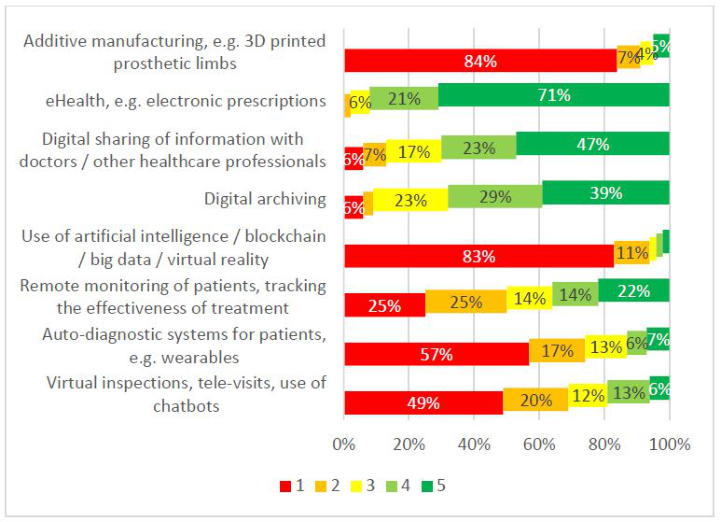
Application of Technologies and Concepts of Industry 4.0 in Healthcare On the basis of a theoretical overview, we wanted to investigate to what extent various technologies and concepts of Industry 4.0 are already applied in the field of healthcare provision in Slovak Republic (see Figure 1). We used the scale from 1 to 5 that indicates the level of use (1 – they do not use at all, 5 – they use at an advanced level). The next graph (Figure 1) is presenting the results.
As we can see on the Figure 1, eHealth solutions have the highest level of use. According to the data available from the National Health Information Centre of Slovak Republic, the development of the number of examination records in healthcare and the development of the number of electronic pre- scriptions is having an upward trend (paradoxically, this trend stopped during the pandemic COVID-19, which was caused mainly by the reduced number of examinations performed during the state of emergency and the reorientation and prioritization of COVID-19 positive patients) (NHIC, 2021).
Digital sharing of information with doctors or other healthcare workers is also relatively popular, which is mostly used at an advanced level by 47% of our respondents. The digital data archive closely related to them is used at
Figure 1: Level of application of technologies and concepts of Industry 4.0 in health- care. (Own processing according to the answers from the questionnaire survey).
an advanced level 4 by 29% and level 5 by 39% of providers. To a slightly lesser extent – 14% and 22% of providers use remote monitoring of patients and the effectiveness of treatment at an advanced level, compared to 25% who said that they do not use these elements of digital (virtual) healthcare solutions at all. The least used are 3D printers, which are currently mainly used in highly specialized workplaces, which was also confirmed by a deeper analysis of the examined sample, since only a sample of specialists indicated the usability of these solutions. We also did not anticipate the current great use of artificial intelligence, blockchain, big data, or virtual reality, therefore we listed all these trends as part of one group. Our assumptions were fulfilled, as up to 83% of healthcare providers state that they do not use these elements of digital (virtual) healthcare at all. Auto-diagnostic systems for patients show slightly better results e.g. wearable devices, which are not used at all by 57% of providers and virtual inspections, tele-visits, or the use of chatbots are not used by 49% of providers.
Digital Healthcare and Its Benefits Digitization of healthcare and the improvement of healthcare is an extremely important topic, also in Slovak Republic. Based on previous results (Figure 1), we can see that various new technologies are already used by healthcare providers. Also, the COVID-19 pandemic has accelerated the application of different digital healthcare solutions. We wanted to investigate if digital healthcare is considered to improve/facilitate patient care, access to clini- cal data and patient engagement. Majority of respondents, more than 90%
Trends and Challenges in Healthcare in Context 827
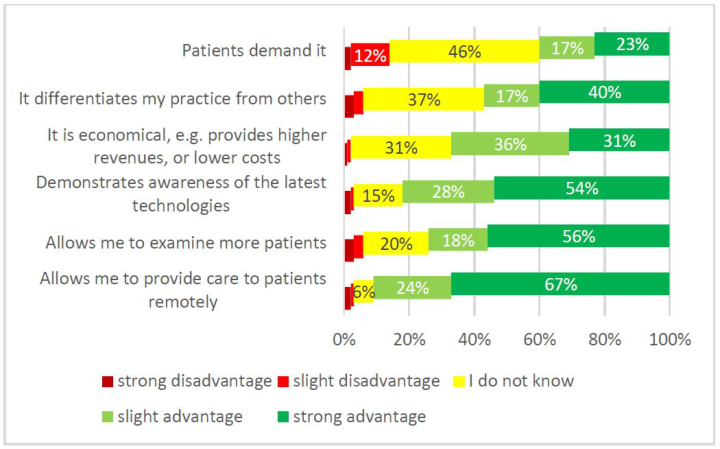
Figure 2: Perception of the advantages of digital healthcare solutions. (Own processing according to the answers from the questionnaire survey).
confirmed that digital healthcare facilitates patient care and access to clini- cal data (64% agreed, 27% rather agreed). In a less significant way, 33% of respondents agreed (while 33% rather agreed) with the fact that digital healthcare improves the engagement of clients.
Further, we investigated how healthcare providers perceive their expe- rience with digital healthcare and if they consider different possibilities connected to digital healthcare as benefits/advantages or disadvantages. The results are presented in Figure 2.
Based on results (Figure 2), 67% of respondents stated as a strong advan- tage (24% as a slight advantage) that digital healthcare solutions allow them to provide care to patients remotely. Also, as a strong advantage, 54% of healthcare providers highlighted that these solutions demonstrate awareness of the latest technologies (28% as a slight advantage). The fact that these solutions make it possible to see or examine more patients was reported by 56% of healthcare providers as a strong advantage (18% as a slight advan- tage). This was followed by the fact that this form of providing healthcare is economical and provides a better way of income, or a reduction in costs (31% of respondents see it as strong advantage and 36% as a slight advantage). As strong advantage of digital healthcare, 40% of respondents identified that it differentiates the practice from other providers (17% as a slight advantage). The least significant was the demand for digital healthcare solutions by cli- ents, this option was mentioned as a strong advantage by 23% of respondents (and 17% respondents as a slight advantage).
CONCLUSION
Industry 4.0 can be currently considered as one of the main trends in the environment, which significantly affect the dynamics and stimulate changes
and innovations. Especially in the healthcare sector, in which the situation has been affected by pandemic of COVID-19, implementation of digitization and new technologies associated with Industry 4.0 is already noticeable. Based on our research, healthcare providers are paying attention to emerging trends and already applying some of concepts and technologies of Industry 4.0. In Slovakia, the eHealth solutions have the highest level of use, especially in form of electronic prescriptions. The rest of technologies do not have such wide- spread application. However, we can expect the digitization of healthcare will increase, which would help clients and healthcare providers achieve gre- ater independence and personalized medicine. To support the digitization and innovativeness of companies, management of intellectual capital is important as it calls attention to develop necessary knowledge, skills, relationships and processes needed to implement new technologies. The innovative healthcare provision can further increase, e.g. by use of auto-diagnostic systems, remote monitoring of patients, artificial intelligence, digital data sharing, or 3D prin- ting. These technologies are expected to represent an essential base of future smart hospitals, where software, technology and processes can efficiently deliver more beneficial results in less time and at lower costs.
ACKNOWLEDGMENT
This research was supported and funded by project VEGA 1/0773/20 titled Management of Intellectual Capital and Measuring of Innovativeness of Slovak Companies.
REFERENCES
Aceto, Giuseppe. Persico, Valerio. Pescapé,Antonio. (2020) Industry 4.0 and Health: Internet of Things, Big Data, and Cloud Computing for Healthcare 4.0. In: Jour- nal of Industrial Information Integration, Netherlands: Elsevier BV, vol. 18. ISSN 2452-414X. https://doi.org/10.1016/j.jii.2020.100129 Bennett-Woods, Deb. (2008) Nanotechnology: Ethics and Society. Boca Raton,
Florida, USA: CRC Press. ISBN 978–1420053524. https://doi.org/10.1201/ 9781315219448 Cassettari, Lucia. Patrone, C. Saccaro. S. (2019) Industry 4.0 and its applications in the Healthcare Sector: a sistematic review. In: XXIV Summer School F. Turco - Industrial Systems Engineering, Romy, Italy: Associazione Italiana Docenti Impi- anti Industriali (AIDI), pp. 136–142. ISSN 2283–8996. http://www.summerscho ol-aidi.it/edition-2019/cms/extra/papers/441.pdf Drath, Rainer. Horch, Alexander. (2014) Industrie 4.0: Hit or Hype?. In: IEEE Indu-
strial Electronics Magazine, USA: IEEE, vol. 8 (2), pp. 56–58. ISSN 1941–0115. https://doi.org/10.1109/MIE.2014.2312079 Hermann, Mario. Pentek, Tobias. Otto, Boris. (2016) Design Principles for Industrie 4.0 Scenarios. In: Proceedings of the 49th Hawaii International Conference on System Sciences (HICSS), USA: IEEE, pp. 3928–3937. ISBN 978-0-7695-5670-3. https://doi.org/10.1109/HICSS.2016.488 Javaid, Mohd et al. (2020) Industry 4.0 technologies and their applications in fighting
Trends and Challenges in Healthcare in Context 829
Kagermann, Henning. Wahlster, Wolfgang. Helbig, Johannes. (2013) Recommendations for implementing the strategic initiative Industrie 4.0: Securing the future of German manufacturing industry: Final report of the Industrie 4.0 Working Group. Munich, Germany: acatech & Forschungsunion Wirtschaft – Wissensch- aft. https://en.acatech.de/publication/recommendations-for-implementing-the-str ategic-initiative-industrie-4-0-final-report-of-the-industrie-4-0-working-group/ Khelassi, Abdeldjalil et al. (2019) Health 4.0: Applications, Management, Technolo-
gies and Review. In: Medical Technologies Journal, Tlemcen, Algeria: Knowledge Kingdom Publishing, vol. 2 (4), pp. 262–276. ISSN 2572-004X. https://doi.org/ 10.26415/2572-004X-vol2iss4p262-276 Leonhard, Gerd. (2016) Technology vs. Humanity: The coming clash between man and machine. London, United Kingdom: Fast Future Publishing. ISBN 978-0993295829. Ministry of Economy of the Slovak Republic. (2016) Concept of intelligent industry
for Slovakia. Bratislava, Slovakia: Ministerstvo hospodárstva SR. https://www.mh sr.sk/inovacie/strategie-a-politiky/smart-industry Ministry of Investments, Regional Development and Informatization of the Slovak Republic. (2019) 2030 Digital Transformation Strategy for Slovakia: Strategy for transformation of Slovakia into a successful digital country. Bratislava, Slovakia: Ministerstvo investícií, regionálneho rozvoja a informatizácie SR. https://www.mi rri.gov.sk/wp-content/uploads/2019/10/SDT-English-Version-FINAL.pdf Mohiuddin, Muhammad et al. (2022) Evolution of Industry 4.0 and Its Impli-
cations for International Business. In: Global Trade in the Emerging Business Environment, London, United Kingdom: IntechOpen. ISBN 978-1-83969-147-8. https://doi.org/10.5772/intechopen.101764 Molnár, Karol. (2016) Perspektívy možností aplikácie štandardov Industry 4.0.
Žilina, Slovensko: MEDIA/ST publishing house. https://www.engineering.sk/cla nky2/stroje-a-technologie/3322-perspektivy-moznosti-aplikacie-%20standardo v-industry-4-0 National Health Information Centre (NHIC). (2021) Dashboards of Electronic Healthcare KPIs. Bratislava, Slovakia: Národné centrum zdravotníckych informácií (NCZI). https://ezdravie.nczisk.sk/en?category=Produktivita Prem, Erich. (2015) A digital transformation business model for innovation. Manch-
ester, United Kingdom: The International Society for Professional Innovation Management (ISPIM). https://www.researchgate.net/publication/284682831 Reddy, Srinivas. Reinartz, Werner. (2017) Digital Transformation and Value Creation: Sea Change Ahead. In: Value in the Digital Era, Nuremberg, Germany: GfK Marketing Intelligence Review, vol. 9 (1), pp. 10–17. ISSN 2628-166X. https://doi.org/10.1515/gfkmir-2017-0002 Schwab, Klaus. (2017) The Fourth Industrial Revolution. Cologny, Geneva, Switzer-
land: World Economic Forum. ISBN 978-1-944835-01-9. Vermesan, Ovidiu. Friess, Peter. (2015) Building the Hyperconnected Society: Internet of Things Research and Innovation Value Chains, Ecosystems and Markets. Aalborg, Denmark: River Publishers. ISBN 978-87-93237-99-5.
Read this individual research paper free through the original publisher, or explore the full digital proceedings book.
ISBN 978-1-958651-44-5
Explore this ISBN in the AHFE Bookstore ↗Listed in the July 2026 bookstore catalogue; search by ISBN to confirm current availability · Digital book purchase optional