Eva Velez, Dolores Chica, Marcial Calero, Laura De Jesús Calero Proaño (2022). Methodology to evaluate the impact of learning with the use of physical modeling of structural prototypes. In: Applied Human Factors Research. AHFE Open Access, vol. 67, pp. 397–400. https://doi.org/10.54941/ahfe1002695
The education of architecture students requires theoretical and practical training in all subjects corresponding to the curriculum. This research shows the methodology to evaluate the impact of the learning of architecture students with the use of physical modeling of structural prototypes, with which it is possible to integrate the conceptual part with the practice. The research method is quantitative quasi-experimental, which must be used on a sample of students, from the Faculty of Architecture and Urbanism of the University of Guayaquil, who must undergo an entry assessment (beginning of the semester), then experiment with the physical modeling of the structural prototypes and, finally, an exit assessment (end of the semester). The results will demonstrate the academic performance after experimenting with the prototypes; the impact on the integration of cognitive processes, the development of creativity, research and innovation.
In the learning process of the architecture student, it is necessary to inte- grate the theoretical and practical knowledge, to obtain better results of learning achievements and the development of competencies such as crea- tivity and innovation, required in the profession. Here lies the importance of having a methodology for the implementation of structural prototypes in the architecture career.
Students who have little or no experimentation present difficulties in their learning because they do not internalize what they have learned, since labora- tory practices facilitate understanding, associate concepts with practice and reduce students’ doubts (Agudelo & García, 2010). However, a big reality is that it is not always possible to do this practical learning, because sometimes it is not possible to set up a laboratory because of the cost of running it or the useful life of the equipment to be used.
The theory of significant learning considers that key factors for success or failure in learning are the notions that students possess in their cogni- tive structure and that are related to the subject of study (Castejón, 2014).
Goal-oriented theories study the ways in which people make efforts to achi- eve their goals, engage, and achieve results. Studies show that students whose goals are meaningful learning always try to improve their own abilities, deve- lop new skills to overcome the challenges they face, while those who set performance goals, try to seek recognition, pass the course, or want to avoid failure. This is a factor to take into account because often students want to obtain a qualification to pass the subject and obtain a professional degree and do not aim to internalize what they have learned.
Learning difficulties may also be influenced by the short time spent on teaching and students, they may not develop research projects, limiting the teaching-learning process of students. The design, construction and imple- mentation of a laboratory equipment involves a conscious and sequential practice of the learning process (Perez & Falcón, 2009) It is necessary to resort to didactic strategies that allow the application of theoretical knowledge through experimentation; a proposal based on teach- ing by discovery and/or experimentation should be implemented (Moreira, 2012). This is why it is important to have a methodological process for the implementation of structural prototypes in the architectural career to strengthen and consolidate their learning.
METHODOLOGY
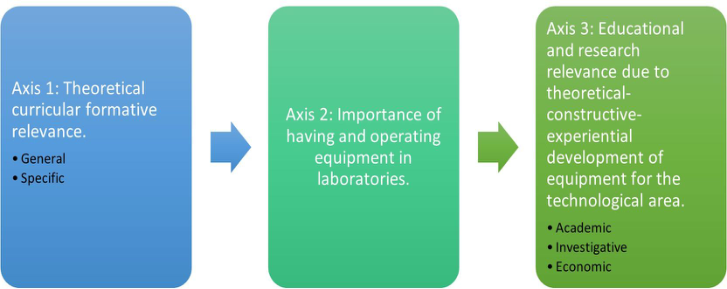
The methodology for evaluating the impact of learning with the use of structural prototypes on architecture students consists of: Choose or select the students legally enrolled in the subject Structures I or II of the degree of Architecture, of the University of Guayaquil of the chosen period. Once the participants have been selected, the purpose and methodo- logy of the research must be explained to them, and the Entry Assessment must be carried out, which will consist of a test of 20 questions and which evaluates three axes: as shown in fig. 1.
Axis 1: Theoretical curricular formative relevance. Axis 2: Importance of having and operating equipment in laboratories. Axis 3: Educational and research relevance due to theoretical-constructive- experiential development of equipment for the technological area.
The entrance test collects information that will serve to determine if stu- dents have done any kind of experimental work during their university studies; if subjects such as mathematics, physics or others use equipment for their learning; if the student considers it important to implement prototypes to facilitate the understanding of the concepts and exercises they are analy- zing during class sessions; and, finally, to know the economic value of the students. are willing to invest to build the prototypes.
After completing the entrance test, third or fourth semester students during the selected academic cycle will carry out research work groups of the sub- ject Structures I or II to design and construct the physical modeling of the structural prototypes and then the experiential development, which must be related to static equilibrium and vector mechanics.
Finally, the Exit Evaluation should be carried out, consisting of 10 que- stions related to the application of knowledge of a conceptual nature, with
Methodology to Evaluate the Impact of Learning with the Use of Physical Modeling 399
Figure 1: Diagnostic evaluation of curricular academic relevance for the development and implementation of research projects, construction and operation of sustainable technological equipment.
which it will be possible to measure the level of knowledge acquired by stu- dents, to apply concepts to real cases and to verify the strengthening and consolidation of what students have learned in the teaching-learning process.
The tabulation of the results of both the input and the output evalua- tion, will be performed in Microsoft Office Excel and after this perform the quantitative analysis.
DISCUSSION
From the results obtained, it will be possible to show whether the students had a better academic performance after the realization of their classes with the structural prototypes and whether they show a significant learning with understanding, meaning, and transferability (López & Tamayo, 2012).
According to (Espinosa & González, 2016), when students attend the lab they have a greater role because they solve various difficulties; also, it could be verified if students have a greater motivation to acquire new knowledge, are more participative and the classes become more interactive. The practices have been considered as a didactic strategy that allows to achieve conceptual, procedural and attitudinal construction and development, this constructi- vist position allows the relationship between teacher and students and the theoretical-practical contents to be taught and learned in a bidirectional way (Agudelo, et al., 2019).
It will also be necessary to determine the percentage of students who have certain difficulties and who, despite great effort and motivation on the part of the teacher, are unable to perform the assigned tasks, and to determine the causes, such as whether it is because of the time required to perform the activity, whether it is because of personal problems that the student might be experiencing at the time, or some other external cause that prevents the student from fulfilling the assigned tasks.
The study of structures through physical models lies in their importance for internalizing knowledge and facilitating the teaching-learning process. According to authors such as (López & Tamayo, 2012), who indicate that
lab work favors and promotes learning, because it allows students to question their knowledge and confront them with reality. Students’ cognitive levels are higher when they perform tasks based on experimentation and experience. Therefore, the experimental activity should be seen not only as a pedagogical tool but as a tool that builds concepts, procedures and attitudes in students (Agudelo, et al., 2019).
CONCLUSION
Physical models of structural prototypes can develop and strengthen various skills in the teaching-learning process such as: conceptual, procedural and attitudinal among others; they serve to motivate students and make them want to learn and contribute to their study group; in addition, there is a gre- ater interaction in class sessions between teacher and student who practice experimentation in the classroom, as well as This is confirmed by studies con- ducted by Lunetta, 1998, cited by (López & Tamayo, 2012), which mention that laboratory practices contribute to the construction in the student of a certain vision of science.
Finally, it is recommended to develop structural prototype models to improve the formative process of students, involving experience and active participation, relating it to professional practice; following the methodology proposed in this paper, it will be possible to implement and measure the impact that this would have on students’ learning.
REFERENCES
Agudelo, J. D. & García, G., 2010. Aprendizaje significativo a partir de prácticas de laboratorio de precisión. Latin-American Journal of Physics Education, 4(1), pp. 149–150. Agudelo, J., Arango, P. & Vega, O., 2019. Laboratorio de física: Una experiencia
significativa.. Entre Ciencia e Ingeniería, pp. 42–52. Castejón, J. C., 2014. Aprendizaje y rendimiento académico. Espinosa, E. & González, K., 2016. Las prácticas de laboratorio: una estrategia didáctica en la construcción de conocimiento científico escolar. Entramado, 12(1), pp. 266–281. López, A. & Tamayo, O., 2012. Las prácticas de laboratorio en la enseñanza de las
ciencias naturales. Latinoamericana de estudios educativos, 8(1), pp. 145–166. Moreira, M., 2012. La teoría del aprendizaje significativo crítico: un referente para organizar la enseñanza contemporánea. Revista Iberoamericana de Educación Matemática, p. 10. Perez, E. & Falcón, N., 2009. Diseño de prototipos experimentales orientados al
aprendizaje de la óptica. Eureka sobre Enseñanza y Divulgación de las Ciencias, 6(3), pp. 452–465.
LISTED IN THE AHFE DIGITAL BOOKSTORE CATALOGUE
Explore the complete digital volume
Applied Human Factors Research
Read this individual research paper free through the original publisher, or explore the full digital proceedings book.
ISBN 978-1-958651-43-8
Explore this ISBN in the AHFE Bookstore ↗Listed in the July 2026 bookstore catalogue; search by ISBN to confirm current availability · Digital book purchase optional