Ilaria Lombardi, Sonia Capece, M.G.L Monaco, Mario Buono (2022). Human-Machine Interaction Safety in Manufacturing: a Scoping Review. In: Safety Management and Human Factors. AHFE Open Access, vol. 64, pp. 221–228. https://doi.org/10.54941/ahfe1002649
As a consequence of robotics integration in industrial production processes, physical and mental stress levels due to human-machine interaction increased, potentially increasing production errors and worker injuries. A systematic scoping review of the literature published in the last 20 years was carried out via PubMed, Scopus, Web of Science, and Embase to answer this question: 'What is known from the current literature about the effects of human-machine interaction in the workplace?'. The analysis highlighted that the main problems were due to the lack of ergonomy in the work organisation, especially regarding cognitive aspects, and the reduced attention threshold associated with the monotony and repetitiveness of the work tasks. Training and information were the essential aspects in managing the reduction of accidents, also using new technologies such as cross-reality.
Industrialisation has led to the widespread use of tools and machines in daily life and the workplace. Still, we have moved to user-centred design in the last few decades and introduced ergonomics or Human Factors (Buono and Capece, 2016). Occupational health and safety have been improved by ada- pting machines and tools to human capabilities, limitations and anatomy. Today, work systems are increasingly built on a foundation of a system con- sisting of workers, tools, tasks, and work contexts (Flaspoler et al. 2009). Rapid advances in automation and digitisation mean that current working conditions are subject to dynamic change, especially in industrial environ- ments (Körner et al., 2018), which are objectively exposed to risk given the high rates of occupational injuries and deaths that are regularly encountered (Song and Awolusi, 2020).
Throughout EU-OSHA’s European Agency for Safety and Health at Work reports, including the third European Survey of Enterprises on New and Emerging Risks (ESENER-3), workplace health and safety risks are analy- sed, focusing on psychosocial risks related to work and new technologies
linked to Industry 4.0 (Irastorza, 2019). In spring/summer 2019, a total of 45,420 establishments - across all business sectors and employing at least five people - were surveyed in the 33 countries covered. Although on the one hand, psychosocial and ergonomic factors also related to human-machine interaction resulted in critical issues, on the other hand mechanisation and digitisation play an important role in mitigating these risks. In particular, the introduction and use of digital technologies such as wearable devices and arti- ficial intelligence is an opportunity to support manufacturing processes and workplace safety. Focusing on the possible impacts of automation systems within production lines, the need for ongoing training to keep skills up-to- date is apparent from 79% of the factories surveyed in the EU28. Technology touched on other important points such as workstation set-up and working hours (66%), as well as making it easier for the operator to sit for long periods (65%) and perform repetitive movements (60%) (Irastorza, 2019).
The paper aimed to summarise available research to answer the following question: ‘What is known from the current literature about the effects of human-machine interaction in the workplace?’.
METHODS
References were screened by setting the database parameters to English, manufacturing, and study type (original articles published in the peer- reviewed journal). Studies published between January 1990 and March 2020 were searched for in PubMed, Scopus, Web of Science, and Embase. The paper is based on a literature review focused on workplace safety in the manu- facturing sector. The following keywords (MESH and non-MESH terms) were used: ‘Human-machine’ OR ‘Human-robot’ OR ‘Human-computer’ AND ‘Interaction*’ OR ‘Interface*’ OR ‘Cooperation’ AND ‘Occupatio- nal’ OR ‘Work*’. Two reviewers independently screened the citations (title and abstract) identified from all sources. Subsequently, full-text articles were reviewed to determine the final set of eligible studies. Disagreements were resolved by discussion with the remaining authors. A data extraction form was developed to determine which variables to extract. The following items were included: article identifiers (authors, year of publication); study iden- tifiers (sample size, design, country); the aim of the study; main results. A qualitative description of the included studies can be found below. Tables and diagrams are used to synthesise the main findings. The selection process was carried out using some freeware (Zotero, Rayyan). PRISMA-ScR guide- lines on conducting systematic scoping reviews were followed (Tricco et al. 2018).
RESULTS
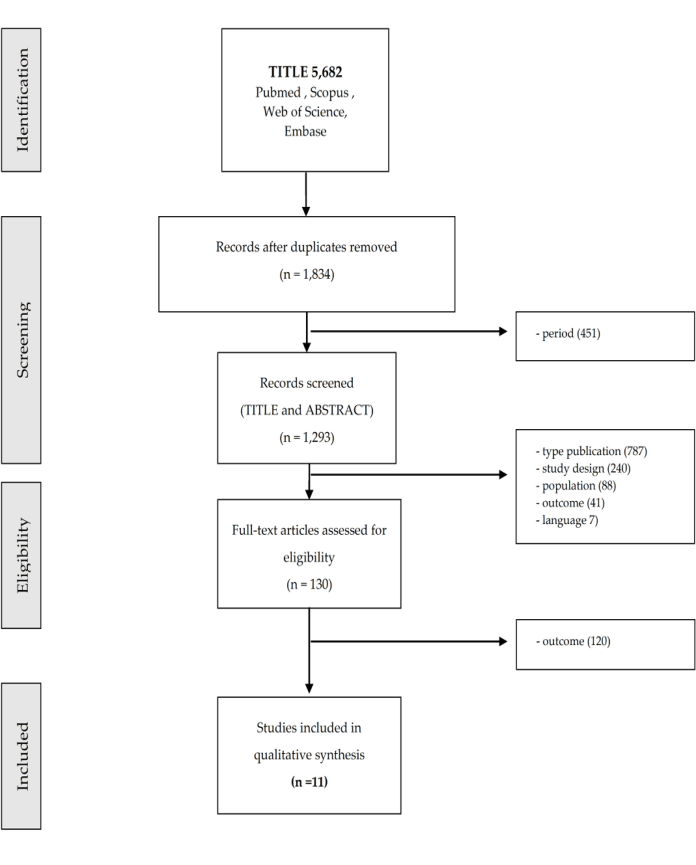
A total of 8,122 papers were identified and, after removing duplicates, 1,834 available articles were selected. According to the inclusion and exclusion criteria, 11 articles were included in the final analysis (see Figure n.1).
Human-Machine Interaction Safety in Manufacturing: A Scoping Review 223
Figure 1: Flow chart diagram depicting the different phases of studies selection process.
DISCUSSION AND CONCLUSION The current research on safety in the workplace concerning human-machine interaction shows how this is influenced by the characteristics and modalities of the interaction itself. The evaluation of the quality of the interaction with the machine and the safety levels in the workplace can proceed according to two different approaches: the empirical approach that involves samples of users who interact with the machine performing various activities; the analytical approach that does not involve users as test subjects, because one or
Continued.
Results indicate that Functional Near Infrared (fNIR) measures are
sensitive to mental task load and practice level and provide
evidence of the fNIR deployment in the field for its ability to
monitor hemodynamic changes associated with relative cognitive
workload changes of operators.
Working under a high cognitive load not only results in greater
muscle activity (greater integrated sEMG) but also affects assembly
task completion times, which may directly affect manufacturing
cycle times.
The available input (from eye-tracking) and output (operator
actions) data when suitably analysed with respect to the process
state can aid in inferring the operator’s mental model at any given
time. Based on the model, the operator’s current knowledge can be
deduced and gaps identified.
EEG and ECG input variables are represented in a probabilistic
model in which links are defined based on the literature. The
outcome of the model is a probability of being inept to perform in
a suitable way. In case of inaptitude, assistance should be delivered
to the user to normalise the current user’s state.
An evaluation of the study demonstrated that even experienced
metal workers accepted the simulation and reacted as if the given
task was real. Behavioural data of considered subjects showed
comparable profiles and most subjects rated the VR-based
approach as a reasonable means for investigating work safety
problems.
The results show that stressors linked to human-machine
interaction are technical problems, poor usability, low situation
awareness, and increased requirements on employees qualification.
To describe an accurate measure
of mental workload in human
operators as a critical element of
monitoring and adaptive aiding
systems designed to improve the
efficiency and safety of
human-machine systems during
critical tasks.
cognitive overload on assembly
task performance and muscle
activity
operator learning and illustrate it
using experimental studies
infer the more likely user’s states
in data-intensive contexts.
strategy that applies VR and
mixed reality technologies to
investigate the usability of
working machines.
To identify potential stressors
associated with the introduction
and use of modern technologies
in the manufacturing industry.
24 to 55 years)
companies
Table 1. Summary of articles selected.
Table available in the original PDF paper.
Author, year Country Setting Sample size Study aims Main findings
Ayaz H. et al.,
2012 USA Laboratory 24 volunteers (age ranged between
Biondi FN
et al., 2021 Canada Laboratory 22 volunteers (12 men, 10 women) To investigate the effect of
Das L. et al.,
2017 India Laboratory Not specified To describe a new framework for
Fern et al.,
2013 Germany Laboratory Not applicable To describe a cognitive model to
Herpers R.
et al., 2013 UK On the field Not specified To develop a safety evaluation
Körner U.
et al., 2018 Germany Laboratory 36 workers 5 different
Human-Machine Interaction Safety in Manufacturing: A Scoping Review 225
The result shows that the participants reported high musculoskeletal
disorder symptoms in the shoulder (59.8%), neck (49.5%), wrist
(39.5%), and upper back (30.6%). And, to reduce the ergonomic risk
factors, revising the height of the workbenches, chairs and redesigning the
truck to decrease the chance of unsuitable positions were recommended
and to reduce other ergonomics hazards and set a good human-machine
interface and appropriate job design.
This preliminary study focuses on the problem of the stress factors
influence on the ability of a person to perform mental work. Within the
framework of the study, the analysis of changes in human physiological
parameters in stress conditions was monitored and experimental studies
of the influence of stress factors on solving cognitive tasks using
pupillometry were conducted.
literature on social stress and automation. Finally, three mechanisms are
proposed that may predict how social stress may affect performance:
‘blank-out’-mechanism, ‘rumination’-mechanism, and
‘increased-motivation’-mechanism.
The salience metric (quantifies the extent of proactive monitoring using
time-based information obtained from the trend of process variables. The
authors demonstrate the applicability of these metrics to assessing
operators’ expertise using various case studies. The quantification offered
by the metrics precludes subjective factors in the benchmarking of
operators, with the concomitant benefits of objectivity and repeatability.
Both group- and cluster-level analyses revealed that: all participants
improved their performance throughout motor practice, and an increase
in mental workload was associated with a reduction of the quality of
motor performance along with a slower rate of motor improvement.
musculoskeletal disorders because of
the long work hours and the
repetitive activities in an unfitted
workstation.
To create a simple and optimal
system for monitoring the quality of
cognitive tasks under the influence
of external stressors (noise,
interference, vibration, etc.) for
application in field conditions, verify
if the reliable measurement is
possible and to determine the
recommendations to the measuring
system sufficiently simple and
sufficiently precise to carry out such
measurements.
stress in human-machine interaction. The review shows that a closer link is needed between the separate
approach that uses the operator’s
attention allocation during different
pre-specified training scenarios
along with process data, alarm
information, and operator actions.
To examine mental workload by
employing the NASA TLX as well as
the changes in motor performance
resulting from the practice of a novel
reaching task.
to 25 years)
and 18 women, age
ranged between 19
to 25 years)
Table 1. Continued.
Table available in the original PDF paper.
Author, year Country Setting Sample size Study aims Main findings
Lu CW. et al.,
2012 China On the field 281 workers (70 male, 211 female) To investigate the risk of
Medvedyk Y.
et al., 2019 Ukraine Laboratory 10 volunteers (age ranged between 16
Sauer J. et al.,
2019 Switzerland Laboratory Not applicable To investigate the issue of social
Shahab MA.
et al., 2021 India Laboratory 10 workers 486 tasks To propose an eye-tracking-based
Shuggi IM et al.,
2017 USA Laboratory 36 healthy volunteers (18 men
more analysts carry out the evaluation of the machine and the work environ- ment with the help of theoretical models. The description and understanding of the user and the task are key elements of the evaluations; other impor- tant elements are mapping task demands and the user’s mental and physical workloads during interaction with the machine (Bligard and Osvalder, 2014; Greco et al. 2020).
The 11 selected articles highlighted how competence and training influence the operator in an industrial dimension in which more and more adva- nced technologies are incorporated. Mechanisation and digitalisation play an essential role in mitigating ergonomic risks, assessed from cognitive (such as mental workload or usability) and physical (such as physical workload or body posture) perspectives. Therefore, the risk of work-related problems is not always entirely avoided by a good ergonomic design of work tools and workspace. Still, factors related to work organisation, user training, and the use of new technologies also come into play. In particular, the introduction and use of digital technologies such as wearable devices and artificial intel- ligence is an opportunity to support production processes and safety in the workplace (Körner et al. 2018).
The operator is subjected to a high cognitive load due to environmen- tal characteristics, task complexity or repetitiveness, and work organisation. Modern technologies reduce heavy physical labour, speed up work processes, and increase flexibility. On the other hand, data also indicate that technology- related stressors accompany contemporary industrial work. Technical pro- blems were described as frequent stressors; users reported that technical problems lead to interruptions, additional pressure for timelines, and mul- titasking, in addition to poor usability of the technical systems they work with. Working with highly automated systems creates difficulty in building an adequate mental representation of machine use. Operators are often faced with situations where they are unable to develop or maintain proper levels of awareness, caused by factors such as high system complexity, inadequate visualisation of the current state of the systems, lack of experience in using the systems, and inadequate training and workstation design relative to the operator’s anthropometric data, often resulting in musculoskeletal disorders (Lu CW et al. 2012).
In conclusion, the design of work activities and workstations should consider the workers’ cognitive load and anthropometry throughout their involvement in the risk assessment to improve safety in the workplace. More- over, it is essential to enhance the training of ‘Operator 4.0, advancing both technique and preparation, improving risks awareness of using the machine, finally ensuring optimal health and safety conditions.
REFERENCES
Ayaz, H., Shewokis, P. A., Bunce, S., Izzetoglu, K., Willems, B., and Onaral, B.
(2012) “Optical brain monitoring for operator training and mental workload assessment”. NeuroImage, 59(1), 36–47.
Human-Machine Interaction Safety in Manufacturing: A Scoping Review 227
Biondi, F. N., Cacanindin, A., Douglas, C., and Cort, J. (2021) “Overloaded and at Work: Investigating the Effect of Cognitive Workload on Assembly Task Performance”. Human factors, 63(5), 813–820. Bligård, L-O., Osvalder, A. (2014) “CCPE: Methodology for a Combined Evalu-
ation of Cognitive and Physical Ergonomics in the Interaction between Human and Machine”. Human Factors and Ergonomics in Manufacturing & Service Industries, 24. Buono, M., Capece, S., (2016) “Design and Ergonomics innovative modelof assessment and validity for passengerseats in the Aerospace industry”. Ergonomia: sfide sociali e opportunità professionali dalla creatività alla praticaper aumen- tare l’impatto dell’ergonomia nella società, XI National Conference SIE 2016, pp. 259. Das, L., Srinivasan, B., and Srinivasan, R. (2017) “Cognitive behaviour based fra-
mework for operator learning: Knowledge and capability assessment through eye tracking”. Fernández, F., Lázaro, I., Gilabert, E., Arnaiz, A., Muñoz, F. M., and Castellanos L., (2013) “A probabilistic model for cognitive-affective user state awareness”. 11th IEEE International Conference on Industrial Informatics (INDIN), pp. 762–767. Flaspoler, E., Hauke, A., Pappachan, P., Reinert, D., Bleyer, T., Henke, N., Kaluza,
S., Schieder, A., Windel, A., Karwowski, W., Slaminen, S., Blaise, J., Claudon, L., Ciccotelli, J., Eeckelaert, L., Verjans, M., Muylaert, K. and De Beeck, R., (2009) “The human machine interface as an emerging risk. EU-OSHA – European Agency for Safety and Health at Work”. Greco, A., Caterino, M., Fera, M., and Gerbino, S. (2020) “Digital Twin for Monitoring Ergonomics during Manufacturing Production”, Applied Sciences 10, n. 21: 7758. Herpers, R., Scherfgen, D., Vieth, M., Saitov, T., Felsner, S., Hofhammer, T., Schaefer,
M., and Huelke, M. (2013) “Vr-Based Safety Evaluation of Automatically Con- trolled Machine Tools,” 2013 5th International Conference on Games and Virtual Worlds for Serious Applications (VS-GAMES), 2013, pp. 1–4. Irastorza X. (2019). Third European Survey of Enterprises on New and Emerging Risks (ESENER 3), EU-OSHA – European Agency for Safety and Health at Work. Körner, U., Müller-Thur, K., Lunau, T., Dragano, N., Angerer, P., and Buchner, A.,
(2018) “Perceived stress in human-machine interaction in modern manufacturing environments-Results of a qualitative interview study”. Lu„ C. W., Yao C. C., and Kuo, C. W. (2012) “The ergonomics approach for thin film transistor-liquid crystal display manufacturing process”. Work (Reading, Mass.), 41 Suppl 1, 5627–5630. Medvedyk, T., Antoniuk, I., and Lebid, S. (2019) “Influence of stress factors
on cognitive tasks performance”. 2019 IEEE 20th International Conference on Computational Problems of Electrical Engineering, CPEE 2019. Rayyan, (Last access 28 February 2022). The Rayyan’s website: www.rayyan.ai Sauer, J., Schmutz, S., Sonderegger, A., and Messerli, N. (2019) “Social stress and performance in human-machine interaction: a neglected research field”. Ergonomics, 62(11), 1377–1391. Shahab, M.A., Iqbal, M. U., Srinivasan, B., and Srinivasan, R., (2021) “Metrics for
objectively assessing operator training using eye gaze patterns”, Process Safety and Environmental Protection, Vol. 156, Pages 508-520, ISSN 0957–5820. Shuggi, I. M., Oh, H., Shewokis, P. A., and Gentili, R. J., (2017) “Mental workload and motor performance dynamics during practice of reaching movements under various levels of task difficulty”. Neuroscience, 360, 166–179.
Song, S., Awolusi, I., (2020) “Industrial Safety Management Using Innovative and Proactive Strategies”, in G. Moynihan (ed.), Concepts, Applications and Emerging Opportunities in Industrial Engineering, IntechOpen, London. Torres, Y., Nadeau, S., and Landau, K., (2021) “Classification and Quantification
of Human Error in Manufacturing: A Case Study in Complex Manual Assembly” Applied Sciences 11, no. 2: 749. Tricco, A.C., Lillie, E., Zarin, W., O’Brien, K.K., Colquhoun, H., Levac, D., Moher, D., Peters, M.D.J., Horsley, T., Weeks, L., Hempel, S., Akl, E.A., Chang, C., McGo- wan, J., Stewart, L., Hartling, L., Aldcroft, A., Wilson, M.G., Garritty, C., Lewin, S., Godfrey, C.M., Macdonald, M.T., Langlois, E.V., Soares-Weiser, K., Mori- arty, J., Clifford, T., Tunçalp, Ö., Straus, S.E., (2018) “PRISMA Extension for Scoping Reviews (PRISMA-ScR): Checklist and Explanation”. Annals of internal medicie, Volume 169 No.7, pp. 467–473. ISSN 0003-4819. Tricco, Andrea C, Lillie, Erin, Zarin, Wasifa et al. (2018) “Prisma Extension for
Scoping Reviews (PRISMA-ScR): Checklist and Explanation”. Annals of Internal Medicine, Volume 169 No.7, pp. 467–473. Zotero, (Last access 31 January 2022). The Zotero’s website: www.zotero.org
LISTED IN THE AHFE DIGITAL BOOKSTORE CATALOGUE
Explore the complete digital volume
Safety Management and Human Factors
Read this individual research paper free through the original publisher, or explore the full digital proceedings book.
ISBN 978-1-958651-40-7
Explore this ISBN in the AHFE Bookstore ↗Listed in the July 2026 bookstore catalogue; search by ISBN to confirm current availability · Digital book purchase optional